Orange Parfait

Today April 26th, we celebrate the birthday of the King Willem-Alexander of the Netherlands. Well actually, his birthday is tomorrow, but you can’t have a party on a Sunday, can you?
The Dutch royal family is also known as ‘de Oranjes’, which is reflected in the use of the colour orange when referring to Dutch royalty. There is no real link between the royal family and the colour. The ‘orange’ in their name refers to the French city of Orange, a Principality one of his ancestors inherited in 1544.
Over the years we prepared Orange Sabayon, Queen’s Soup, Orange and Almond Cake, Bouchée à la Reine, Orange Flan, Canard à l’Orange and Baba au Mandarine Napoléon on this day.

Today we finally have nice weather in the Netherlands, so let’s prepare something very special: a parfait of orange. The recipe we followed was published by Jeroen Meus, a well-known Belgian chef. He was inspired by Bernard Pacaud, a French chef who owns restaurant l’Ambroisie in Paris, awarded with three Michelin Stars.

Perfect

A (French) parfait is an ice cream made without churning, so no need for an ice cream maker. In this case the mixture is poured into an empty orange and frozen.
One of the components of a parfait is the combination of egg yolks and sugar, beaten until ruban. This means that the mixture has become pale yellow and soft. It should resemble Greek yoghurt.
The beaten egg whites will add lightness, as they do in mousse au chocolate.
Then it’s a matter of richness (cream), flavour (coffee, orange, mango, passion fruit et cetera) and sugar.
Making a parfait requires a number of parallel actions, but with the right mise-en-place it’s not difficult (although, to be fair, our kitchen was a bit of a mess).

Orange Parfait

The orange parfait as prepared by Jeroen Meus is a combination of:

  • Whipped Cream
  • Cooked Cream flavoured with Orange Peel
  • Whipped Egg White 
  • Orange Juice
  • Mandarine Napoléon
  • Egg yolks and Sugar (beaten until ruban)
  • Gelatine
  • A salad of Oranges and Blood Grapefruit

Details can be found on the website of Jeroen Meus, including a helpful video (in Dutch).

Orange Parfait ©cadwu

Authentic Dutch Pepernoten

Today, December 5th (actually December 6th), we celebrate the birthday (actually name day) of Sinterklaas or Sint Nicolas (270-343), patron saint of children (and Amsterdam), the Greek Bishop of Myra (now Demre), currently Turkey, but living in Madrid according to Dutch tradition and arriving end of November per steamboat. He rides a white horse over the rooftops at night and can be in different places at the same time. Very confusing but it makes perfect sense to children.

His assistants, (called Pieten), carry bags with sweets and presents. They used to be Zwarte Pieten (Black Pete) but thankfully that part of the tradition has now changed significantly making the Sinterklaas festivities more inclusive. Piet has become a Sooty Piet (they squeeze down and up sooty chimneys in order to deliver presents).

The celebration is not just about presents and sweets, it is about behaviour: Sinterklaas carries a big book with information about children: who has been good (sweets, presents) and who has been naughty (spanking with the birch rod that is used by Piet to sweep chimneys or being put in a now empty bag and taken back to Spain). Now you know why most Dutch and Belgian children become nervous and restless beginning of December!

Culinary

The culinary aspect of Sinterklaas is about sweets: chocolate letters (the first letter of your name), chocolate coins, marzipan figures, chocolate frogs (in a bathing suit, obviously) and mice (both stuffed with fondant), speculaas (spiced short crust), kruidnoten (as speculaas but slightly different) and pepernoten. Both kruidnoten en pepernoten were thrown through the room, for the children to look for.
The smaller sweets were part of a ritual: in the evening you would put a shoe in front of the fireplace (or a similar apparatus, as long as it was connected to a chimney, things became challenging with the introduction of central heating) and you would sing a traditional Sinterklaas song. If possible you would put a carrot in your shoe for Sinterklaas’ horse. The next morning the sweets would be waiting for you in your shoe. Wonderful memories!

Pepernoten

If you shop these days in the Netherlands, you will see lots and lots of pepernoten. One Dutch company specialises in pepernoten and produces them in over 50 flavours. These pepernoten are actually kruidnoten. In 1593 Carolus Battus mentions Peper-coecxkens. The recipe for the original pepernoot goes back to 1756 when Gerrit van den Brenk writes a book called Volmaakte onderrigtinge, ten dienste der koekbakkers of hunne leerlingen (which translates into something like Perfect lessons for cookie bakers and their pupils). The ingredients are honey, white rye flour, potash and grinded anise seed. Dutch pâtissier Cees Holtkamp modernized the recipe, enabling us to recreate pepernoten.

What You Need
  • 50 grams of Brown Caster Sugar
  • 75 grams of Honey
  • 150 grams of White Rye Flour
  • 2 grams of Salt
  • 20 grams of Water
  • 5 grams of Baking Powder
  • 6 grams of grinded Anise Seed
  • 10 grams of Water
  • Neutral Oil
  • No Pepper (despite the name!)
What You Do

Best option is to watch Cees Holtkamp preparing pepernoten with support from his granddaughter Stella. The video comes with English subtitles. An even better idea is to buy his book Dutch Pastry. It’s available via the usual channels or order it at your local bookstore. Price is approximately 20 – 25 euro or US dollar.
Combine sugar, honey and water in a pan. Heat the mixture without boiling. Remove from heat. Immediately add flour and salt. Use a kitchen aid with hooks to make the dough. It will be very sticky and odd. Allow to rest for a few hours.
Add baking powder, anise seed and water. Kneed, cover with plastic foil and allow to rest until the next day.
Preheat your oven to 180 °C or 355 °F traditional. Make small cubes and use your hands to turn these into balls. Generously coat a baking tin with oil. We used a spring baking tin, which is not what we should have done. It is better to use a seamless baking tin. Wet your hands with oil, coat every ball with oil and add to the tin. The tin must be completely filled, so the balls must touch each other. This way you get the typical rounded-cube-shape of pepernoten. If not, add some aluminium foil to the tin. Transfer to the oven and leave for 20 minutes. Detach the pepernoten as soon as possible.

PS

We could only find whole grain rye flour, which is not suitable for this recipe. Instead, we used all-purpose flour.

Royal Orange and Almond Cake

April 27th we celebrate the birthday of King Willem-Alexander of the Netherlands. Hip hip hooray!
The Dutch royal family is also known as ‘de Oranjes’, which is reflected in the use of the colour orange when referring to Dutch royalty. Actually, there is no link between the royal family and the colour. The ‘Oranje’ in the name refers to the French city of Orange, a Principality one of his ancestors inherited in 1544.

Nevertheless, over the years we prepared Orange Sabayon, Queen’s Soup, Bouchée à la Reine, Orange Flan and Canard à l’Orange on this day. What better way to celebrate a birthday than by baking a cake, a flavourful, moist Orange and Almond cake?

What You Need

  • One large Orange
  • 3 Eggs
  • 100 grams Fine Caster Sugar
  • 125 grams of Almond Flour
  • 3 grams of Baking Powder

What You Do

Wash the orange and cook it (meaning the whole orange) for 2 hours in some water. Let cool.
Preheat the oven to 170 °C or 340 °F. Coarsely cut the orange, remove the pits and blender the orange until you have a marmalade-like consistency. Add the baking powder to the almond flour and mix. Beat the eggs and the sugar until light and airy. This may take 5 minutes. Add the blended orange and mix gently. Add the almond flour and the baking powder. Mix. Coat a baking spring form (18 cm or 7 inch) with butter, add the mixture and transfer to the oven for 40-45 minutes. The cake will rise only a little during the baking process. When ready, leave the cake to cool in the tin.

Orange and Almond Cake ©cadwu

Chicken with Almonds and Ginger

Reading (very) old recipes allows you to discover new combinations, techniques and flavors, or better said, discover forgotten combinations, techniques and flavors.

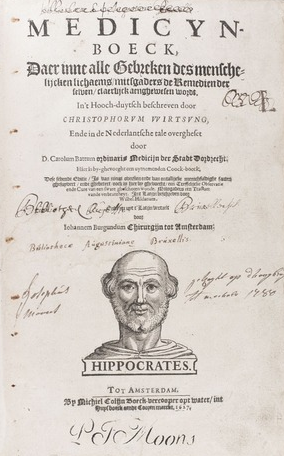
The University of Amsterdam is home to the Special Collections, the material heritage of the University. One of the collections is related to recipes, cookbooks, books on etiquette, nutrition, food et cetera. The oldest cookbook is Eenen seer schoonen ende excelenten Cocboeck, inhoudende alderley wel geexperimenteerde cokagien, van ghebraet, ghesoden, Pasteyen, Taerten, toerten, Vlaeijen, Saussen, Soppen, ende dier-gelijckeOock diversche Confeyturen ende Drancken, etc. by medical doctor Carel Baten (Carolus Battus) and was published in 1593. The book contains some 300 recipes for stews, roasts, poached food, pies, cakes, sauces and soup. It was published as an annex to his Medecijn Boec (medicine book). 

Luilekkerland

In 2018 Onno and Charlotte Kleyn published Luilekkerland (named after the painting by Pieter Bruegel de Oude). It’s a great book on 400 years of cooking in the Netherlands. They must have spent months at the Special Collections going through various cookbooks and manuscripts with recipes. They created ‘a magical mystery tour’ through the kitchens of the past.
In the book they describe one of the recipes of Carolus Battus: een sause op eenen gesoden capoen. Or in English: poached Capon with sauce. 

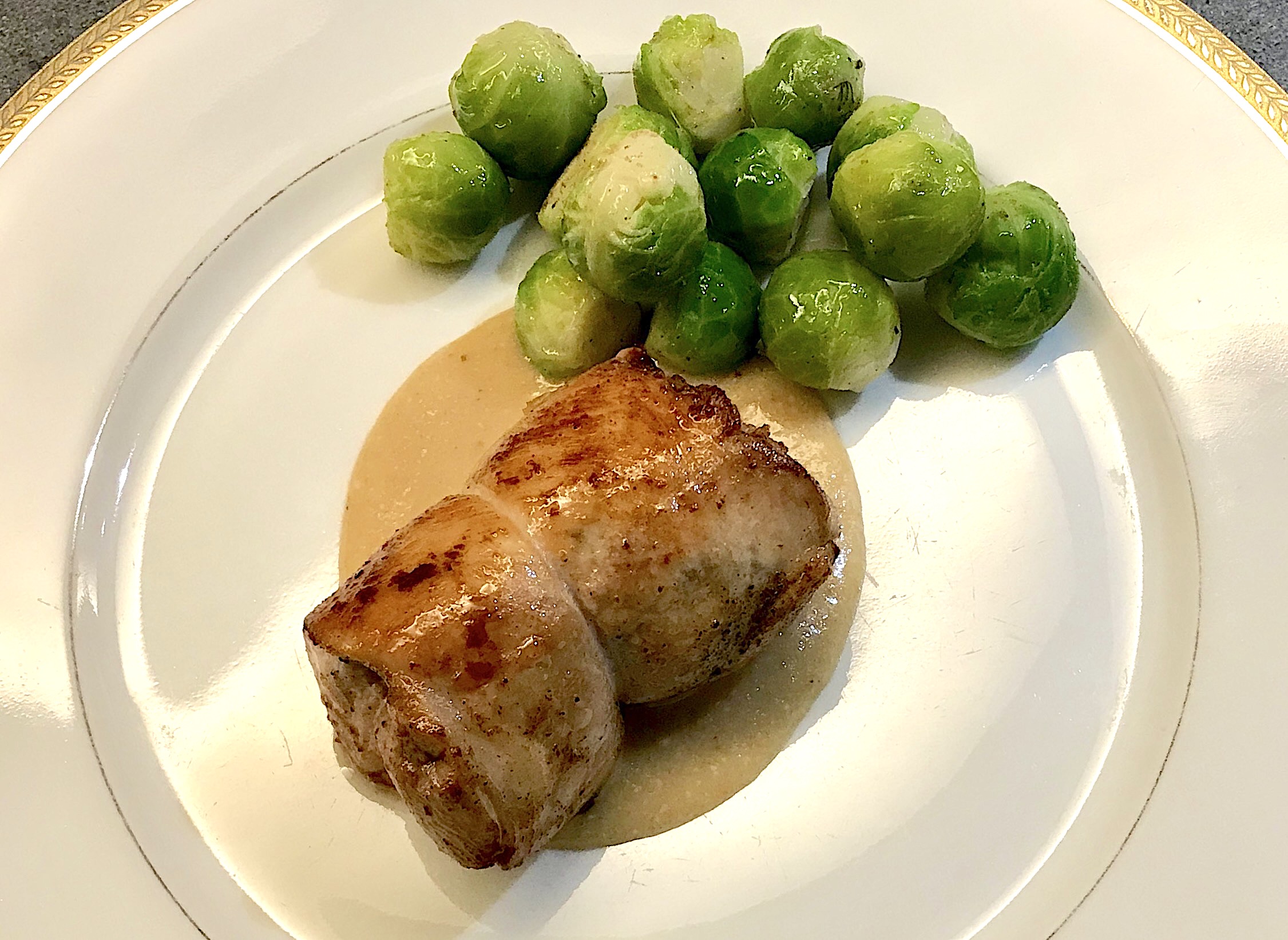
Capon is very expensive, so like Onno and Charlotte we go for chicken. Our recipe is for 2 chicken thighs, but we could also imagine making a roulade and then serving a slice of chicken roulade with the sauce.
The surprise is in the sauce: the combination of bread, ginger and almonds is tasty and complex. The sauce may appear to be filming and fat, but actually it’s not. The texture of the sauce is interesting as well: the bread will make the sauce a bit porridge-like and the crushed almonds prevent the sauce from being smooth.
Our version is a bit closer to 2022: we’re not the biggest fans of poaching and we don’t see the need for sugar in the sauce.

Wine Pairing

Best is to go for a white wine with a touch of sweetness, for instance a Gewürztraminer. This will combine very well with the somewhat unusual flavors in the dish.  If you go for a glass of red wine, then we would suggest a pinot noir, nice and earthy.

What You Need

  • 2 Organic Chicken Thighs
  • Chicken Stock and Optional
    • Leek
    • Carrot
    • Celeriac
    • Onion
  • Olive Oil
  • Butter
  • 15 grams of White Almonds
  • 1 – 2 cm of Fresh Ginger
  • 100 ml of Dry White Wine
  • Slice of Toasted Bread

What You Do

If your chicken stock needs a boost, then add the vegetables and let simmer for 15 minutes or so. Best is to make your own stock.
In a small skillet heat the butter and olive oil. Fry the chicken until nearly done. In parallel blender the almonds and the toasted bread. Grate the ginger. Add the white wine and the ginger to the mixture and blender. Add some stock and blender for a few seconds. Transfer the mixture to a pan and warm over medium heat. It requires attention, so keep an eye on the sauce and stir every minute or so. The sauce will thicken so you will probably need to add more stock. Transfer the chicken to a warm oven and let rest. Deglaze the pan with some stock and add this liquid to the sauce. Stir well. Now it’s time to taste and adjust. Remember the taste is new, so take your time. Serve the chicken with the sauce. 
We enjoyed the chicken as a main course with some Brussels sprouts, olive oil and nutmeg.