
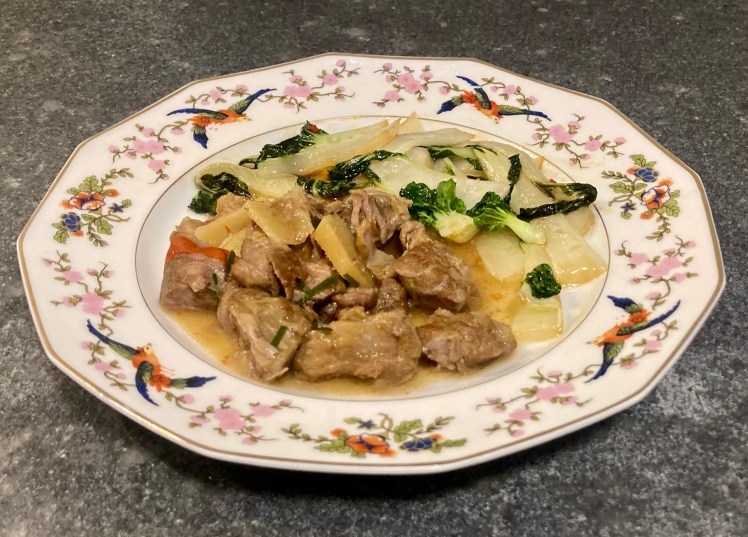
Neck of Lamb, Asian style
We can hear you thinking, ‘Shouldn’t that be rack of lamb?’.
Isn’t it interesting how much we are focused on specific parts of an animal? We love our steak, but what to do with an oxtail? We love pork loin, but how about the pig’s nose? And we enjoy grilled rack of lamb, but how about the neck?
Supermarkets know everything about our focus and preferences. So if you would like to cook pig’s feet (or trotters), kidneys, liver, sweetbread or lamb’s neck: where to go? Try finding a ‘real’ butcher, one that buys the whole animal, not just the popular parts.
Lamb’s neck is very underrated. Some feel it’s okay for your dog only, but that’s silly. When cooked slowly it becomes tasty, nicely structured, juicy and tender.
It combines very well with strong flavours such as ginger, cilantro seeds, star anise, soy sauce and the leaves of the Makrut or Thai lime (also known as Djeroek poeroet or Djeruk purut). You will get a flavourful, complex sauce in combination with lovely, aromatic meat.
Wine Pairing
If you decide to pair with white wine: we enjoyed our Neck of Lamb with a glass of Alsace Gewurztraminer, Cave de Beblenheim. The wine has a beautiful gold colour, and an expressive aromas of roses. The palate presents a nice structure with a fruity and spicy association which of course goes very well with the oriental twist to the stew. In general we suggest an aromatic white wine with just a touch of sweetness.
If you decide to pair with red wine: a few weeks later we enjoyed the dish with a glass of Cinsault, produced by Domaine Coudoulet. This is a relatively light wine, to be served chilled (12 °C or 54 °F). Cinsault is a grape native to the south of France. It was somewhat forgotten but is now gaining popularity. It has a floral nose, with aromas of raspberry and fresh fruit on the palate and discreet tannins.
What You Need
- 300 grams Neck of Lamb
- Olive Oil
- Shallot
- Fresh Ginger (4 cm, depending on your taste)
- 1/2 red Chili
- 1 Garlic Clove
- Noilly Prat
- Cilantro Seeds
- Star Anise
- Low Salt Soy Sauce
- 4 leaves of Djeroek Poeroet
What You Do
- Cut the meat in not too small cubes – they will shrink during the cooking process
- Fry the meat in oil, giving it a nice colour. If so required, do so in multiple batches
- In the mean time cut the shallot, peel the ginger and slice, remove the seeds from the chili and cut the garlic clove (but not too fine)
- Remove the meat from the pan and glaze the shallot, chili, ginger and garlic
- Add a splash of Noilly Prat, the crushed cilantro seeds, the star anise, some low-salt soy sauce and the djeroek poeroet
- Stir
- Transfer the meat back to the pan and add water, making sure the meat is just covered
- Leave to simmer for 6 hours in total
- Check the pan every hour, stir and add water is so required
- Also check if the djeroek poeroet and/or chilli are not overpowering
- After 5 hours check the taste, perhaps add soy sauce, remove the djeroek poeroet or the star anise
- After 6 hours cool the stew and transfer to the refrigerator. You could also decide to transfer it to the freezer for use at a later date
- The following day remove as much of the fat as possible
- Warm the stew, check taste and tenderness
- You may want to reduce the liquid in a separate pan
- Warm through and through
- (Optional) thicken the sauce with potato starch, this way your sauce will remain transparant
- Serve with steamed Pak Choi with oyster sauce
PS Looking for a nice starter? Why not serve with Hot and Sour Soup?


 Cook and Drink