Oden

A traditional Japanese dish, often enjoyed in winter. It is tasty, light and full of surprises. Oden is a meal that requires a bit more work (and of course time) then you would expect. It also requires some shopping, given some of the ingredients are not easy to find. We enjoyed our first Oden at the Taishunken restaurant in the famous Sankeien Garden in Yokohama. Loved it!
We are not from Japan so we humbly present our version of this classic. We hope it inspires you to cook Oden and enjoy it as much as we did.

Pairing

A cup of Japanese green tea is the obvious choice.
You could also combine your oden with a glass of Chardonnay (with a touch of oak perhaps), for instance if you serve it for dinner. Oden is rich in flavours, umami of course, but not spicy, so we would not suggest a Gewürztraminer or a Sauvignon Blanc.
A glass of cold, dry sake will also be great.

What You Need

  • For the Dashi
    • 1 litre of Water
    • 20 grams of Dashi Kombu (Rishiri Kombu)
    • 20 grams of Katsuobushi (Bonito Flakes)
  • For the Stew
    • One Daikon
    • One Pack of Konnyaku
    • 1 sheet of Hayani Kombu
    • Chikuwa Fish Cakes
    • One Pack of Gobo Maki Burdockroot Fish Cakes
    • 2 boiled eggs
    • Abura Age Fried Tofu
    • Mochi (Sticky Rice Cake)
    • Soy Sauce (preferably one with less salt)
    • Mirin
  • Karashi
  • Rice with ginger

What You Do

First step is to peel the daikon and slice it (2 centimeters is best). Now use a sharp knife to plane of the edge of the daikon. This improves the presentation, and it is supposed to stop the daikon from falling apart. Cook the daikon for one hour in water. Drain and set aside.
In parallel: cut the konnyaku in triangles and cook these in water for 15 minutes. Konnyaku is made from the konjac plant and is specific for the Japanese cuisine.
Also in parallel: cook the sheet of Hayani Kombu for 5 minutes. This is young kombu and edible, different for the one you use when preparing dashi. Let cool a bit, slice and knot ribbons. Not sure why but is looks great when you serve it. (Yes, well spotted, it’s not in the picture; unfortunately, we couldn’t find Hayani when we prepared our oden.)
Make 1 litre of dashi. This seems simple but requires precision. Clean the kombu with a wet cloth and put into one litre of cold water. Gently raise the temperature to 80 °C or 175 °F. Remove and discard the kombu. Bring the liquid to a boil, add the katsuobushi, bring to a boil and immediately set heat to zero. Wait 5 minutes or so. The katsuobushi will sink to the bottom of the pan. Now very gently pass the liquid through a wet towel or a sieve. Do not squeeze, just give it time. The result will be a great, clean dashi.

Now it’s time to add the dashi to the pan (should be a clay pot, but we stick to our Le Creuset), add one tablespoon of mirin, one (or two, depending on your taste) of light soy sauce, add the daikon, the konnyaku, the chikuwa fish cakes and the gobo maki burdockroot fish cakes.
Allow to simmer for at least 2 hours. 30 minutes before serving add boiled eggs, two Hayani ribbons, fried tofu and mochi. The last two ingredients must be combined by putting the mochi into the tofu.
Serve with karashi (Japanese mustard, which is different from wasabi by the way) on the side.

  • Oden ©cadwu
  • Oden with names of Ingredients ©cadwu

Tamagoyaki (Japanese Omelette)

Rolled Omelette

Tamagoyaki is best described as a Japanese rolled omelette and it is often served for breakfast or included in a bento box. It’s made by rolling multiple thin layers of egg; let’s say the concept of a Swiss roll but with much thinner layers. Making Tamagoyaki requires years of practice and a special rectangular pan (a makiyakinabe) using chopsticks only. But we, as western cooks with little patience, we use a round small, non-stick pan and two spatulas. The result is very tasty and it will make you think of a real Tamagoyaki.

The ingredients are a bit of a puzzle. Eggs, soy sauce and mirin for sure. Other ingredients include sugar (for a sweet version), sake and dashi (for a savoury version called Dashimaki Tamago).

The technique of rolling thin layers of egg is a great way of making an omelette. Feel free to replace the Japanese ingredients with some chicken stock and finely grated Parmesan cheese. You will love it!

Wine Pairing

Tamagoyaki comes with some umami thanks to the dashi and a touch of sweetness. Enjoy with a sparkling wine, for instance a Crémant de Bourgogne. Our choice was a glass of Blanc de Blanc Brut made by Vitteaut Alberti. Its aromas are fresh and flowery; the flavours suggest honey and pear. You could also serve a dry Riesling or Sylvaner.
Serving sake is also a good idea; our choice would be a Ginjo-Shu because of its delicate and light flavour.

What You Need

  • 2 Eggs
  • 2 Tablespoons of (Light) Dashi
  • 1 Teaspoon of Mirin
  • 1 Teaspoon of Light Soy Sauce
  • Oil

What You Do

Heat a small non-stick pan (10 -15 centimetre) until warm but not hot. Whisk the eggs, add dashi and mirin. Use kitchen paper soaked with oil to coat the pan. Use a (small) sauce spoon to add a bit of the mixture. Make sure you can repeat this as often as possible, so it has to be a really thin layer of egg. When nearly set, roll it up and move to the side. Coat the pan with oil. Add some of the mixture, make sure it connects to the roll, wait until nearly set and roll it up. Repeat until the mixture is used up. The tamagoyaki should be yellow with perhaps a touch of golden brown.
When done, feel free to shape the tamagoyaki by rolling it in a bamboo sushi mat. Slice and serve, perhaps with some grated daikon on the side.

Duck with Ginger, Mirin, Soy Sauce and Yuzu

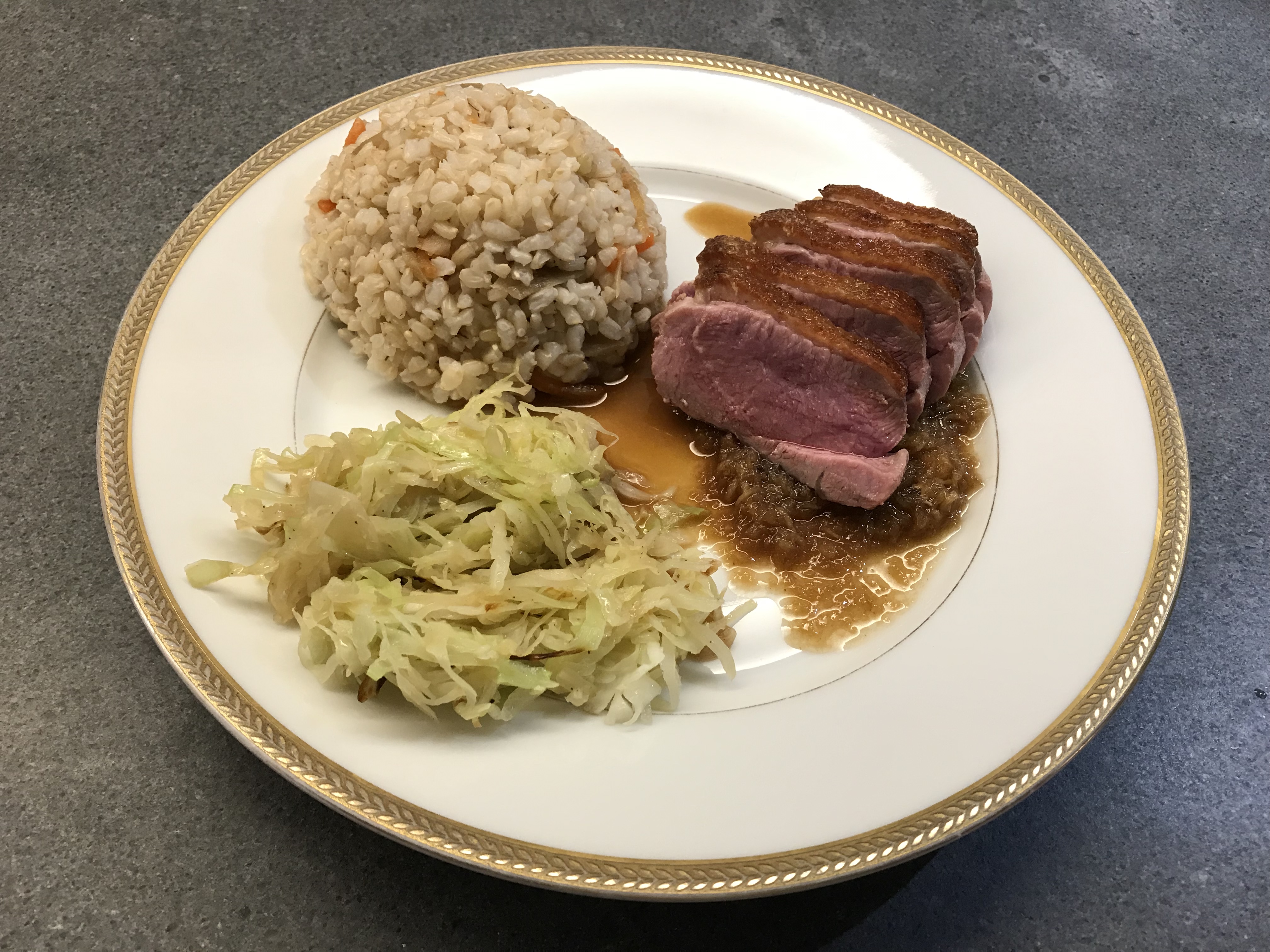
Obviously Breast of Duck is great when combined with an orange sauce (or even better, with Mandarine Napoléon). Or combined with a Green Pepper Sauce, or with hoisin, soy sauce and five-spice powder (as used for Peking Duck). We combine the duck with fresh ginger (a bit spicy, but since the ginger is cooked in the sauce it will be very mild), yuzu (citrus fruit originaly from Japan, Korea and China) and sweet mirin and soy sauce. The cabbage comes with tamari and sesame oil, so this dish is full of wonderful flavours. Have we mentioned the pickled cucumber?

Wine Pairing

You could combine the duck with white wine, provided it has lots of character, for instance a Gewürztraminer. A red wine is the more obvious choice: a rich, warm Carignan will do nicely. The wine needs to combine with the richness of the dish and of course the sweetness of the soy sauce and the mirin. Duck is somewhat sweet in its own right and the sauce amplifies this. The wine should be fruity (plum), spicy and definitely not too woody.

What You Need
  • 2 Small Breasts of Duck or 1 Large One
  • Soy Sauce (we prefer the version with less salt)
  • Mirin
  • Yuzu
  • Ginger (fresh)
What You Do
  1. Check the breast of duck for remainders of feathers
  2. Remove the vein on the meat side of the breast (and the odd membrane you don’t like)
  3. Put on a dish, cover and transfer to the refrigerator
  4. Leave in the refrigerator for a few hours, making sure it’s nice, firm and cold. We want crispy fat, so we need to fry the meat relatively long. In order to get the right cuisson, we start with cold meat (so not your normal room temperature).
  5. Fry the duck in a hot, non-sticky skillet for 12 minutes on the skin side
  6. Reduce the heat after a few minutes. You don’t need oil or butter, the duck fat will do the trick
  7. Flip and fry for 2 minutes on the other side
  8. Remove from the pan and cover the meat with aluminium foil in such a way that the crispy skin is not covered. The foil should only cover meat
  9. You may want to remove some fat from the pan
  10. Add some water and a generous amount of grated ginger (let’s say 3 – 4 centimetre), stir, add mirin and soy sauce
  11. Keep warm
  12. Add liquid from the duck to the sauce
  13. After 10 minutes or so the ginger should be soft and the falvours integrated. If not, just give it a few more minutes
  14. Remove the breast from the foil and slice
  15. Make sure that any liquid left is added to the sauce
  16. Quickly stir the sauce, add a bit of Yuzu to bring acidity to the sauce, heat a bit more, dress on a plate and put the slices of duck on top of it.
Serve with…
  • Vegetables
    • Oxheart or Chinese Cabbage
    • Olive Oil
    • Tamari
    • Sesame Oil
  • Rice
    • Whole Grain Rice
    • Pickled cucumber

Grate the cabbage. Fry in a warm skillet in some olive oil. Add some tamari. Taste and adjust if necessary. Before serving add some excellent sesame oil. In parallel cook the rice and add some chopped pickled cucumbers to the rice.

Duck with Ginger, Mirin and Soy Sauce © cadwu