Together: Our Community Cookbook

Food is much more than just food, it’s about culture, about being with friends, family, about learning from other cultures, about talking and sharing memories, about emotions, about special days and celebrations. It brings people together and enhances our understanding of others.

We take part in Jo Stacy’s BKD Cookbook Club and this month the focus is on Christmas recipes for us all to make and share. Our choice is a recipe for a Casserole from Together: Our Community Cookbook.

The book is written by a group of residents, gathering in the aftermath of the Grenfell Tower tragedy in London to cook food for their families, friends and neighbours. They began using the kitchen at the Al-Manaar Muslim Cultural Heritage Centre and used the kitchen for two days per week, preparing food and eating together. Gradually more local women began to join in, embracing the community and supporting their neighbours. This was the beginning of the Hubb Community Kitchen (‘hubb’ meaning ‘love’ in Arabic).
In 2018 the group published Together: Our Community Cookbook with 50 simple and tasty recipes from the Middle East, North Africa, Europe and other countries.
Food that brings people together, food you prepare for your loved ones.

The book features mouthwatering recipes including Shakshouka (Algeria), Potato Fritters with Cilantro (India), Spicy Peanut Dip (Uganda), Green Rice (Iraq), Fennel and Orange Salad (Italy) and many more.

Food that helped restore hope and provided a sense of home.

Casserole

We decided to prepare Tepsi Baytinijan. To quote Intlak Alsaiegh, the author of this recipe: “Tepsi translates as ‘casserole’ and this is a traditional Persian dish of meatballs in tomato sauce with eggplant. It’s quite rich. You could make it with less oil, I suppose, but then it wouldn’t be so traditional—or taste so good.”

The dish is indeed a rich, tasty combination of small meat balls (ground beef, garlic, curry powder), fried egg plant, fried potatoes, onion, green pepper, tomatoes, tomato paste and tamarind paste, served with basmati rice or crusted bread.
The detailed recipe can be found in Together: Our Community Cookbook or on Food52.

Together: Our Community Cookbook is dear to us, because it shows us that food can unite people. Preparing food from this book will bring you closer to the hope and strength of the Grenfell community.

The book is available via the usual channels and your local bookstore. A portion of the proceeds from the sales will help the Hubb Community Kitchen to strengthen lives and communities through cooking.

We wish you Happy Holidays and a Wonderful 2025!
Mr. Cook and Mr. Drink

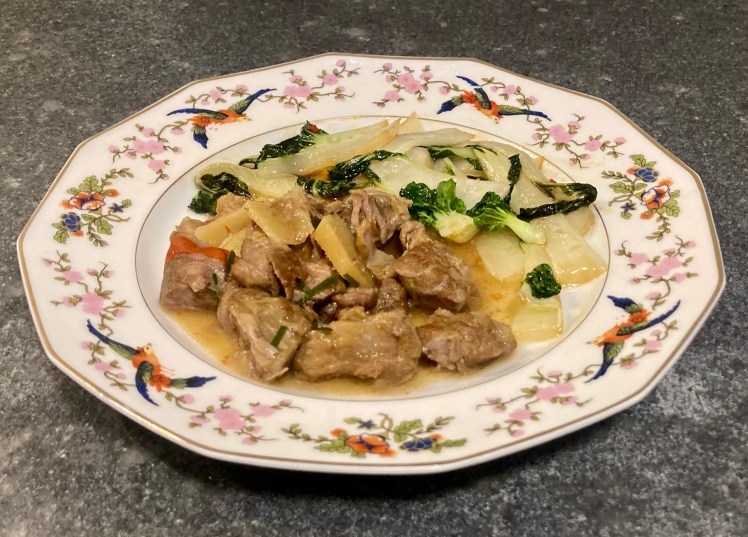
Lamb Shank with Star Anise, Ginger and Djeroek Poeroet

The obvious way to prepare lamb shanks is to fry them briefly in oil en butter and then cook them for hours in red wine with a bouguet garni of rosemary, thyme, parsley, sage and perhaps lavender. Maybe add a small tomato to help the sauce. We take a different approach by adding strong flavors like ginger, cilantro seeds, star anise, soy sauce and the leaves of the Makrut or Thai lime (also known as Djeroek Poeroet or Djeruk Purut). You will get a full, complex sauce in combination with tasty, juicy, tender and aromatic meat.

Wine Pairing

The obvious choice would be a glass of Pinot Blanc or Pinot Gris. We once enjoyed the dish with a glass of Gewurztraminer from the Alsace. A touch of spiciness and sweetness, which worked really well with the star anise and ginger.
Combining the lamb shanks with red wine is more challenging. Our choice was a bottle of Cuvée Equinoxe produced by Domaine d’Arjolle, from the Languedoc region in France. The wine is made with 100% merlot grapes. It has an intense ruby ​​color and aromas of red fruit. The flavour is soft and long, with a touch of sweetness and oak. A soft, not too complex Syrah could also be very nice with the lamb shanks.

What You Need
  • 2 Lamb Shanks
  • Shallot
  • Olive oil
  • Fresh Ginger (4 cm, depending on your taste)
  • 1/2 red Chili
  • 2 Garlic Cloves
  • Noilly Prat
  • teaspoon of Cilantro Seeds
  • 2 Star Anise
  • Low Salt Soy Sauce
  • 6 leaves of Djeroek Poeroet
What You Do

Fry the meat in olive oil, giving it a nice colour. In the mean time cut the shallot, peel the ginger and slice, remove the seeds from the chili and cut the garlic clove (but not too fine). Remove the meat from the pan and glaze the shallot, chili, ginger and garlic. Add the Noilly Prat, crushed cilantro seeds, star anise, some low-salt soy sauce and the djeroek poeroet. Stir. Transfer the meat back to the pan and add some water, perhaps 3 cm. Leave to simmer for 4 – 6 hours in total. Check the pan every hour and add water if so required. After 6 hours remove the shanks from the sauce and cool. Reduce the sauce, let cool and transfer to the refrigerator. The following day remove as much of the fat from the sauce as possible. Warm the sauce together with the shanks, check taste and tenderness.
Serve with steamed Bok Choy tossed with sesame oil or with rice.

Lamb Shank ©cadwu
Lamb Shank ©cadwu

Cod and Horn of Plenty

The magic of a great combination: only two ingredients supported by butter, olive oil and white pepper. It made us think of James Tanner’s inspiring Take 5 Ingredients. Sometimes you need various cooking techniques and lots of ingredients. Sometimes the combination of only 5 ingredients is all you need to make a perfect dish.

Why perfect? Both the fish and the mushroom are clearly present and nicely balanced. As if the combination brings out the best of both. The butter supports the richness of the fish and the aromas are delicate. The texture of the cod is soft and a touch flaky; the Trompettes de la Mort have a more fibrous and chewy texture. Excellent mouthfeel!

Wine Pairing

You’re looking for a wine that has minerality, a touch of oak and has sufficient body and length, for instance a Chardonnay.
We enjoyed our Cod and Horn of Plenty with a glass of Chablis, Antonin Rodet, Premier Cru, Montmains. It has a clear and pale gold colour. It comes with mineral notes and a touch of lemon. The taste is delicate and persistent with aromas of fresh citrus. It goes very well with the ‘long’ taste of the dish and the citrus is ideal with the cod and butter.

What You Need

  • 150 grams of Cod
  • 100 grams of Horn of Plenty
  • Butter
  • Olive Oil
  • White Pepper

What You Do

Make sure the mushrooms are fresh and dry. They become soggy and smelly easily. Clean the mushrooms thoroughly with a piece of kitchen paper. This can be time consuming. You may want to cut the cod in two. Fry the cod in olive oil with some butter in a non-stick pan. In a second pan fry the mushrooms in olive oil. This may take 5 minutes or so. Transfer the mushrooms from the pan to a warm plate with kitchen paper. When the cod is ready, serve immediately on a warm plate with some white pepper and sprinkle the mushrooms on top.

  • Cod and Horn of Plenty ©cadwu
  • Horn of Plenty ©cadwu

Fairy Ring Mushroom with Pork Chops

Spring brings us several edible or even delicious mushrooms, such as the Fairy Ring Mushroom, Morels and the Mushroom of Saint George.

The Fairy Ring Mushroom is a very common mushroom in many countries. The name is not very helpful since many mushrooms grow in the pattern of a ring. The German and Dutch names (Rasen-Schwindling and Weidekringzwam) are more helpful; these refer to the fact that they grow in meadows and lawns.

In France the Mushroom of Saint George is called mousseron and the Fairy Ring Mushroom faux mousseron. But because of the limited availability of the Mushroom of Saint George the faux (false) is dropped in the second name and the Fairy Ring Mushroom is often referred to and sold as mousseron.

It’s a small, very edible mushroom, available from early spring until late autumn. Its taste is a bit sweet and perhaps that’s why some people suggest using them to make sweet cookies. Hm, we think you can do better than that!

We combine the Fairy Ring Mushroom with excellent organic pork (also a touch of sweetness), cream, white wine, fresh sage and a splash of cognac to give the dish a nutty component.

Wine Pairing

We enjoyed our Fairy Ring Mushrooms and pork with a glass of Austrian Zweigelt, produced by Weingut Prechtl. This red wine is fruity and elegant with notes of blackberry and cherry. The tannins are well structured but not overly present. In general you’re looking for a full bodied red wine with fruit and not too much acidity.

What You Need

  • 2 Organic Pork Chops with lots of nice fat (Sirloin or Shoulder)
  • 100 gram of Fairy Ring Mushroom
  • Half a glass of Dry White Wine
  • Fresh Sage
  • Chicken Stock
  • Crème Fraîche
  • Splash of Cognac
  • Olive Oil

What You Do

Start by cleaning the mushrooms with kitchen paper. Remove the stems. Fry the caps in olive oil. When the liquid has evaporated, add some dry white wine and two finely chopped leaves of sage. Allow to simmer for 5 minutes or so. Add some crème fraîche and a few moments later a splash of cognac. Stir and leave to simmer for another 5 minutes. In parallel fry the pork chops until brown and leave to rest in aluminium foil. Remove the pork fat from the pan and deglaze with chicken stock. Reduce. Now add the liquid from the pan to the mushrooms, add more finely chopped sage and some black pepper.

  • Fairy Ring Mushrooms with Pork ©cadwu
  • Fairy Ring Mushrooms ©cadwu
  • Zweigelt made by Weingut Prechtl

Chicken with Fresh Oregano

Thyme, Oregano, Basil, Rosemary, Saffron, Sage: all powerful Mediterranean herbs. Oregano, or Wild Marjoram, is an interesting one. Probably best known as the herbal ingredient of pizza. A dried herb, one to store in a jar, forget about and then use beyond its ‘use-by date’ and be disappointed.
Such a pity because fresh oregano is aromatic, slightly bitter, pungent and perhaps chemical, depending on the variety, of course. Great to combine with lamb, a tomato salad, grilled fish and of course chicken. It’s also great to flavour olive oil with oregano. So ask your supermarket or local greengrocer for fresh oregano!

Wine Pairing

We enjoyed our chicken and oregano with a glass of Rioja Paternina Reserva 2015 produced by Marques de la Concordia. Reserva means that the wine ages for a minimum of 3 years, with at least 1 year in oak barrels. The grapes are tempranillo, mazuelo and garnacha; very typical for Rioja. It’s a powerful, full-bodied red wine with aromas of black cherries and touch of vanilla and various spices. The wine goes very well with the velvety chicken and the very present flavours of the oregano.

What You Need

  • Chicken Thighs
  • Olive Oil
  • Black Pepper
  • Chicken Stock
  • Lots of Fresh Oregano

What You Do

Halve the thighs, heat a heavy iron skillet, add olive oil and quickly fry the meat on all sides. Reduce the heat and add two third of the chopped oregano. Keep on low to medium heat for 10 minutes or so. Add some chicken stock, just to deglaze the pan. You will notice that the juices becomes green thanks to the oregano, so please coat the meat with the cooking liquid. Just before serving add the remaining oregano, some freshly ground black pepper and mix.
Serve with green beans, cooked in water with fresh garlic, wrapped in pancetta (after having grated some nutmeg over the beans) and then fried for 5 minutes in some olive oil.

  • Chicken with Fresh Oregano ©cadwu
  • Federico Paternina Rioja Reserva 2015 ©cadwu
  • Fresh Oregano ©cadwu


Duck Breast with Sichuan Pepper

Tingling Citrus

Why call something pepper when actually it is not hot and spicy like black pepper or chili? Perhaps because of the shape? The Chinese name is huā jiāo, meaning something like flower pepper. Actually it is a dried berry from western China. Other names are Szechuan Pepper, Chinese Prickly Ash, Mala Pepper et cetera. The quality may vary, depending on the actual species used. The taste has two components: the aroma of citrus and an intriguing tingling effect on the tongue.
The Sichuan cuisine combines it with chili pepper, star anise and ginger.

Wine Pairing

A cup of Jasmine Tea is an excellent choice. You could also go for white wine, for instance a German Riesling or Gewurztraminer. We decided to go for a Pinot Noir from La Cour Des Dames. In general you’re looking for a red wine with aromas of berries, floral notes and delicate wood. The tannins should be soft or well-integrated.

What You Need

  • Duck Breast
  • Sichuan Pepper
  • Light Soy Sauce
  • Normal Soy Sauce
  • Mirin
  • Chicken Stock
  • Corn Starch

What You Do

Start by warming a non-stick frying pan. Add the Sichuan pepper (we suggest one or two teaspoons). Gently roast the peppers until you can smell their lovely aroma. Transfer the berries to a mortar and let cool. Take the duck breast from the refrigerator, clean it if necessary and transfer to the now hot non-stick frying pan. By starting with cold meat, you will get the best result: crispy fat, a golden brown colour and seignant meat. Fry the duck breast for 2 minutes, then reduce the heat, give it 10 more minutes on the fat-side and finish with 2 or 3 minutes on the meat-side.
Wrap the breast in foil, making sure the fat is not covered.
Crush half of the Sichuan peppers. Add stock to the pan, soy sauce, crushed Sichuan pepper and a teaspoon of mirin. Stir and add liquid from the duck. The duck must rest for 10 minutes, so occasionally add liquid and stir the sauce. Taste the sauce and adjust. When ready, make the sauce thicker using corn starch. Coarsely crush the remaining Sichuan pepper.
Slice the meat and serve with the sauce. Sprinkle the remaining Sichuan pepper on top of the meat.

We served the duck breast with a combination of stir fried (Chinese, napa or oxheart) cabbage, spring onion, chili pepper and sesame oil.

Duck Breast with Sichuan Pepper ©cadwu

Salad with Various Beans and Swordfish

When in Valencia

The Mercat Central in Valencia is one of the largest markets in Europe. Its architecture is amazing, but even more stunning are the products: fruit, vegetables, mushrooms, wines, fresh meat, sausages, hams, herbs, spices, fish, bread, chickens, pickles, snails, weeds, offal, rice, nuts, beans: anything and everything you can dream of.
Albufera is a fresh water area not far from Valencia used for growing rice. It is of course the ideal rice for paella. If an original recipe of paella would exist, it would include rice, olive oil, rabbit, saffron and various beans such as broad beans, roget and garrofón.
Inspired by the classic Salade Niçoise we bought a slice of excellent swordfish, sweet onions, potatoes, eggs and of course: lots of beans. Shall we call it Salade Valençoise?

Wine Pairing

We served the salad as a main dish. Combining wine and salad is not straightforward because acidity is an important aspect of a dressing and therefore of a salad. In this case we have a range of flavours and textures so we would suggest a wine with a very present floral bouquet. The taste should be smooth and fruity. We enjoyed it with a glass of Albariño Rias Baixas 2018 produced by Bodegas Bouza do Rei, made from 100% Albariño grapes.
Another excellent choice would be Sericis, 2018 from the house of Murviedro. A wine from Utiel-Requena, so from the Valencia region. A wine made from 100% Merseguera grapes. Full bodied yet light, elegant and surprisingly low in its alcohol with only 12%. Well balanced acidity which is great when combining it with a salad.

What You Need

  • Mixed Salad
  • White Sweet Onion
  • Flat Beans (we also used the local red variety Roget)
  • Green Peas
  • Broad Beans
  • Garrofón (Lima Beans or Butter Beans)
  • Sword Fish
  • 2 Eggs
  • 2 Small (New) Potatoes
  • Olive Oil
  • Vinegar
  • Mustard
  • Black Pepper

What You Do

Start by pealing the broad beans, the green peas, the flat beans, the garrofón beans and the potatoes. Cook all five ingredients separately until al dente. Cook the eggs until just done. Let cool. Peel the broad beans and the garrofón beans again. Make a dressing by combining olive oil, vinegar and mustard. Slice the flat beans, the onion and the potatoes. Cut the egg in four. Fry the swordfish until just done. In parallel mix the salad with the onion, the flat beans, the green peas, the potatoes and the broad beans. Add the dressing and toss. Slice the swordfish and decorate the salad with egg, garrofón and swordfish. A touch of black pepper to finish.

Choucroute de la Mer with Riesling

Bofinger

The traditional Choucroute Garnie or d’Alsa­ce comes with various sausages, smoked pork belly, confit de canard, steamed potatoes and Dijon mustard. Combine it with a glass of Riesling and you will have a great dinner. Perhaps a bit heavy on the stomach, but the sauerkraut itself will make things lighter.
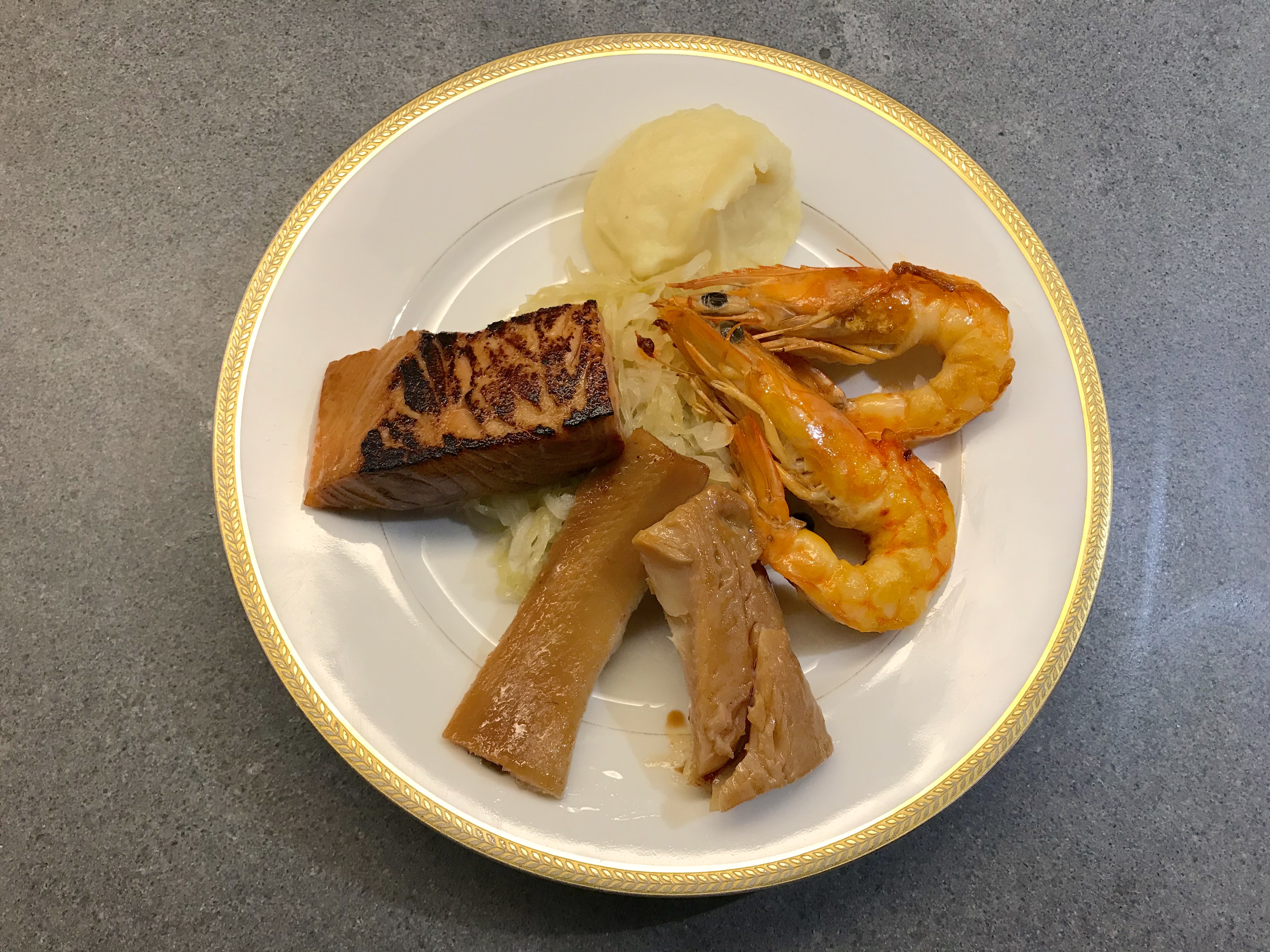
A very interesting variation is called Choucroute de la Mer. We have fond memories of restaurant Bofinger in Paris. They serve an excellent Choucroute de la Mer with haddock, salmon, sea bass, king prawns, boiled potatoes and horseradish butter. The haddock is actually smoked haddock, which works really well with the choucroute. The sharp horseradish is an excellent alternative for the Dijon mustard. When in Paris, go to Bofinger and order Choucroute de la Mer!

For some reason it’s hard to find smoked haddock where we live, so we tried smoked herring (kippers). Worked very well. And because we wanted to give the fish a deeper, fermented flavour (after all, the choucroute is fermented white cabbage) we marinated the fish in miso before frying it. Excellent result, deep and intense flavours and not to heavy on your stomach.

Wine Pairing

We very much enjoyed a glass of Riesling with our Choucroute de la Mer. We decided to buy a bottle of 2017 Riesling Kalkmergel, produced by Weingut Rings. It’s a classic, organic Riesling from the Pfalz in Germany. It is juicy and fresh with balanced acidity. Great combination with the sauerkraut, the fish and the umami from the miso.

What You Need

  • For the Marinated Fish
    • Salmon
    • Haddock
    • Miso
  • For the Choucroute
    • One Shallot
    • 500 grams of Sauerkraut
    • 10 – 20 Juniper Berries
    • Dry White Wine
    • Olive Oil
    • Bay Leaf
    • Butter
  • For the Horseradish Butter
    • Horseradish
    • Soft Butter
  • For the Mash
    • Parsnip
    • Jerusalem Artichoke
    • Parsley Root
    • Or a combination of these
    • White Pepper
    • Crème Fraiche
    • Olive Oil
  • 4 Large Shrimps
  • Kippers

What You Do

This recipe requires a bit of planning!
The fish needs to be marinated for five days. Use a shallow bowl, cover the bottom with miso and place the fish on top of it. Now cover the fish with miso, making sure it’s completely coated. It requires a bit of patience. Cover the bowl with foil and transfer to the refrigerator for 5 days. Check every day and if necessary add some miso. We use miso with less salt (and more flavours). After five days the salmon will have a deep red colour and the white haddock will be also have an beautiful red/brown colour. The miso marinate will also change the structure of the fish, so carefully monitor when frying. We have the best results with thinner pieces of fish.
Four days later (so one day before your want to serve the choucroute de la mer): taste the sauerkraut. If too much acidity, then squeeze and remove some of the liquid. Cut and slice a shallot. Crush the juniper berries (feel free to add a few more, we just love them). Now combine the sauerkraut with the shallot and the berries. Mix. Add white wine, a generous splash of olive oil and a bay leaf. Coat a heavy (iron) oven dish with butter and add the mix. Put aluminium foil on top of it, making sure you press it on the sauerkraut (as if it’s a cartouche). Leave for 4-6 hours in the oven on 80° Celsius or 175° Fahrenheit. Cool and store in the refrigirator for the next day.
Warm the dish in the oven (same temperature, let’s say one hour) and in parallel make the mash. Finish with some crème fraiche, a dash of excellent olive oil and white pepper. Keep warm.
Combine the soft butter with the grated horseradish. Taste and adjust. Set aside.
Clean the prawns without removing the head
Make sure you have three nice, warm pans. One heavy iron skillet for the prawns, two non-sticky ones for the salmon and the haddock.
Wash and dry the salmon and the haddock. Decide on the order of frying. We started with the salmon. We like to have a bit of caramelisation on the salmon.
In parallel (planning!) remove the skin from the kippers. Transfer to the the oven and grill two minutes on the former skin side. Turn, drizzle with some olive oil and grill for another three minutes.
Make sure salmon, haddock, shrimps and kippers are ready to be served at the same time.
Serve the sauerkraut on a warm plate and decorate with salmon, kippers, haddock and shrimps. Add the mash. And don’t forget the horseradish butter!

Choucroute de la Mer © cadwu

Lamb Shank with Rosemary

When In Paris…

A few years ago when attending a business lunch in Paris (the things we have to endure in life…) we were overwhelmed by the menu. We quickly decided to go for Lamb and told the waiter in our very best French we would like to taste Souris d’Agneau au Vin Rouge et aux Herbes, although not exactly knowing what a Souris might be. So during that lunch we discovered the joys of Lamb Shank.
Most recipes recommend preparing lamb shank in a hot oven (200 °C or so) but that’s actually not the best way to do it. Too hot, too fast, too dry.

Lamb shank has a generous amount of fat which makes it ideal for slow cooking. Our preferred option is to use a pressure cooker. Within 45 minutes the lamb shanks will be perfectly cooked, tender and moist.

Wine Pairing

We would suggest drinking a glass of Bordeaux with the lamb shank. The Bordeaux is in general a classic blend with Merlot, Cabernet Sauvignon and Cabernet Franc. The wine should be well structured with lots of fruit. It should support the sweetness of the dish (carrots, lamb, leek). Soft tannins, a smooth texture and sufficient length. We very much enjoyed a glass of Chateau Beaulieu (2012) with our lamb.
Remember to use the same wine for cooking the lamb!

What You Need

  • 2 Lamb Shanks (with fat, please!)
  • 2 Shallots
  • Carrot
  • Leek
  • Celeriac
  • 2 Garlic Gloves
  • Olive Oil
  • Bouquet Garni, for instance:

    • Bay Leaf
    • Parsley
    • Thyme
    • lots of Rosemary (and 2 extra sprigs)
  • Red Wine
  • Water
  • Black Pepper
  • Brussels Sprouts or Carrots

What You Do

Start by colouring the lamb shanks in olive oil. Transfer to a plate and then gently fry the shopped shallot, the leek, the carrot, the celeriac and the garlic. When ready add the red wine and some water, depending on your taste. Add the generous bouquet garni with extra rosemary and some cooked garlic. Transfer the lamb shanks back to the pan and close the pressure cooker. Cook for 30 – 45 minutes depending on the size of the shanks. Transfer the shanks to a warm plate, pass the cooking juice through a sieve (discarding the vegetables), check the sauce, reduce if necessary,  and serve the shanks with a classic branch of rosemary, Brussels sprouts and some bread.
If you want to emphasize the natural sweetness of the dish, then serve with glazed carrots.


Chicken with Tarragon, Leek and Nero d’Avola

Some combinations are made in heaven. Chicken and Tarragon is such a combination: it simply works brilliantly. Tarragon is a very powerful, aromatic herb, full of flavors such as anise and licorice. It’s the key ingredient of the sauce Béarnaise and it is of course wonderful when combined with vinegar and mustard. For kitchen purposes you need to buy French tarragon. The other well-known variety is called Russian tarragon. It’s a nice plant for your garden or balcony, with flowers and lots of leaves, but the taste is very bland, so not one to use in the kitchen.

We use butter to carry the taste of the tarragon to the chicken and to the sauce. It’s the principle behind enfleurage and maceration in the perfume making industry: fat is used to absorb the fragrance. So yes, you need an excellent chicken with lots of fat under the skin.

This recipe works with a whole chicken, with breasts and legs, provided they come with a skin. The crux of this recipe is to create a layer of tarragon butter between the meat and the skin, allowing for a crispy skin in combination with rich, flavored meat. You can stuff the chicken in the morning or the day before. Ideal when you’re having guests!

The sauce is very rich, so instead of using flour or cream, we create an emulsified sauce by blendering the mixture. The result is a velvety, filming sauce.

We enjoyed our chicken with a glass of Inycon Nero d’Avola. The wine is elegant, fruity, not too full bodied and it has soft tannins and a gentle acidity. You will also taste licorice, which is a nice reflection of the tarragon and the Pastis. The balance of the acidity of the wine and the filming structure of the sauce is essential to the dish.

Here is what you need

  • 2 Chicken Legs
  • 8 Sprigs of Tarragon
  • 20 + 10 grams of Butter
  • Olive Oil
  • Pastis
  • Chicken Stock
  • Optional: Leek, olive oil and water

Strip the tarragon leaves from the stem and chop. Let’s say you need one or two sprigs of tarragon per chicken leg. Use a fork to make the tarragon butter. Use your fingers to create space (a pocket) between the skin and the meat. Start for instance in the middle of the leg (outside) or at the rear of the whole chicken. Be careful not to open the edges, otherwise the tarragon butter can’t do its work. Put some of the butter between the skin and the meat and use your fingers to create a thin layer by pressing the butter to the sides. Coat the bottom of a shallow baking pan with olive oil.
Transfer the chicken legs to the pan. Add some additional butter to the pan (not on top of the chicken). Also add the sprigs you haven’t used. Put the pan in an oven of 200˚ Celsius or 390˚ Fahrenheit for 30 minutes.
Transfer the chicken legs and two sprigs of tarragon to a plate and keep them warm in the oven (just switch it of and keep the door open). Deglaze the pan with chicken stock and Pastis. Deglazing simply means that you add a liquid and then by stirring the mixture you capture the residue in the pan. As if you are cleaning the pan. Blender the mixture and poor through a sieve into a small saucepan. You now have a homogenous, emulsified sauce. Warm the sauce and stir occasionally for five minutes. Serve the chicken with the sauce, the fried sprigs of tarragon and the briefly cooked leek.

(P.S. Clean the leek, making sure you have removed the sand and dirt. Slice thinly and cook with some olive oil and a drop or two of water. Five minutes maximum should do the trick.)