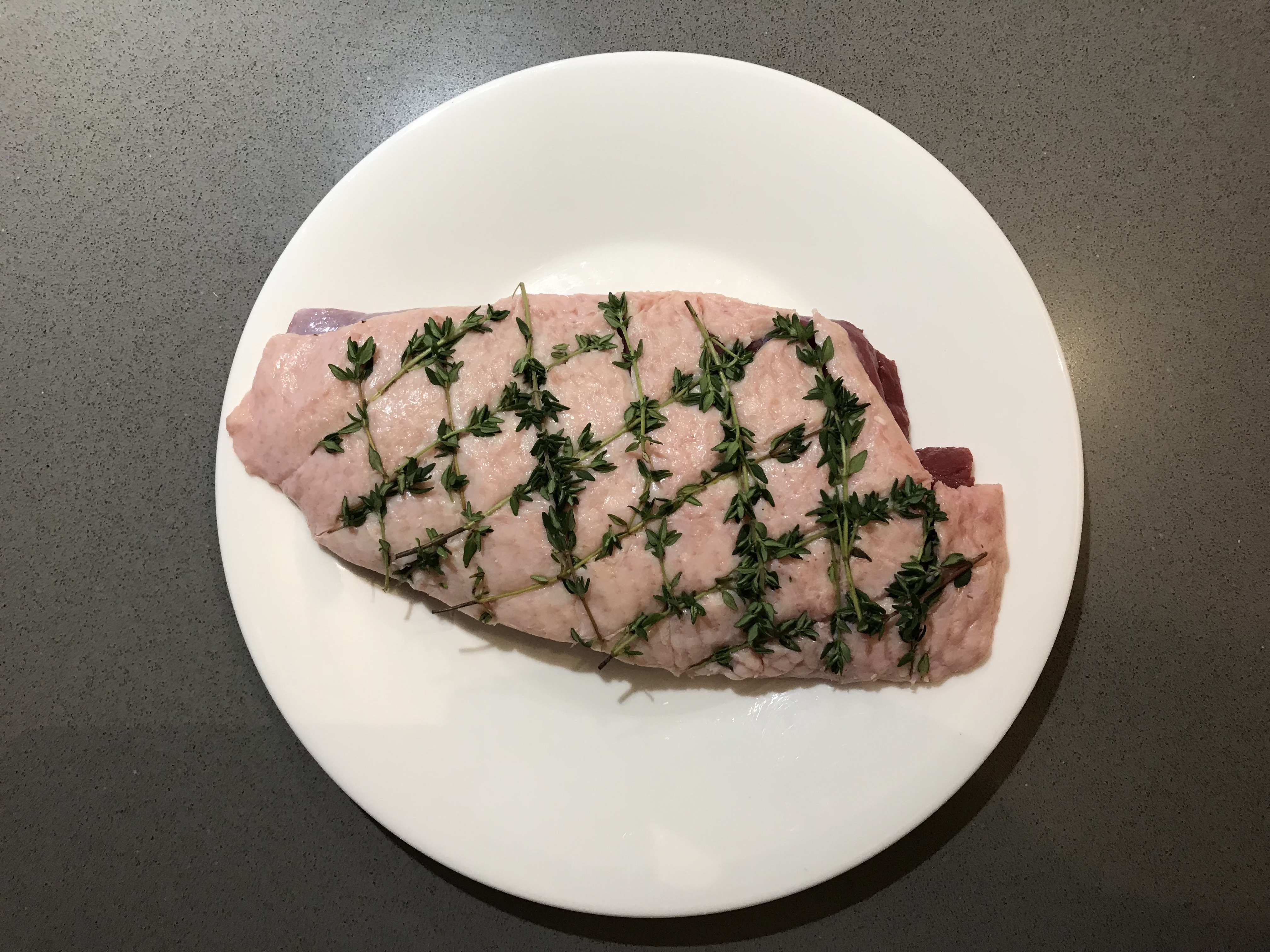
Duck with Garlic Thyme Sauce

Breast of Duck (Margret de Canard) is often paired with sweet ingredients, such as figs and oranges. We love the combination of duck with a green pepper sauce, because the sharpness emphasises the natural sweetness of the duck meat. In this recipe we do something similar. The sauce with thyme and mustard is aromatic and a touch sharp, which is very nice with the duck. The grated garlic adds spiciness to the sauce, making the dish more complex and bold. Delicious when combined with the sweet and sour caponata and crunchy fried polenta.

Wine Pairing

To balance the flavours of the dish, we suggest a fruity, dry red wine, one with subtle tannins and lots of freshness. We enjoyed a glass of Nero d’Avola, made in Sicily. The unoaked wine had a ruby red colour and aromas of cherries and plum. Serving the wine slightly chilled (meaning 15°C or 16°C (59°F or 61°F)) enhanced the freshness, acidity and fruitiness of the wine.

What You Need
  • 1 Breast of Duck
  • Thyme
  • Chicken Stock
  • Garlic
  • Mustard
  • Crème Fraîche
  • ½ grated clove Garlic
  • Black Pepper
  • To serve with the Duck
What You Do
  1. Check the breast for remainders of feathers
  2. Remove the vein on the meat side of the breast (and other bits you don’t like)
  3. Place on a dish, cover with foil and transfer to the refrigerator
  4. Leave in the refrigerator for one hour, making sure it’s nice, firm and cold
  5. Fry the duck in a hot, non-sticky skillet for 10-12 minutes on the skin side. Reduce the heat after a few minutes. You don’t need oil or butter, the ducks fat will do the trick
  6. Now fry for 2-3 minutes on the meat side and remove
  7. Cover with aluminum foil in such a way that the crispy skin is not covered. The foil should only cover the meat
  8. Remove most of the fat from the pan, but not all
  9. Add chicken stock and thyme
  10. Deglaze the pan
  11. Start building the sauce by adding juices from the duck
  12. Add mustard. This will not only add complexity and sharpness to the sauce, it will also make it thicker
  13. Add crème fraîche
  14. Add stock, mustard and crème fraîche to taste
  15. After 10 – 15 minutes add grated garlic, this will give a boost to the sauce
  16. Slice the duck (we like fairly big slices; you may prefer thinner ones)
  17. Add the last juices to the sauce and serve the duck with the sauce, caponata and fried polenta
Duck with Garlic Thyme Sauce ©cadwu served with caponata and polenta
Duck with Garlic Thyme Sauce ©cadwu

Bitter Orange

One of our favourite dishes is Duck Breast with Orange Sauce. Not difficult to make and the result is always tasty. Use a combination of fresh orange juice, thyme, rosemary, butter, Mandarine Napoléon, Cointreau, chicken stock and/or orange peel to make a tasty, not to sweet sauce. Mandarine Napoléon is preferred because it gives bitterness and depth to the sauce. The juicy meat, the sweetness of the duck and the orange, the nice aromas, the herbs and the velvety mouthfeel of the sauce make this an excellent combination.

Last week we were lucky, very lucky when we spotted Orange Amère on our local market. Bitter Orange! Also known as Seville Orange, Bigarade Orange or Pomerans. Finally! The ideal ingredient to make Orange Curd, Marmalade and of course Orange Sauce.

We bought a handful and as soon as we were at home, we wanted to taste it. The Bitter Orange does not contain much juice, their seize is similar to that of a clementine and the seeds are relatively big. The taste is sweet and gentle at first, and then you have bitterness, some astringency and length. Wow! We rushed to our butcher, bought an excellent magret de canard and later enjoyed a perfect Duck Breast with Orange Sauce.

Bitter Oranges are normally available from late December until the end of February. Ask your greengrocer!

Our suggestions: Duck Breast with Orange Sauce and Orange Curd.

  • Bitter Orange ©cadwu
  • Duck Breast with Bitter Orange Sauce ©cadwu

André Daguin

A Grand Chef

Le chef gascon André Daguin, roi du magret de canard, est mort.
André Daguin passed away in December 2019 in Auch, France. From 1960 to 1997 he was owner and chef of the Hôtel de France in Auch. He was awarded two Michelin Stars and more importantly for us he put Gascogne on the culinary map. He was one of the leaders of the nouvelle cuisine and a master of foie gras. He was much appreciated by other French chefs and was elected President of Union des Métiers et des Industries de l’Hôtellerie, the French association of people working in hotels, restaurants and bars. His most significant and unparalleled contribution was the invention of Magret de Canard or grilled Duck Breast in 1959. It is one of many reasons why he was a grand chef.

A True Invention

The best known preparations of duck are confit de canard (the legs of the duck cooked in goose fat) and magret de canard, smoked or grilled. As if preparing the whole bird is not something you want to do. When you look for recipes in classic cookbooks like La Cuisinière Provençale by J.- B. Reboul (published in 1897) and in La Scienza in Cucina e l’Arte di Mangiare Bene by Pellegrino Artusi (publihed in 1891), then you will notice that all recipes are for complete birds. Braised if a young animal, stewed if older and larger. With olives, chipolata (small sausages), oranges or onions.
One day in 1959, after a busy lunch, a sales man arrived at the Hôtel. Not much was left in the kitchen, but André Daguin wanted to serve lunch to his late guest. He took a raw magret (ready to be made into confit) and prepared it quickly, like a steak. No doubt the surprised guest loved it. A nice and unconfirmed story.

Today grilled duck breast is one of France’s most popular dishes and many chefs offer recipes for it. With an orange sauce, with a green pepper sauce or with an Asian twist.
The original (!) by André Daguin is with foie gras. Obviously!

Breast of Duck with Thyme © cadwu