End of the Asparagus Season

Only a few days left before the end of the asparagus season on June 24th! So dash off to your greengrocer and buy some lovely asparagus, white, green, purple, it’s all fine and great, as long as they are locally farmed and fresh.

Last year our favorite way to prepare them was with scrambled eggs and shrimps. A delicious combination. This year our favorite was with Truffle Butter and Egg. A combination that very much relies on the quality of the truffle butter. Other favorites this year were steamed asparagus with kimizu (the beautiful, light, golden Japanese sauce made with egg yolks and rice vinegar), à la Flamande (mimosa of egg, butter, parsley and nutmeg), as a salad and of course as a Charlotte.

Truffle Butter

Products with truffle (oil, tapenade, purée) can be very disappointing. The vast majority is based on oil that has been artificially flavoured using a synthetic agent such as 2,4-dithiapentane. Not a truffle in sight. In case of truffle purée or tapenade the mixture is often dominated by (button) mushrooms, dried cèpes, salt, garlic and again, synthetical flavored oil.
In this recipe we use white truffle oil. The two main white truffles are Bianchetti (Tuber Borchii Vitt) and Alba (Tuber Magnatum Pico). Bianchetti is a powerful and remarkable truffle (we use it in combination with oysters) but it is not as expensive and special as an Alba truffle. A Bianchetti truffle will cost you 10 euro per 10 grams whereas an Alba truffle will be priced at 70 euro per 10 grams. When buying a truffle product, make sure you read the label and check which truffle is used.

Asparagus with Truffle Butter ©cadwu

A dear friend gave us a jar of white truffle butter and a small bottle of white truffle oil, both produced by Il Mondo Del Tartufo. The butter was fantastic and so was the oil. Both are made with Alba truffle. Later we combined normal butter with truffle oil (and perhaps a pinch of salt) to recreate the truffle butter.

Wine Pairing

The obvious choice is a glass of Pinot Blanc, although we actually prefer a dry Muscat in combination with a classic preparation such as à la Flamande. Depending on the dish it could also be a Verdicchio, an Albariño or perhaps even a Portuguese Vinho Verde.
We combined our Asparagus with Truffle Butter with a Dutch wine, produced by Hoeve Nekum. The winery was founded in 1988 but the history of the actual farm (hoeve in Dutch) goes back to the 14th century. We enjoyed their Rivaner, a white wine with a light color, a floral aroma and a fresh delicate taste with some acidity. The combination with the rich, buttery slightly bitter asparagus was excellent. In general you’re looking for a fresh, gentle wine, not too complex and one that you would also enjoy as an aperitif.

What You Need
  • 14 White Asparagus
  • 1 Egg
  • some Butter
  • White Truffle Oil
  • White Pepper
What You Do

We use our Russel and Hobbs food steamer to prepare the asparagus. An essential kitchen aid for only 50 euro or US dollar. 
Towards the end of the season the asparagus can be fairly thin, hence the 14. Clean and peel the asparagus. Put butter in a cup. Start by steaming the egg. After 2 minutes add the asparagus. 3 Minutes later turn the egg upside down and place the cup in the steamer basket. Another 5 minutes later everything is ready. Peel the egg and mash with a fork, creating a ‘mimosa’ of egg. Add two or three teaspoons of truffle oil (depending on your taste and the quantity of butter) to the butter and mix. Add some white pepper to the mimosa. Spoon the butter over of the asparagus and decorate with mimosa.
PS If you make this dish earlier in the season, then steam the asparagus for 20 minutes, the egg for 5+5 minutes and the butter for 5 minutes.

Asparagus!

Only a few days left before the end of the asparagus season on June 24th! So dash off to your greengrocer and buy some lovely asparagus, white, green, purple, it’s all fine and great, as long as they are locally farmed and fresh.

The classic way of preparing asparagus is to cook (or better: steam) them. You can pair the steamed asparagus with kimizu (the beautiful, light, golden Japanese sauce made with egg yolks and rice vinegar) Hollandaise, morels or scrambled eggs with shrimps. Classic way to serve them is à la Flamande (mimosa of egg, butter, parsley and nutmeg). You could add boiled eggs, ham and new potatoes to have a nice dinner. Or if you want to spent more money, then you serve them with summer truffle or with Sauce Périgueux.

Grilling the asparagus is also possible, simply serve them with excellent olive oil and grated Parmesan cheese.

Parhaps as a salad on a summers evening? Of course, with a delicious dressing made of white wine vinegar, olive oil, a touch of honey and lots of chervil.

A more exotic way of is to fry the asparagus with black olives and basil. Goes very well with lamb.

Wine Pairing

The obvious choice is a glass of Pinot Blanc, although we actually prefer a dry Muscat in combination with a classic preparation such as à la Flamande. Depending on the dish it could also be a Verdicchio, an Albariño or perhaps even a Portuguese Vinho Verde. Feel free to experiment; yesterday we enjoyed our asparagus with a glass of wine made of muscat and picpoul grapes. Delicious combination! The wine comes from the Pont Du Gard region (near Nimes, France) and is produced by Château Mourgues du Grès.
A more serious rosé is a perfect choice when you grill the asparagus, for instance a glass of Domaine Vico Corse Le Bois du Cerf Rosé 2021. This exceptional rosé from Corsica is made of grenache and sciacarello grapes. It is medium bodied and fresh with aromas of red fruit with a complex, long and fruity taste.
A pinot noir or grenache based wine is great when you fry the asparagus, depending on the preparation of the meat.

Asparagus ©cadwu
Asparagus ©cadwu

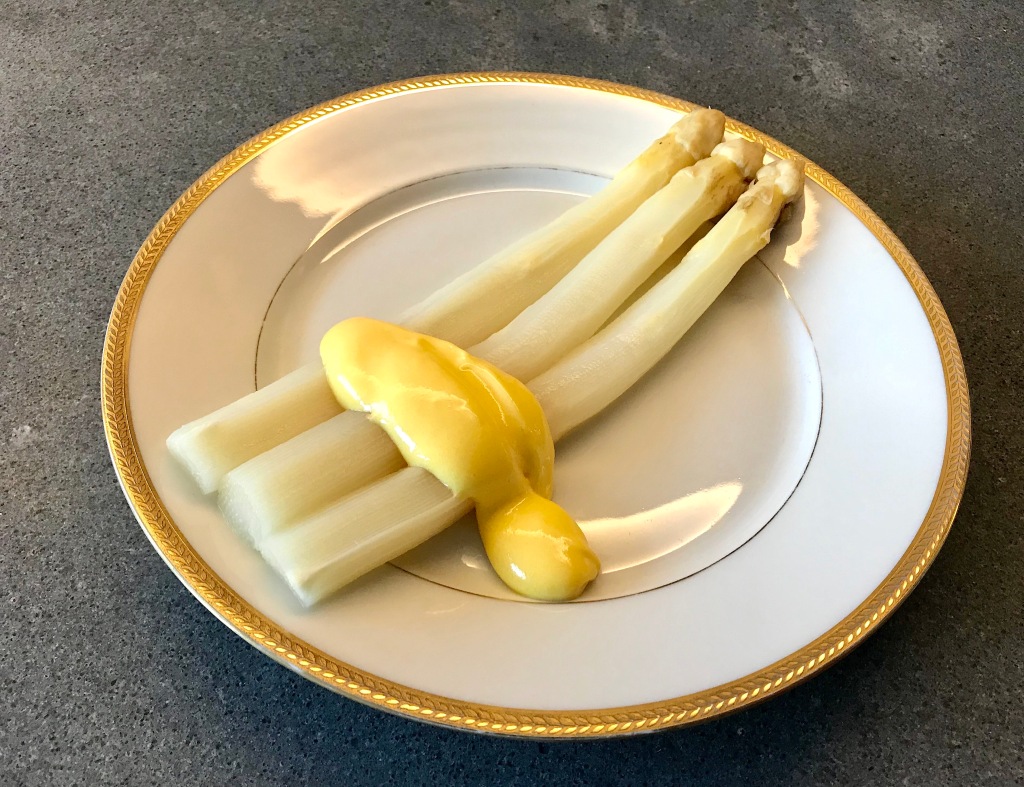
Asparagus with Kimizu

The combination of white asparagus and Hollandaise is classic. The sweetness and bitterness of the asparagus together with the velvety, rich flavours of the sauce is just perfect.

A few years ago we enjoyed Kimizu-Ae (white asparagus with Kimizu) at Yamazato in Amsterdam. We were immediately intrigued by this combination. The Kimizu is a rich and light sauce; it comes with a velvety feeling, a touch of sweetness, a bright yellow colour and perfect acidity. So yes, the next day we prepared our own Kimizu.

Kimizu is based on two main ingredients: egg yolk and rice vinegar. You could add some mirin and a pinch of salt. Kimizu does not contain butter (the egg yolk being the only source of fat) so Kimizu, although it seems similar to Hollandaise, is lighter, easier to digest and fresher.
Many recipes for Kimizu include starch, probably because the cook has trouble making a warm, emulgated sauce. Our advice: never use starch or beurre manié. The consistency is an essential element of the sauce and must be the result of carefully heating the mixture of egg yolk, vinegar, mirin and water.

Using a microwave oven to make Kimizu is a great idea (see our recipe for Hollandaise), although it does require more whipping and more attention compared to making Hollandaise.

Wine Pairing

We enjoyed our Asparagus and Kimizu with a glass of Sancerre, Domaine Merlin Cherrier. This classic wine reflects the chalky terroir of Sancerre beautifully. The combination of Sauvignon Blanc (citrus, minerals) and Kimizu (touch of sweetness, present but not overpowering acidity) works really well. A wine of true class and complexity with a long finish.

What You Need

  • Two Egg Yolks
  • 1,5 tablespoon of Rice Vinegar (depending on the size of the egg yolks and the acidity of the vinegar)
  • 3 tablespoons of Water
  • Teaspoon of Mirin (optional)
  • Pinch of salt (very optional)
  • 6 Asparagus

What You Do

The amount of water you’ll need depends on the acidity of the rice vinegar and the size of the egg yolks. Whisk the two egg yolks, add the rice vinegar, the mirin, the water and whisk some more. Now transfer to the microwave and give it let’s say 10 seconds on 30% power. Remove from oven and whisk well. Repeat. You will now feel the consistency changing. If not, don’t worry, just repeat the step. After 2*10 or 3*10, move to steps of 5 seconds on 30% power. Whisk, whisk again and feel free to find your own way. When the Kimizu is ready, take it out of the oven, continue whisking gently and perhaps cool slightly in a water bath.
In parallel steam the asparagus (depending on the size 20 or 25 minutes; they should be well done for this dish).
Serve the asparagus with a generous helping of Kimizu.

White Asparagus with Kimizu ©cadwu