Exploring Asma Khan’s Ammu (Part 3)

We conclude our review of Asma Khan’s cookbook Ammu, Indian Home Cooking to Nourish Your Soul by preparing two dishes: Saffron Lamb and Pulao and asking our esteemed panel (André, Joke, Martine and Rutger) for their thoughts. In Part 1 we wrote about her Pumpkin and Coconut soup and in Part 2 about her Pineapple and Chilli Chutney and Eggs in Tamarind Gravy

Asma Khan is an Indian British chef, cookbook author and restaurant owner. In 2012 her pop-up restaurant started for 12 guests at her home, serving food cooked from traditional family recipes. Today her all-female Darjeeling Express restaurant in London offers Indian Rajput and Bengali home cooking specialties.

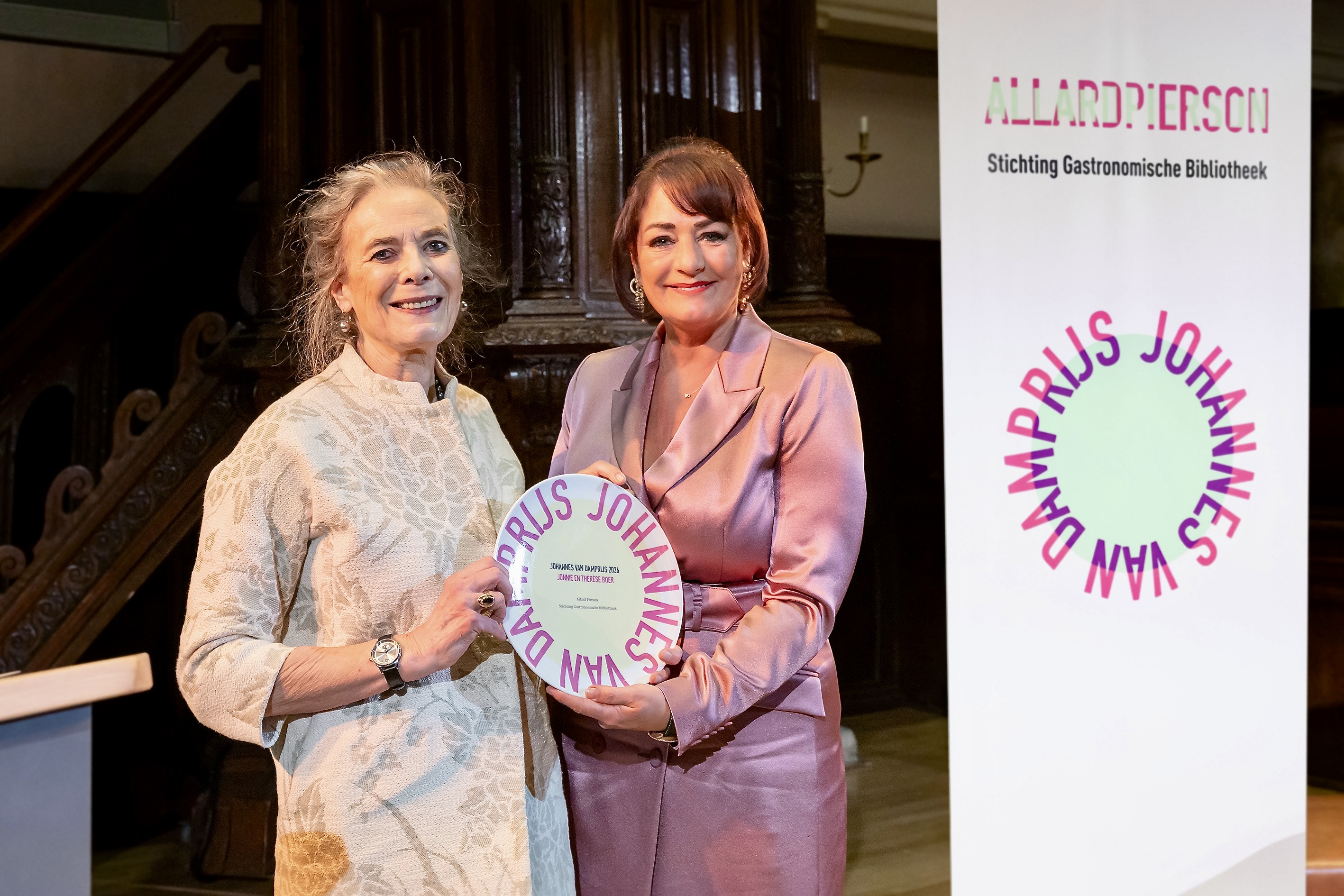
In 2024 she won the Johannes van Dam Prize, a lifetime achievement award for an individual who has made an exceptional contribution to the world of gastronomy. Previous winners of the prestigious prize include Yotam Ottolenghi, Carlo Petrini, Alice Waters, Claudia Roden, Jeroen Meus and Alain Passard.

The book is called ‘Ammu’ which translates to ‘Mother’. The stories, the recipes, the whole book is a tribute to the food her mother (and the family’s cook) prepared. But we feel it’s more: it’s also a tribute to original flavours, to people taking time to prepare food, to sharing and enjoying, to communities and heritage.

Saffron Lamb

The recipe calls for a whole leg of lamb. For practical reasons we decided to make a stew using neck of lamb. The meat is marinated for at least 4 hours (or overnight) in a combination of yoghurt, garlic, chilli powder and saffron. Using saffron can be challenging. Asma Khan soaks the saffron in tepid water, which makes it much easier to add the right amount of saffron, not only at the beginning but also just before serving. The stew was a well-balanced combination of lamb, spices and saffron. To quote Asma Khan: “This is a good one to serve friends and family to make them feel loved without having to spend a lot of time in the kitchen!”. It was Rutger’s favourite.

Pulao
Pulao © cadwu with rose petals, cardamom, cinnamon and pistachios. Recipe by Asma Khan

Doesn’t it look amazing? Basmati rice with cardamon, cinnamon, rose petals, pistachios, apricots, cloves, onion, rose water and bay leaf. The pulao surprised us all with its flavours, aromas and vibrant colours. The rice has a sweet undertone which makes it ideal to serve with spicy dishes. It combined very well with the lamb, the chutney and the eggs.

It was Martine’s favourite. Preparing it is, as you will expect by now!, a bit of work but it’s not difficult.

Should This Book Be On Your Shelf?

Our answer is “Yes, definitely” but our esteemed panel didn’t agree with us. They loved the dishes and the range of (new) flavours, the complexity of the aromas and the beautiful colours. They would be happy to enjoy more food from Asma Khan, but the time and effort required to prepare the food would be a problem.
Which means we will plan another Asma Khan dinner, with dishes such as Stir-Fried AuberginesCoconut Ladoo and Prawns with Peas and Potatoes. To be continued!

The Book

Ammu, Indian Home Cooking to Nourish Your Soul by Asma Khan is available via the usual channels or your local bookstore for 35,00 US$ or 26,00 EUR.
Some of her recipes were published by the BBC, other recipes were published by Great British Chefs and these by the Foodnetwork.

Exploring Asma Khan’s Ammu (Part 2)

We continue our review of Asma Khan’s cookbook Ammu, Indian Home Cooking to Nourish Your Soul by preparing two dishes: Pineapple and Chilli Chutney and Eggs in Tamarind Gravy and asking our esteemed panel (André, Joke, Martine and Rutger) for their thoughts. . Earlier we wrote about her Pumpkin and Coconut soup.

Asma Khan is an Indian British chef, cookbook author and restaurant owner. In 2012 her pop-up restaurant started for 12 guests at her home, serving food cooked from traditional family recipes. Today her all-female Darjeeling Express restaurant in London offers Indian Rajput and Bengali home cooking specialties.

In 2024 she won the Johannes van Dam Prize, a lifetime achievement award for an individual who has made an exceptional contribution to the world of gastronomy. Previous winners of the prestigious prize include Yotam Ottolenghi, Carlo Petrini, Alice Waters, Claudia Roden, Jeroen Meus and Alain Passard.

The book is called ‘Ammu’ which translates to ‘Mother’. The stories, the recipes, the whole book is a tribute to the food her mother (and the family’s cook) prepared. But we feel it’s more: it’s also a tribute to original flavours, to people taking time to prepare food, to sharing and enjoying, to communities and heritage.

Wine Pairing

Aska Khan doesn’t include suggestions for drink pairing in the book. As a main we served four dishes: Pineapple and Chilli Chutney, Eggs in Tamarind Gravy, Saffron Lamb and Pulua. We paired this with a red wine called Magenta produced by Domaine de l’Arjolle from the Côtes de Thongue area (west of the French city of Montpellier) made with merlot and cinsault grapes. The wine has a light red colour, and its taste made us think of cherries and red fruit. Excellent light wine that combined very well with the various flavours of Asma Khan’s dishes. In general, we would suggest a light, fruity red wine.
If you would like to enjoy a white wine, we would suggest one with limited acidity, for instance Pinot Gris.

Eggs in Tamarind Gravy
Eggs in Tamarind Gravy ©cadwu

When going through the book, we noticed this delicious looking dish. It made us think of Sambal Goreng Telor, an Indonesian side dishe which combines fried hard-boiled eggs with a sauce made with chillies, lemon grass, shrimp paste and other ingredients.

The recipe for Eggs in Tamarind Gravy is not too difficult, just a bit time consuming. The gravy is made with very thinly sliced onions, garlic, ginger, turmeric, chilli, tamarind extract and water. Once combined it needs to be reduced by half. We read the recipe again and started to wonder why it was called ‘gravy’. The liquid in our pan resembled a watery soup, not gravy. We left it to reduce, on low heat, and we waited patiently. It started to thicken and after two or three hours we knew Asma Khan was right: gravy it was.
We think that the very thinly sliced onion, cooked through and through, worked as a thickener. Ten minutes before serving we made three shallow slits on the surface of each hard-boiled egg, which helps the eggs to absorb the gravy.
The panel loved the combination of subtle flavours: sweet, tangy, sour and rich. The sauce has the texture of old-fashioned gravy and it coated the eggs perfectly.

Pineapple and Chilli Chutney
Pineapple Chutney ©cadwu

We decided to prepare Saffron Lamb because of the intriguing recipe (more in our next review). Asma Khan suggests serving the lamb with Rose, Apricot and Pistachio Pulau and Pineapple and Chilli Chutney, so that’s what we did.

The chutney is made with red chillies (we used Kashmiri red chilies), Indian bay leave (tej patta), ginger, sugar, salt and water. It needs to cook until the chutney thickens and looks glossy. As with the gravy we were slightly worried: after thirty minutes our chutney wasn’t glossy or thick and the pineapple was bright yellow. But after three hours the chutney looked exactly as Asma Khan predicted.
The panel was surprised by the sweetness and gentle spiciness of the chutney. The flavour of the pineapple was clearly present, but in a savoury way. Tasty in its own right, very nice accompaniment with the lamb and the rice.

The Book

Ammu, Indian Home Cooking to Nourish Your Soul by Asma Khan is available via the usual channels or your local bookstore for 35,00 US$ or 26,00 EUR.
Some of her recipes were published by the BBC, other recipes were published by Great British Chefs and these by the Foodnetwork.

Exploring Asma Khan’s Ammu (Part 1)

Recently we bought Asma Khan’s cookbook Ammu, Indian Home Cooking to Nourish Your Soul. ‘An entrancing book’, according to Nigella Lawson.
Asma Khan is an Indian British chef, cookbook author and restaurant owner. In 2012 her pop-up restaurant started for 12 guests at her home, serving food cooked from traditional family recipes. Today her all-female Darjeeling Express restaurant in London offers Indian Rajput and Bengali home cooking specialties.

In 2024 she won the Johannes van Dam Prize, a lifetime achievement award for an individual who has made an exceptional contribution to the world of gastronomy. Previous winners of the prestigious prize include Yotam Ottolenghi, Carlo Petrini, Alice Waters, Claudia Roden, Jeroen Meus and Alain Passard.

We prepared five dishes from the book and asked our esteemed panel (André, Joke, Martine and Rutger) for their thoughts. In this post we will look into Asma Khans Pumpkin and Coconut Soup and a dessert from Bengali, Bhapa Doi. On July 17th we will post part 2 of this review.

Flavours and Aromas

Asma Khan’s cookbook is about the food she enjoyed when she lived in India, the food she missed so much when living in the UK. By publishing the recipes, she creates an opportunity for all of us to enjoy the food that is close to her heart. That’ s why we followed her instructions to the letter, with one exception; we used less chillies.

Spices

Buying the right spices was a bit of a challenge. One of the ingredients of the Pineapple Chutney is Tej Patta, or Indian bay leaf. It has a clear cinnamon-like flavour and is not to be confused with common bay leaf.
We also needed not too spicy large chillies. We found some excellent Kashmiri Red Chilies. Flavourful, a touch spicy and dark red.
One dish required Cassia Bark which we couldn’t find and replaced with cinnamon.
We wanted to serve original Indian beer, so we had to find a few bottles of Kingfisher or Cobra.
The shopping took a bit of time, but it was worth the effort!

Not Just Another Cookbook

The book is called ‘Ammu’ which translates to ‘Mother’. The stories, the recipes, the whole book is a tribute to the food her mother (and the family’s cook) prepared. But we feel it’s more: it’s also a tribute to original flavours, to people taking time to prepare food, to sharing and enjoying, to communities and heritage.

Pumpkin and Coconut Soup
Pumpkin and Coconut Soup ©cadwu

When talking about our menu, we looked at the menu of The Darjeeling Express and decided to prepare one starter and four dishes as main course. A vegetarian Pumpkin and Coconut soup would be ideal as a starter. The ingredients are pumpkin, onion, garlic, ginger, red chillies, coconut cream, salt, star anise and fennel seeds. Two tablespoons of fennel seeds (for 6 servings)? Star anise? Would that work? 

The panel was impressed: a delicious pumpkin soup, spicy, but not the kind of spiciness that lingers on. The fennel worked beautifully with the pumpkin and coconut. The star anise gave the soup a nice additional and unexpected aroma. André’s favourite.

Bhapa Doi
Bhapa Doi ©cadwu

When reading the book, we noticed that the recipes are not too complex, however, most are rather labour intensive. The book includes several recipes for desserts but given the time we needed to prepare the other dishes we decided to make a relativity easy Bengali dessert (not included in the book).

The Bhapa Doi is rich and moist, the taste long and (not overly) sweet. It made us think of cream cheese pie. The raisins combined very well with the creamy flavours and the cardamom. Perhaps we could have made smaller portions?

What You Need (for 7 ramekins (150 ml))
  • One tin of Condensed Milk (approximately 400 grams)
  • 250 ml Greek Yoghurt
  • 100 ml Whole Milk
  • 1½ teaspoon of finely crushed Cardamom Seeds
  • Handful of Sultana Raisins
  • Pistachio Nuts (to decorate)
What You Do
  1. Soak the sultana raisins for 15 minutes in lukewarm water
  2. Preheat your oven to 170 °C or 340 °F traditional (no fan)
  3. Combine the condensed milk with the yoghurt until smooth
  4. Add the milk and combine
  5. Add the crushed cardamom seeds
  6. Use kitchen paper to dry the raisins
  7. Add the raisins to the mixture
  8. Fill the ramekins with the mixture
  9. Place the ramekins in a baking tray
  10. Add boiling water up to 2/3 of the height of the ramekins
  11. Close the oven door and reduce the temperature to 120 °C or 250 °F
  12. Leave in the oven for 30 – 40 minutes, until set
  13. Test with a needle (it should come out dry)
  14. Remove the ramekins from the baking tray and allow to cool.
  15. Best to refrigerate the ramekins for 4+ hours in the refrigerator before serving
  16. Decorate with pistachio nuts
The Book

Ammu, Indian Home Cooking to Nourish Your Soul by Asma Khan is for sale via the usual channels or your local bookstore for 35,00 US$ or 26,00 EUR.
Some of her recipes were published by the BBC, other recipes were published by Great British Chefs and these by the Foodnetwork.

Asma Khan Wins Johannes van Dam Prize

The Johannes van Dam Prize 2024 was won by Indian British chef, cookbook author and restaurant owner Asma Khan. In 2012 her restaurant started for 12 guests at her home, serving food cooked from traditional family recipes. Today her all-female Darjeeling Express restaurant in London offers Indian Rajput and Bengalihome cooking specialties. On her current menu are dishes such as Chicken Momis (dumplings served with smoked chillies sesame chutney) and Badami Baingan (aubergine with coconut, peanut and tamarind). Sounds delicious!

Prize

The Johannes van Dam Prize is a lifetime achievement award for an individual who has made an exceptional contribution to the world of gastronomy. Previous winners of the prestigious prize include Yotam Ottolenghi, Carlo Petrini, Alice Waters, Claudia Roden, Jeroen Meus and Alain Passard. The prize giving ceremony used to be part of the Amsterdam Symposium on the History of Food, but for reasons unknown to us it was decided to separate the two events. As a result, the prize giving event in 2024 with Asma Khan was relatively small and went by hardly noticed. A pity.

Cookbook

We bought her cookbook Ammu, Indian Home Cooking to Nourish Your Soul. ‘An entrancing book’, according to Nigella Lawson. We were impressed by the great stories and of course the recipes. Over the coming weeks we will prepare some of the dishes and ask our review panel to taste the flavours of Asma Khan’s kitchen.

Join us!

Please join us in preparing one (or more) of her dishes. You could buy the book, look at her recipes as published by the BBC or these recipes published by Great British Chefs or these from the Foodnetwork.
Post about it on your blog and ping back, track back, share or re-post.

Let’s enjoying Indian Home Cooking to Nourish Your Soul!

Ammu by Asma Khan
Ammu by Asma Khan

Ottolenghi’s SIMPLE

In 2017 during the Amsterdam Symposium on the History of Food, Yotam Ottolenghi was awarded the prestigious Johannes Van Dam prize, in recognition of his contribution to the culinary tradition. The prize is named after Dutch culinary author and critic Johannes van Dam who was not only known for his reviews of restaurants but also for his massive collection of books on food and drinks. The jury, chaired by Professor Louise O. Fresco, mentioned his passion for vegetables and his talent to bring colour and flavours to his food. She also mentioned his influence on what we eat in general and how he made bold, tasty Mediterranean ingredients and food popular and accessible through his books.
Yotam Ottolenghi is a well-known and very successful chef, patron, restaurateur and cookbook author. If someone says, “This is a recipe from Yotam Ottolenghi”, the suggestion is that the food will be exciting, colourful, vegetable focused, delicious and absolutely modern.
During one of the breaks, we leaved through his books. Great pictures, nice design, well written recipes and the food delectable. Perhaps we should buy one of his books?
For some reason we didn’t.

When Bernadette suggested to review SIMPLE, as part of her excellent series of cookbook reviews, we borrowed a copy and decided to make two recipes: Tofu and French beans with chraimeh sauce and Quick okra with sweet and sour dressing. The Tofu-dish is labelled with S, meaning it’s Short on Time. The Okra one is labelled with S and I, meaning it has 10 or less Ingredients and is Short on Time.

Tofu

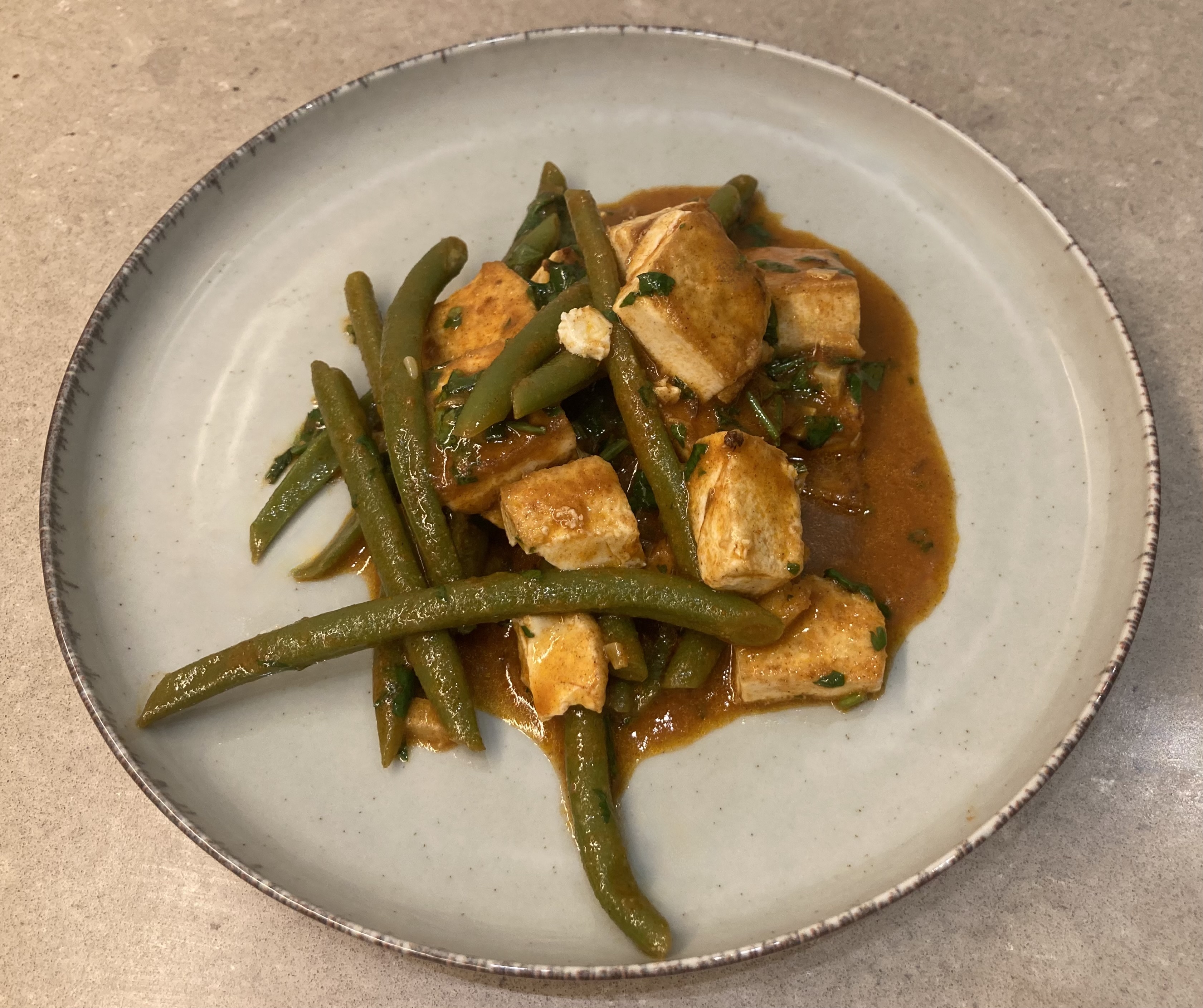
The tofu dish is a combination of French beans, flour, tofu, sunflower oil, dill, black pepper, salt and coriander. The chraimeh sauce is made with garlic cloves, sweet paprika, caraway seeds, ground cumin, ground cinnamon, green chilli, sunflower oil, tomato paste, caster sugar and lime juice. The result is tasty and flavourful, although, honestly, we think it would be better to leave out the tofu. Then you would have a very nice side dish. The chraimeh sauce will probably combine very well with fish. The recipe for this dish was published in the Guardian.

Okra

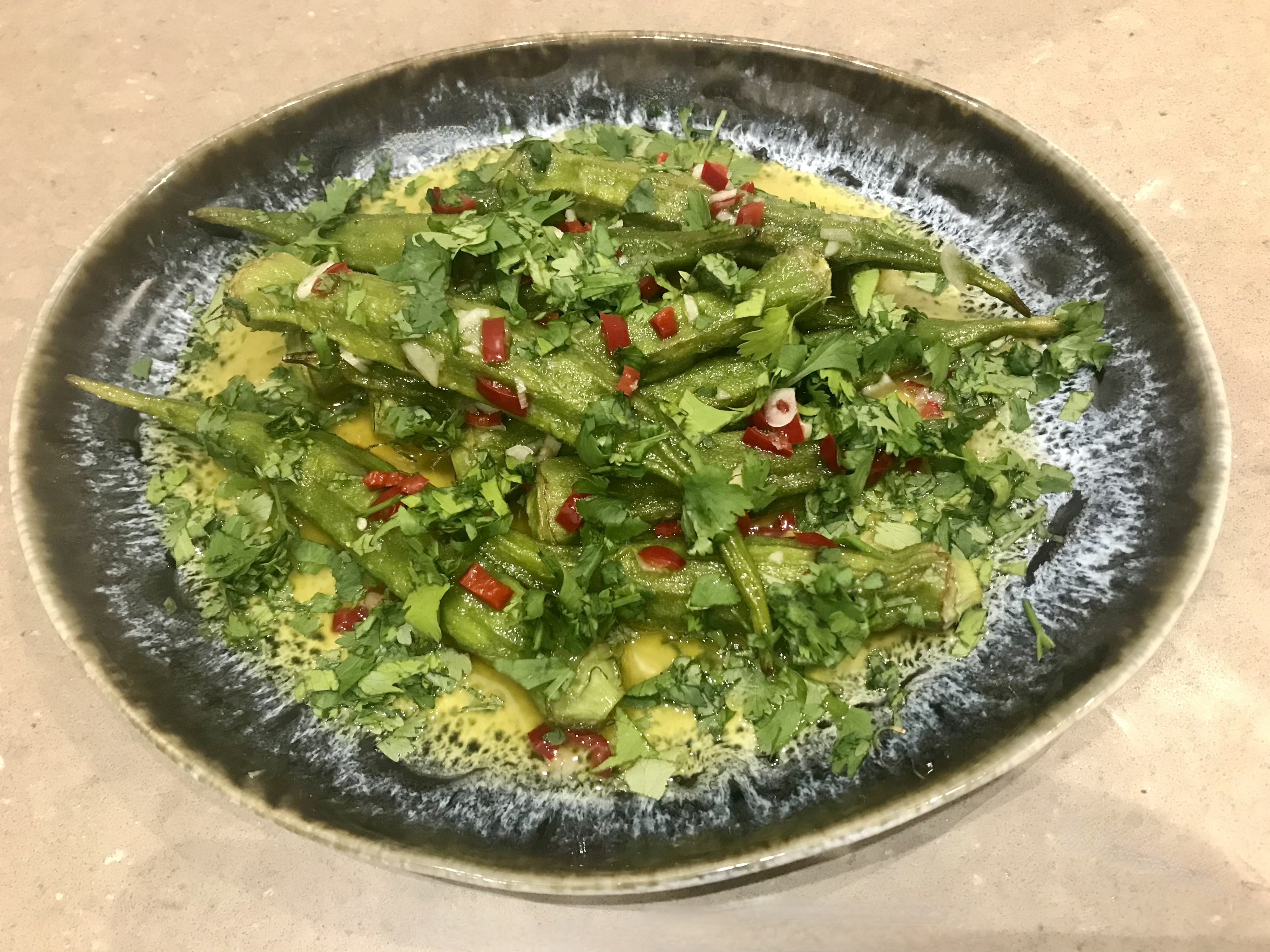
We love okra, so we were keen to make the salad. It’s a combination of okra, olive oil, garlic cloves, red chilli, sweet chilli sauce, maple syrup, lime juice, sesame oil, coriander leaf and salted roasted peanuts. We didn’t add peanuts. The salad was very nice and balanced with lots of flavours. One to remember. This recipe was also published in the Guardian.

The Book

We enjoyed both dishes, but we haven’t bought SIMPLE for a number of practical reasons. For instance, the vast majority of the recipes requires you to preheat your oven to 180 °C or 200 °C. Not something you’d like to do on a regular basis if you cook for 2 persons as we do most days. Another practical point is the size of his books: they simply don’t fit in our bookcase. Fortunately he has published many recipes on his website and there are 60 videos available via his YouTube channel.

Should SIMPLE be on your shelf? Probably yes if you’re looking for very tasty dishes, clear instructions, inspirational combinations and beautiful pictures. But we could also imagine that you’re happy reading his weekly recipes in the Guardian! SIMPLE is available via your local bookstore or via the well known channels for 20 US$ or 26 Euro.

The 2022 Johannes van Dam Prize

Today the program of the 7th Amsterdam Symposium on the History of Food closed with the Prize-giving ceremony of the 2022 Johannes van Dam Prize and the 2022 Joop Witteveen Prize. Previous winners of the prestigious Johannes van Dam Prize include Yotam Ottolenghi, John Halvemaan, Carlo Petrini, Alice Waters, Claudia Roden and Alain Passard.

Joop Witteveen Prize

The Joop Witteveen prize was awarded to Marleen Willebrands, Christianne Muusers and Alexandra van Dongen, authors of Het Excellente Kookboek van doctor Carolus Battus. This book focus on the culinary world of doctor Battus, who lived from 1539 until 1619. His cookbook was published in 1593.

Two publications were shortlisted: Dirk-Jan Verdonk, Dierloos: Een geschiedenis van vegetariërs en veganisten in Nederland and Ingrid de Zwarte, Hongerwinter.

Marleen Willebrands and Christianne Muusers

Johannes van Dam prize

The 2022 Johannes van Dam prize was awarded to Belgian Chef Jeroen Meus. He is well known for his inspiring daily TV program Dagelijkse Kost (Daily Food). In this 15 minutes program he shares the fun of preparing food, for instance crumble pie with pears and raisinsmonkfish with a mustard crust or penne with chorizo and red bell pepper. His aim is not to cook on Michelin Star level, his aim is to help everyone prepare tasty, good food, every day of the week. His books and website (in Dutch only) support this goal in a very helpful way.

Professor Louise O. Fresco, President of the Executive Board of Wageningen University & Research and chair of the jury, emphasised that Jeroen has a true talent to bring food and people together. She also highlighted his passion to prepare good food, and the fact that he shares that passion not only through cookbooks, but also via social media and a daily show on television. She mentioned he is an inspiration to all of us who love to cook and enjoy food.

Jeroen thanked the jury and all those who supported him over the years. He mentioned that he shared the love for meatballs with potato mash and endive (Chicorium endivia) with culinary journalist and food expert Johannes van Dam. He promised to prepare this dish next week on television, as a tribute to good food and to the prize.

And The Winner Is…

The 2022 Johannes van Dam prize will be awarded to Belgian Chef Jeroen Meus during the Amsterdam Symposium on the History of Food on February 11th. Jeroen Meus is well known for his inspiring daily TV program Dagelijkse Kost (Daily Food). In this 15 minutes program he shares the fun of preparing food, for instance crumble pie with pears and raisins, monkfish with a mustard crust or penne with chorizo and red bell pepper. His aim is not to cook on Michelin Star level, his aim is to help everyone prepare tasty, good food, every day of the week. His books and website (in Dutch only) support this goal in a very helpful way.

He is a true TV-chef in the sense that he is in contact with his viewers. He is entertaining, professional, funny and never arrogant. He balances traditional Belgian food with changes in our culture (more focus on vegetables, more variation, different cultures). His food reflects these changes and inspires us to follow his friendly culinary adventures.

The prize is named after culinary writer and critic Johannes van Dam who was not only known for his reviews of restaurants but also for his massive collection of books on food and drinks. The prize is awarded to individuals who have made an outstanding contribution to the dissemination of the knowledge on international gastronomy. Jeroen Meus, through his tv programs, books and website, has clearly done so. His cooking brings people together and broadens our culinary scope.

Previous winners of this prestigious prize include Yotam Ottolenghi, John Halvemaan, Carlo Petrini, Alice Waters, Claudia Roden, Harold McGee and Alain Passard.

Jeroen Meeus Atribution: Arne Aelterman, CC BY-SA 4.0 , via Wikimedia Commons
Jeroen Meus – attribution: Arne Aelterman, CC BY-SA 4.0 , via Wikimedia Commons

Symposium on the History of Food

Next year on February 11th and 12th, the 7th Amsterdam Symposium on the History of Food will take place in Amsterdam. You can also join online, for € 40,00 only. Lunch not included of course. This year’s theme is Food and the Environment: The Dynamic Relationship Between Food Practices and Nature

Program

The key note will be delivered by Ewout Frankema, Professor of Rural and Environmental History at the Dutch Wageningen University and research fellow of the UK Centre for Economic Policy Research (CEPR). Amongst the speaker are Christian Reynolds on The evolution of “sustainable” and vegetarian recipes from manuscripts and cookbooks to online and Amber Striekwold on The Dutch Alternative Food Movement.

Ceremony

On Friday 11th the program will close with the Prize-giving ceremony of the 2022 Johannes van Dam Prize and the 2022 Joop Witteveen Prize. Previous winners of the prestigious Johannes van Dam Prize include Yotam Ottolenghi, John Halvemaan, Carlo Petrini, Alice Waters, Claudia Roden and Alain Passard (see picture).

Join the Symposium

Additional information and the registration form are available on the website of the symposium.

Alain Passard speeches after having received the Johannes van Dam Prize 2019 © cadwu

Alain Passard Receives the Johannes van Dam Prize 2019

Symposium on the History of Food

On Friday November 15th and Saturday 16th 2019 the annual Amsterdam Symposium on the History of Food took place at the main auditorium of the University of Amsterdam. Such a pleasure to listen to great papers presented, discussing (post-) colonial foodways; creating, negotiating, and resisting transnational food systems. Two award ceremonies are part of the symposium.

Joop Witteveen Prize

Maarten Hell, author of De Amsterdamse herberg 1450-1800: geestrijk centrum van het openbare leven (published by VanTilt, Nijmegen, 2017) was the winner in the Academic category, the Joop Witteveen Prize. A book that discusses not only the history of food and drink as served in the inns in Amsterdam between 1450 and 1800, but also the development of what we would call hospitality.
The prize is named after culinary historian and author Joop Witteveen (1928-2016). Together with his partner Bart Cuperus and Johannes van Dam (see below) he founded the Dutch Gastronomische Bibliotheek (gastronomic library), now part of the historical collection of the University of Amsterdam.

Johannes van Dam Prize

Alain Passard received the prestigious Johannes van Dam prize. The jury, chaired by professor Louise O. Fresco (President of the Wageningen University & Research Executive Board), mentioned his impressive contribution to international cuisine. She highlighted that many years ago Alain Passard shifted towards vegetables, creating a new balanced cuisine, without banning fish and meat from his menu. The vegetables and fruit are organic and produced on his own three farms. His combinations and flavours are exceptional, just think about a side dish with haricots verts, almonds, white peach and basil.
His second important contribution to today’s cuisine is to introduce colour and art as elements of cooking, next to flavour, shape, odour, temperature and texture. His approach is unique and his recipes are a tribute to vegetables, fruit, flavour and colour.

The prize is named after culinary writer and critic Johannes van Dam (1946-2013) who was not only known for his reviews of restaurants but also for his massive collection of books on food and drink plus his passion for tasty, good food. Amongst his favourite dishes were the typical Dutch kroketten (‘croquets’ in French). Normally a cheap and fat snack, but Johannes van Dam was convinced that it is a true delicacy provided – of course – it is prepared the right way.
Mr. Passard was clearly very happy, proud and touched to receive the prize. In his speech he emphasized the importance of the season. He mentioned that nature is a cook book in its own right, one that is beautiful and should be followed.

We couldn’t agree more.

This slideshow requires JavaScript.

This Week was Special-A

This week on Friday and Saturday the annual Amsterdam Symposium on the History of Food took place at the main auditorium of the University of Amsterdam. Such a pleasure to listen to great papers presented, discussing the origin of umani or the history of Byzantine taste (presented by Anouk Everts). The key-note was delivered by Peter Klosse. He made many interesting points with regard to taste and flavour. His analysis of Mouth Feel is food for thought and discussion.
PS Garum as used in the Byzantine kitchen is a fish sauceIt is made from fermented fish (sardines for instance) and salt. It goes back to Roman times. Fun to make, actually….

Johannes van Dam prize

Yotam Ottolenghi received the prestigious Johannes van Dam prize. The jury, chaired by professor Louise O. Fresco, mentioned Yotam’s impressive contribution to current Dutch and International cuisine. The prize is named after culinary writer and critic Johannes van Dam who was not only known for his reviews of restaurant but also for his massive collection of books on food and drinks. Mr. Ottolenghi was very pleased to receive the prize (as you can see in the picture!)

Joop Witteveen prize

Antwerpen a la carte was the winner in the Academic category, the Joop Witteveen Prize. A book that discusses not only the history of food in the port city of Antwerpen, but also today’s role of a (hungry) city in the area of food production and consumption. Main authors are Ilja van Damme and Leen Beyers. The book is linked to an exposition at the MAS in Antwerp.
More information about the papers can be found on the website of the conference.