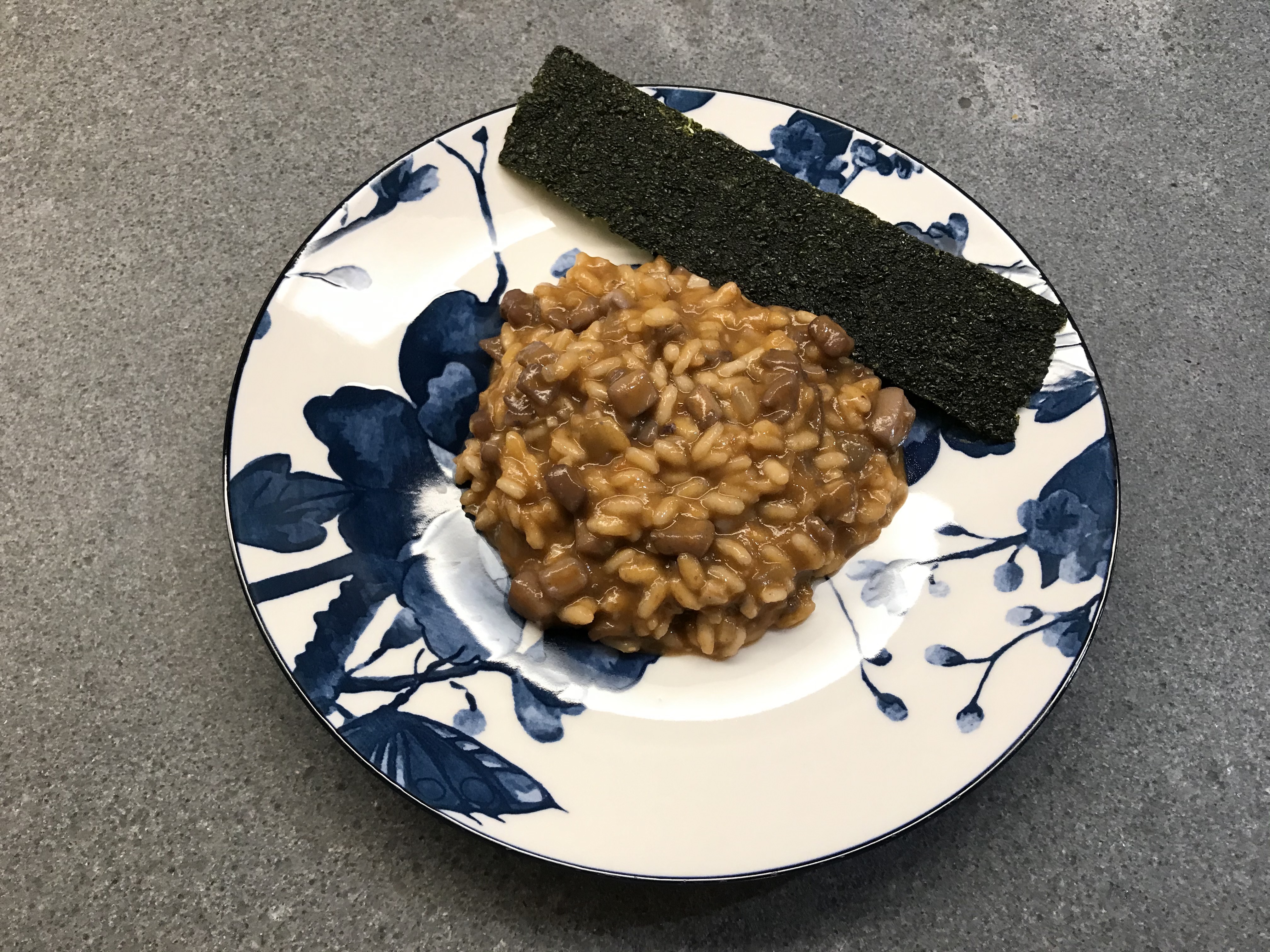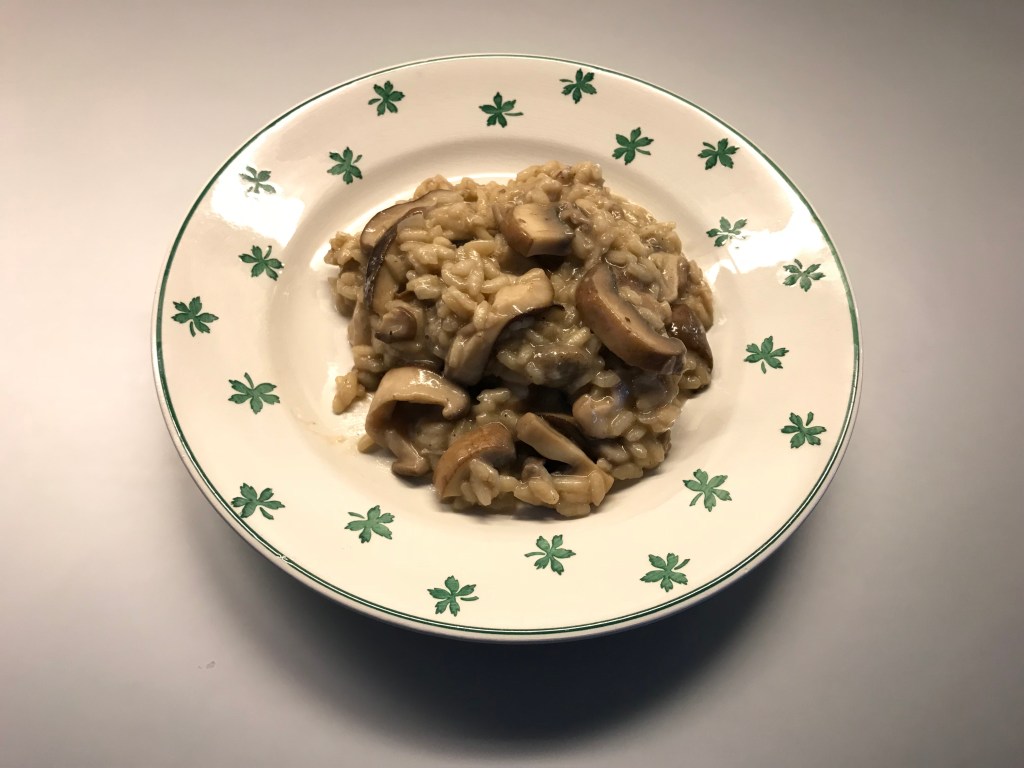
Risotto with Mushrooms

And on the 8th day he remembered he had forgotten to create food. So he quickly created something so simple, so tasty, so fulfilling that he knew people would still enjoy it, many, many years later. He called it Risotto.

Five Challenges When Making Risotto
  1. We’re always too busy! We are tempted to buy risotto rice that cooks quickly and can be served in under 10 minutes. Never rush a risotto!
    And by the way, what is so important that you don’t have 34 minutes to cook your own lovely, genuine, risotto? Why would quick be more important than tasty?
  2. And since we are too busy: why look for fresh cèpes if you can buy a pack of risotto rice with cèpes. Second mistake. You will not taste cèpes but a series of nasty E numbers and salt. Just look at the package! It will probably contain 0,01% of cèpes.
  3. We think risotto is too basic, so we’ve decided to prepare a luxurious version. Let’s add tomatoes, or salmon, or spinach and pumpkin, or chicken, or saffron, shrimps and peas. Please don’t. It will only ruin the lovely combination of rice, butter, stock and Parmesan cheese.
  4. Risotto is too heavy, too rich. Let’s use crème fraîche or Mozzarella and not Parmesan and not butter, let’s simply skip the butter. Fourth mistake: butter and Parmesan cheese are essential, for the taste, the mouthfeel and the consistency.
  5. Buy risotto-rice without checking if it’s the right rice. We use beautiful Carnaroli rice, superfine quality, produced by Acquerello. It doesn’t come cheap (we pay € 11,95 per kilo) but why would you not treat yourself to the best risotto rice? It has all the right qualities and the taste is outstanding.
Wine Pairing

We enjoyed our Risotto with a glass of Soave. Some acidity, touch of bitterness, nicely balanced with the butter and the cheese. It’s light and fruity; it elevates the risotto.

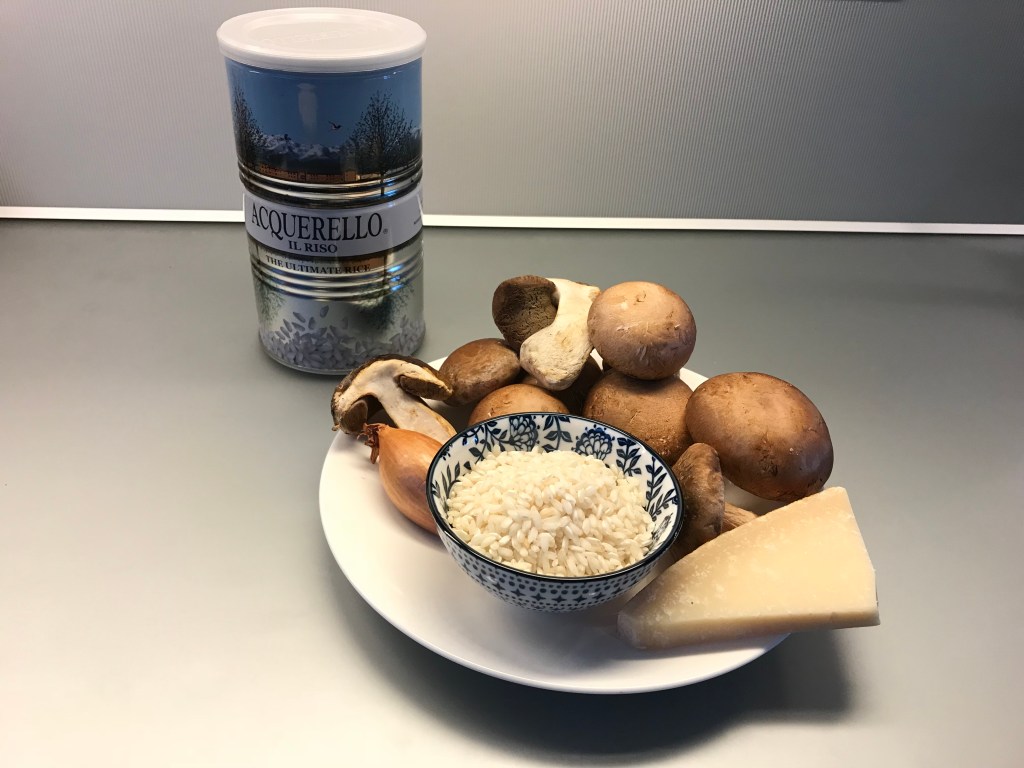
What You Need
  • 70 grams of Acquerello rice
  • 1 Shallot
  • Butter
  • Olive Oil
  • 100 gram of Shiitake
  • 200 gram of mushrooms, for instance Chestnut Mushrooms
  • optional: 100 gram of Cèpes
  • Chicken Stock
  • Parmesan Cheese
What You Do
  1. Peel and chop the shallot
  2. Add butter and olive oil to the pan and glaze the shallot
  3. In parallel clean and slice the various mushrooms. Feel free to use other mushrooms as well. We think the Shiitake is an important one because it adds depth to the taste
  4. Bring the stock to a boil
  5. After 5 minutes add the mushrooms to the pan and fry gently for 5 minutes
  6. Add the rice to the pan and coat the rice for 2 minutes
  7. Start adding the stock, spoon by spoon and stir the rice frequently
  8. When using Acquerello rice it takes 18 minutes
  9. Check the rice
  10. When okay, transfer the pan to the kitchen counter top and leave to rest for 2 minutes.
  11. Add chunks of butter, stir, add a bit more butter and the grated Parmesan cheese
  12. Stir, a bit of black pepper, add more butter or Parmesan cheese if so required
  13. Serve immediately.

Insalata Caprese

Tomatoes

In 2013 the German culinary press characterised Dutch tomatoes as ‘wasserbomben’, let’s say ‘water balloons’. And they were right. Even more so, many tomatoes were, and still are, tasteless and watery. And since the Netherlands are in the top 3 of tomato exporting countries, you run the risk of buying a red balloon. Which is of course not what you want to do. So if you plan to make one of the simplest and tastiest starters ever, you have to find the best tomatoes ever. Or grow your own of course.

Mozzarella

Meaning Buffalo mozzarella, made from the milk of the Italian buffalo. Since 1993 it’s a DOP (Denominazione di Origine Protetta) and protected under EU law. It’s a young, moist, tasty cheese with a lovely soft, elastic but not chewy texture and it comes with a skin as a result of the shaping and pickling. The taste is more robust than mozzarella made from cow milk and it’s ideal for a salad. The cow version is best used for cooking. The smoked version should be ignored.

Basil

Someone should write ‘The Case of the Dying Basil’. A whodunit in which a clever detective will reveal why the basil plant you buy from the green grocer or supermarket will very likely die within 3 days, regardless what you do. And since they always die on us, we buy ‘fresh’ leaves.
The most used variety of basil is sweet or Genovese basil. Others are Thai basil (slightly spicy with a hint of anise) and red (or purple) basil (similar to sweet basil but more powerful). Alain Passard’s book Collages et Recettes includes a recipe for purple carrots with purple basil and cinnamon. Wonderful colours and a delicate taste.

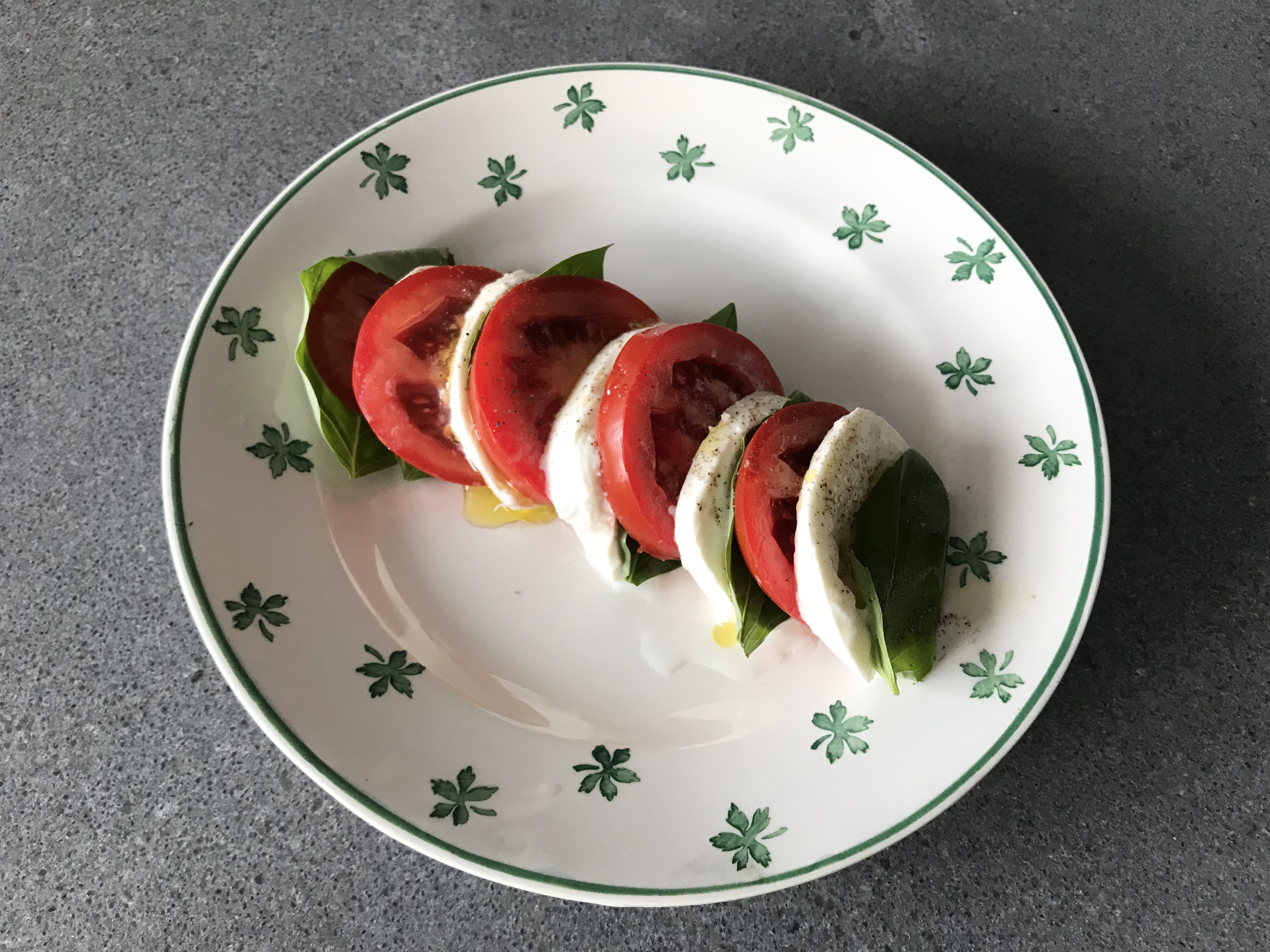
Insalata Caprese

This salad stands or falls on the quality of the ingredients. And it requires the talent to keep things simple, so you have to stick to the 5 (five!) ingredients, meaning tomatoes, mozzarella, basil, olive oil and pepper. The salad does not come with balsamic vinegar, lettuce, pineapple nuts, salt, honey, croutons, oregano, mustard or a vinaigrette. Five ingredients. That’s it.
You wonder why? Because this way the Insalata Caprese is at its best. Tasty, sweet, rich, moist, fresh and a reflection of Italy and of summer. Adding an ingredient will worsen the concept of the salad and reduce its taste.

Wine Pairing

We suggest an excellent rosé, one with flavour and depth. For instance Monte del Frà Bardolino Chiaretto 2018. You’re looking for a wine with delicate scents of berries accompanied by light and refreshing hints of green apples and subtle spicy tones. On the palate the wine should reveal juicy sensations of red berries along with an appealing and refreshing acidity.

What You Need

  • Two Excellent Ripe Tomatoes, chilled
  • One Ball (125 gram) of Excellent Buffalo Mozzarella
  • Fresh Basil
  • Excellent Olive Oil
  • Fresh ground Black Pepper

What You Do

Slice the (chilled) tomatoes, slice the mozzarella and create the ‘tricolore’. Add fresh black pepper and drizzle generously with olive oil.

Insalata Caprese © cadwu

Panna Cotta

Such a lovely and simple dessert! Provided of course it’s made the right way. So no milk, no yoghurt, no cream cheese, no whipped cream and most certainly no whipped egg white! Just cream. Cooked Cream. And preferably cream with lots of fat because then you will need less gelatine.
You can serve the panna cotta after a few hours (or the next day) with a rich strawberry or raspberry sauce, but we prefer to enjoy the panna cotta with a bit of candied orange zest, simply because we want to balance the sweetness and richness of the panna cotta with the acidity and bitterness of the orange. Home made is preferred, see the recipe for an Orange Flan.

What You Need (For 4)

  • 500 ml fresh Cream
  • 3,5 leaves of Gelatine (5,25 grams)
  • 1 Vanilla Bean
  • 25 gram Sugar
  • Candied Orange

What You Do

The recipe is for 4 panna cotta (actually should we say 4 panne cotte).
Slowly bring the cream to the boil. Add the seeds of the vanilla but also add the remainder of the bean. Now keep close to boiling for 15 minutes. Stir when necessary. Remove from the heat and while stirring add the sugar until totally resolved. Now pass through a sieve to make sure you remove all the bits you don’t want. Follow the instruction of the gelatine and add the leaves. Stir well until homogeneous. Cool the liquid somewhat before filling the forms. We used a silicone mold. Nice and easy! The only thing you need to do is to make the mold a bit moist with water. Let the panna cotta cool and then store in the refrigerator until set. Don’t forget to seal with cling foil, otherwise your panna cotta will absorb aromas from other food in the refrigerator.

Panna Cotta © cadwu
Panna Cotta © cadwu

Antonio Carluccio

Inspiration

Sadly Antonio Carluccio passed away this week on Wednesday November 8th 2017. To us he has been a true inspiration, especially when it comes to mushrooms. Thanks to him we started to explore a wide variety of mushrooms, such as Ceaser’s mushrooms and Pied Blue. His books on mushrooms showed us the world beyond the classics mushroom recipes. Every year we prepare his oysters with sabayon and white truffle. Pure magic.

Carluccio also showed us that you need to be a chef to create Michelin star worthy food, and that you need to be a decent cook to create tasty and healthy daily food. A combination of olives, pancetta, cheese, artichokes and a glass of red wine is a great way to start your meal and will only take you a bit of shopping and 5 minutes to present the food. And reading his books: you can learn how to be a decent cook.

MoF MoF

He said his motto was “mof mof” – minimum of fuss, maximum of flavour. No doubt a lot of hard work is required to reach that level, but let us assure you: it’s a great motto for daily cooking.