Quails and Snails in a Green Sauce

Many years ago we were looking for a place to eat in Fréjus. It was our last evening in France before returning home and obviously we were looking for something special, something typical Provençal. The area of our hotel wasn’t very promising, so we were ready to settle for pizza until we saw a small restaurant with a very interesting menu. It offered Tisane de RomarinCailles et Escargots and many other exciting dishes we unfortunately can’t remember. We entered the restaurant and had a perfect evening.

Combining quails and snails isn’t the most obvious idea, but rest assured, it works beautifully, also thanks to the very intriguing green sauce. It took us some time to make the sauce as it should be, but after a few attempts we think this is the right bridge between the quails and the snails.

Of course, we made a note of the name of the restaurant and of course, we lost it. A pity, although preparing this dish brings us back to a lovely evening in Fréjus.

Wine Pairing

Enjoy your Quails and Snails with a glass of Bourgogne: a chardonnay with a touch of oak. The wine must be dry, mineral and medium bodied. We enjoyed a glass of Bourgogne as produced by Louis Jadot. The wine partly matured in stainless steel tanks and partly in oak barrels. The result is a wine that has citrus and apple aromas in combination with oak and vanilla. Great with the freshness of the herbs and the richness of the sauce. It balances very well with both the quails and the snails. Two sides to everything in this dish!

What You Need

  • 2 Quails 
  • 6 Snails (click here when you want to know which snail to buy)
  • For the Sauce
    • 1 Bunch of Parsley
    • ½ Bunch of Tarragon
    • A few Leaves of Young Spinach
    • Cream
  • Vegetable Stock
  • Olive Oil
  • White Pepper

What You Do

Wash the snails with plenty of water. Set aside. Clean the quails. Best is to use the breasts only. (You could also serve the legs, provided you remove the main bone. It’s a bit of extra work, also for your guests.) Make sure you have a warm heavy iron skillet ready and a small pan with warm vegetable stock. Set your oven to 60 °C or 140 °F.

Blanch parsley, tarragon and spinach in boiling water and cool immediately in ice water. Blender parsley, tarragon and spinach with some ice water until you have a very smooth green liquid. Set your blender to turbo! Press using a sieve and store the green liquid. It will remain stable for at least an hour.

Fry the breasts quickly in olive oil. Warm the snails in the vegetable stock. Transfer the breasts to the warm oven. Clean the pan with kitchen paper, add cream and chicken stock. Let reduce for 5-10 minutes or until you’re happy with the consistency. Add liquid from the quails. Stir and taste. Perhaps some white pepper? Add green liquid until you have the right colour and taste. Be very careful, if you overheat the sauce it will lose its vibrant green colour. Serve the breasts and the snails in the sauce.

Quails and Snails in a Green Sauce ©cadwu

The King of Chefs

He was born in the Rue du Bac (Paris) in June 1784. Today a fashionable street, well known to many because the prestigious department store Le Bon Marché is located on the corner with the Rue de Sèvres. In his days the area was a swamp with housing for the very poorest of Paris.
He was named after Queen Marie Antoinette, which wasn’t a great idea because she was beheaded only 9 years later during the peak of the French Revolution. He changed his name to Antonin and later he would sign his books and menus with Antonin Carême de Paris.

Abandonded

When he was only ten years old, his father left him at one of the gates of Paris. Fortunately, he was picked up by the owner of one of the many Parisian chophouses. This is where he learned his first cooking skills. Six years later he started with the famous Pâtissier Sylvain Bailly. He became a Master of Pastry, Sugar and Pâtisserie in general. It wasn’t long before his talent was recognised by the influential statesman Talleyrand.

As a young man Antonin Carême would spend his free afternoons at the library, studying and researching ancient recipes and (Greek and Roman) architecture. He became an expert in drawing, a skill he used to design and create pièce montéesextraordinaires, huge table pieces made from sugar, reflecting a roman temple, a Greek building, a fountain etcetera. These extraordinaires could be used to serve food, but more importantly they were elegant masterpieces. In some cases, it took him 6 weeks to create a pièce montée.

Author

He made notes of everything he prepared and published various cookbooks (that sold very well). His aim was to explain how to prepare a dish, not to impress the reader. The cookbooks include his own beautiful drawings and many detailed menus. Amongst his creations are over 100 soups and the delicious Charlotte Russe. He perfected and popularised Mille-Feuille, Vol Au Vent and Croquembouche. He is one of the three main chefs of the Haute or Grande Cuisine (the others are François-Pierre de La Varenne and Auguste Escoffier). He was one of the first to study how to combine wine and food. As part of the systematisation of French cuisine he introduced the four main sauces: Béchamel, Velouté, Espagnole and Allemande.

Cooking For Kings

In his inspiring book Cooking For Kings, The Life of Antonin Carême, The First Celebrity Chef, author Ian Kelly introduces us to the live of Antonin Carême. In a very easy to read, inviting way he shows us how Carême developed from a poor boy into a culinary, artistic talent. One that not only influenced his own generation but also many to come. His focus on detail, hygiene, the use of fresh ingredients and aesthetic presentation is still very much part of today’s kitchen.

Cooking For Kings, the live of Antonin Carême is a tribute to a devoted, extremely talented chef. The book includes several very interesting recipes, for instance gâteau pithivier and cold salami of partridges. Perhaps old school, but nevertheless worth trying!

PS

We’re still looking for a hard copy of French Cookery: comprising L’Art de la Cuisine Francaise; Le Patissier Royal; Le Cuisinier Parisien (translated by William Hall; published in London, 1836). Anyone? Thankfully the book has been digitised!

Escargots de Bourgogne

We noticed that more and more supermarkets and shops sell snails. Canned, frozen or with garlic butter ready to be cooked in the oven, all very tempting. Snails are high on protein, low on fat, high on minerals, low on calories. A glass of white wine and some crusted bread; what more do you need as a healthy starter?
But before buying snails it’s important to look at the label and find out what kind of snail you’re buying.

The snail used for the classic Escargots de Bourgogne is called Helix Pomatia. It’s protected in many countries. Farming of this snail is not profitable. Excellent taste, expensive and hard to find.
There are three alternatives: Helix Aspera (either the small one called Petit Gris or the large one called Gros Gris) and Helix Lucorum. The last one is considered to be less tasty than the other three, but when prepared well, it’s a very nice, affordable alternative. All three can be farmed.

It could also say Achatina on the label. This is a different kind of land snail, much larger than the first four. It’s taste and texture are okayish.

Sometimes it simply says ‘Escargots’ and ‘Gros’ on the tin. Sounds good, doesn’t it? Well, it may and it may not. Some companies cook larger (sea) snails, chop these, and sell the chunks as ‘Escargots’. The term ‘Gros’ is supposed to make you think of the Gros Gris. Don’t be fooled: they are rubbery, tasteless and a waste of money.

The classic Escargots de Bourgogne are prepared with butter, garlic and parsley. We like to add a bit of tarragon and a pinch of salt. Traditionally they are served in the shell and you need a tong and a special fork to eat them. The ones we use are from a can, so no special equipment required. 

Wine Pairing

The obvious choice is a glass of Bourgogne: a chardonnay with a touch of oak. The wine must be dry, mineral and medium bodied.

What You Need

  • 12 snails
  • Butter
  • Parsley
  • Garlic
  • Tarragon
  • Salt
  • 2 Snail Plates

What You Do

You could of course buy fresh snails (which makes us think of the amazing market in Valencia! So much choice, such excellent quality. Also various kinds of snails, fresh and alive, obviously, also the Caragolus, the snail that is required when you prepare a traditional Paella Valenciana) but otherwise buy them canned. Remove them from the can, wash carefully with lots of water and set aside.

Chop parsley, tarragon and garlic very fine. Using a fork, combine butter, herbs, garlic and a pinch of salt. Transfer six snails to a snail plate, add a chunk of butter to every snail, transfer the snail plate to an oven at 160 °C or 320 °F for 10 minutes or until boiling hot. Serve the snail plate on a cool plain white plate.

Escargots de Bourgogne ©cadwu

Eggs Poached in Tomato Sauce

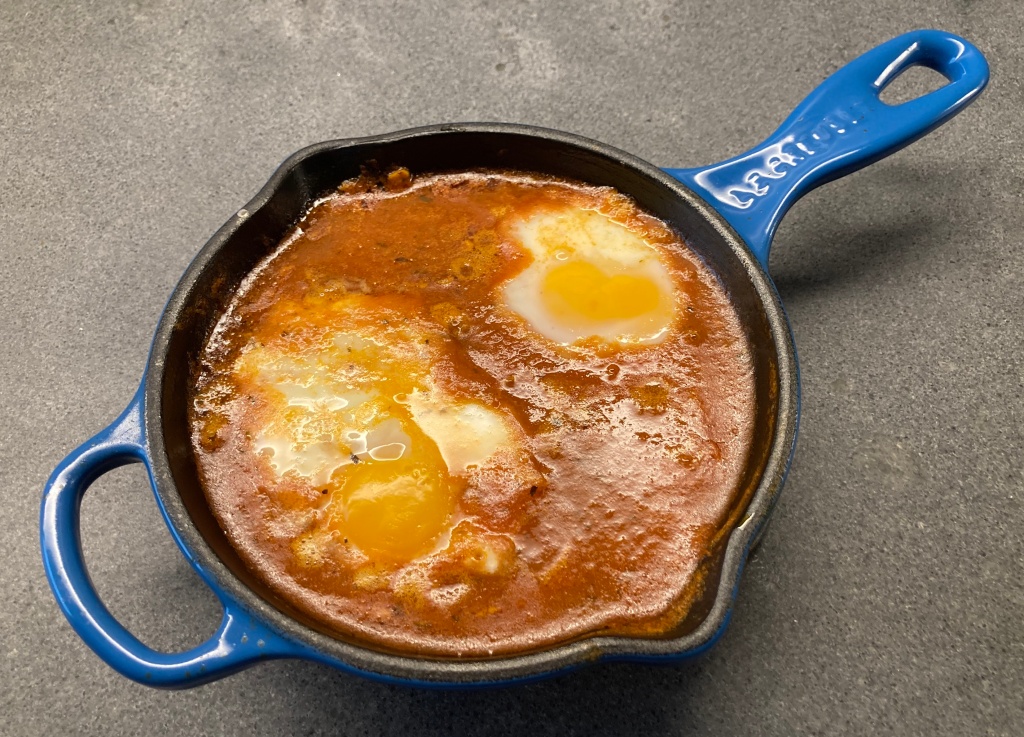
Poaching eggs in water requires a bit of technique or a nice tool. Poaching eggs in tomato sauce is slightly different: you want to keep the white close to the yolk, but it should not envelope it: the yolk must remain visible.

The combination of tomato sauce and egg seems to be a bit odd, but the rich, runny egg in combination with the slightly acidic, aromatic tomato sauce is really nice. Great suggestion for lunch or a hearty breakfast. Feel free to create your own version of this dish, for instance by adding some parsley or cheese. Serve with crusted bread.

In most cases the result is shown in a pan. For good reasons: it does not look very attractive when served on a plate. The fun is definitely in the flavours and aromas.

What You Need

What You Do

Warm the tomato sauce and reduce. Increase the heat until the sauce is nearly boiling, gently add the eggs (as you would do when poaching eggs in water) and reduce heat. Using a small spoon make sure the white remains close to the yolk, without covering it. Wait until the white is set. Perhaps add some freshly grounded black pepper.

Eggs Poached in Tomato Sauce ©cadwu

Sauce Provençale

Based on one of the leading (mother) sauces this is a quick, tasty and uplifting sauce with olives, capers and Herbes de Provence. The success of this sauce depends on the use of the intense, flavorful classic tomato sauce. Sauce Provençal has a good structure and comes with a variety of flavors, making it very much an accompaniment for grilled chicken or fish. If you use modern tomato sauce, then the result will be nice, but not as spectacular.

Herbes de Provence is a mixture of dried herbs such as oregano, thyme, rosemary, savory and perhaps sage and lavender. Feel free to create your own mixture. If you buy a ready-made mixture, make sure it has character, aromas and structure.

What You Need
  • Classic Tomato Sauce
  • One shallot
  • Two Tomatoes
  • One Glove of Garlic
  • Teaspoon of Herbes de Provence
  • Capers
  • Black Olives
  • Olive Oil
  • Black Pepper
What You Do
  1. Peel the tomatoes, remove the seeds and cut in small cubes
  2. Finely chop the shallot
  3. Wash and drain the capers
  4. Crush the garlic
  5. Slice the olives in two
  6. Heat a heavy iron skillet and gently glaze the shallot
  7. Add tomatoes, garlic and herbes de Provence
  8. Leave on low heat for 5 minutes
  9. Add the classic tomato sauce, the capers and the olives
  10. Leave for 5-10 minutes
  11. Stir the mixture gently
  12. You want to keep the structure of the tomatoes
  13. Taste and perhaps add some black pepper
Sauce Provençal with Grilled Chicken ©cadwu

The Art of Sauces: Classic Tomato Sauce

This recipe goes back to the days of Antonina Latini who published a recipe for a tomato sauce in his Lo Scalco alla Moderna (The Modern Steward, or The Art of Preparing Banquets Well) in 1692. Marie-Antoine Carême wrote about Latini’s recipes and Auguste Escoffier positioned the sauce as a leading (mother) sauce.

The sauce is different from a modern, vegetarian tomato sauce, for instance because one of the ingredients is salted pork, which obviously brings saltiness and depth to the sauce, in a very natural way. 
The sweetness of the tomato is supported by carrots, onions and various herbs, making it a much more complex sauce. The flavours and aromas of the tomatoes benefit from the rich and tasteful context. This also supports the concept of a leading sauce: you can use it as a starting point for other sauces.
The texture of the sauce (it’s not smooth) in combination with the fat creates a very pleasant mouthfeel.

Sauce Tomate has many derivatives, such as Sauce PortugueseSauce Marinara and even Ketchup. In one of our next posts we will describe how to make Sauce Provençal and Oeuf à la Provençal (eggs poached in tomato sauce).

What You Need

  • 200 grams of Salted Organic Pork (not smoked)
  • ½ Leek
  • 1 Carrot
  • 1 Celery Stalk
  • 1 Shallot
  • 2 gloves of Garlic
  • 4 – 6 Excellent Ripe Tomatoes
  • White Stock (Veal preferably)
  • Bouquet Garni (Parsley, Thyme, Bay Leaf, Rosemary)

What You Do

  1. Start by cleaning and chopping the vegetables
  2. Wash, dry and dice the salted pork
  3. Render the pork meat on medium heat in a Dutch oven
  4. Once lightly coloured add the leek, carrot, celery and shallot
  5. Allow to cook for 5 to 10 minutes
  6. You’re looking for a bit of colour, but not too much
  7. Add the tomatoes and the garlic
  8. Once warm, wait for a few minutes before adding some white stock
  9. This is a tricky part: if you add too much stock your sauce will be thin. Therefore some recipes suggest adding flour. We decided against it because we want a natural consistency
  10. Now it’s a matter of simmering, either in the oven or on low heat
  11. Allow to simmer for 90 minutes.
  12. Remove the pork meat from the sauce
  13. Pass the sauce through a sieve, making sure you capture all those lovely juices
  14. It’s hard work, but the remainder in your sieve should be as dry as possible.

Beaujolais Primeur 2021

Beaujolais Primeur or Nouveau is made from the Gamay grape, using a technique called macération carbonique. The result is a fruity, light red wine, with little or no tannins. One that can’t be stored for too long. It was (and is) a very popular wine in many a French Bistro, served and enjoyed with lunch.

Over the years we became used to the idea of drinking the first French wine of the year and we started to pay more attention to the quality, only to notice that actually most of the primeur wines were thin, with a bit of acidity but without depth or length.

Today we will open a bottle of Jean-Paul Brun Terres Dorées Beaujolais L’Ancien Primeur 2021. Jean-Paul Brun is a serious and excellent producer of beautiful, tasty Beaujolais wines. We’re sure this primeur will be pure pleasure and a true indication of the quality of the Beaujolais wines this year.

Food Pairing

We will enjoy our Beaujolais Primeur with Confit the Canard and Roasted Seasonal Vegetables.

Beaujolais Primeur at The Art of Wines, Amsterdam ©cadwu

Fleurs de Courgettes Farcie

Such a pleasure to see courgette flowers in your garden or at the greengrocers. The young courgette is firm and tasty; the flowers a beautiful yellow. Simply stuff the flowers, fry in a pan or cook in the oven and you have a great side dish or starter. And then you start wondering: ‘Stuff with what? Cheese? Salmon? Mushrooms? Tomatoes? Ricotta? Vegetable Mousse?’
Earlier we described a simple, tasty vegetarian version. This recipe requires a bit more work, but the result is delicious and beautiful. Crab and courgette go together very well; it’s a well balanced combination with surprisingly delicate flavors.

Wine Pairing

Obviously a nice glass of Côtes de Provence Rosé is an excellent choice. But you could also go for a white wine, for instance a Macon-Villages as produced by Bouchard Père & Fils. In general a subtle wine that goes well with the gentle flavors of both the crab and the courgette.

What You Need
  • One Courgette (small and firm)
  • One Garlic Clove
  • Olive Oil
  • Six Small Courgettes with their flower
  • Crab
  • Black Pepper
What You Do
  1. Wash the courgette, dry and grate coarsely
  2. Warm a small cooking pan, add olive oil and the grated courgette
  3. Fineley grate the garlic and mix with the courgette
  4. Leave for 20 minutes minimum on low heat
  5. When ready, set aside and let cool.
  6. Best is to use a leg of a fresh (littoral) crab, but you could also buy a can of most excellent crab
  7. If using fresh crab, heat a pan with water, bay leaf and crushed black pepper corns; cook the crab for 10 minutes, remove from the water, set aside until cooler and then remove the meat from the shell. Be sure to remove all shards of shell. Set aside and let cool.
  8. Remove the stamens from the flowers
  9. Remove the end of the small courgette
  10. Use a very sharp knife to slice the courgettes lengthwise in 3, making it look like a fan
  11. Heat water in a pan and poach the small courgettes (not the flowers!) for 60-90 seconds depending on the size
  12. Add some crab meat to the courgette mixture and taste
  13. Keep adding crab until you’ve reached the perfect combination (or the end of the crab)
  14. Add some black pepper
  15. Stuff the flowers
  16. Close them by slightly twisting the leaves of the flower
  17. Sprinkle with olive oil, making sure they are completely coated with oil
  18. Heat your oven to 200° C or 390° F
  19. Using the broiler is a good idea
  20. Transfer to the oven and cook for 10 minutes
  21. The flowers should be crisp and perhaps a touch golden
  22. Allow to cool for a few minutes before serving.

Ratatouille

Think summer vegetables, think Ratatouille! Which is also the title of a film released in 2007 about a rat called Remy with a passion for cooking. If you want to see how he prepares ratatouille then simply go to YouTube (or buy the DVD if you’re old fashioned like us).
Ratatouille brings back memories of summer, of the South of France, of the Mediterranean. It combines very well with a simple sausage, with lamb, with grilled chicken.
However you prepare your ratatouille, be sure to prepare it a day ahead. The taste becomes much more integrated after a day (or two) in the refrigerator. Unfortunately it doesn’t freeze well due to the eggplant.

Our recipe is very much the recipe of a dear friend. She taught us how to make ratatouille in her summer kitchen, overlooking the pool and the garden with herbs and vegetables. Indeed, fond memories.
To our surprise she added cilantro (you would expect thyme or basil) and many years later we are still grateful for this twist. The cilantro enhances the feeling of summer and it supports the various vegetables in a beautiful way.

Wine Pairing

We enjoyed our ratatouille with a glass of simple, red wine with lots of red and black fruits. Spicy with subtle tannins. A wine that brings summer to your glass. A glass of Syrah from the Languedoc-Roussillon are will be perfect.

What You Need (4 people)
  • 1 Eggplant or Aubergine
  • 1 Courgette or Zucchini
  • 1 Red Bell Pepper
  • 1 Chili Pepper
  • 4 Excellent Tomatoes
  • Cilantro
  • Olive oil
What You Do
  1. Cut the aubergine in small but not too small chunks
  2. Drizzle with salt and mix
  3. Let the mixture rest for a few hours, allowing for the aubergine to loose water and become firm. Best way to do this is by putting the aubergine in a sieve and let it rest above a bowl
  4. The tomatoes require some attention as well. You could peel them, but that’s optional. What is not optional is to separate the tomato meat and juices from the pits. First step is to remove the internal hard bits and the pits and put these aside. You now have the outer part of the tomato, which you can slice. Cut the remainder of the tomatoes roughly, add to a sieve and by using the back of a spoon make sure you capture the juices. Be surprised about the volume of tomato juice and the small amount of tomato bits and pits that remain in your sieve.
  5. Cut the bell pepper into long slices and fry these in the pan with olive oil
  6. Peel the courgette, slice in the way you sliced the aubergine and add to the pan. Continue frying
  7. Add the finely chopped chilli pepper (not the seeds of course)
  8. Add the firm aubergine after having removed the remaining salt with water
  9. After a few moments add the tomato chunks, fry a bit more, add the tomato juice and leave on low to medium heat for 60 minutes
  10. Try not to stir too much; otherwise you risk creating mashed vegetables
  11. Cool, set aside and store in the refrigerator
  12. The next day: if you have excess liquid, remove the vegetables from the liquid, reduce it until thickened and transfer the vegetables back into the pan. Otherwise gently warm the ratatouille, add some chopped cilantro, mix gently and add more cilantro just before serving

PS

Many years later we found the ‘original’ recipe of Ratatouille in Nice.

Ratatouille ©cadwu
Ratatouille ©cadwu

Daube Provençale

On a warm summer’s evening, sitting on your terrace, relaxing and sipping rosé, you wonder what to eat. Perhaps something that will make you think of the beautiful Cote d’Azur, with the chirping of cicadas and aromas of pine trees? A Salade Niçoise or something more substantial?
That’s the moment to dive into your freezer and look for that last portion of Daube Provençale. Excellent beef, stewed in red wine and packed with flavours, olives and mushrooms.

Fortunately preparing Daube Provençale is not too much work (and it keeps well in the freezer). You can also be fairly flexible with the recipe. Well known chef Hélène Barale (La Cuisine Niçoise, Mes 106 Recettes) uses beef, veal and pork with tomatoes and dried mushrooms, Hilaire Walden (French Provincial Cooking) suggests marinating the beef in red wine and also adds orange peel and olives whereas the classic La Cuisinière Provençale published in 1897 and written by Jean-Baptiste Reboul suggests adding vinegar to the marinade but doesn’t use tomatoes, mushrooms or olives.

Wine Pairing

We prepared our daube with red wine from France, made from Cabernet Franc grapes and produced by La Tour Beaumont. In general you need a full bodied, fruity red wine, with a good structure. You could of course enjoy the daube with the same red wine, but the daube is flexible. Just remember that the flavours and aromas are intense. 

What You Need (for 4)
  • 750 grams of Excellent Marbled Beef (Blade Steak for instance)
  • ½ Carrot
  • Shallot
  • 3 Garlic Gloves
  • 250 grams of Mushrooms
  • 50 grams of Black Olives (Kalamata or Taggiasca)
  • Olive Oil
  • Bouquet Garni (Bay Leaf, Thyme, Oregano, Rosemary, Parsley, Chives and/or Sage)
  • 500 ml Red Wine
What You Do
  1. Slice the meat into nice, big cubes
  2. Heat a heavy large pot through and through, add olive oil and fry the meat until brown
  3. Probably you need to do this in two or more batches
  4. Set the meat aside
  5. Fry the chopped shallot, the carrot and the garlic until smooth
  6. Transfer the meat to the pot, stir well, add the red wine, the (halved) olives and the bouquet garni
  7. Keep on low heat for 2 hours
  8. Clean the mushrooms and add these to the pan
  9. Keep on low heat for another two hours
  10. Check if the meat is soft and tender
  11. Quickly cool the pot and transfer the content to the refrigerator
  12. The next day label off some of the fat (we prefer not to do this, but feel free to do so)
  13. You could divide the daube in two portions. One for the freezer, the other one to enjoy today
  14. Warm the daube
  15. Option 1: remove some of the bigger mushrooms and four tablespoons of cooking liquid. Blender the liquid and mushrooms very fine and transfer back to the pan. This mixture will thicken the cooking liquid
  16. Option 2: combine 15 grams of flour with 15 grams of butter until it’s a smooth paste. Add this to the daube, making sure it’s fully dissollved. This way of thickening is called Beurre Manié
  17. Leave the daube to gently simmer for an hour.
  18. If the sauce has not yet reached the right consistency, then transfer cooking liquid to a separate pan and reduce on medium to high heat. Transfer back to the main pan and combine.
  19. Serve with red bell pepper salad, pasta, polenta or boiled potatoes.
  • Daube Provençale ©cadwu
  • Ingredients of Daube Provençale ©cadwu
  • Daube Provençale ready to be stewed ©cadwu