Quail with Pruneaux d’Agen, Sage and Olives

Quail

We love our quails! They have a delicate taste, but they also allow you to add strong flavours like sage, bay leaf or black olives. We prefer small and tasty black olives (in oil) for instance Taggia olives from Italy. Prune-wise Pruneaux d’Agen are ideal, but in general the prune should be moist, sweet and full of flavours.

Wine Pairing

A medium bodied red wine, not too complex, will work very well; for instance a Shiraz. We enjoyed our quail with a glass of Puech d’Hortes from La Colombette made from syrah and grenache grapes. The wine should balance with the sweetness (sage, Pruneaux d’Agen), the nutty character of the pancetta and the bitterness of the olives and the sage.

What You Need

  • 2 Quails
  • 50 grams of Pancetta
  • Sage (fresh, 6 leaves or so)
  • 6 Pruneaux d’Agen
  • 10 or more Black Olives
  • Olive oil
  • Butter

What You Do

Make sure the quail is sufficiently fat, not damaged and not frozen. Clean the inside of the quails with kitchen paper and remove anything that’s left. We prefer it if the head is still attached to the body. This allows you to use the skin of the neck, after having removed the head and the spine. Cut 4 prunes, the pancetta, the sage and the olives in smaller bits and mix together. Now stuff the quail with the mixture and finish with a prune. Use kitchen string to close the quail. Pre-heat your oven to 220° Celsius or 430°  Fahrenheit. Put the quails in a skillet with olive oil. Put some butter on top of the quail. Make sure the breast is downward facing. This way the fat will go towards the breast, making sure these are nice and moist. Put in upper half of oven. After 10 minutes turn the quails and label fat over the breast. After another 10 minutes your quails should be ready and golden. This of course depends on your oven. You may want to give the quails a few extra minutes. Remove from the oven, cover the quails with aluminium foil and let them rest for 10 minutes. Remove the kitchen string before serving.


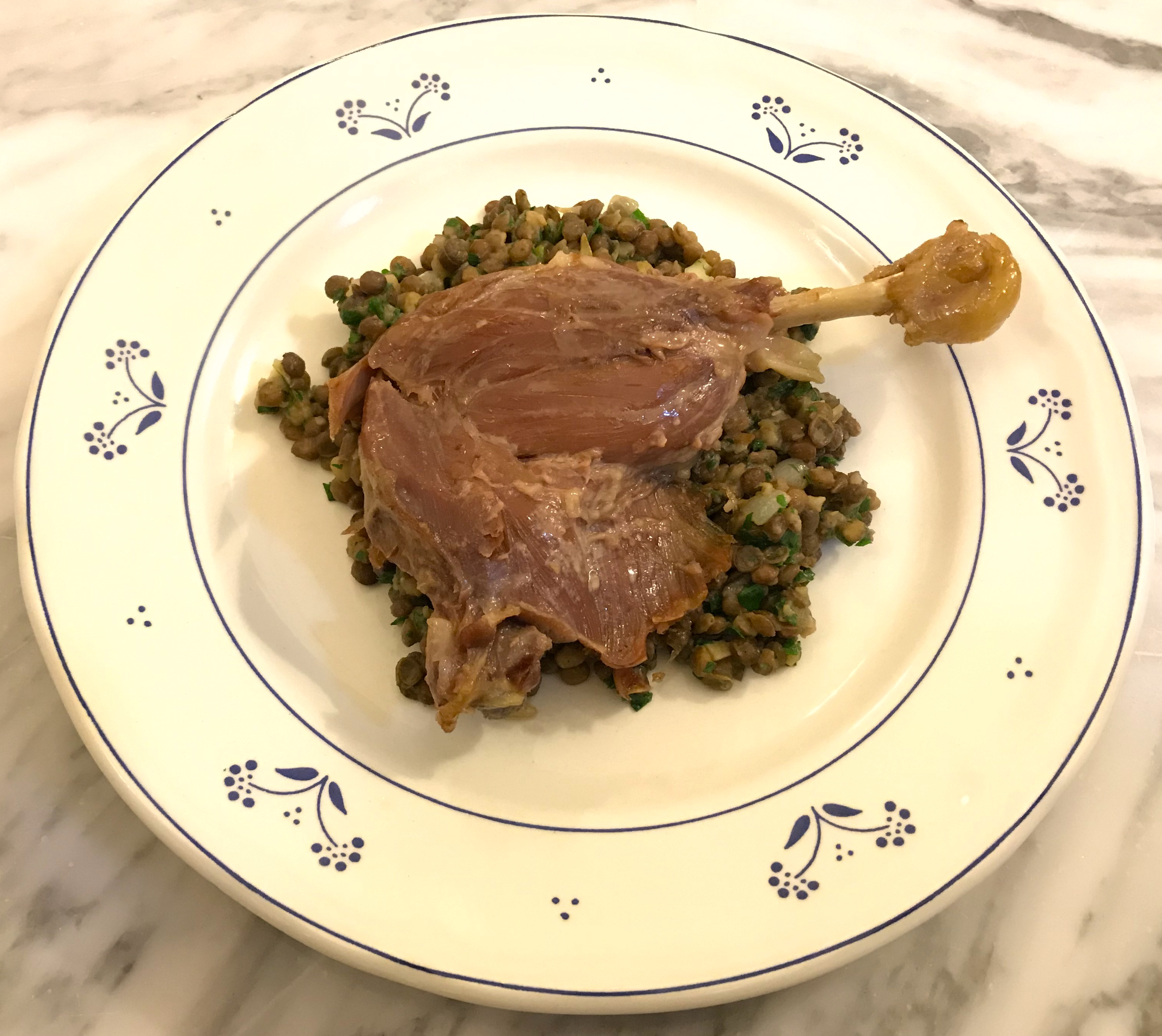
Lentils with Confit of Duck

A Nice Lunch

Think France, think a small restaurant in a small street, nice and simple, no Michelin star in sight. It’s 12.30, time for a quick lunch. You enter the restaurant, take a seat and order today’s dish, the plat du jour. It turns out to be a generous helping of lentils with confit de cuisse de canard and parsley. After having enjoyed your lunch, you think about the joy of good food and the beauty of lentils. Lentille Verte du Puy, such a treat! The combination of the confit, the lentils and the parsley with the sweetness of the shallot and the garlic is elegant, moist and full of flavours.

Feel free to buy ready-made confit. You could of course make it yourself but it is fairly time consuming and not something you would do for two confits only. In our experience most of the confits you can buy (tinned or vacuumed) will be fine. If you’re lucky your local butcher will make his or her own confits. We have included an alternative recipe below.

Wine Pairing

We suggest a glass of not too complex red wine; a well-balanced wine with notes of red fruit, gentle tannins and not too oaky. We enjoyed a glass of Bordeaux-Supérieur, Château Picon.

What You Need

  • 3 Shallots
  • 1 Garlic Glove
  • Coriander Seed
  • Lentils (Lentille Verte du Puy O.P & A.O.C. from Sabarot)
  • Chicken Stock
  • 2 Confits de Canard
  • Olive Oil
  • Parsley
  • Black Pepper
  • Optional: Green Salad

What You Do

Finely chop one shallot and glaze gently in olive oil. In the mean time check the lentils for small pebbles; wash them. Once the shallot is glazed add the crushed coriander seed and the lentils. Heat and stir for one minutes, as you would do with risotto rice. Add some chicken stock and water (the stock is only intended to give the lentils a small push) and leave to simmer on low heat. When the lentils are nearly done, finely chop the other two shallots and glaze gently in olive oil and in the fat that comes with the confit. In parallel warm the two confits. After a few minutes add the finely chopped garlic to the shallot. Chop the parsley. When the garlic and shallot are nicely soft and sweet, add the parsley, some black pepper and then mix with the lentils. Remove the skin from the confit and serve the duck on top of the lentils. Perhaps serve with a simple green salad.

Alternative Way of Making Confit of Duck

Start by crushing a nice amount of juniper berries. Take a sheet of strong aluminium foil, add some crushed berries, a bay leaf and put one duck leg (skin side up) on top. Drizzle with plenty of olive oil. Add the remainder of the berries and a second bay leaf. Wrap the meat in foil, making sure it is tightly closed and the foil intact. If not sure wrap with a second piece of foil. Transfer to a warm oven (90° Celsius or 200° Fahrenheit) for at least 8 hours.

Lentils with Confit of Duck © cadwu

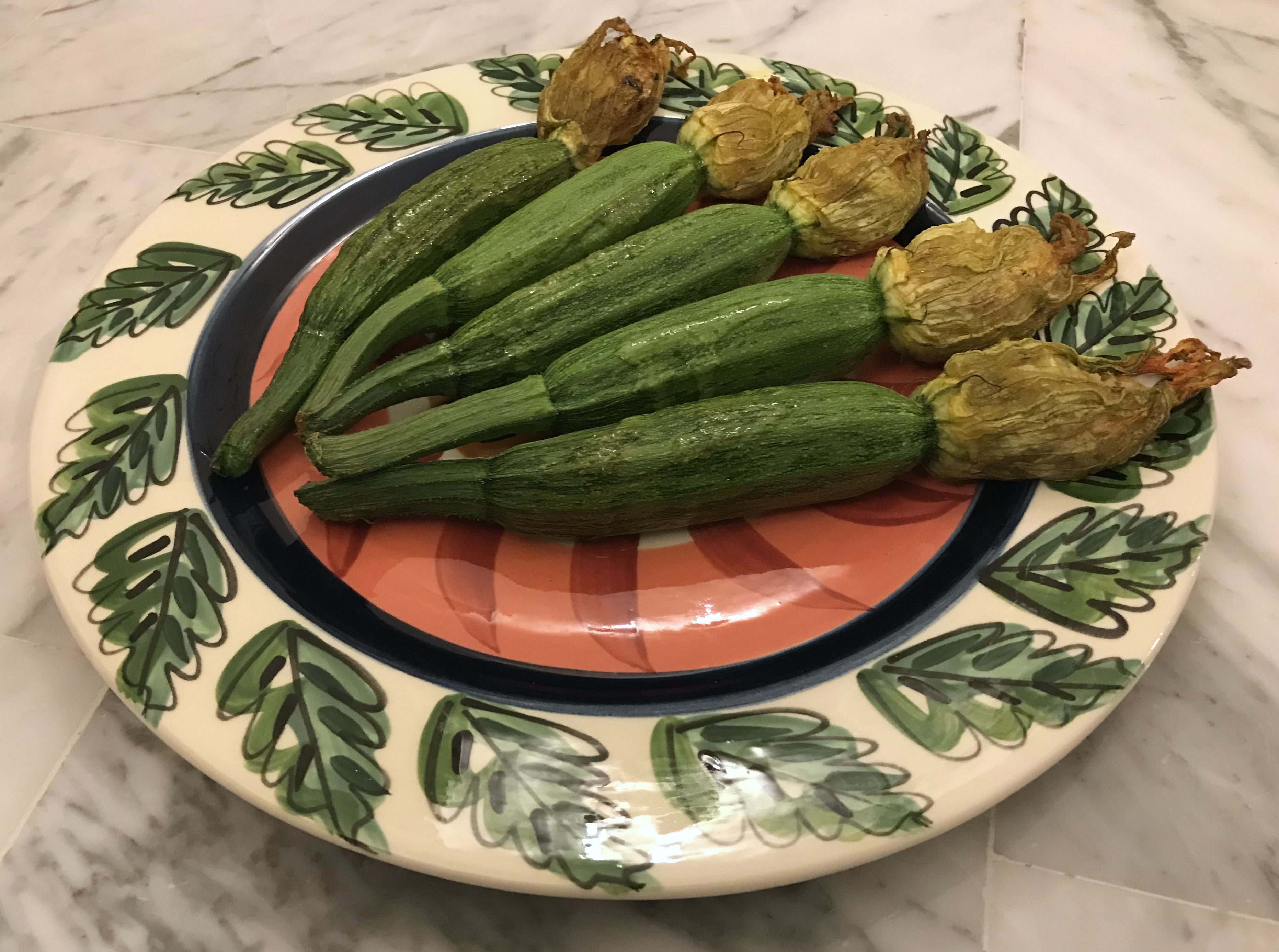
Stuffed Courgette or Zucchini Flowers

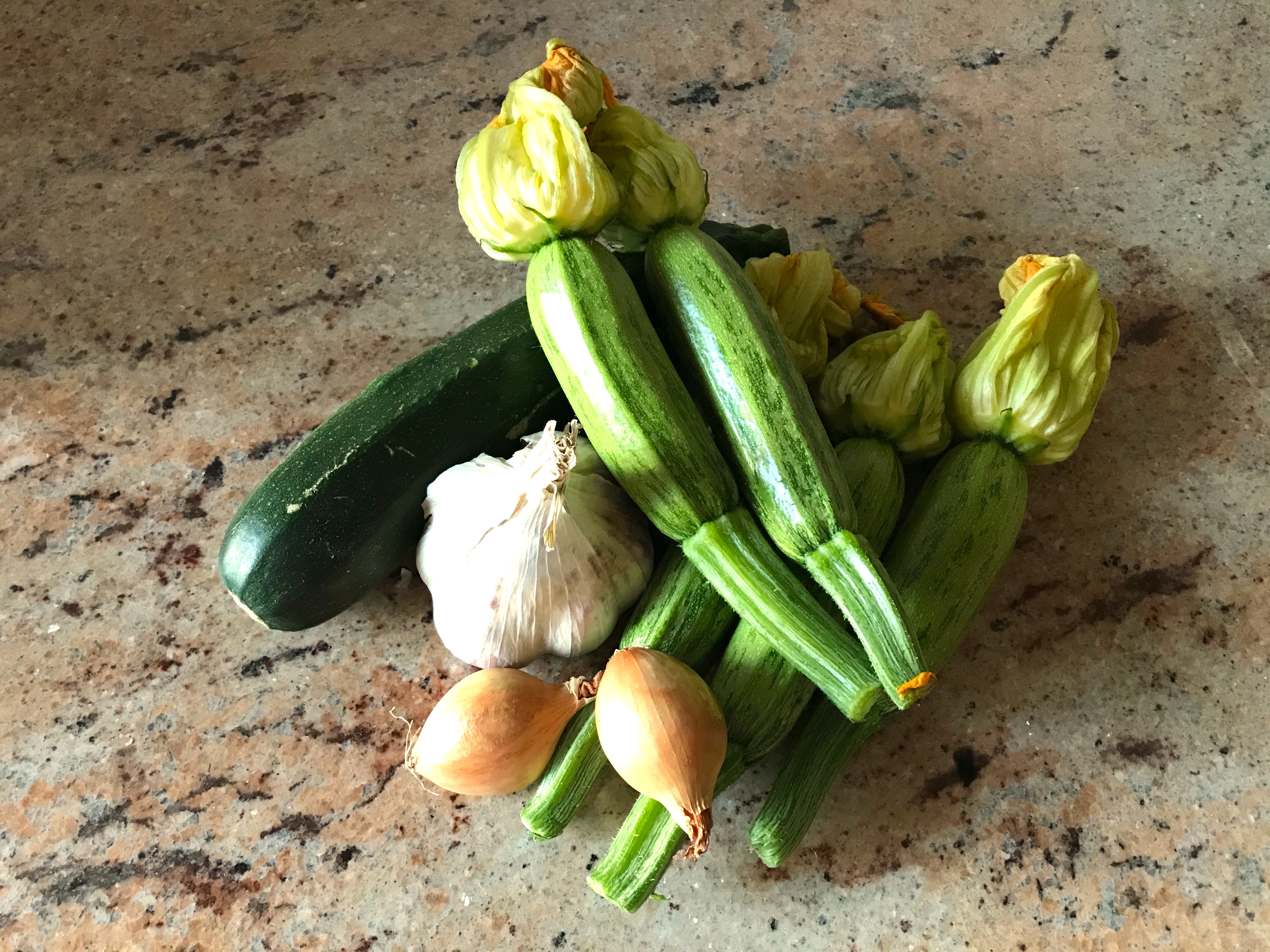
Such a pleasure to see courgette flowers in your garden or at the greengrocers. The young courgette is firm and tasty; the flowers a beautiful yellow. Simply stuff the flowers, fry in a pan or cook in the oven and you have a great side dish or starter. And then you start wondering: ‘Stuff with what? Cheese? Salmon? Tomatoes? Egg? And how to make a filling that remains inside the flower and isn’t too firm?‘.
We prefer a simple approach: stuff the flowers with a perfect combination: courgette, thyme, shallot, garlic and Parmesan cheese. Firm, tasty and all about zucchini. Enjoy as a starter or combine the stuffed flowers with grilled lamb or chicken.

What You Need
  • Small Courgettes with their flower
  • One Courgette (small and firm; you need 1 small courgette to stuff 4 flowers)
  • One Shallot
  • One Garlic Clove
  • Olive Oil
  • Parmesan Cheese
  • Thyme or Herbes de Provence
  • Black Pepper
What You Do
  1. Remove the stamens from the flowers
  2. Peel the additional courgette, slice the shallot and the garlic very thinly
  3. Warm a heavy iron pan and gently glaze the shallot
  4. After a few minutes add the garlic
  5. Remove the seeds from the courgette and grate coarsely
  6. When the shallot and the garlic are sufficiently glazed, add the grated courgette and the thyme or Herbes de Provence
  7. Mix and warm for 15-20 minutes, making sure the liquid evaporates.
  8. ry to keep the structure of the coarsely grated courgette
  9. Add finely grated Parmesan cheese, mix and taste
  10. Adjust with cheese, black pepper and thyme or Herbes de Provence
  11. Set aside and let cool.
  12. Heat your oven to 180° Celsius or 360° Fahrenheit
  13. Stuff the flowers, close them and sprinkle with olive oil
  14. Transfer to the oven and cook for 15 – 20 minutes
  15. Depending on your oven you may need to use ‘traditional’ or a combination with a small broiler. You want the flowers to become crisp
  16. Allow them to cool for a few minutes before serving.
PS

In case the grated courgette looses its structure and the mixture becomes too dense, then beat an egg white until very firm and gently spoon this through the cold mixture before stuffing the flowers.


Quail with Pruneaux d’Agen and Bay Leaf

Fond Memories

Many years ago we enjoyed dinner at a restaurant called Auberge des Seigneurs in Vence, France. The menu included classic dishes such as blue trout, chicken, tian and tender lamb cooked on a spit before an open fire. Ah, Madame Rodi, we fondly remember those evenings, Monsieur Tim and your infinite hospitality.
One of the items on the menu was quail with prunes and bay leaf. Since that day we love our quails! They have a delicate taste, with a nice touch of fattiness. For some reason the meat goes very well with strong flavours like bay leaf, black olives, sage et cetera.
Make sure the quail is sufficiently fat and not frozen. We prefer it if the head is still attached because it allows you to use the skin of the neck, after having removed the head and the spine.
Buying Pruneaux d’Agen could be a challenge, but other prunes will be fine too, provided they are moist and tasty.

Wine Pairing

At the Auberge we enjoyed the red Rimauresq Classique, A.O.P. Côtes de Provence – Cru classé. In general a red wine will go very well with the quails, provided it comes with a bit of fruit and it is not too complex. It should balance with the sweetness and nuttiness (prunes, pancetta) of the dish and the beautiful smell of bay leaf.

What You Need

  • 2 Quails
  • 50 grams of Pancetta
  • 2 Bay Leaves
  • 6 Pruneaux d’Agen
  • Olive oil
  • Butter

What You Do

  1. Clean the inside of the quails with kitchen paper and remove anything that’s left
  2. Check the skin for feathers and hollow shafts
  3. Cut 4 pruneaux and the pancetta in smaller bits and mix together
  4. Stuff the quail with a bay leaf, then the mixture and finish with a pruneaux
  5. Use kitchen wire to close the quail
  6. Pre-heat your oven to 180° Celsius (355° Fahrenheit)
  7. Put the quails in a skillet with olive oil
  8. Make sure the breast is downward facing. This way the fat will go towards the breast, making sure these are nice and moist
  9. Put in upper half of oven
  10. After 15 minutes turn the quails, label fat over the breast and after another 15 minutes your quails should be ready and golden
  11. Remove from the oven and let the quails rest for 10 minutes
  12. You could cover the quails with aluminium foil, to make the meat juicer but you risk losing the crispy skin
  13. Remove the kitchen wire and serve with seasonal vegetables from the oven or with golden turnips

Flan with Prawns, Blue Cheese, Spinach and Dill

Something on a Spoon

A glass of white wine, perhaps a glass of Crémant d’Alsace or maybe even a glass of Champagne; such a great way to start dinner (or lunch when you feel like treating yourself). You enjoy some bread with homemade Tapenade, or a few nice olives. All good. And then suddenly the chef presents you her or his Amuse-Bouche. Something very special and an indication of the chef’s talent. But in most cases it’s something on a spoon and not very special.

A bit of background: amuse-bouche is actually not a French term. Restaurateurs made it up because they think amuse-gueule (the correct term) is a bit harsh. ‘Gueule’ can refer to both humans and animals. And ‘ferme ta gueule’ is far from polite. So restaurateurs started using ‘bouche’, to eliminate the impression that they think their guests have a snout.

Some say the concept of the amuse was invented by the Nouvelle Cuisine in the 1960s. Not really. In 1946 Francis Ambrière, in his book Les Grandes vacances, writes “… Une côtelette à midi. Quelques amuse-gueule à l’heure du goûter. Et le soir, ô splendeur, un gigot bien saignant, le premier gigot depuis l’an 40!”

Today’s amuse-gueule is a dish in its own right that amuses the mouth, fools your appetite and makes you want to start on the first course. Small, tasty, full of flavours and maybe a bit out of the ordinary.

We use a traditional coddler for this amuse-gueule, but you could also use a small ramequin. No spoon, please.

Wine Pairing

Typically the amuse-gueule is combined with your aperitif. We combined this amuse gueule with a glass of German Sekt, to be more precise with a glass of Reichsrat von Buhl – Pfalz – Sekt – Spätburgunder Brut rosé 2016, which is a superb pale pink wine, made from 100% Pinot Noir and produced by one of the leading wineries in Germany. Think red berries, brioche, a delicate texture with a nice mousse, fresh acidity and a long-lasting aftertaste.

What You Need (for 4)

  • One Egg
  • Four Medium Sized Raw Prawns
  • 75 grams Spinach
  • ½ Shallot
  • A Generous Tablespoon of Crème Fraiche
  • Dill
  • Blue Cheese
  • Chives
  • 4 Edible flowers

What You Do

Start by cleaning the prawns, removing the head, the shell and the vein. We used Argentine red shrimps. The meat is fairly soft and they become beautifully red when cooked. Fry the shrimps is some olive oil for 3 minutes. Remove the shrimps from the pan, set aside and let cool. Gently fry the shallot in the same pan for 10 minutes until glazed. Remove from the pan and let cool. In a different pan quickly cook the (dry and clean) spinach in some olive oil. Keep stirring! Drain if so required, set aside and let cool.
Cut the prawns in smaller bits. Chop the spinach using a large knife. Whisk the egg until completely smooth. Now add the (cool) bits of prawn, the spinach and the shallot. Whisk with a spoon. Add the Crème Fraiche. Add some chopped dill (depending on your taste), a bit of blue cheese (not too much, just to add a dimension to the dish) and a generous amount of chives. Mix. Coat the coddlers or ramequins with butter. Add the mixture to the coddlers or ramequins. Heat your oven to 170° Celsius (or 340° Fahrenheit). Place the coddlers or ramequins in a shallow dish. Add boiling water up to 2/3 of the height of the coddler or ramequin. Close the oven and reduce the temperature to 120° Celsius (or 250° Fahrenheit). After 30 minutes au bain marie your amuse-gueule should be ready. Test with a needle. Let cool.
If using a coddler, remove and dry the lid, add the flower and close.

Amuse-Gueule © cadwu


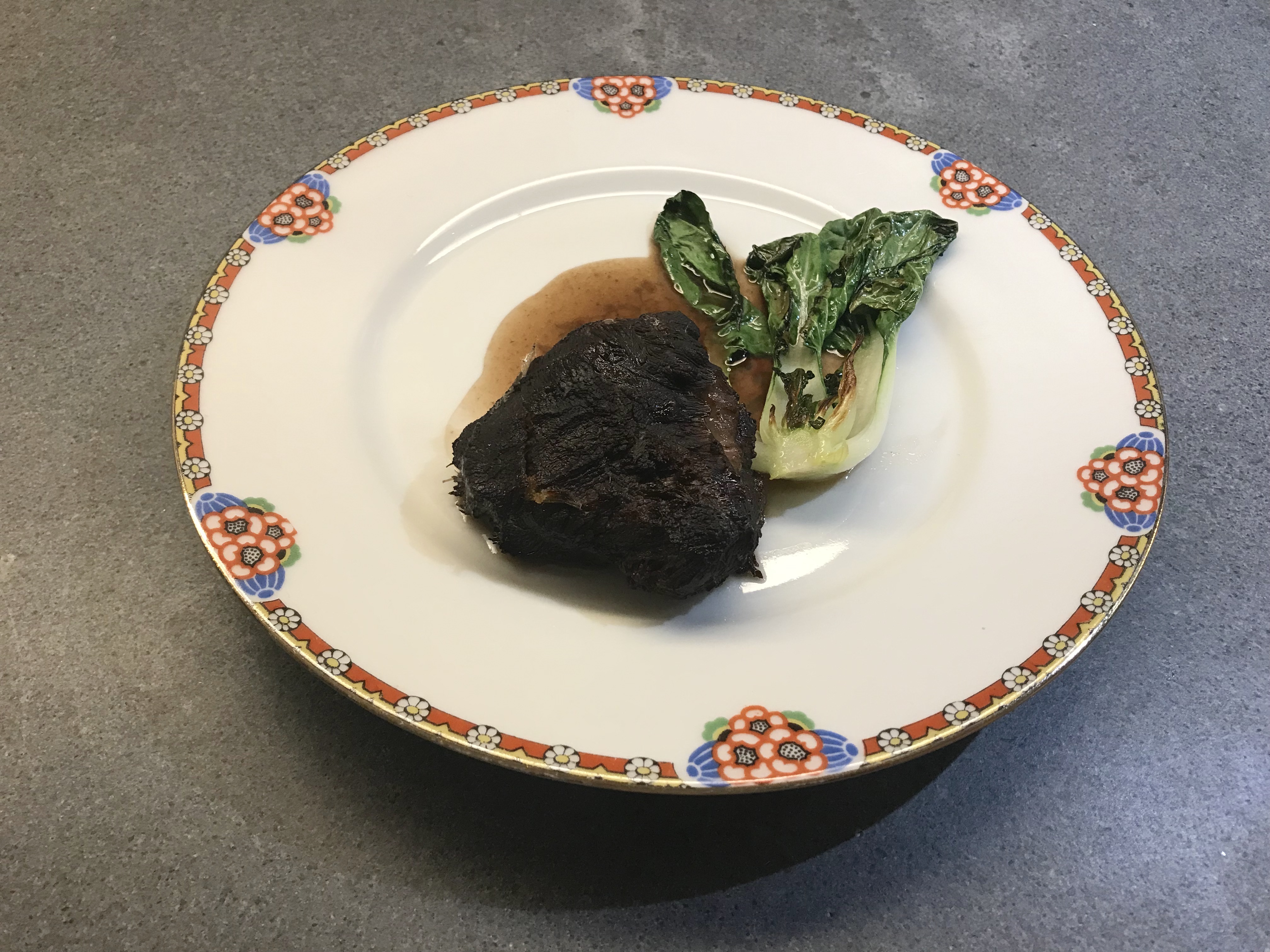
Veal Cheeks with Pak Choi (Bok Choy)

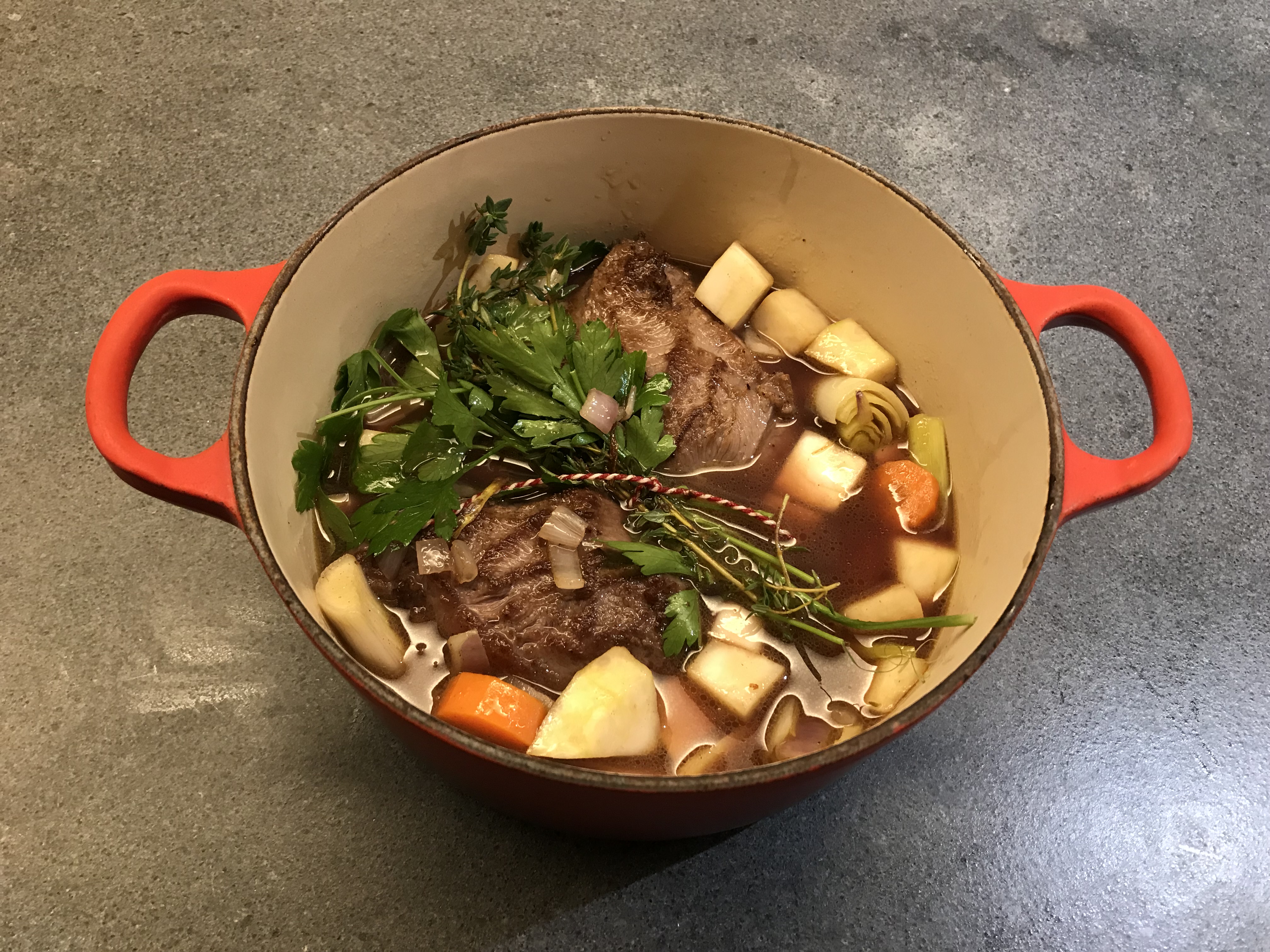
You may have spotted Joue de Veau in a French Boucherie or Supermarket. Probably close to the Ris de Veau, the Collier D’Agneau and the Abats de Porc. Not the most obvious choices, but in reality Joue de Veau (Veal Cheek) is a true delicacy. The meat requires a few hours to become tender, but it’s worth the wait. When you serve it you will pleasantly surprised: the meat is extremely tender, juicy and a touch of pink on the inside.

The cheek requires cleaning. Best is to ask your butcher to do this or use a very sharp knife.
We prepare the meat with a classic combination carrot, onion, leek and celeriac plus red wine and a bouquet garni. Don’t make the bouquet too powerful; the idea is to support the meat, nothing else.

No need to use an expensive wine for the stew. A simple, red wine is fine. Some people will argue that the wine you use for cooking must be the one you serve with the food. Nonsense. Feel free to drink a Baralo (like we did) with the Veal Cheeks, but don’t waste half a bottle of it by using it as a cooking liquid.

The Pak Choi works really well with the Veal Cheeks. It brings the bitterness of cabbage, balancing the sweetness of the meat and the deep taste of the sauce. Plus the fried Pak Choi is a bit crispy, both the leaves and the stem, which is great in combination with the moist, tender meat.

Wine Pairing

A full-bodied red wine with clear tannins, a delicate smell and red fruit aromas will be an excellent choice. Velvety and smooth. As the Veal Cheeks: simple yet complex. We drank a glass of Barolo from the house of San Silvestro. A perfect match with the veal, the sauce and the cabbage.

What You Need

  • 2 Veal Cheeks (one per person)
  • Carrot
  • Celeriac
  • Onion
  • Leek
  • Olive Oil
  • Bouquet Garni
    • Bay Leaf
    • Thyme
    • Parsley
  • Red Wine
  • (baby) Pak Choi (Bok Choy)

What You Do

  1. Clean the cheeks
  2. Start by adding oil to the pan
  3. Fry the Veal Cheeks until they have a nice, golden colour
  4. Transfer to a plate
  5. Add more oil and fry the chopped vegetables
  6. Be careful not to add too much carrot or celeriac
  7. Stir for a few minutes and then add the meat
  8. Add wine and the bouquet garni
  9. Leave on a low heat for 4-6 hours until tender
  10. Make sure to turn the meat every hour or so
  11. Cool the stew and transfer to the refrigerator
  12. The next day remove the fat (if any) and warm the stew
  13. When warm, transfer the meat to a plate and keep warm (for instance in an oven of 65 °C or 150 °F, the ideal temperature for your plates as well)
  14. Remove the vegetables and the bouquet
  15. Reduce the liquid with one-third or more
  16. Taste and adjust
  17. In a non-stick pan heat some oil and fry the Pak Choi for 2 times 2 minutes, maximum
  18. In parallel fry the meat in a non-stick pan, one or two minutes in total. This will give the meat a crispy touch and an even deeper dark brown colour
  19. Serve the Joue de Veau with the sauce, crusty bread and the Pak Choi.

Pissaladière

Pissaladière is a very tasty combination of onions, local French herbs, anchovies and black olives. It originates from the South of France (Côte d’Azur) and many a local boulangerie will offer their home-made, original pissaladière. We compared many recipes, enjoyed lots of slices of Pissaladière when in France and are pleased to present our version. It does not include tomatoes, milk, almonds, sugar, coconut oil and is not made with puff pastry.

Best is to make your own pastry (especially because it’s very simple) and use fresh yeast. Since it’s more and more difficult to buy, we use dried yeast. Key to making pissaladière is time. The onions need an hour, they need to cool and the dough needs to proof twice. But we’re not in a hurry!

We combined our pissaladière with French charcuterie; think Paté en Croûte (recipe to follow), Rossette (from Lyon), Rillettes d´Oie, Jambon persillé and cornichons. You could also combine pissaladière with a nice simple green salad.

We enjoyed our Pissaladière with a glass of Cô­tes de Pro­ven­ce ro­sé made of Cinsault, Grenache and Shiraz grapes. Dry, with a touch of grapefruit and wonderfully pale pink.

Here is what you need

  • 600 grams of White Onions (or a combination of White Onions and Shallots)
  • Olive Oil
  • Butter
  • Bay Leaf
  • Anchovies
  • Halved Black Olives
  • Pastry
    • 125 grams of Flour
    • 2 grams of Yeast (depending on the yeast you use)
    • 75 ml of Water
    • Dash of Salt
    • Some Olive Oil
    • Herbes de Provences (or thyme)

Start by caramelizing the onions. Peel the onions, cut in 4 and slice. Not too thin, the onions will shrink. Fry gently in olive oil and butter. When starting to color reduce the heat, add the bay leaf and allow to simmer for one hour, stirring every 15 minutes or so. Check the taste, the bay leaf can be overpowering. Let cool and set aside (for instance until the next day).
Mix flour, yeast, salt and herbes de Provences. Add water and olive oil and knead for 10 minutes. Let proof for 2 hours. Transfer to kitchen top and create a thin rectangular pastry. Coat a baking plate with oil and transfer the pastry to the plate. With a fork make small holes in the pastry (not in the edge). This is important given the fact that the onions are cold and moist. Now add the onions and make a nice pattern with the anchovies and the halved olives. Bake in a hot oven (top half, 220˚ Celsius or 430˚ Fahrenheit) for 15 minutes. Serve warm (or cold) but not hot.