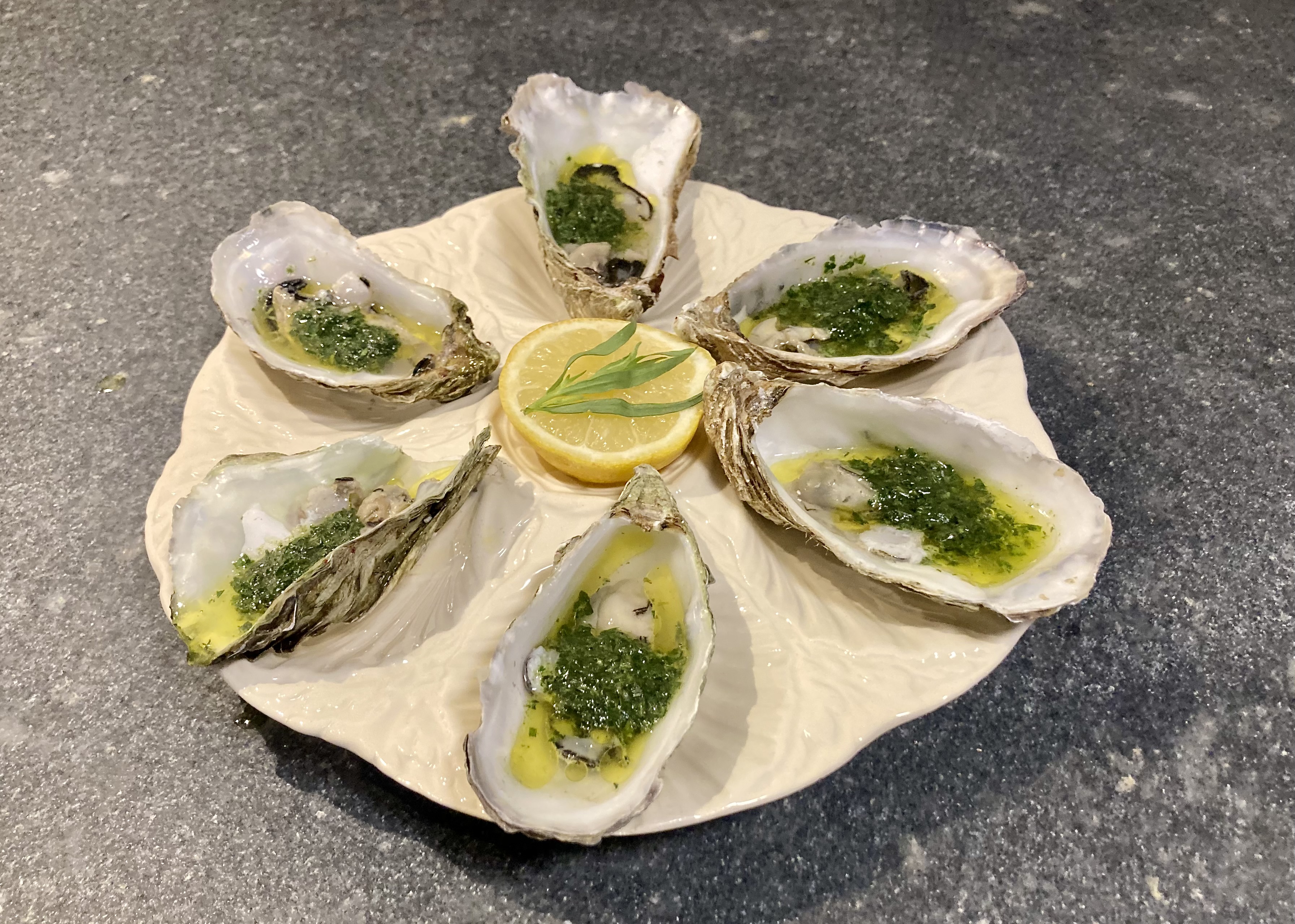
Oysters With Tarragon

Enjoying oyster begins by deciding which oysters to buy. Should they be small or large, should the taste be creamy and sweet or lean and juicy? If an oyster looks creamy (opaque) then it will taste creamy.

Next decision: raw or cooked? We think the best way to eat an oyster is to eat it raw. You will taste the saltiness, the texture and all of its flavours. The usual way to counter the saltiness is by adding a bit of lemon or mignonette but you could also go for something spicy like Tabasco, horseradish or perhaps wasabi. Don’t add something sweet because the oyster has its own sweetness.
In most cases cooked or steamed oysters are covered with lots of overwhelming ingredients, in an attempt to hide the taste of the oyster. Most likely the oyster will be overcooked and its structure rubbery and nasty. If you trust the chef, go for Steamed Oysters with Black Bean Sauce or for Oysters Rockefeller. Or even better: prepare our quick and easy Oysters with Tarragon, a delicious combination of warm (but not cooked) oyster and velvety anise flavours.

And finally: how to eat an oyster? Eating means chewing and tasting. Please don’t “drink” an oyster. If you do, you will only taste sea water.

Wine Pairing

When eating oysters, your wine must have some minerality. Think Chablis, Picpoul de Pinet, Sancerre or Sylvaner. We enjoyed a glass of Pommery Royal Brut champagne. The wine is elegant and uplifting, it comes with subtle notes of brioche and apple, a fine mousse and the perfect acidity with the oysters. Its freshness works very well after the intense taste of the oyster and the tarragon.

What You Need
  • 6 or 12 Oysters
  • Butter
  • Lots of Tarragon
  • White Pepper
  • Lemon Juice
What You Do
  1. Buy lean (not creamy) oysters, for instance the ones from the Île de Ré
  2. Combine butter and finely chopped tarragon with some white pepper
  3. Taste and add more tarragon
  4. Store in the refrigerator
  5. Scrub each oyster under cold, running water
  6. Open the oyster
  7. Use your knife or a spoon to detach the muscle underneath the oyster from the bottom shell
  8. Remove any small bits of broken shell or sediment
  9. Remove some of the liquid
  10. Add one or two drops of lemon juice to every oyster
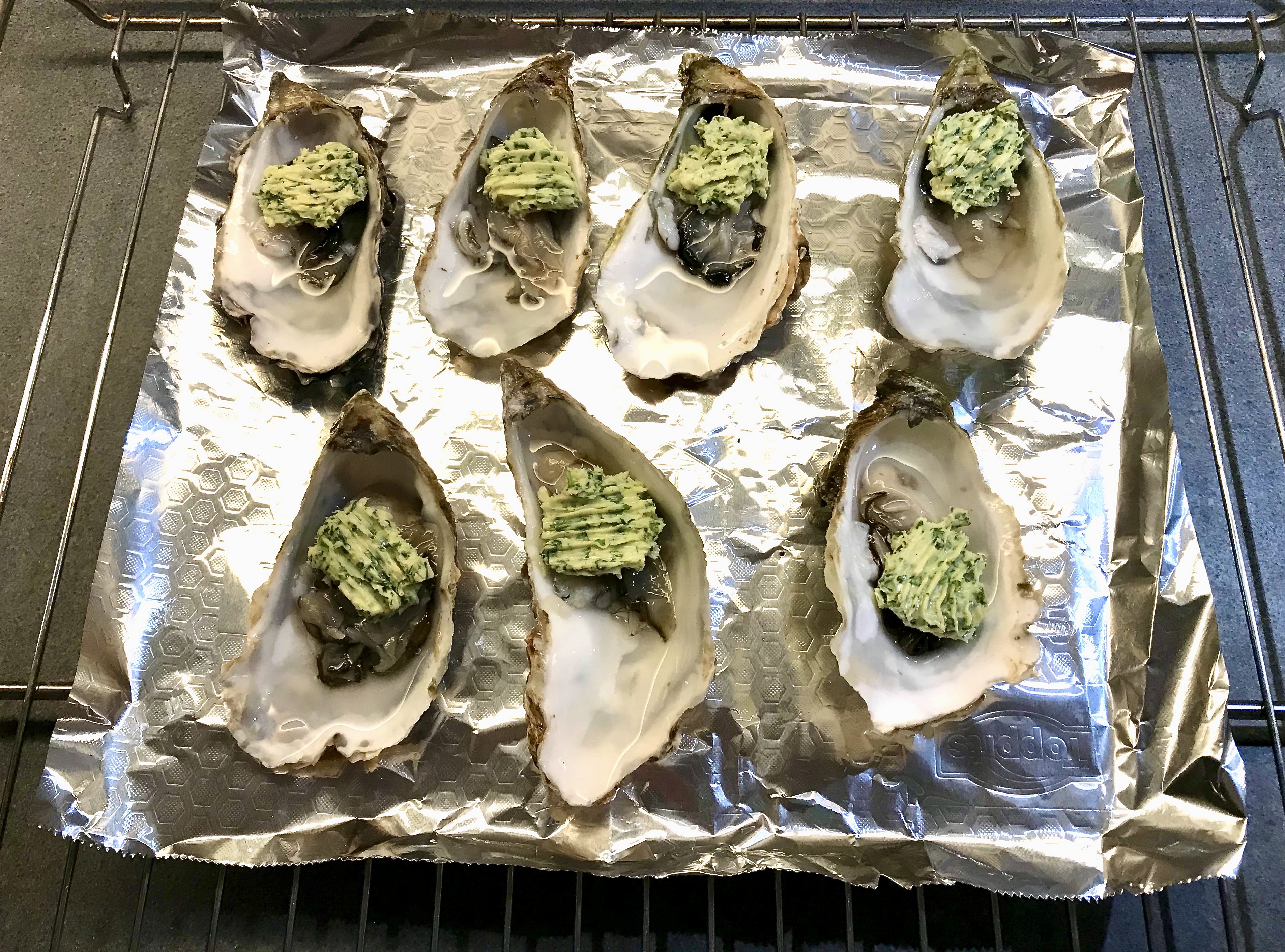
  11. Top with a teaspoon of tarragon butter
  12. Make sure you have everything ready (plate, tongs, wine, guests)
  13. Transfer the oysters to the oven and place as close to the grill as possible
  14. Set your oven to grill or broil and leave the oysters for 3 or 4 minutes in the oven
  15. Transfer the oysters to a plate and serve immediately
  16. 🥂Happy New Year!🥂


Easy Mushroom Pie

Hurray! The mushroom season has started! Last Friday we bought beautiful golden chanterelles (girolles) and white beech mushrooms (shimeji). It’s the time of year to enjoy wonderful dishes such as Cèpes à la Bordelaise or Salad with Mushrooms and Smoked Duck. Will there be bay boletes this year? Or the intriguing Japanese Matsutake? It’s been some time since we last saw these on the market, and we would really love to make Matsutake with Spinach and Ginger again.
We decided to celebrate the start of the season by making an easy Mushroom Pie, packed with rich flavours, nuttiness and a touch of autumn.

Wine Pairing

We treated ourselves to a bottle of Pinot Noir from the Elzas region, made by Sophie Schaal. She produces wine in France and South Africa. The grapes are handpicked and then naturally fermented before ageing in French oak barrels for 10 months. The result is a wine with a deep ruby colour. The aromas suggest black fruit and a touch of vanilla. The taste is well balanced with soft tannins and length.
In general, you’re looking for a wine with red fruit and refined tannins. Some earthiness will match very well with the mushrooms and the taleggio.

What You Need
  • For the Pastry
    • 100 grams of Flour
    • 50 grams of Water
    • 10 grams of Olive Oil
    • 1 gram of Salt
  • For the Filling
    • 250 grams of firm Mushrooms (shiitake, golden chanterelles, beech mushrooms, button mushrooms)
    • 1 Organic Egg
    • 50 grams of Taleggio
    • 50 ml Double Cream
    • Thyme
    • 1 small Garlic Clove
    • Black Pepper
    • Olive Oil
    • 2 slices of Bacon (optional)
What You Do
  1. Combine flour, salt, water and olive oil
  2. Kneed for a minute and store in the refrigerator for at least 30 minutes.
  3. Clean the mushrooms and slice if necessary
  4. (Optional) Fry the bacon, let dry on kitchen paper and crumble. Add to the egg mixture (step 11)
  5. Lightly fry the mushrooms in a heavy iron skillet
  6. Transfer the mushrooms to a plate and let cool
  7. After 30 minutes: preheat the oven to 180 ˚ C or 355 ˚ F
  8. Combine the egg with the cream
  9. Add lots of thyme and black pepper
  10. Add grated garlic
  11. Add the mushrooms
  12. Slice small cubes of taleggio
  13. Add the cheese to the mixture
  14. Roll out the dough with a rolling pin on a lightly floured surface.
  15. Coat a 22 cm or 9-inch round baking tin with oil or butter
  16. Place the dough in the baking tin
  17. Add the mixture and distribute evenly
  18. Transfer to the oven for 35-40 minutes or until nice and golden
  19. Allow to cool for a few minutes
  20. Remove from the tin and let cool on a wire rack
  21. Serve lukewarm
PS

It tastes even better the next day!

An easy to make mushroom pie with rich flavours
Mushroom Pie ©cadwu

Asma Khan Wins Johannes van Dam Prize

The Johannes van Dam Prize 2024 was won by Indian British chef, cookbook author and restaurant owner Asma Khan. In 2012 her restaurant started for 12 guests at her home, serving food cooked from traditional family recipes. Today her all-female Darjeeling Express restaurant in London offers Indian Rajput and Bengalihome cooking specialties. On her current menu are dishes such as Chicken Momis (dumplings served with smoked chillies sesame chutney) and Badami Baingan (aubergine with coconut, peanut and tamarind). Sounds delicious!

Prize

The Johannes van Dam Prize is a lifetime achievement award for an individual who has made an exceptional contribution to the world of gastronomy. Previous winners of the prestigious prize include Yotam Ottolenghi, Carlo Petrini, Alice Waters, Claudia Roden, Jeroen Meus and Alain Passard. The prize giving ceremony used to be part of the Amsterdam Symposium on the History of Food, but for reasons unknown to us it was decided to separate the two events. As a result, the prize giving event in 2024 with Asma Khan was relatively small and went by hardly noticed. A pity.

Cookbook

We bought her cookbook Ammu, Indian Home Cooking to Nourish Your Soul. ‘An entrancing book’, according to Nigella Lawson. We were impressed by the great stories and of course the recipes. Over the coming weeks we will prepare some of the dishes and ask our review panel to taste the flavours of Asma Khan’s kitchen.

Join us!

Please join us in preparing one (or more) of her dishes. You could buy the book, look at her recipes as published by the BBC or these recipes published by Great British Chefs or these from the Foodnetwork.
Post about it on your blog and ping back, track back, share or re-post.

Let’s enjoying Indian Home Cooking to Nourish Your Soul!

Ammu by Asma Khan
Ammu by Asma Khan

Authentic Dutch Pepernoten

Today, December 5th (actually December 6th), we celebrate the birthday (actually name day) of Sinterklaas or Sint Nicolas (270-343), patron saint of children (and Amsterdam), the Greek Bishop of Myra (now Demre), currently Turkey, but living in Madrid according to Dutch tradition and arriving end of November per steamboat. He rides a white horse over the rooftops at night and can be in different places at the same time. Very confusing but it makes perfect sense to children.

His assistants, (called Pieten), carry bags with sweets and presents. They used to be Zwarte Pieten (Black Pete) but thankfully that part of the tradition has now changed significantly making the Sinterklaas festivities more inclusive. Piet has become a Sooty Piet (they squeeze down and up sooty chimneys in order to deliver presents).

The celebration is not just about presents and sweets, it is about behaviour: Sinterklaas carries a big book with information about children: who has been good (sweets, presents) and who has been naughty (spanking with the birch rod that is used by Piet to sweep chimneys or being put in a now empty bag and taken back to Spain). Now you know why most Dutch and Belgian children become nervous and restless beginning of December!

Culinary

The culinary aspect of Sinterklaas is about sweets: chocolate letters (the first letter of your name), chocolate coins, marzipan figures, chocolate frogs (in a bathing suit, obviously) and mice (both stuffed with fondant), speculaas (spiced short crust), kruidnoten (as speculaas but slightly different) and pepernoten. Both kruidnoten en pepernoten were thrown through the room, for the children to look for.
The smaller sweets were part of a ritual: in the evening you would put a shoe in front of the fireplace (or a similar apparatus, as long as it was connected to a chimney, things became challenging with the introduction of central heating) and you would sing a traditional Sinterklaas song. If possible you would put a carrot in your shoe for Sinterklaas’ horse. The next morning the sweets would be waiting for you in your shoe. Wonderful memories!

Pepernoten

If you shop these days in the Netherlands, you will see lots and lots of pepernoten. One Dutch company specialises in pepernoten and produces them in over 50 flavours. These pepernoten are actually kruidnoten. In 1593 Carolus Battus mentions Peper-coecxkens. The recipe for the original pepernoot goes back to 1756 when Gerrit van den Brenk writes a book called Volmaakte onderrigtinge, ten dienste der koekbakkers of hunne leerlingen (which translates into something like Perfect lessons for cookie bakers and their pupils). The ingredients are honey, white rye flour, potash and grinded anise seed. Dutch pâtissier Cees Holtkamp modernized the recipe, enabling us to recreate pepernoten.

What You Need
  • 50 grams of Brown Caster Sugar
  • 75 grams of Honey
  • 150 grams of White Rye Flour
  • 2 grams of Salt
  • 20 grams of Water
  • 5 grams of Baking Powder
  • 6 grams of grinded Anise Seed
  • 10 grams of Water
  • Neutral Oil
  • No Pepper (despite the name!)
What You Do

Best option is to watch Cees Holtkamp preparing pepernoten with support from his granddaughter Stella. The video comes with English subtitles. An even better idea is to buy his book Dutch Pastry. It’s available via the usual channels or order it at your local bookstore. Price is approximately 20 – 25 euro or US dollar.
Combine sugar, honey and water in a pan. Heat the mixture without boiling. Remove from heat. Immediately add flour and salt. Use a kitchen aid with hooks to make the dough. It will be very sticky and odd. Allow to rest for a few hours.
Add baking powder, anise seed and water. Kneed, cover with plastic foil and allow to rest until the next day.
Preheat your oven to 180 °C or 355 °F traditional. Make small cubes and use your hands to turn these into balls. Generously coat a baking tin with oil. We used a spring baking tin, which is not what we should have done. It is better to use a seamless baking tin. Wet your hands with oil, coat every ball with oil and add to the tin. The tin must be completely filled, so the balls must touch each other. This way you get the typical rounded-cube-shape of pepernoten. If not, add some aluminium foil to the tin. Transfer to the oven and leave for 20 minutes. Detach the pepernoten as soon as possible.

PS

We could only find whole grain rye flour, which is not suitable for this recipe. Instead, we used all-purpose flour.

Quail à la Roden

A few excellent ingredients is sometimes all you need to cook a wonderful dish. In this case you need quail, shallot, olive oil, butter, sage and Marsala.
We love the delicate, pleasantly intense flavour of quails. They are great to combine with strong flavours like bay leaf, pancetta and prunes but in this case, we follow a recipe by Claudia Roden, as published in her excellent book The Food of Italy. We tweaked it a bit, so please buy Claudia Roden’s book when you want to make the original.
Marsala is a fortified wine from Sicily. Perhaps you know it as something sold in small bottles, especially for cooking purposes. Never buy this nasty product because it can’t be compared to real Marsala. Same story for the small ‘Madeira’ bottles.
Quails must be sufficiently fat and undamaged. We prefer the French label rouge quails. Not cheap, but a wealth of flavours. 

Wine Pairing

The dish comes with a gentle, intense and slightly sweet taste thanks to the sage, the marsala and the quail. You could go for a medium bodied red wine. We enjoyed a glass of Domaine Vico Corse Le Bois du Cerf Rosé 2021 with our quail. This is an exceptional rosé from Corsica. It is made from grenache and sciacarello grapes. It is medium bodied and fresh with aromas of red fruit. Its taste is complex, long and fruity.

What You Need

  • 2 Quails
  • 1 Shallot
  • Olive Oil
  • Butter
  • 4 Leaves of Sage
  • Dry or Medium Dry Marsala
  • Chicken Stock
  • Black Pepper

What You Do

Clean the inside of the quail with a bit of kitchen paper and remove anything that’s left. Check for remaining feathers and shafts. Gently fry the chopped shallot in butter and olive oil until soft. Remove the shallot from the pan, increase the temperature and fry the quails until golden-brown. Reduce the heat, add shallot and sage. Pour in marsala and stock. Cook the quails for 20 minutes until done, turning them over regularly. Transfer the quails to a warm oven (60˚ C or 140˚ F). Reduce the sauce, taste, add black pepper, perhaps some freshly chopped sage and diced cold butter to thicken the sauce. Serve the quail on top of the sauce.
Claudia Roden serves the quails with risotto. 

The Silver Palate

Think about the US, think about food and you’ll end up thinking about fast food, pale fries, endless portions of meat and bagels and waffles, sweetened orange juice and blueberry muffins with too much sugar. Which is such a pity, because the US cuisine is so much more and diverse. Just think about, eh, well, yes, eh…

The Shop

Which is exactly the reason why we bought The Silver Palate Cookbook, written by Julee Rosso and Sheila Lukins, with Michael McLaughlin. It’s the story of two young, motivated people, Julee and Sheila, one from marketing with a passion for cooking and the other a graduate from Le Cordon Bleu in Paris. Both were trying and struggling to balance work, family, hobbies and interest. One day they came up with the idea of setting up a shop where people could buy great food, to take home and ‘graciously serve as their own’, solving one of the problems in their own life. And so, mid-July 1977, they opened their gourmet food shop in New York, selling Tarragon Chicken Salad, Nutted Wild Rice, Giant Chocolate Chip Cookies, Cheese Straws and on and on.

The Book

The shop was more than successful and in 1981 they were asked to write a cookbook. It was published in 1982 and not much later it was published in various languages. The Silver Palate Cookbook was a huge success, and still is.

The book includes a wealth of recipes, ranging from finger food, dazzlers, soups, pasta to game, stew pots, vegetables, sweets and brunch drinks. The book is very well designed, with beautiful drawings and pictures. Next to the recipes you’ll find interesting background information and tips. It’s a pleasure to read recipes for dishes such as Glazed Blueberry Chicken (with homemade blueberry vinegar and thyme, so not overly sweet at all!), Clam Chowder or Sorrel Soup.

The 25th Anniversary Edition of The Silver Palate cookbook is available via your local bookstore and the well-known channels for approximately US$ 17,00 or € 22,00.

Symposium on the History of Food

Next year on February 11th and 12th, the 7th Amsterdam Symposium on the History of Food will take place in Amsterdam. You can also join online, for € 40,00 only. Lunch not included of course. This year’s theme is Food and the Environment: The Dynamic Relationship Between Food Practices and Nature

Program

The key note will be delivered by Ewout Frankema, Professor of Rural and Environmental History at the Dutch Wageningen University and research fellow of the UK Centre for Economic Policy Research (CEPR). Amongst the speaker are Christian Reynolds on The evolution of “sustainable” and vegetarian recipes from manuscripts and cookbooks to online and Amber Striekwold on The Dutch Alternative Food Movement.

Ceremony

On Friday 11th the program will close with the Prize-giving ceremony of the 2022 Johannes van Dam Prize and the 2022 Joop Witteveen Prize. Previous winners of the prestigious Johannes van Dam Prize include Yotam Ottolenghi, John Halvemaan, Carlo Petrini, Alice Waters, Claudia Roden and Alain Passard (see picture).

Join the Symposium

Additional information and the registration form are available on the website of the symposium.

Alain Passard speeches after having received the Johannes van Dam Prize 2019 © cadwu

This Week was Special-A

This week on Friday and Saturday the annual Amsterdam Symposium on the History of Food took place at the main auditorium of the University of Amsterdam. Such a pleasure to listen to great papers presented, discussing the origin of umani or the history of Byzantine taste (presented by Anouk Everts). The key-note was delivered by Peter Klosse. He made many interesting points with regard to taste and flavour. His analysis of Mouth Feel is food for thought and discussion.
PS Garum as used in the Byzantine kitchen is a fish sauceIt is made from fermented fish (sardines for instance) and salt. It goes back to Roman times. Fun to make, actually….

Johannes van Dam prize

Yotam Ottolenghi received the prestigious Johannes van Dam prize. The jury, chaired by professor Louise O. Fresco, mentioned Yotam’s impressive contribution to current Dutch and International cuisine. The prize is named after culinary writer and critic Johannes van Dam who was not only known for his reviews of restaurant but also for his massive collection of books on food and drinks. Mr. Ottolenghi was very pleased to receive the prize (as you can see in the picture!)

Joop Witteveen prize

Antwerpen a la carte was the winner in the Academic category, the Joop Witteveen Prize. A book that discusses not only the history of food in the port city of Antwerpen, but also today’s role of a (hungry) city in the area of food production and consumption. Main authors are Ilja van Damme and Leen Beyers. The book is linked to an exposition at the MAS in Antwerp.
More information about the papers can be found on the website of the conference.