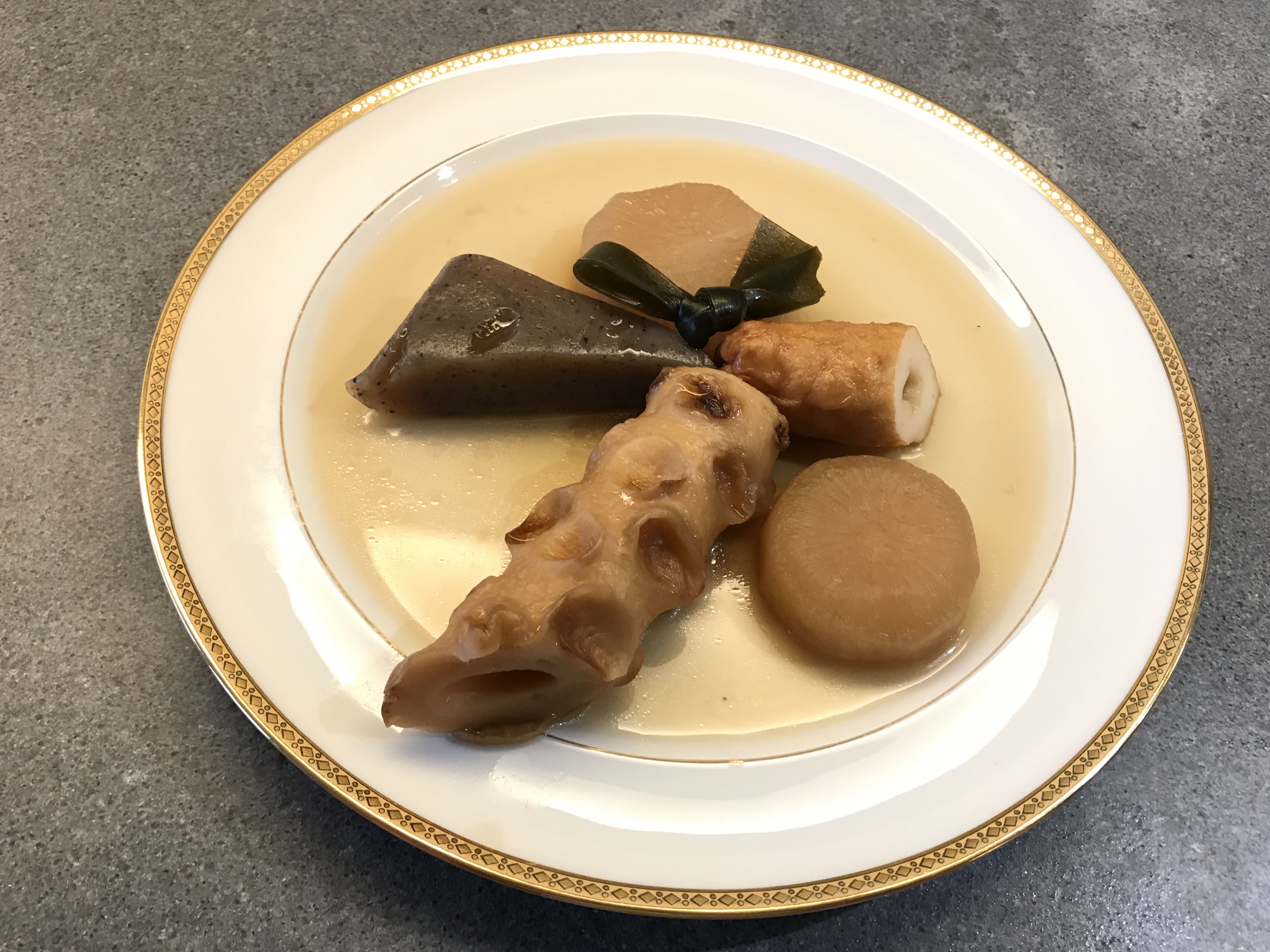
Oden

A traditional Japanese dish, often enjoyed in winter. It is tasty, light and full of surprises. Oden is a meal that requires a bit more work (and of course time) then you would expect. It also requires some shopping, given some of the ingredients are not easy to find. We enjoyed our first Oden at the Taishunken restaurant in the famous Sankeien Garden in Yokohama. Loved it!
We are not from Japan so we humbly present our version of this classic. We hope it inspires you to cook Oden and enjoy it as much as we did.

Pairing

A cup of Japanese green tea is the obvious choice.
You could also combine your oden with a glass of Chardonnay (with a touch of oak perhaps), for instance if you serve it for dinner. Oden is rich in flavours, umami of course, but not spicy, so we would not suggest a Gewürztraminer or a Sauvignon Blanc.
A glass of cold, dry sake will also be great.

What You Need

  • For the Dashi
    • 1 litre of Water
    • 20 grams of Dashi Kombu (Rishiri Kombu)
    • 20 grams of Katsuobushi (Bonito Flakes)
  • For the Stew
    • One Daikon
    • One Pack of Konnyaku
    • 1 sheet of Hayani Kombu
    • Chikuwa Fish Cakes
    • One Pack of Gobo Maki Burdockroot Fish Cakes
    • 2 boiled eggs
    • Abura Age Fried Tofu
    • Mochi (Sticky Rice Cake)
    • Soy Sauce (preferably one with less salt)
    • Mirin
  • Karashi
  • Rice with ginger

What You Do

First step is to peel the daikon and slice it (2 centimeters is best). Now use a sharp knife to plane of the edge of the daikon. This improves the presentation, and it is supposed to stop the daikon from falling apart. Cook the daikon for one hour in water. Drain and set aside.
In parallel: cut the konnyaku in triangles and cook these in water for 15 minutes. Konnyaku is made from the konjac plant and is specific for the Japanese cuisine.
Also in parallel: cook the sheet of Hayani Kombu for 5 minutes. This is young kombu and edible, different for the one you use when preparing dashi. Let cool a bit, slice and knot ribbons. Not sure why but is looks great when you serve it. (Yes, well spotted, it’s not in the picture; unfortunately, we couldn’t find Hayani when we prepared our oden.)
Make 1 litre of dashi. This seems simple but requires precision. Clean the kombu with a wet cloth and put into one litre of cold water. Gently raise the temperature to 80 °C or 175 °F. Remove and discard the kombu. Bring the liquid to a boil, add the katsuobushi, bring to a boil and immediately set heat to zero. Wait 5 minutes or so. The katsuobushi will sink to the bottom of the pan. Now very gently pass the liquid through a wet towel or a sieve. Do not squeeze, just give it time. The result will be a great, clean dashi.

Now it’s time to add the dashi to the pan (should be a clay pot, but we stick to our Le Creuset), add one tablespoon of mirin, one (or two, depending on your taste) of light soy sauce, add the daikon, the konnyaku, the chikuwa fish cakes and the gobo maki burdockroot fish cakes.
Allow to simmer for at least 2 hours. 30 minutes before serving add boiled eggs, two Hayani ribbons, fried tofu and mochi. The last two ingredients must be combined by putting the mochi into the tofu.
Serve with karashi (Japanese mustard, which is different from wasabi by the way) on the side.

  • Oden ©cadwu
  • Oden with names of Ingredients ©cadwu

Fish Cakes by Jean Beddington

Jean Beddington: a culinary, passionate creative! She was chef at five restaurants, owned her own successful restaurant, and still is an inspiration to many. One of her motto’s is ‘seemingly simple’, not with the intention to impress but with the intention to surprise and enhance the sensation when enjoying her food and the way it is presented.

Background

In her book Absolutely Jean Beddington she writes about her background, her youth in England, her eagerness to cook, the holidays with her father when they would stay at budget hotels and eat at Michelin Star restaurants, her travels, her years in Japan and her education (she studied Arts and Chemistry). When she moved to the Netherlands, she decided to become a chef, which is the obvious choice for someone with such a talent. She was one of the first to bring new ingredients to the classic French cuisine. For instance, she began using cilantro and yuzu. She was also inspired by the Japanese way of presenting food: beautifully designed and served on a variety of plates. She began doing this when most guests still expected bread and garlic butter at the beginning of their lunch or dinner.

Books

She published several books. One is dedicated to stock: the basis of soups, sauces and dishes. She explains how to make stock and how to create delicious food, for instance green vegetables in stock with couscous, yogurt and harissa sauce. 

Her book Absolutely Jean Beddington is very dear to us. It has three main chapters: the first one is called Glossy with beautifully presented food, the second one is called Real Time with food as you could expect to eat at her restaurant (which is closed, unfortunately) and our favourite chapter is called Daily. Indeed, recipes that are easy to follow and help prepare tasty, wonderful food, every day.

Fish Cakes

We prepared her fish cakes with a beetroot, ginger, apple and onion chutney. The fish cakes are intriguing and the chutney is the perfect accompaniment. Yummy!

Oden

A Traditional Japanese Dish

If we say ‘Japanese food’, you will probably think ‘sushi’, ‘sashimi’, ‘yakitori’, perhaps ‘udon’. But Oden? Probably not. Such a shame because Oden is a really wonderful dish. Oden for lunch or as a course in a typical Japanese menu: tasty, light and full of surprises. Oden is a stew that requires a bit more work than you would expect and of course time. It also requires some shopping, given some of the ingredients are not easy to find.
We are not from Japan so we humbly present our version of this (wintery) classic. We hope it inspires you to cook Oden and enjoy it as much as we did.

Wine and Sake pairing

We preferred a glass of Chardonnay with the Oden during our dinner; others preferred a glass of cold sake. The stew is rich in flavours, umami of course, but not spicy, so we would not suggest a Gewurztraminer of a Sauvignon Blanc. A Chardonnay (with a touch of oak perhaps) will be a good choice.

What You Need

  • For the Dashi
    • 20 grams of Dashi Kombu (Rishiri Kombu)
    • 25 grams of Katsuobushi (Bonito Flakes)
  • For the Stew
    • One Daikon
    • Chikuwa Fish Cakes
    • One Pack Konnyaku
    • One Pack of Gobo Maki Burdockroot Fish Cakes
    • 1 sheet of Hayani Kombu
    • 2 boiled eggs
    • Abura Age Fried Tofu
    • Mochi (Sticky Rice Cake)
    • Soy Sauce (preferably one with less salt)
    • Mirin
  • Karashi

What You Do

Start by making one litre of dashi. This seems simple but requires precision. Clean the kombu with a wet cloth and put into one litre of cold water. Gently raise the temperature to 80° Celsius or 176° Fahrenheit. Remove and discard the kombu. Bring the liquid to a boil, add the katsuobushi, bring to a boil and immediately set heat to zero. Wait 5 minutes or so. The katsuobushi will sink to the bottom of the pan. Now very gently pass the liquid through a wet towel. Do not squeeze, just give it time. The result will be a great, clean dashi. Cool and set aside.
Next step is to peel the daikon and slice it (2 centimeters is best). Now use a sharp knife to plane of the edge of the daikon. This improves the presentation and it is supposed to stop the daikon from falling apart. Cook the daikon for one hour in water. Drain and set aside.
Step three is to cut the konnyaku in triangles and cook these in water for 15 minutes. Konnyaku is made from the konjac plant and is specific for the Japanese cuisine.
Step four is to cook the sheet of Hayani Kombu for 5 minutes. This is young kombu and edible, different for the one you used when preparing dashi. Let cool a bit, slice and knot ribbons. Not sure why, but is looks great when you serve it.
Now it’s time to add the dashi to the pan (should be a clay pot, but we stick to our Le Creuset), add one tablespoon of mirin, one (or two, depending on your taste) of soy sauce, add the daikon, the konnyaku and the fish cakes.
We served our oden as a course during dinner, so we limited the number of ingredients. If served for lunch add boiled eggs, fried tofu and mochi. The last two ingredients have to be combined by putting the mochi into the tofu.
Allow to simmer for at least 2 hours. Best is, as always, to serve it the next day.
Serve with some karashi (Japanese mustard, which is different from wasabi by the way).

Oden © cadwu
Oden © cadwu