Pork with Enoki

It’s nearly the end of the mushroom season in Europe. It’s hard to find chanterelle (girolle), and nearly impossible to buy fresh cèpes. The black winter truffle (Tuber melanosporum) is an exception. It’s available until March, but the price may be prohibitive. Better to focus on cultivated mushrooms, such as enoki, available at your local Asian supermarket. A delicious mushroom with a pleasant texture and aroma. Its flavour is mild, a bit sweet and fruity. You can use it raw in a salad, in a soup or combine it with soba noodles. A few weeks ago, we wrote about an omelette with enoki and a light soy sauce. The result is a lovely sweet, rich and intriguing dish.
Combining enoki with pork is also a great idea. Feel free to adjust the recipe and make the sauce spicier or sweeter or thicker. The result will be tasty given all three elements in the dish bring some kind of sweetness.

Wine Pairing

You could emphasize the Asian influence by serving a glass of Pinot Gris, Riesling, Chenin Blanc or perhaps Soave. In general you’re looking for a light or medium bodied, unoaked, dry white wine with nice acidity. Benefits are minerality and florality. A glass of Côtes de Provence rosé will also be a good choice.
If you want to focus on the flavours of the pork, we suggest a glass of Beaujolais or a glass of wine made with Grenache (France) or Garnacha (Spain) grapes.

What You Need

  • Organic Pork Tenderloin
  • 100 grams of (Golden) Enoki
  • Soy Sauce
  • Light Soy Sauce (we used Tentsuyu)
  • Stock
  • Oyster Sauce
  • Black Bean Sauce (optional)
  • Red Chili Paste (optional)
  • Olive Oil

What You Do

Fry the pork in olive oil until pink. Turn on a regular basis. Remove the stem (bottom) of the enoki. Fry in olive oil for maximum one minute. Add some (vegetable stock), soy sauce, oyster sauce, black bean sauce and red chili paste and create a not overly sweet, intense sauce. We like some spiciness, hence the chili paste. Serve the meat on top of the enoki mixture.

Enoki with Eggs and Soy Sauce

Enoki is one of the most popular mushrooms. It’s been cultivated for many years (or better: centuries) and it is available in Asian supermarkets as enokitake. The cultivated enoki grows in the dark, hence it being white, and needle shaped with a small cap. Wild enoki benefits from the exposure to light and becomes brown and its shape is more mushroom-like. The golden enoki we use is also cultivated. 

Enoki has a pleasant texture and aroma. Its flavour is mild, a bit sweet and fruity. You can use it raw in a salad, in a soup or combine it with soba noodles. Combining it with pork is also a great idea. We decided to prepare an omelette with a light soy sauce. The result is a lovely sweet, rich and intriguing omelette.
We’re not sure if it’s an appetizer in its own right or that is should be served alongside other dishes. Suggestions welcome!

Wine Pairing

We enjoyed our golden enoki with a very special wine: Sint Catharinadal Norbertus 2022. The wine is made in the Netherlands by the sisters of the Norbetine convent, founded in 1271. For centuries the sisters used the grounds for cattle and corn. Since 2017 they also produce wine, with the help of many volunteers and experts. Their motto is I am the true vine, and my Father is the vinedresser.  Amongst the grapes are Chardonnay, Pinot Gris, Pinot Blanc, Pinot Noir, Auxerrois and Gamay. We would suggest opening a bottle of their white wine. It has subtle aromas (apple, pear, melon), some acidity and its taste is very pleasant (fruit, touch of almonds).
More information (in Dutch only) on their website. The wine can be bought via Les Généreux.

What You Need

  • 100 grams of (Golden) Enoki
  • 2 Eggs
  • Light Soy Sauce (we used Tsuyu)
  • 3 cloves of Garlic
  • ½ red Chilli Pepper
  • 2 Spring Onions (Scallions)
  • Olive Oil

What You Do

Remove the stem (bottom) of the enoki. Blanch the mushrooms for 60 seconds in very hot water. Remove and pat dry using kitchen paper. Start making a sauce with soy sauce, garlic, pepper and spring onions. Reduce. Fry the mushrooms in oil, just to remove excess water. Reduce temperature. Beat the eggs and add the mixture to the pan. Allow to become a moist omelette on very low heat. Remember not to fry it! The egg should set and become baveuse. Transfer the omelette to a plate, use a spoon to cover the omelette with the liquid and decorate with a mixture of garlic, spring onion and chilli pepper.

The Quiet Hunt

Antonio Carluccio’s The Complete Mushroom book is more than a cookbook. The first part of the book discusses foraging and collecting mushrooms, with clear descriptions of each mushroom and poisonous look-alikes. It’s a pleasure to read, but we’re not brave enough to start our own quiet hunt.

Fortunately, mushrooms are becoming more popular and greengrocers and supermarkets have started selling chestnut mushrooms, button mushrooms and shiitake. Asian supermarkets in most cases sell (king) oyster mushrooms, shiitake, enoki and shimeji.
Don’t be tempted to buy dried mushrooms: expensive, no aroma, nasty taste and not even close to a fresh mushroom.

Recipes

The second part of the book includes some 150 mushroom recipes, ranging from classic Italian dishes to culinary treats. Carluccio’s recipes are well written and informative. You’ll get the feeling that he lets you in on some of his secrets. And given he started foraging mushrooms as a young child, there are a lot of secrets to share!

One of our favourites is a salad made with maitake, fresh scallops, crab and shrimps. It’s an amazing result, with lots of pleasant flavours, also thanks to the cilantro, dill and parsley. Part of the fun is that the scallops are not seared but prepared like ceviche. Maitake is also available as a cultivated mushroom.

Caponata

More favourites? Of course! How about Mushroom Caponata or Tagliolini with black truffle? The caponata is a combination of mushrooms, egg plant and various herbs, so if you can buy button mushrooms and for instance shiitake, you’re ready to go.

Our all-time favourite from this book is the combination of fresh oysters with white truffle (bianchetti). A starter we prepare once or twice a year, depending on the availability of the truffle. Always a pleasure…

The Mushroom Book – the Quiet Hunt was published in 2001. It’s available (in most cases second hand) via channels such as Amazon and e-Bay for prices between 25 and 50 euro.

One of the very best books on mushrooms, written by a true expert.

PS

Later we found an earlier book by Antonio Carlucci called A Passion for Mushrooms, published in 1989. Very little overlap in recipes. A must-have for mushroom lovers!

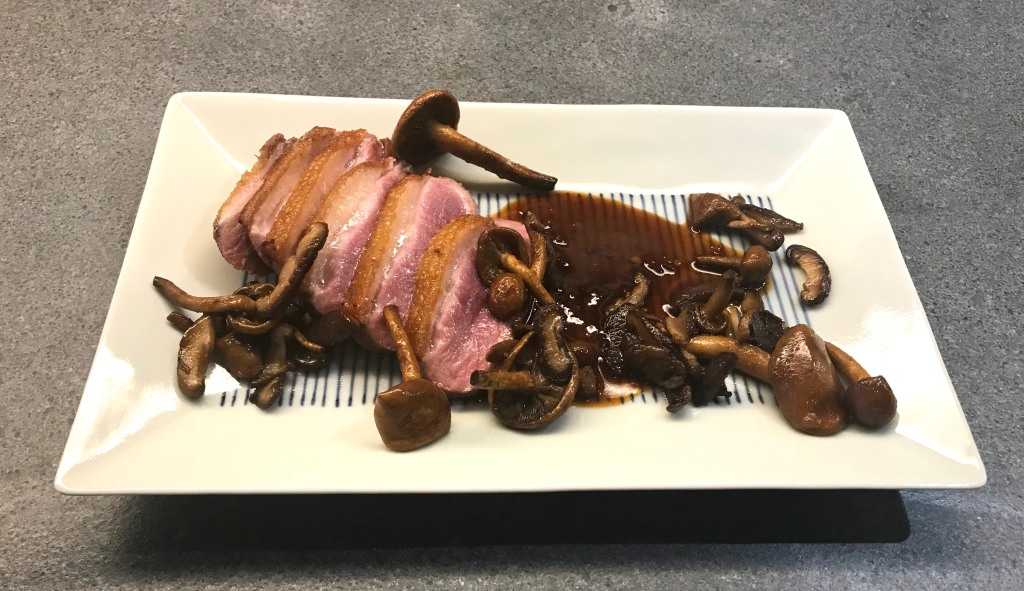
Duck with Soy Sauce and Mushrooms

In his book Yamazato, Kaiseki Recipes: Secrets of the Japanese Cuisine, author and Michelin Award winning chef Akira Oshima includes a recipe for breast of duck, marinated in a soy-based sauce, served with Belgian endive (chicory) and karashi (Japanese mustard). A mouth-watering dish. The book contains some 20 recipes that are technically challenging (at least, we think so) and well written.

In general the combination of duck and soy sauce works really well. It’s all about sweetness and umami. The Japanese mushrooms (shiitake, enoki, nameko and/or shimeji) add nuttiness and texture to the dish.
We use soy sauce and tsuyu: a mix of soy sauce, mirin and dashi, ideal for making a tempura dip and great to give extra flavor to the sauce.

Wine Pairing

We enjoyed our duck with a glass of gewurztraminer (full bodied and long lasting with aromas of lychees and roses) but there are many options in this case. Perhaps a nice rosé or a sake with a touch of sweetness?

What You Need

  • Breast of Duck
  • Japanese Mushrooms
  • Soy Sauce (preferably with less salt)
  • Tsuyu
  • Chicken Stock
  • (Olive) Oil
  • Mirin
  • (optional) Sake

What You Do

Start by cleaning the breast of duck and then fry it, straight from the fridge, for 12 minutes on the skin-side and 2 minutes on the meat-side in a non-stick pan. Wrap in foil, making sure the skin is not covered. Clean the pan with kitchen paper and fry the sliced mushrooms for 5 minutes or so in oil until ready. Set aside and keep warm. Add soy sauce, tsuyu and chicken stock to the pan and reduce. Add a splash of sake and some mirin. Add cooking liquid of the duck. Let simmer for a few minutes, add the mushrooms and make sure they are coated with the sauce. Slice the duck, add liquid to the sauce, stir and serve.

Duck with Soy Sauce and Mushrooms ©cadwu