
Caramelised Belgian Endive with Lemon

Belgian Endive (or Chicory or Witloof) used to be a fairly bitter vegetable. There were two ways of solving this: cook it for a long time in salted water and/or remove the solid part from the stem. Today’s Belgian Endive is not that bitter, so you can happily enjoy all of it and forget about cooking it.

A traditional way of preparing Belgian Endive is to blanch it in boiling water, drain, then wrap the endive in ham, cover it with a béchamel sauce with cheese (sauce mornay) and chapelure. Transfer the dish to the oven until golden. It’s a nice way of preparing Belgian Endive when you want to take a trip down memory lane.
Another option is to slice it and make a salad, preferably the one created by Antonio Carluccio. His salad with truffle and truffle oil is brilliant.
A much better idea is to caramelise Belgian Endive in a hot skillet. Adding lemon juice will enhance the bitterness of the Belgian Endive and add acidity. And if you bought the right kind of lemon, you will also have a floral touch because of the bergamot.

Enjoy the caramelised Belgian Endive with lamb or pork chops.

Wine Pairing

A simple full-bodied red wine will work very well with the Belgian Endive. Make sure it’s not too subtle!

What You Need
  • Belgian Endive
  • Olive Oil
  • (optional) Butter
  • Lemon
What You Do
  1. Clean the Belgian Endive by removing the outer leaves and cut in half (top down)
  2. No need to remove the centre core
  3. Heat a skillet
  4. Add olive oil
  5. Place the Belgian Endive in the pan, flat side down
  6. Keep on medium heat for some 10 minutes until caramelised, so really dark brown
  7. Turn the Belgian Endive and continue for another 5 to 10 minutes
  8. Optional: reduce heat and add some butter
  9. When you’re happy with the result, add fresh lemon juice to taste
  10. Leave in the pan for a few seconds
  11. Stir and check the taste
  12. Serve on a hot plate
PS

If you feel inspired by this recipe, then search for Witloof from Belgium by Liesbeth Hobert and Felix Alen. Over 150 pages with suggestions how to prepare Witloof. Pity it’s in Dutch only, despite its title.
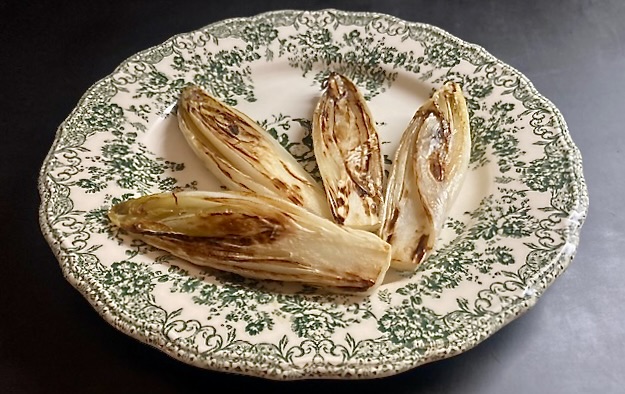
Belgian Endive ©cadwu caramalised with olive oil and lemon juice
Belgian Endive ©cadwu

Belgian Endive with Cheese Sauce and Ham

When asked for a typical Flemish dish, award winning chef Jeroen Meus immediately mentioned Belgian Endive with Cheese Sauce and Ham.
At home we found the recipe in my mother’s kookschrift, a notebook with recipes she learned as a young woman. She would cook the dish often, typically on a Sunday evening, and serve it with mashed potatoes. Her recipe is fairly straightforward: wash and clean the Belgian endive and cook it for 30 minutes (the recipe is from 1950!) in salted water. Then make a béchamel sauce, add cheese, wrap the endive in ham, spoon the sauce over the vegetables, add butter and breadcrumbs and transfer the combination to the oven for 15-20 minutes. Done!

Actually, her recipe is not very different from how Jeroen Meus prepares the dish. He doesn’t use breadcrumbs and he adds nutmeg and a splash of lemon to the sauce. He suggests steaming or braising the endive.

Most recipes mention removing the bitter core of the Belgian endive. Perhaps that was necessary in 1950, but today’s Belgian endive is not as bitter, so there is no need to do that. Belgian endive must have some bitterness.

Wine Pairing

Enjoy your Belgian Endive with a nice glass of red wine, one with a bite and not too complex. For instance a blend of Cabernet Sauvignon and Syrah from France, a Carmenère from Chili or a Spanish Rioja (Crianza or Joven). 

What You Need

  • For the Endive
    • 4 Belgian Endive
    • 4 slices of Excellent Organic Cooked Ham
    • For the Cheese Sauce
      • 20 grams of Flour
      • 20 grams of Butter
      • Milk
      • 75 grams of grated Cheese (preferably a combination of Gruyère and Emmentaler)
      • optional: one Egg Yolk
    • Nutmeg
    • White pepper
  • For the Mash
    • Root Parsley
    • Parsnip
    • Nutmeg
    • Fresh Parsley
    • White Pepper

What You Do

  1. Chop the bottom of the base of the endive and remove the outer leaves if they don’t look great
  2. Steam the endive or braise in butter. We prefer braising in butter, which may take 30 minutes on low heat. This way you keep all the flavors and the texture. If steamed: make sure you squeeze the endives gently to get rid of the water excess
  3. Make the cheese sauce with flour, butter and milk, adding most of the grated cheese when the béchamel is ready
  4. Add grated nutmeg and white pepper to taste
  5. You could turn it into a classic Sauce Mornay by adding one egg yolk to the sauce
  6. Preheat the oven (200°C or 390 °F). Wrap a piece of ham around each endive and arrange in a shallow baking dish. You don’t want any space between the endive
  7. Spoon the sauce over the endive
  8. Sprinkle remainder of the cheese over the sauce
  9. Bake until golden brown on top, 15 to 25 minutes
  10. We prefer using the grill

For the Mash

  1. Clean and dice the root parsley and the parsnip (ratio 1:1)
  2. Cook quickly in a limited amount of water
  3. When ready, drain and mash using a blender
  4. Add nutmeg and white pepper
  5. Just before serving add lots of finely chopped fresh parsley.