Smoked Salmon and Egg Salad

The joy of preparing food together, the joy of eating tasty and simple food, the joy of sharing. It’s one of the themes of Together: Our Community Kitchen, our suggestion for this year’s Christmas cookery book. It was written by a group of residents, gathering in the aftermath of the Grenfell Tower fire in London. They began cooking food for their families, friends and neighbours. Food that helped restore hope and provided a sense of home.

The recipe for this tasty salad is simple, quick and fun to make. It is rich, with warm flavours, a bold structure and of course lots of salmon. The egg yolks are set, but only just, adding to the great mouthfeel. Take some crusted bread, put the salad on top of it, perhaps a bit extra?, and enjoy!

Wine Pairing

A glass of dry sparkling wine will be great. A glass of Sauvignon Blanc or Chardonnay will also fine, as long as the wine is acidic enough to balance the fat from the fish and the egg. We enjoyed a glass of Sicilian white wine made by Baglio di Grìsi with the local grillo-grape. This full-bodied wine has the right level of acidity and minerality. Excellent with the salmon and the egg.

What you need
  • 2 Organic (or Demeter) Eggs
  • 100 grams organic Smoked Salmon
  • Chives
  • Mayonnaise
  • Crème Fraîche
  • Mustard
  • Lemon
  • Black pepper
What You Do

Boil the eggs until slightly set. Peel and let cool. Coarsely slice the salmon. Same with the eggs. Chop the chives. Combine one tablespoon of mayonnaise, 2 teaspoons of crème fraîche, 1 teaspoon of mustard, chives, a few drops of lemon and black pepper. Add the salmon and combine. Add the egg and gently combine. Now it’s a matter of tasting. Perhaps you want to add more mayonnaise, crème fraîche or lemon. Let cool and serve with crusted bread.

We wish you a wonderful 2025 with lots of culinary adventures!
Mr. Cook and Mr. Drink

Deviled Eggs with Chervil and Crayfish

Deviled (or stuffed) eggs are a traditional appetizer or hors-d’œuvre, easy, tasty and always welcome. Simply cook the eggs, halve them, scoop out the yolk and mix with butter, cream or mayonnaise and add for instance mustard, or curry powder, or pickles or, well, actually, most combinations work.

The idea of deviled or stuffed egg goes back many years. See for instance this recipe from Carolus Battus (published in 1593). Or try this recipe for uova ripiene from Pellegrino Artusi (1891): boil, peel and halve the eggs. Use one anchovy per two eggs. Use a fork to combine anchovy, egg yolk, a little parsley, very little onion and butter to make a smooth paste. Stuff the eggs with the paste and cover with mayonnaise.

Artusi also described a second recipe: stuff the eggs with a mixture of egg yolk, bread (soaked in milk) and mushrooms (soaked in lukewarm water). Stuff the eggs. Arrange the eggs in an oven dish, cover with potato puree and serve warm. We could imagine topping with grated cheese and turn it into Deviled Eggs Au Gratin.

We combine the eggs with mayonnaise, mustard, chervil and crayfish. Chervil is a delicate herb. It brings a hint of liquorice or anise to food, for instance to omelettes, salads or in this case the egg mixture and the cray fish. Decorating with chervil is not only nice; it also makes the chervil more present.

Drink Pairing

Deviled eggs are flexible when it comes to drink pairing. Simply enjoy with your favourite drink!

What You Need
  • 6 Organic Eggs
  • Dijon Mustard
  • Mayonnaise
  • Chervil
  • Cray Fish
  • Black Pepper
What You Do

Boil the eggs, peel and halve. Scoop out the egg yolk, finely chop the chervil, add a teaspoon or two of mustard (after all, they are called deviled egg), two or three teaspoons of mayonnaise, some black pepper and a generous amount of chervil. Mix with a fork. Taste and adjust. Stuff the eggs and decorate with grayfish and chervil. Keeps well in the refrigerator for a few hours if covered with cling foil. Just before serving, decorate the eggs with chervil.

Deviled Eggs with Chervil and Crayfish ©cadwu

Deviled Eggs with a Twist

Easy to make, tasty, and most people love them. You only need a few simple ingredients such as hard boiled (organic) eggs, mayonnaise, Dijon mustard, vinegar (or lemon juice) and black pepper. Sprinkle some paprika on top and they’re ready.

Alas, we’re not huge fans of paprika. Why would you ruin lovely ingredients like egg, mayonnaise and mustard by adding a spice that is at best a touch sweet and in most cases bland?

Paprika (powder) is made from dried red peppers and probably originates from Mexico. When it was brought to Europe, local versions were created, for instance a hot Hungarian version (essential when making goulash) and a smoked Spanish version (pimentón, key ingredient of chorizo and paella). Local peppers were used, including red bell pepper, and the flavours ranged from mild and sweet to hot. By the way, the term ‘deviled’ refers to the spiciness of the dish.
Unfortunately, nowadays factory produced paprika seems to be used for its red colour only.

We combine a bit of everything by adding roasted bell pepper. It adds depths, smokiness, complexity and flavour.

What You Need

  • 6 organic Eggs
  • Mayonnaise
  • Dijon Mustard
  • Lemon Juice
  • Red Bell Pepper
  • Black Pepper
  • Parsley (optional)

What You Do

Grill the bell pepper in your oven until nicely burned, perhaps 10 minutes. Transfer to a plastic container and close the lid. Wait a few hours before peeling the bell pepper. Use a sharp knife to mash the bell pepper. It’s fine if the mash has a bit of structure.
Boil the eggs and let cool. Slice the eggs lengthwise, remove the yolk. Use a fork to crumble the yolks (mimosa) and then combine with mayonnaise, mustard and mashed bell pepper. Add lemon juice and black pepper to taste. Remember the stuffing should be ‘devilish’. Add mixture to the egg whites. Decorating with parsley gives an extra twist to the deviled eggs.

Deviled Eggs ©cadwu
Deviled Eggs ©cadwu

Eggs Poached in Tomato Sauce

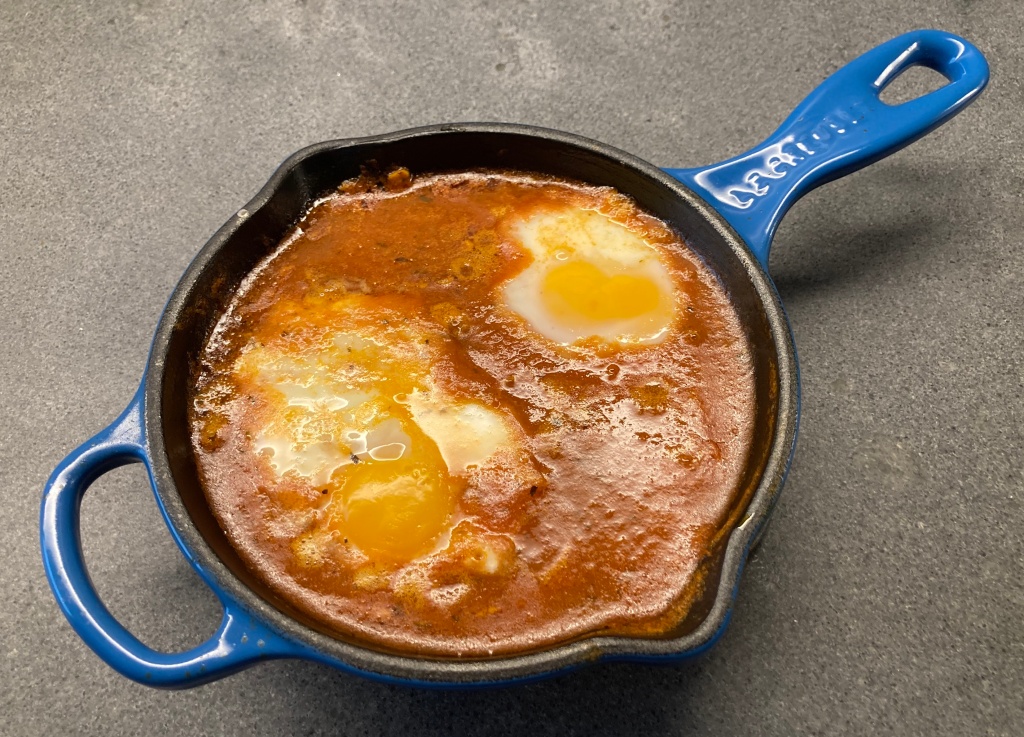
Poaching eggs in water requires a bit of technique or a nice tool. Poaching eggs in tomato sauce is slightly different: you want to keep the white close to the yolk, but it should not envelope it: the yolk must remain visible.

The combination of tomato sauce and egg seems to be a bit odd, but the rich, runny egg in combination with the slightly acidic, aromatic tomato sauce is really nice. Great suggestion for lunch or a hearty breakfast. Feel free to create your own version of this dish, for instance by adding some parsley or cheese. Serve with crusted bread.

In most cases the result is shown in a pan. For good reasons: it does not look very attractive when served on a plate. The fun is definitely in the flavours and aromas.

What You Need

What You Do

Warm the tomato sauce and reduce. Increase the heat until the sauce is nearly boiling, gently add the eggs (as you would do when poaching eggs in water) and reduce heat. Using a small spoon make sure the white remains close to the yolk, without covering it. Wait until the white is set. Perhaps add some freshly grounded black pepper.

Eggs Poached in Tomato Sauce ©cadwu

Asparagus with Scrambled Eggs and Shrimps

Asparagus and eggs, it’s a match made in heaven. For instance à la Flamande (with boiled egg, butter, parsley and ham) or more exotic with Kimizu or with scrambled eggs, chives and shrimps.

Shrimps?

Indeed, with small excellent shrimps, preferably freshly peeled; not used as an ingredient but as an element of flavour. The first time we tasted this combination we were surprised by the role of the shrimps. The salty, intense taste, balanced with the very rich eggs and the sweet-bitter asparagus is a very clever idea. The chives in the scrambled eggs lift the dish to a higher level.
Unfortunately we don’t know who created it, so we offer the recipe with a caveat.

Scrambled eggs?

Preparing scrambled eggs, it seems obvious and simple, but actually we are looking for a version that is more like a sauce. Gordon Ramsey’s instructive and hilarious video shows you how to make scrambled eggs, so no need for us to explain. You need to stop a bit earlier, given it needs to have a sauce-like consistency.

Wine Pairing

We decided to drink a glass of Rivaner from the house Gales in Luxembourg. The aroma made us think of grapefruit, ripe melon and apple. The taste is elegant with a touch of sweetness, acidity and minerality. Ideal with our dish! The sweetness with the asparagus, the acidity in combination with the scrambled eggs and chives, the minerality with the shrimps. And the taste is surprisingly long lasting, which is perfect with such a rich dish.

What You Need

  • 6 White Asparagus
  • 2 Eggs
  • Butter
  • Chives
  • Crème Fraiche
  • White Pepper
  • A Few Small (unpeeled) Shrimps

What You Do

Peel the asparagus and steam for 20 minutes or so. They should have a bite. Prepare scrambled eggs à la Ramsay. Serve the asparagus with the scrambled eggs and just a few shrimps. Done!

Caudle, Eggnog, Ajerkoniak and Advocaat

In the old days new mothers and their visitors were served Caudle, a combination of white wine, eggs, sugar, cloves, raisins, nutmeg and cinnamon. The idea was to strengthen the new mother and of course to celebrate the occasion. Dutch master Jan Steen painted De Kandeelmakers (The Caudle Makers) around 1665. Note the nutmeg grater!

The ingredients are not too dissimilar to those of Eggnog. Basically this is custard infused with various spices, such as vanilla, nutmeg, cinnamon and cloves. The custard is enriched with whole cream, rum/brandy/whisky/cognac and whipped egg white. Our Eggnog was very tasty, creamy and soft with the right push from the cognac. The spices worked really well, especially the nutmeg. We suggest not adding cream because it actually doesn’t bring much other than a fatty feeling in your mouth.

A less complex version is Ajerkoniak from Poland. It combines egg yolks with non-sweetened condensed milk, sugar and vodka (or plain alcohol). The result is a strong, smooth and sweet drink. The vodka worked very well with the eggs but we thought the condensed milk was a bit too present.

Making Caudle, Ajerkoniak or Eggnog begins with whisking sugar and egg yolks until it’s smooth, pale and creamy. This is called whisking the eggs ruban and may take 10 minutes. Interestingly the result is a dish in its own right called Kogel Mogel.

We also prepared Advocaat from the Netherlands. It is a combination of eggs, alcohol and sugar (so no milk, cream or spices). It can be enjoyed as a drink (but our grandmother used a small spoon, probably because she didn’t want to be heard slurping). Our version is a bit thicker, making it ideal as a dessert.

What You Need

  • 2 Egg Yolks
  • 25 grams of Sugar
  • 50 ml of Brandy, Gin or Vodka
  • Whole Cream

What You Do

  1. Mix the egg yolks and the sugar well. It doesn’t need to become ruban but some increase in volume is needed
  2. Now gently add brandy, gin or vodka
  3. Transfer to the microwave and very gently heat the mixture. We used one interval of 10 seconds to start with and continued with intervals of 5 seconds. In total only 55 seconds on 30% power
  4. Stir well after every interval until it becomes thick
  5. The consistency must be similar to a thick pastry cream (crème pâtissière)
  6. Cool quickly and store in the refrigerator
  7. Serve with some whipped cream

PS Obviously you need fresh eggs when making Ajerkoniak, Eggnog, Kogel Mogel, Advocaat, Mayonnaise, Sabayon, Béarnaise, Kimizu et cetera. We don’t think eating fresh, organic eggs is a problem. Eating all kinds of additives, chemicals such as E102 – Tartrazine to make commercial Advocaat look as yellow as real Advocaat, unclear syrops, modified milk ingredients, guar gum, monoglycerides etcetera, that’s a problem.

  • Advocaat ©cadwu
  • Eggnog ©cadwu
  • Ajerkoniak ©cadwu

Eggs Benedict with Kimizu

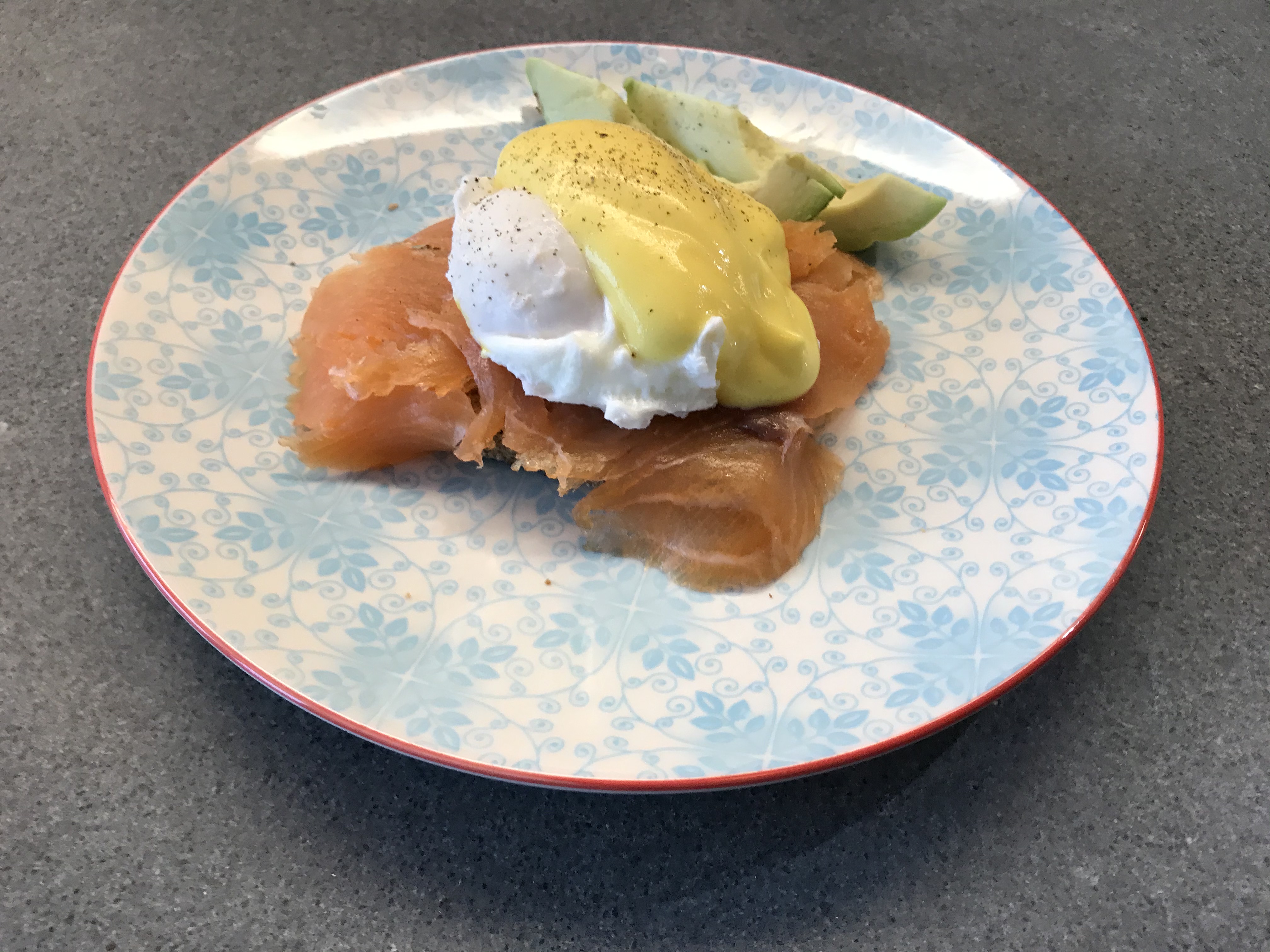
Preparing Eggs Benedict comes with two technical challenges: Hollandaise Sauce (Kimizu in our case) and Poached Eggs.
Poaching an egg seems simple and straightforward when you watch the video made by chef Jacques Pepin, But we know that they’re intimidating to make plus it’s really challenging to get them just right: especially the gooey, liquid yolk.

Chef Pepin makes some very important suggestions: the main protein in egg white is Ovalbumin and it sets at 84,5 °C or 184 °F . According to chef Pepin the egg white becomes rubbery when the water temperature is too high. And he is right! Keep the water hot, but not boiling, when ‘boiling’ or poaching an egg.
He also mentions that the eggs must be cold. Makes sense, because then the yolk will remain runny.
And finally he explains how to store pre-poached eggs, reducing stress in the kitchen.

But the challenge remains: poaching an egg requires skills and experience. Or an OXO good grips egg poacher. Yes, we know, it sounds like another disappointing, expensive, and silly kitchen tool, but it actually works really well. Easy to use, easy to clean and great results, again and again.

What You Need

  • For the Poached Eggs
    • 2 cold, organic Eggs
    • Vinegar
  • For the Kimizu
    • 2 Egg Yolks
    • 1,5 tablespoon of Rice Vinegar (depending on the size of the egg yolks and the acidity of the vinegar)
    • 3 tablespoons of Water
    • 2 teaspoons of Mirin (1 could also be fine, depending on your taste)
  • English muffins or a slice of home made Bread
  • Salmon
  • Avocado
  • Black Pepper

What You Do

Best to make the poached eggs in advance and store them in cold water. Just before serving warm them in a pan of hot water. With the OXO poacher it’s simple: fill a pan with water and add a splash of vinegar. Bring the water to a simmer and crack an egg into the centre of the each poacher. You could also crack the egg into a little bowl or cup and then drop it into the centre of the poacher. After 30 seconds or so you can remove the OXO poacher and use it for another egg. We poached our eggs for 3 minutes maximum. Dry the poached eggs with kitchen paper and trim the egg white if necessary. Serve with toasted muffin or bread, salmon, avocado and of course Kimizu.

Omelet with Winter Truffle

Black truffles are harvested from November to March, so be extravagant and buy one before the season ends. When buying a truffle, please ask if it’s okay to smell them, because the aroma will tell you everything you need to know about the quality.
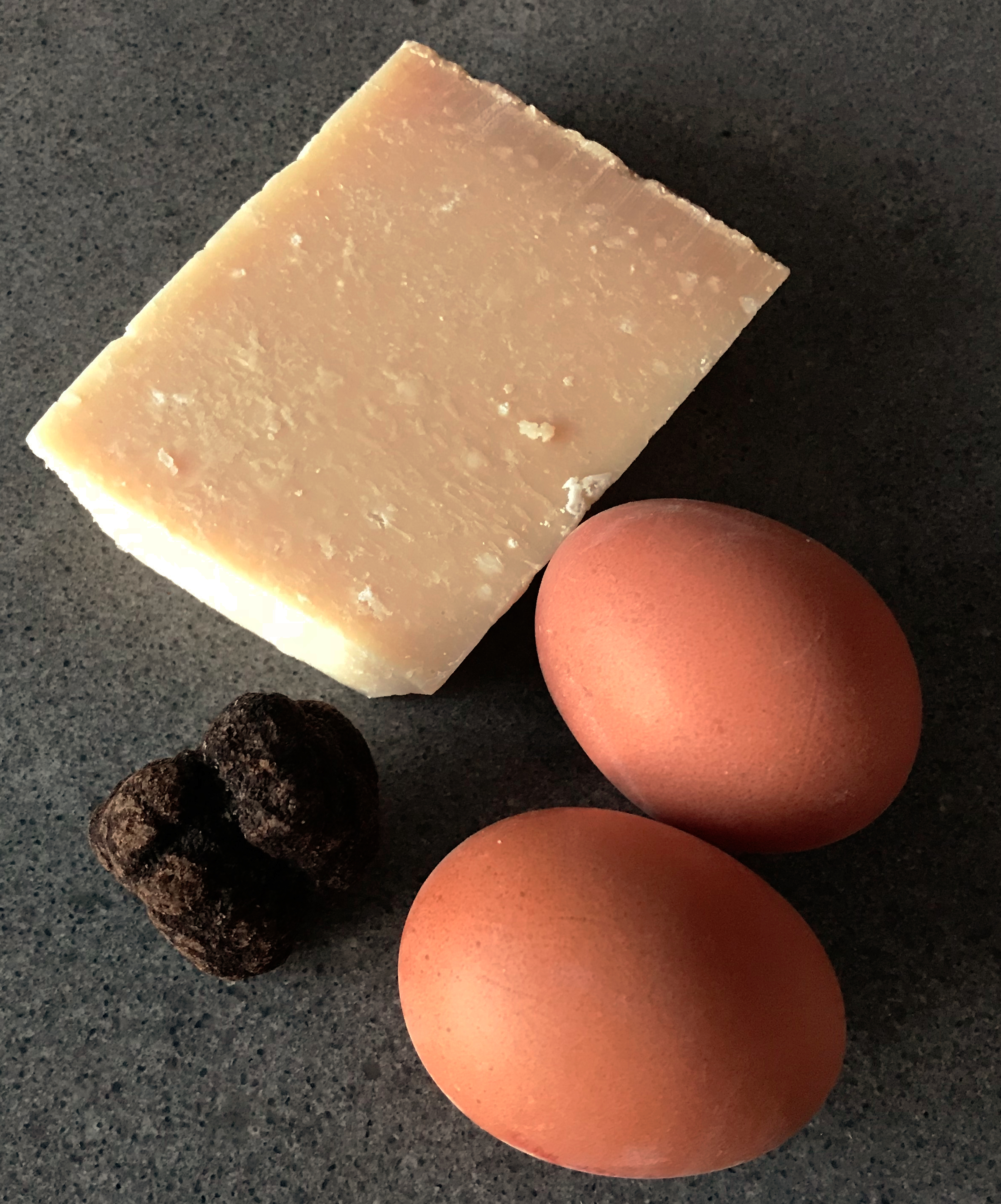
Black truffles combine really well with a warm purée of potatoes, with scallops, risotto and everything eggs. We used our truffle to make one of the simplest and tastiest truffle dishes ever: an omelet with truffle and Parmesan cheese.
If you store a black truffle for a day or so, then please store it in a small box with some rice and an egg. The rice will prevent the truffle of becoming wet and the egg will embrace the aromas of the truffle and become a treat in its own right.

Wine Pairing

A not too complex white wine goes very well with this omelet, best would be a classic Pinot Blanc or Riesling from the Alsace region (for instance produced by Kuentz-Bas). Think fruity aromas, floral characteristics, minerality and a touch of acidity and sweetness.

What You Need

  • 2 Eggs
  • Butter
  • Parmesan Cheese
  • 10 grams or (budget permitting) more Black Truffle
  • White Pepper

What You Do

Clean the truffle if necessary. Take a fairly small iron skillet and make sure the pan is warm through and through but not hot. Using a fork (a spoon is even better) whisk the two eggs together. Add butter to the pan and wait until it is melted. It should not change colour or sizzle. An omelet should not be fried; the bottom must remain yellow. Add the whisked egg to the pan and wait until the egg is beginning to set. Check the consistency with your fingers. There is no alternative to baveuse! Take your time.
Serve the omelet on a warm dish with some freshly grated Parmesan cheese, white pepper and grated black truffle.

Tamagoyaki (Japanese Omelette)

Rolled Omelette

Tamagoyaki is best described as a Japanese rolled omelette and it is often served for breakfast or included in a bento box. It’s made by rolling multiple thin layers of egg; let’s say the concept of a Swiss roll but with much thinner layers. Making Tamagoyaki requires years of practice and a special rectangular pan (a makiyakinabe) using chopsticks only. But we, as western cooks with little patience, we use a round small, non-stick pan and two spatulas. The result is very tasty and it will make you think of a real Tamagoyaki.

The ingredients are a bit of a puzzle. Eggs, soy sauce and mirin for sure. Other ingredients include sugar (for a sweet version), sake and dashi (for a savoury version called Dashimaki Tamago).

The technique of rolling thin layers of egg is a great way of making an omelette. Feel free to replace the Japanese ingredients with some chicken stock and finely grated Parmesan cheese. You will love it!

Wine Pairing

Tamagoyaki comes with some umami thanks to the dashi and a touch of sweetness. Enjoy with a sparkling wine, for instance a Crémant de Bourgogne. Our choice was a glass of Blanc de Blanc Brut made by Vitteaut Alberti. Its aromas are fresh and flowery; the flavours suggest honey and pear. You could also serve a dry Riesling or Sylvaner.
Serving sake is also a good idea; our choice would be a Ginjo-Shu because of its delicate and light flavour.

What You Need

  • 2 Eggs
  • 2 Tablespoons of (Light) Dashi
  • 1 Teaspoon of Mirin
  • 1 Teaspoon of Light Soy Sauce
  • Oil

What You Do

Heat a small non-stick pan (10 -15 centimetre) until warm but not hot. Whisk the eggs, add dashi and mirin. Use kitchen paper soaked with oil to coat the pan. Use a (small) sauce spoon to add a bit of the mixture. Make sure you can repeat this as often as possible, so it has to be a really thin layer of egg. When nearly set, roll it up and move to the side. Coat the pan with oil. Add some of the mixture, make sure it connects to the roll, wait until nearly set and roll it up. Repeat until the mixture is used up. The tamagoyaki should be yellow with perhaps a touch of golden brown.
When done, feel free to shape the tamagoyaki by rolling it in a bamboo sushi mat. Slice and serve, perhaps with some grated daikon on the side.

Stuffed Eggs with Summer Truffle

Summer Truffle

One of the obvious benefits of the summer truffle is its price. We paid € 3,50 per 10 gram last week, which is a very reasonable price for a genuine truffle. And 10 gram is sufficient for these delicious stuffed eggs.
Summer truffles are harvested between May and August in France, Italy and Spain. They come with a few characteristics that you have to take into account. First of all, summer truffle loses most (if not all) of its flavour when heated. A better idea is to shave the truffle over a warm dish, for instance asparagus or pasta, just before serving. Second aspect to keep in mind: summer truffles are not as powerful in terms of aroma and flavour as other truffles.

Truffles love eggs, love potatoes, love foie gras, love Madeira, love morels. Tournedos Rossini, Antonio Carlucci’s pasta with Morel & Truffle Sauce (described in The Complete Mushroom Book) and the classic Pâté Périgueux: all delicious.

We combine our summer truffle with eggs and mayonnaise. We crush the truffle to add a crunch to the dish. Please prepare the dish a few hours before serving, allowing the truffle to become more present. You will be surprised about the richness of these stuffed eggs!

Wine Pairing

Best to combine with a not too oaky Chardonnay, for instance French Burgundy. An excellent choice would be Bourgogne Couvent des Jacobins, made by Louis Jadot.

What You Need

  • Three eggs
  • (Homemade) Mayonnaise
  • 1 Anchovy
  • 10 gram of Summer Truffle (more preferred)
  • Black Pepper
  • Fresh Lemon

What You Do

Boil or steam the eggs until just done. Peel and let cool. Slice the eggs in two. Mash up the three egg yolks with a fork. Add a small spoon of mayonnaise and mix. Mash 1 cm of anchovy and add to the mixture. Crush the summer truffle and add to the mixture. Add a few drops of lemon juice and a bit of black pepper. Taste but keep in mind that the truffle will become much more present. Stuff the eggs, cover with foil and let cool. You could decorate the eggs with a thin slice of summer truffle.