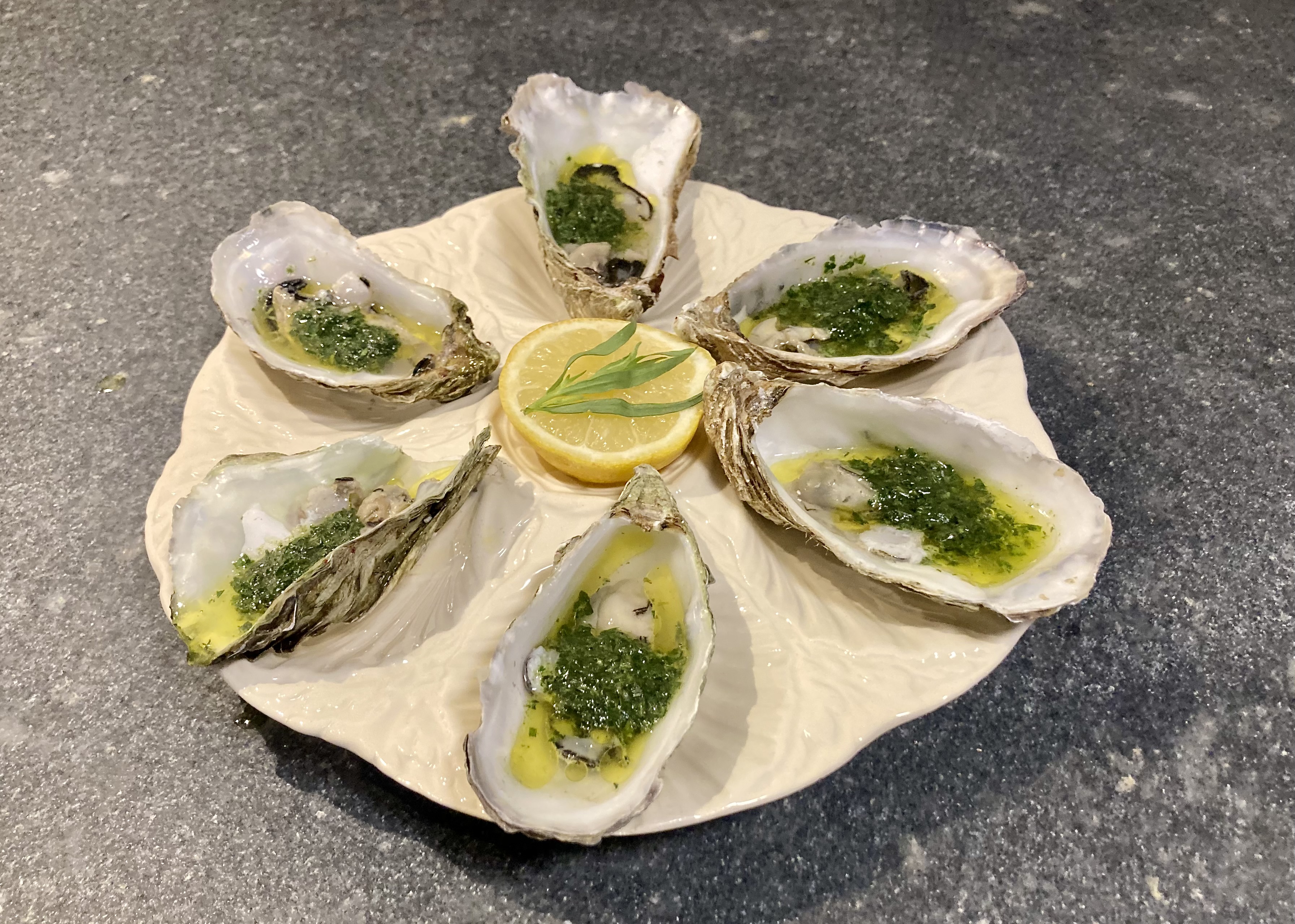
Oysters With Tarragon

Enjoying oyster begins by deciding which oysters to buy. Should they be small or large, should the taste be creamy and sweet or lean and juicy? If an oyster looks creamy (opaque) then it will taste creamy.

Next decision: raw or cooked? We think the best way to eat an oyster is to eat it raw. You will taste the saltiness, the texture and all of its flavours. The usual way to counter the saltiness is by adding a bit of lemon or mignonette but you could also go for something spicy like Tabasco, horseradish or perhaps wasabi. Don’t add something sweet because the oyster has its own sweetness.
In most cases cooked or steamed oysters are covered with lots of overwhelming ingredients, in an attempt to hide the taste of the oyster. Most likely the oyster will be overcooked and its structure rubbery and nasty. If you trust the chef, go for Steamed Oysters with Black Bean Sauce or for Oysters Rockefeller. Or even better: prepare our quick and easy Oysters with Tarragon, a delicious combination of warm (but not cooked) oyster and velvety anise flavours.

And finally: how to eat an oyster? Eating means chewing and tasting. Please don’t “drink” an oyster. If you do, you will only taste sea water.

Wine Pairing

When eating oysters, your wine must have some minerality. Think Chablis, Picpoul de Pinet, Sancerre or Sylvaner. We enjoyed a glass of Pommery Royal Brut champagne. The wine is elegant and uplifting, it comes with subtle notes of brioche and apple, a fine mousse and the perfect acidity with the oysters. Its freshness works very well after the intense taste of the oyster and the tarragon.

What You Need
  • 6 or 12 Oysters
  • Butter
  • Lots of Tarragon
  • White Pepper
  • Lemon Juice
What You Do
  1. Buy lean (not creamy) oysters, for instance the ones from the Île de Ré
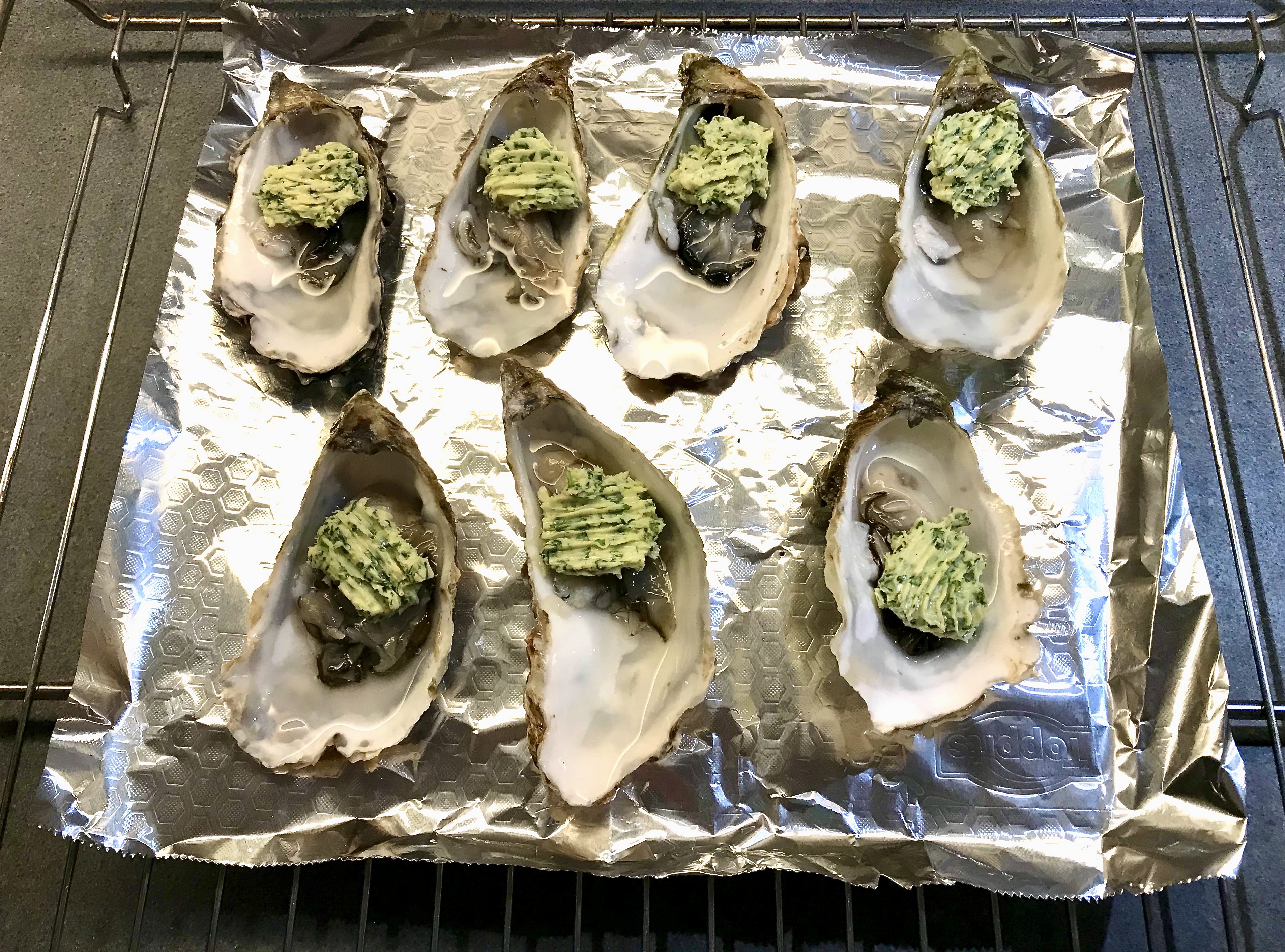
  2. Combine butter and finely chopped tarragon with some white pepper
  3. Taste and add more tarragon
  4. Store in the refrigerator
  5. Scrub each oyster under cold, running water
  6. Open the oyster
  7. Use your knife or a spoon to detach the muscle underneath the oyster from the bottom shell
  8. Remove any small bits of broken shell or sediment
  9. Remove some of the liquid
  10. Add one or two drops of lemon juice to every oyster
  11. Top with a teaspoon of tarragon butter
  12. Make sure you have everything ready (plate, tongs, wine, guests)
  13. Transfer the oysters to the oven and place as close to the grill as possible
  14. Set your oven to grill or broil and leave the oysters for 3 or 4 minutes in the oven
  15. Transfer the oysters to a plate and serve immediately
  16. 🥂Happy New Year!🥂


Easy Mushroom Pie

Hurray! The mushroom season has started! Last Friday we bought beautiful golden chanterelles (girolles) and white beech mushrooms (shimeji). It’s the time of year to enjoy wonderful dishes such as Cèpes à la Bordelaise or Salad with Mushrooms and Smoked Duck. Will there be bay boletes this year? Or the intriguing Japanese Matsutake? It’s been some time since we last saw these on the market, and we would really love to make Matsutake with Spinach and Ginger again.
We decided to celebrate the start of the season by making an easy Mushroom Pie, packed with rich flavours, nuttiness and a touch of autumn.

Wine Pairing

We treated ourselves to a bottle of Pinot Noir from the Elzas region, made by Sophie Schaal. She produces wine in France and South Africa. The grapes are handpicked and then naturally fermented before ageing in French oak barrels for 10 months. The result is a wine with a deep ruby colour. The aromas suggest black fruit and a touch of vanilla. The taste is well balanced with soft tannins and length.
In general, you’re looking for a wine with red fruit and refined tannins. Some earthiness will match very well with the mushrooms and the taleggio.

What You Need
  • For the Pastry
    • 100 grams of Flour
    • 50 grams of Water
    • 10 grams of Olive Oil
    • 1 gram of Salt
  • For the Filling
    • 250 grams of firm Mushrooms (shiitake, golden chanterelles, beech mushrooms, button mushrooms)
    • 1 Organic Egg
    • 50 grams of Taleggio
    • 50 ml Double Cream
    • Thyme
    • 1 small Garlic Clove
    • Black Pepper
    • Olive Oil
    • 2 slices of Bacon (optional)
What You Do
  1. Combine flour, salt, water and olive oil
  2. Kneed for a minute and store in the refrigerator for at least 30 minutes.
  3. Clean the mushrooms and slice if necessary
  4. (Optional) Fry the bacon, let dry on kitchen paper and crumble. Add to the egg mixture (step 11)
  5. Lightly fry the mushrooms in a heavy iron skillet
  6. Transfer the mushrooms to a plate and let cool
  7. After 30 minutes: preheat the oven to 180 ˚ C or 355 ˚ F
  8. Combine the egg with the cream
  9. Add lots of thyme and black pepper
  10. Add grated garlic
  11. Add the mushrooms
  12. Slice small cubes of taleggio
  13. Add the cheese to the mixture
  14. Roll out the dough with a rolling pin on a lightly floured surface.
  15. Coat a 22 cm or 9-inch round baking tin with oil or butter
  16. Place the dough in the baking tin
  17. Add the mixture and distribute evenly
  18. Transfer to the oven for 35-40 minutes or until nice and golden
  19. Allow to cool for a few minutes
  20. Remove from the tin and let cool on a wire rack
  21. Serve lukewarm
PS

It tastes even better the next day!

An easy to make mushroom pie with rich flavours
Mushroom Pie ©cadwu

Asma Khan Wins Johannes van Dam Prize

The Johannes van Dam Prize 2024 was won by Indian British chef, cookbook author and restaurant owner Asma Khan. In 2012 her restaurant started for 12 guests at her home, serving food cooked from traditional family recipes. Today her all-female Darjeeling Express restaurant in London offers Indian Rajput and Bengalihome cooking specialties. On her current menu are dishes such as Chicken Momis (dumplings served with smoked chillies sesame chutney) and Badami Baingan (aubergine with coconut, peanut and tamarind). Sounds delicious!

Prize

The Johannes van Dam Prize is a lifetime achievement award for an individual who has made an exceptional contribution to the world of gastronomy. Previous winners of the prestigious prize include Yotam Ottolenghi, Carlo Petrini, Alice Waters, Claudia Roden, Jeroen Meus and Alain Passard. The prize giving ceremony used to be part of the Amsterdam Symposium on the History of Food, but for reasons unknown to us it was decided to separate the two events. As a result, the prize giving event in 2024 with Asma Khan was relatively small and went by hardly noticed. A pity.

Cookbook

We bought her cookbook Ammu, Indian Home Cooking to Nourish Your Soul. ‘An entrancing book’, according to Nigella Lawson. We were impressed by the great stories and of course the recipes. Over the coming weeks we will prepare some of the dishes and ask our review panel to taste the flavours of Asma Khan’s kitchen.

Join us!

Please join us in preparing one (or more) of her dishes. You could buy the book, look at her recipes as published by the BBC or these recipes published by Great British Chefs or these from the Foodnetwork.
Post about it on your blog and ping back, track back, share or re-post.

Let’s enjoying Indian Home Cooking to Nourish Your Soul!

Ammu by Asma Khan
Ammu by Asma Khan

Lentils with Sausage and Beetroot

Think France, think a nice small bistro in a small street, off centre, nothing posh, no Michelin star in sight. It’s 12.30, time for a quick lunch. You enter the restaurant, take a seat and order today’s dish, the plat du jour. It turns out to be a generous helping of lentils, fried sausages, mashed potatoes and mustard. A beer works beautifully with it. After having enjoyed your lunch, you think about the joy of good food, French mustard and the beauty of lentils. Time for a coffee. And perhaps a glass of Calvados?

In our recipe for Cod with Lentils and Cilantro we mentioned the joy of lentils, especially the joy of eating Lentille Verte du Puy A.O.P & A.O.C. from Sabarot.

We’re not too keen on mashed potatoes so we decided to combine the lentils and sausage with a beetroot salad.

Sausage wise we suggest coarsely ground (so not minced) organic porc sausages with sage, for instance Lincolnshire sausages. The texture of the sausages is great in combination with the size of the lentils. 

Wine Pairing

We enjoyed our lentils with a glass of red Pays d’Oc wine, with grapes such as Grenache and Syrah. The Syrah brings an intense colour, aromatic strength and structure. The Grenache reveals red berry flavours. For instance wine from Domaine La Colombette. This producer is well known for its innovative light wines and its Super Bio wines, made with grapes (Cabernet Noir, Souvignier Gris) that have a natural resistance to various diseases, meaning that no pesticides are needed in the vineyard.

What You Need

  • For the Lentils
    • Shallot
    • Olive Oil
    • Green or Du Puy Lentils
    • Parsley
  • For the Sausages
    • 2 or 4 Sausages (organic pork with sage, coarsely ground)
    • Olive Oil
  • For the Salad
    • Beetroot
    • Spring Onion
    • Vinegar (plain and white wine)
  • French Mustard

What You Do

One day before serving, wash the beetroot, wrap in foil and put in the oven on 180° Celsius or 365° Fahrenheit for 45-60 minutes, depending on the size. Transfer, remove foil and let cool.
Cut the shallot in small bits and glaze gently in olive oil. In the mean time check the lentils for small pebbles; wash the lentils. Once the shallot is glazed, add the lentils and heat them for a few minutes, as you would do with risotto rice. Add some chicken stock and water (the stock is only intended to give the lentils a small push) and leave to simmer on low heat. Fry the sausages in olive oil in a heavy iron skillet. Remove the skin of the beetroot, slice the beetroot and combine with thinly sliced spring onion and vinegar. Mix. Drain the lentils, chop the parsley and add to the lentils.
Serve the sausage on top of the lentils. Definitely a good dash of French mustard on the side!

  • Lentils with Sausage and Beetroot ©cadwu
  • Du Puy Lentils AOP AOC © cadwu

All Our Recipes For You

A few years ago we created an overview of recipes per season, simply because it’s such a good idea to enjoy what is available in the season. Nice to eat strawberries in Winter, but isn’t it a much better idea to enjoy seasonal slow cooked pears?

We then introduced overviews per course, ranging from side dish to lunch. The categories didn’t always make sense, so we added a few more, making our admin more complicated, especially when we updated a recipe or a picture.

The obvious thing happened: we lost track of recipes, noticed some links were broken and the overviews became incomplete.

So how to organise this blog?

After much debate and intense workshops (not really) we’re pleased to present to you an old fashioned, up to date and very easy to use (and maintain) index of All Our Recipes For You!

All Our Recipes For You ©cadwu