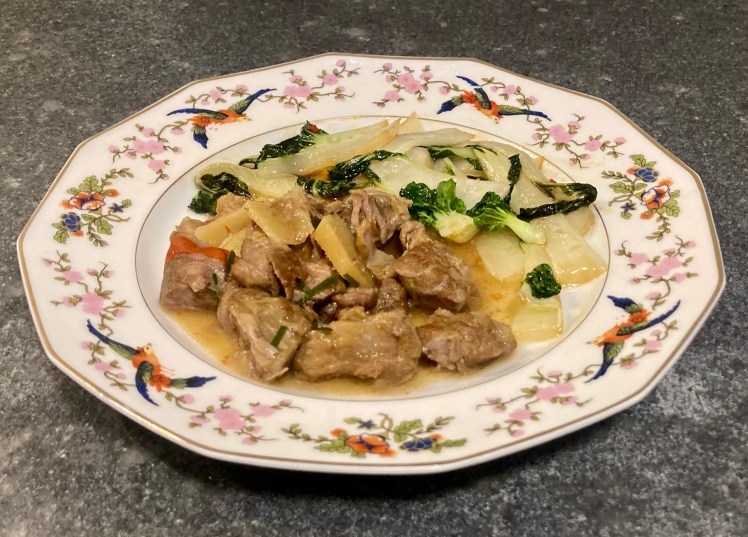
Lamb Shank with Star Anise, Ginger and Djeroek Poeroet

The obvious way to prepare lamb shanks is to fry them briefly in oil en butter and then cook them for hours in red wine with a bouguet garni of rosemary, thyme, parsley, sage and perhaps lavender. Maybe add a small tomato to help the sauce. We take a different approach by adding strong flavors like ginger, cilantro seeds, star anise, soy sauce and the leaves of the Makrut or Thai lime (also known as Djeroek Poeroet or Djeruk Purut). You will get a full, complex sauce in combination with tasty, juicy, tender and aromatic meat.

Wine Pairing

The obvious choice would be a glass of Pinot Blanc or Pinot Gris. We once enjoyed the dish with a glass of Gewurztraminer from the Alsace. A touch of spiciness and sweetness, which worked really well with the star anise and ginger.
Combining the lamb shanks with red wine is more challenging. Our choice was a bottle of Cuvée Equinoxe produced by Domaine d’Arjolle, from the Languedoc region in France. The wine is made with 100% merlot grapes. It has an intense ruby ​​color and aromas of red fruit. The flavour is soft and long, with a touch of sweetness and oak. A soft, not too complex Syrah could also be very nice with the lamb shanks.

What You Need
  • 2 Lamb Shanks
  • Shallot
  • Olive oil
  • Fresh Ginger (4 cm, depending on your taste)
  • 1/2 red Chili
  • 2 Garlic Cloves
  • Noilly Prat
  • teaspoon of Cilantro Seeds
  • 2 Star Anise
  • Low Salt Soy Sauce
  • 6 leaves of Djeroek Poeroet
What You Do

Fry the meat in olive oil, giving it a nice colour. In the mean time cut the shallot, peel the ginger and slice, remove the seeds from the chili and cut the garlic clove (but not too fine). Remove the meat from the pan and glaze the shallot, chili, ginger and garlic. Add the Noilly Prat, crushed cilantro seeds, star anise, some low-salt soy sauce and the djeroek poeroet. Stir. Transfer the meat back to the pan and add some water, perhaps 3 cm. Leave to simmer for 4 – 6 hours in total. Check the pan every hour and add water if so required. After 6 hours remove the shanks from the sauce and cool. Reduce the sauce, let cool and transfer to the refrigerator. The following day remove as much of the fat from the sauce as possible. Warm the sauce together with the shanks, check taste and tenderness.
Serve with steamed Bok Choy tossed with sesame oil or with rice.

Lamb Shank ©cadwu
Lamb Shank ©cadwu

Coq au Vin

A classic French dish and one of our favorites. Warm, rich and full of flavors. Obviously the dish is about two ingredients: chicken and wine. Use (organic) chicken, preferably with the bone, so a whole chicken, legs or drumsticks. A classic Coq au Vin is made with Bourgogne (Burgundy), a relatively expensive red wine from France made from Pinot Noir grapes. According to some people the wine you use for the stew must also accompany the dish. Which would mean that some of your beautiful Bourgogne ends up in the stew. Not the best idea! We think that the background of this ‘rule’ is about the quality of the wine you use for the stew: in this case you’re looking for a nice, medium bodied red wine with aromas of dark fruit; one you would be perfectly happy to drink. So not some left over red wine, or a wine you didn’t like. A perfect stew requires quality ingredients, that’s all.
Earlier we thickened the sauce using mushrooms; in this version we use Beurre Manié, the combination of butter and flour, which gives the sauce a rich, velvety feel.

Wine Pairing

We decided to open a bottle of Merlot, produced by Le Fat Bastard. An easy to drink red wine with the right aromas and a hint of wood. Worked beautifully with the richness of the sauce, the depth of the mushrooms and obviously the chicken!

What You Need

  • 4 Drumsticks
  • Slice of Pancetta or Bacon
  • 10 Pearl Onions
  • 100 grams Button Mushrooms
  • 2 Garlic Gloves
  • 1 Carrot
  • Chicken Stock
  • Red Wine
  • Bouquet Garni (Bay Leaf, Parsley, Thyme, Rosemary)
  • Black Pepper
  • Olive Oil
  • Soft Butter
  • Flour

What You Do

Cube the strip of pancetta or bacon in, peel the onions, slice and quarter the carrot, peel and finely chop the garlic. Add olive oil to a warm heavy pan. Begin by frying the pancetta or bacon until crispy. Remove from the pan and let drain on kitchen paper. Add (whole) pearl onions and carrot to the pan and fry until golden. Remove from the pan and let drain on kitchen paper. Add chicken to the pan and fry until golden. When golden add the garlic and fry for 3 minutes on medium heat. Add pancetta, carrot and onions back to the pan. Add chicken stock and red wine. The chicken should be nearly covered. Add bouquet garni and leave to simmer on low heat for 45-60 minutes, depending on the size of the chicken.
Clean the mushrooms with kitchen paper and fry them gently in a skillet. Remove chicken and bouquet garni from the pan. Transfer the chicken to an oven at 60 °C or 140 °F. Discard the bouquet. Reduce the liquid. Use a fork to combine 20 grams of butter with 20 grams of flour (or more of both, depending on the amount of liquid). Add the Beurre Manié to the liquid, stir and allow to simmer and thicken for some 15 minutes. Return the chicken to the sauce, add the fried mushrooms, black pepper and allow to integrate for 5 minutes. Serve with a fresh green salad (a vinaigrette of olive oil, white wine vinegar and Dijon mustard will be great) and crusted bread.

Coq Au Vin ©cadwu
Coq Au Vin ©cadwu

Earthly Delights

The Mushroom Book by Michael McLaughlin and Dorothy Reinhardt (Illustrator) is a lovely, small book with some 35 recipes and 60 very delightful full-colour wood-cut illustrations. Just look at the cover! It’s the kind of book that we bought because it looks good. A book you simply want to have.

Only later did we find out that it discusses the history and other interesting back ground information of various mushrooms, including information on choosing, storing and preparing them. The book offers an introduction to the joy of cooking with mushrooms such as button mushrooms, morels, oyster mushroom, truffle, trompette de la mort, chanterelle, shiitake, cèpes and huitlacoche, a Mexican mushroom that grows on corn.
Michael McLaughlin is also known as co-author of The Silver Palate Cookbook with recipes from Manhattan’s celebrated gourmet food shop.

Amongst our favourite recipes are Mushroom Tapenade and Raw Mushroom, Fennel and Provolone Salad.

The Mushroom Book was published in 1994. It’s available (in most cases second hand) via channels such as Amazon and e-Bay for something like 15 euro. Ii is an ideal and friendly introduction to the world of earthly delights. 

The Mushroom Book
The Mushroom Book

Mirepoix

A combination of three ingredients that is essential when preparing stocks, stews and sauces: onion, carrot and celery (ratio 2:1:1). It’s intriguing that this combination works so well. All three bring sweetness when cooked, the combination is balanced and it brings depth to the result.

The celery could be a bit confusing: should it be celeriac, the root (knob) or celery, the fibrous stalks? Some suggest using the root in winter and the stalks in summer. We suggest using the stalks in all cases. They are very aromatic and they come with a touch of saltiness, very different from the root.

When for instance you want to make a beef stew, then first sear the beef, remove it from the pan, perhaps add some oil or butter and then add the mirepoix. Leave to simmer on low heat for 15 minutes or so or until soft. It’s all about creating flavours and aromas. Make sure you don’t brown the mirepoix. 

Another approach is to add it to (cold) water. This works well when making a white stock. And of course, when you want to make a powerful, tasty vegetable stock.

What You Need

  • 1 Large Onion
  • 3 Celery Stalks
  • 1 Carrot
  • 1 Leek
  • 1 Small Tomato
  • 2 Garlic Cloves
  • 1 Bouquet Garni (Parsley, Bay Leaf, Thyme)

What You Do

In the Netherlands an extended version of Mirepoix is fairly standard: onion, carrot, celery and leek (ratio 1:1:1:1) , also known as WUPS (Wortel, Ui, Prei en Selder). We prefer this version because the leek seems to bring extra flavours. Or perhaps because we’re Dutch?
Clean and dice the celery, the carrot, the leek and the tomato. Peel and chop the onion and the garlic. Add all ingredients and the bouquet garni to a pan with cold water and allow to simmer for one hour or so. Pass through a sieve and decide if you want to reduce the liquid. It freezes very well, so ideal to make ice cubes for use in sauces.

Mirepoix ©cadwu
Mirepoix plus extra ingredients for vegetable stock ©cadwu

Coq au Vin

One of our favourites for a grey, wintery evening. Warm, rich and full of flavours.
Let’s first talk about the chicken: we prefer using chicken thighs, organic, obviously. Great texture, layered and a bit of fat. You could also use chicken legs, but then we suggest removing the main bone; you don’t want to struggle while eating.

The second main ingredient is the red wine. A classic Coq au Vin is made with Bourgogne, a relatively expensive red wine from France made from Pinot Noir grapes. According to some people the wine you use for the stew must be the same that accompanies the dish. Which would mean that part of your beautiful Bourgogne ends up in the stew. Hm. We think that the background of this ‘rule’ is about the quality of the wine you use for the stew: it must be a nice, dry, red wine; one you would be perfectly happy to drink. So not some left over red wine, or a wine you didn’t like. A perfect stew requires quality ingredients, that’s all.

The third main ingredient is the pearl onion, that lovely small, silver onion. Great to pickle, but for a Coq au Vin you need fresh ones.

Wine Pairing

We enjoyed our Coq au Vin with a glass of Révélation Pays d’Oc Syrah-Viognier produced by Badet Clément. It’s a full-bodied wine with flavours of blackberry and spices. Touch of oak as well. The 15% Viognier gives the wine a nice, light touch. Great wine for a very reasonable price.

What You Need

  • 2 Chicken Thighs
  • 4 strips of Pancetta or Bacon
  • 14 Pearl Onions
  • 100 grams Mushrooms
  • 2 Garlic Gloves
  • Chicken Stock
  • Red Wine
  • Water
  • Bouquet Garni (Bay Leaf, Parsley, Thyme, Rosemary)
  • Black Pepper
  • Chopped Parsley
  • Olive Oil
  • Snow Peas (Mangetout)
  • Nutmeg

What You Do

Clean and quarter the mushroom, slice the strips of pancetta or bacon in four, peel the onions, slice the thighs in two or three, peel the garlic and chop. Add olive oil to a warm heavy pan. Begin by frying the pancetta or bacon until crispy. Remove from the pan and let drain on kitchen paper. Add (whole) pearl onions to the pan and fry until golden. Remove from the pan and let drain on kitchen paper. Add mushrooms to the pan and fry until golden. Remove from the pan and let drain on kitchen paper. Add chicken thighs to the pan and fry until golden. When golden add the garlic and fry for 3 minutes on medium heat. Add pancetta, mushrooms and onions to the pan. Add chicken stock, red wine and perhaps some water. The chicken should be nearly covered. Add bouquet garni and leave to simmer on low heat for 30-45 minutes, depending on the size of the chicken. 

Remove chicken, mushroom, pancetta, garlic and bouquet garni from the pan. Discard the bouquet. Return one or two mushroom to the liquid. Transfer the remaining ingredients to an oven at 60 °C or 140 °F. Blender the liquid for one minute. Reduce the liquid until it has reached the right consistency. The fun is that a liquid thickened with blended mushrooms doesn’t split. Return the ingredients to the sauce and boil the snow peas. Combine the coq au vin with the parsley, add some black pepper. Steam or quickly cook the peas, coat with excellent olive oil and add some freshly grated nutmeg.

Coq Au Vin ©cadwu
Coq Au Vin ©cadwu

Mushroom Soup with Pancetta and Thyme

This morning when we looked outside, we saw a grey, foggy city. Knowing it would take hours for the fog to clear, we started thinking about something warm for lunch. Perhaps some soup with crusty bread? We opened our refrigerator. Various mushrooms, thyme, rosemary, cream, a carrot, some left over stock. Yes! We knew what we wanted to cook for lunch: Mushroom Soup with Pancetta. A hearty, rich soup, ideal for a cold, grey day. The combination of mushrooms, pancetta and cream works very well; the celery and leek add complexity and the thyme brings character.

Wine Pairing

It was much later that afternoon before the fog left the city, but since we also had some left over Chardonnay in the fridge, which we enjoyed with our soup, we didn’t mind that much.

What You Need

  • Pancetta
  • Shallot
  • Mushrooms (Best is a Mix of Champignons, Shiitake etcetera)
  • Celery
  • Leek
  • Carrot
  • Garlic
  • Stock (Chicken or Vegetable)
  • Bouquet Garni (Thyme, Rosemary and Bay Leaf)
  • Black pepper
  • Cream
  • Fresh Thyme
  • Olive Oil

What You Do

Keep two strips of pancetta apart (to be grilled just before serving). You probably need 4-6 strips in total. Slice the remaining pancetta and fry in olive oil on medium heat. Remove the pancetta from the pan, chop the shallot and glaze it in the fat and perhaps some extra olive oil. Clean and slice the mushrooms, slice half a stalk of celery, half a leek, a small carrot, chop two gloves of garlic and add this to the shallot. Gently fry for a few minutes. Add the pancetta, the stock and the bouquet garni. Allow to simmer for 30 minutes. Remove the bouquet garni. Blender the soup, pass through a sieve and leave on low heat for 10 minutes. The mushrooms will emulgate the soup, so no need to add a roux. Now it’s time to taste the soup and perhaps add some black pepper. Add cream and fresh thyme and leave for another 5-10 minutes. In the meantime grill the two strips of pancetta until brown and crispy. Cut the stripes in five pieces depending on the size. Serve the soup in a warm bowl with the pancetta on top of it.

Culinary Trends

Suppose we would publish a recipe that would include instructions such as “Coat cubes of pork meat with curry and microwave these for 2 minutes”, and “Combine oil, chilli, garlic and onion, heat for 1 minute on 100% power, add chicken stock, soy sauce and corn starch, stir and heat for 2 minutes on 50%”, you would of course think you are back in the 1980’s.

It’s fascinating that what we buy, the way we prepare it, and even how we serve and eat it, is constantly changing. Just look at the pictures in a 1950’s cookbook and try not to smile. Impossible.

Knowing that our culinary habits are constantly changing is one thing, understanding why they change is much more complex. 

Influence

A great example of a supplier influencing their customers is a magazine called Allerhande, published by leading Dutch supermarket Albert Heijn. The magazine, first published in 1954, is not your ordinary flyer with an overview of discounted articles, it’s a reflection of culinary trends (linked of course to what’s available in the supermarket) and trends in society with a focus on the individual.

Dutch author Klaartje Scheepers was brave enough to read all issues since 1954 and in her excellent book Van Aardappel tot Avocado (available in Dutch only) she describes how closely food is linked to our daily life and the world we live in. She writes about the 1950’s housewife struggling to keep her family happy and well-fed, about the introduction of the tv-dinner, about nutrition, the need to have a refrigerator, a blender, a microwave, an electric tin opener, about how we started to embrace dishes from other countries, including something odd called pizza, about diets and of course, about how supermarkets are closely monitoring these developments.
Reading Van Aardappel tot Avocado is a pleasure, not only because of the interesting insights, but also because it helps you recognize today’s trends. And of course it’s also a fun trip down memory lane. Highly recommended!

Your Menu

Why not sit back, take a sip of wine and wonder how your Seasonal menu is influenced by your local supermarket, by well-known chefs, culinary influencers and blogs. What made you decide? Availability? Recipe on the internet? Price? Friends? As seen on Youtube?
Interesting, isn’t it?

Klaartje Scheepers - Van Aardappel tot Avocado
Klaartje Scheepers – Van Aardappel tot Avocado

The Art of Sauces: Modern Tomato Sauce

We love a good sauce: it supports the flavours, it adds complexity to the dish and it brings components together. Orange sauce with duck, Béarnaise with beef, Sauce Mornay on a Croque Monsieur: the sauce is the key to the dish.

Marie-Antoine Carême (1784 – 1833) was the first chef to analyse sauces and create a classification. He identified four leading (mother) sauces and described how other sauces could be derived from these four. His four leading sauces are Espagnole (made with brown roux, roasted bones and brown stock), Velouté (white roux and light (veal) stock), Béchamel and Allemande (light roux with veal stock and thickened with egg yolks and cream). If for instance you want to make a Pepper Sauce, then you start by making a Sauce Espagnole.

Auguste Escoffier (1846 – 1935) refined the classification and replaced Sauce Allemande with Sauce Tomate as leading sauce. Later Hollandaise and Mayonnaise were added to the list of main sauces.

Sauce Tomate as prepared by Carême and Escoffier is very different from the sauce we use on pizza’s and pasta’s. It’s made with salted pork, veal stock, bones, various aromatic vegetables and of course tomatoes. Among the derived sauces are Sauce Portuguese and Sauce Provençal.
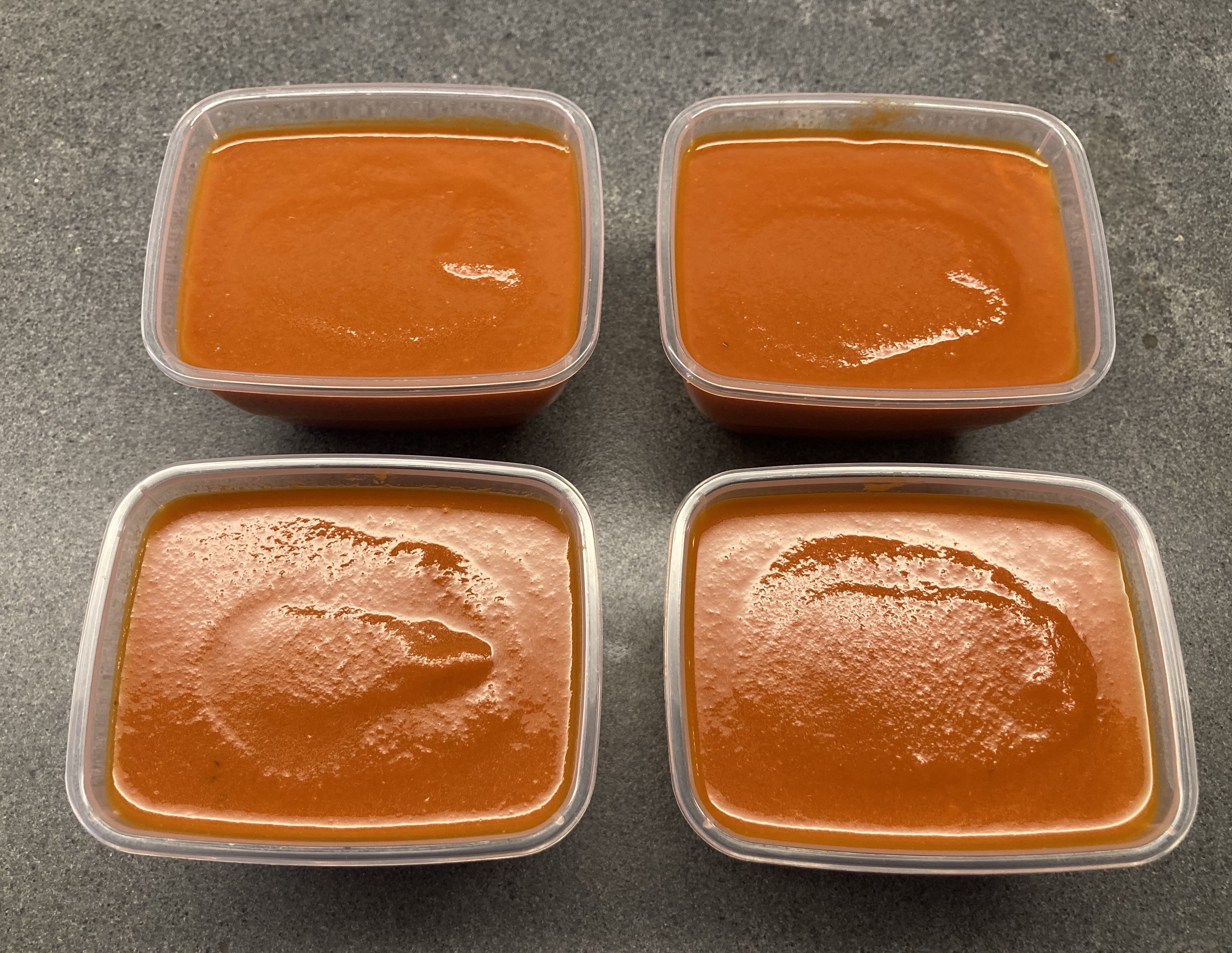
Next week we will share the Classic way of cooking Sauce Tomate in detail; today we share our modern (vegetarian) recipe.
The sauce freezes very well, so ideal to make a nice quantity.

What You Need

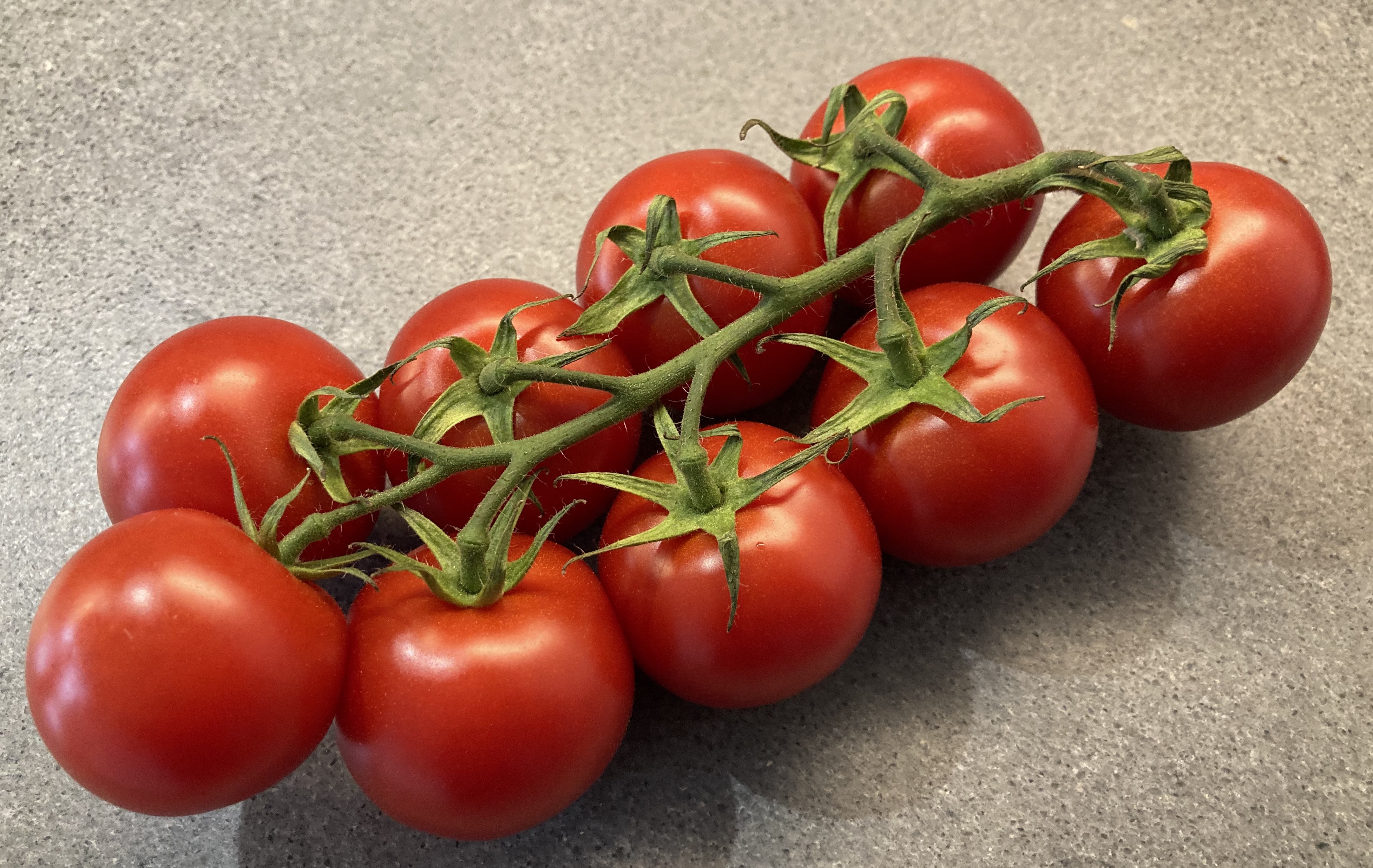
  • 4 – 6 Excellent Ripe Tomatoes (depending on the size)
  • 1 Red Bell Pepper (preferably grilled and peeled)
  • ½ Chilli
  • 1 Onion
  • 1 Garlic Clove
  • Olive oil
  • 1 Glass of Red Wine
  • Bouquet Garni (Parsley, Thyme, Rosemary, Bay Leaf)

What You Do

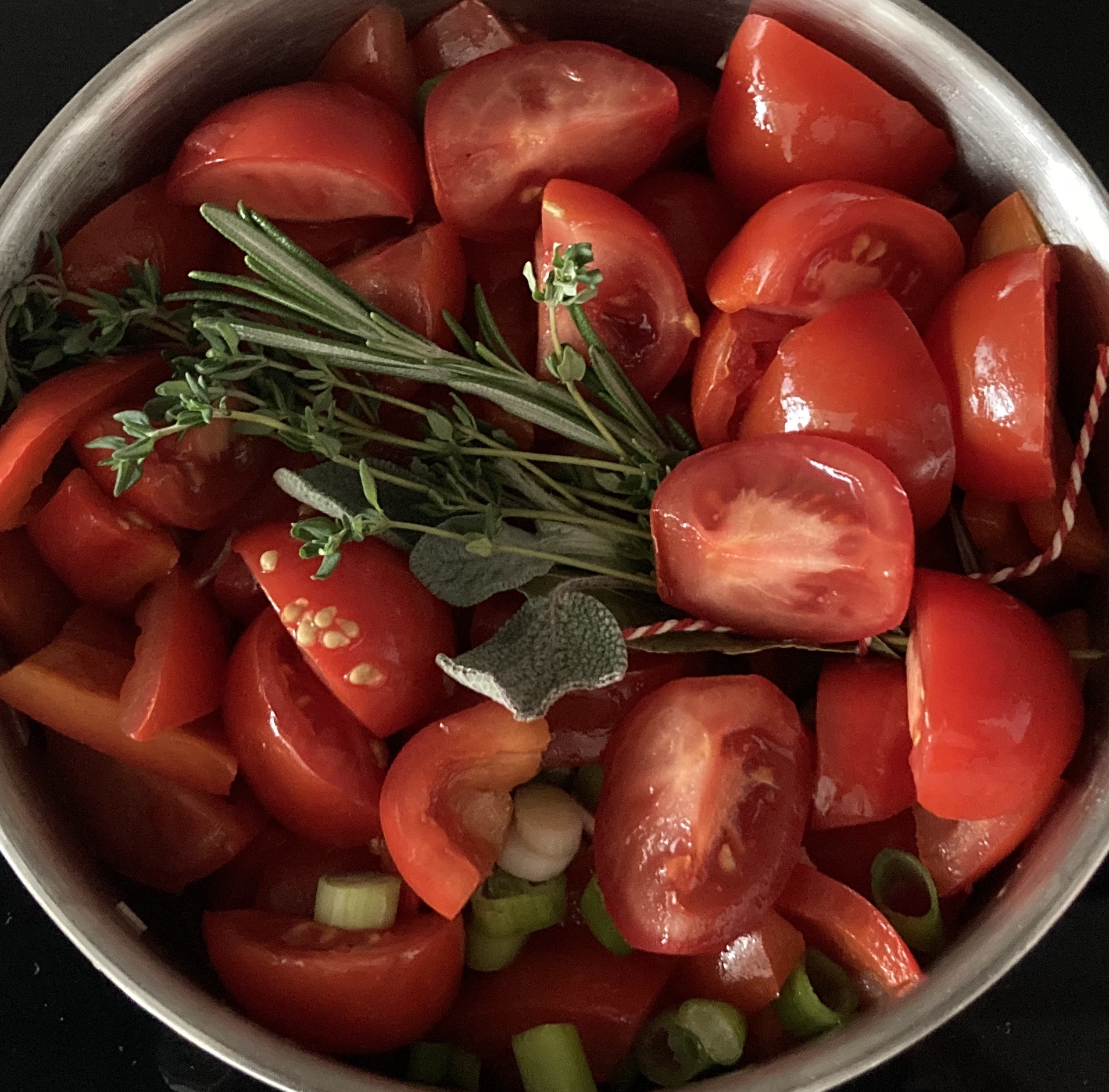
Wash the tomatoes and slice in chunks. Peel the onion and chop. Add olive oil to the pan and glaze the onion for 10 minutes or so. Stir and add the sliced bell pepper and the sliced and seeded chilli. Let cook on medium heat for 5 minutes or so. Reduce heat. Add the chopped garlic clove. After 5 minutes or so add the sliced tomatoes, the red wine and the bouquet garni. Leave for 2 hours minimum to simmer. Remove the bouquet garni and blender the mixture. Pass through a sieve and leave to simmer for another 2 hours. Cool and transfer to the refrigerator or freezer.

PS Grilling a bell pepper: slice the pepper in large slices. Set your oven to grill, put a sheet of aluminium foil on the baking tray, put the slices on the foil, skin up and transfer to the oven, as close to the grill as possible. Wait for 10 minutes or until the skin is seriously burned. Transfer the slices to a plastic container and close the lid. Wait for an hour. Using your fingers and perhaps a knife, peel of the skin. Store the bell pepper and the juices in the refrigerator. The taste is deeper and sweeter compared to raw bell pepper.

All Our Recipes For You

A few years ago we created an overview of recipes per season, simply because it’s such a good idea to enjoy what is available in the season. Nice to eat strawberries in Winter, but isn’t it a much better idea to enjoy seasonal slow cooked pears?

We then introduced overviews per course, ranging from side dish to lunch. The categories didn’t always make sense, so we added a few more, making our admin more complicated, especially when we updated a recipe or a picture.

The obvious thing happened: we lost track of recipes, noticed some links were broken and the overviews became incomplete.

So how to organise this blog?

After much debate and intense workshops (not really) we’re pleased to present to you an old fashioned, up to date and very easy to use (and maintain) index of All Our Recipes For You!

All Our Recipes For You ©cadwu

A Royal Sabayon

Happy Birtday!

Today April 27th we celebrate the King’s Birthday in the Netherlands. Hip hip hurrah! The Dutch Royal Family is known as the House of Orange-Nassau, hence the link to anything orange (oranje in Dutch), including a liqueur called Oranje Bitter. It’s not many people’s favourite; most people prefer another traditional drink: lots of beer.

There are many recipes for Oranje Bitter; most of them with too much sugar and undefined herbs. We prefer the more classic version produced by Van Wees and De Ooievaar. Their Oranje Bitter is made with Pomerans (Citrus Aurantium, the bitter orange) and Curaçao peel.

Our grandmother wasn’t a big fan of Oranje Bitter, but she felt she had to serve it on the (then) Queens Birthday. She combined one tradition with another: she made Dutch Advocaat using Oranje Bitter. Basically Advocaat (similar to Eggnog) is a sabayon-like drink made with egg yolks, sugar, vanilla and a strong alcohol (brandewijn, gin, vodka or grappa), served in a nice glass with a small spoon and possibly topped with whipped cream (but no need for that).

Grandmother cooked her advocaat Au Bain Marie; we prepare our Royal Sabayon using a microwave oven.

What You Need

  • 3 Egg Yolks
  • 30 grams of Sugar
  • 80 ml of Oranje Bitter

What You Do

Mix the egg yolks and the sugar well. Make sure the sugar is dissolved before adding the liquid. Transfer to the microwave and very gently heat the mixture. We used intervals of 10 seconds to start with and intervals of 5 seconds to finish. In total only 75 seconds on 30% power. Duration depends on the power of your microwave. Stir well (or whisk, but not too much) after every interval until it becomes thick. The consistency must be similar to a thick pastry cream (crème pâtissière). Cool quickly and store in the refrigerator.

PS Obviously you need fresh eggs when making  a sabayon, mayonnaise, béarnaise et cetera. We don’t think eating fresh, organic eggs is a problem. Eating all kinds of additives, unclear syrops, modified milk ingredients, guar gum, monoglycerides et cetera, that’s a problem.

PS Use the egg whites to make madeleines.