Neck of Lamb, Asian style

We can hear you thinking, ‘Shouldn’t that be rack of lamb?’.

Isn’t it interesting how much we are focused on specific parts of an animal? We love our steak, but what to do with an oxtail? We love pork loin, but how about the pig’s nose? And we enjoy grilled rack of lamb, but how about the neck?
Supermarkets know everything about our focus and preferences. So if you would like to cook pig’s feet (or trotters), kidneys, liver, sweetbread or lamb’s neck: where to go? Try finding a ‘real’ butcher, one that buys the whole animal, not just the popular parts.

Lamb’s neck is very underrated. Some feel it’s okay for your dog only, but that’s silly. When cooked slowly it becomes tasty, nicely structured, juicy and tender.
It combines very well with strong flavours such as ginger, cilantro seeds, star anise, soy sauce and the leaves of the Makrut or Thai lime (also known as Djeroek poeroet or Djeruk purut). You will get a flavourful, complex sauce in combination with lovely, aromatic meat.

Wine Pairing

If you decide to pair with white wine: we enjoyed our Neck of Lamb with a glass of Alsace Gewurztraminer, Cave de Beblenheim. The wine has a beautiful gold colour, and an expressive aromas of roses. The palate presents a nice structure with a fruity and spicy association which of course goes very well with the oriental twist to the stew. In general we suggest an aromatic white wine with just a touch of sweetness.

If you decide to pair with red wine: a few weeks later we enjoyed the dish with a glass of Cinsault, produced by Domaine Coudoulet. This is a relatively light wine, to be served chilled (12 °C or 54 °F). Cinsault is a grape native to the south of France. It was somewhat forgotten but is now gaining popularity. It has a floral nose, with aromas of raspberry and fresh fruit on the palate and discreet tannins.

What You Need
  • 300 grams Neck of Lamb
  • Olive Oil
  • Shallot
  • Fresh Ginger (4 cm, depending on your taste)
  • 1/2 red Chili
  • 1 Garlic Clove
  • Noilly Prat
  • Cilantro Seeds
  • Star Anise
  • Low Salt Soy Sauce
  • 4 leaves of Djeroek Poeroet
What You Do
  1. Cut the meat in not too small cubes – they will shrink during the cooking process
  2. Fry the meat in oil, giving it a nice colour. If so required, do so in multiple batches
  3. In the mean time cut the shallot, peel the ginger and slice, remove the seeds from the chili and cut the garlic clove (but not too fine)
  4. Remove the meat from the pan and glaze the shallot, chili, ginger and garlic
  5. Add a splash of Noilly Prat, the crushed cilantro seeds, the star anise, some low-salt soy sauce and the djeroek poeroet
  6. Stir
  7. Transfer the meat back to the pan and add water, making sure the meat is just covered
  8. Leave to simmer for 6 hours in total
  9. Check the pan every hour, stir and add water is so required
  10. Also check if the djeroek poeroet and/or chilli are not overpowering
  11. After 5 hours check the taste, perhaps add soy sauce, remove the djeroek poeroet or the star anise
  12. After 6 hours cool the stew and transfer to the refrigerator. You could also decide to transfer it to the freezer for use at a later date
  13. The following day remove as much of the fat as possible
  14. Warm the stew, check taste and tenderness
  15. You may want to reduce the liquid in a separate pan
  16. Warm through and through
  17. (Optional) thicken the sauce with potato starch, this way your sauce will remain transparant
  18. Serve with steamed Pak Choi with oyster sauce

PS Looking for a nice starter? Why not serve Hot and Sour Soup (recipe next week!)
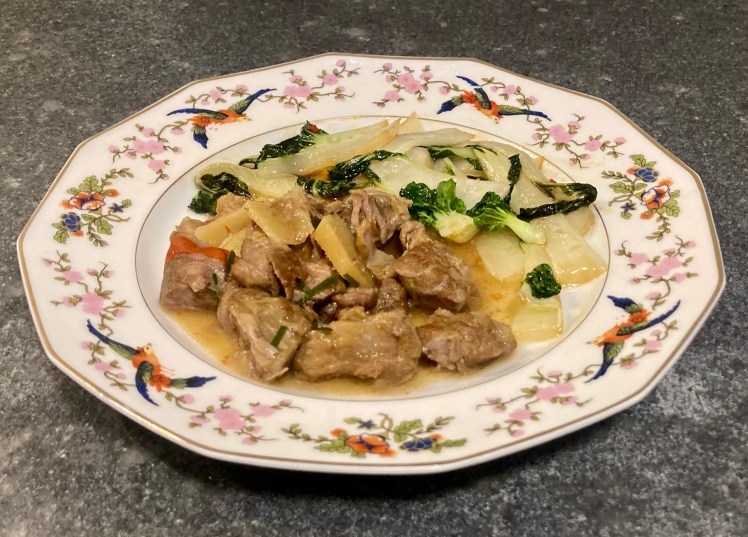
Neck of Lamb Asian Style ©cadwu with djeroek poeroet, ginger, soy sauce and cilantro seeds
Neck of Lamb Asian Style ©cadwu

Lamb Shank with Star Anise, Ginger and Djeroek Poeroet

The obvious way to prepare lamb shanks is to fry them briefly in oil en butter and then cook them for hours in red wine with a bouguet garni of rosemary, thyme, parsley, sage and perhaps lavender. Maybe add a small tomato to help the sauce. We take a different approach by adding strong flavors like ginger, cilantro seeds, star anise, soy sauce and the leaves of the Makrut or Thai lime (also known as Djeroek Poeroet or Djeruk Purut). You will get a full, complex sauce in combination with tasty, juicy, tender and aromatic meat.

Wine Pairing

The obvious choice would be a glass of Pinot Blanc or Pinot Gris. We once enjoyed the dish with a glass of Gewurztraminer from the Alsace. A touch of spiciness and sweetness, which worked really well with the star anise and ginger.
Combining the lamb shanks with red wine is more challenging. Our choice was a bottle of Cuvée Equinoxe produced by Domaine d’Arjolle, from the Languedoc region in France. The wine is made with 100% merlot grapes. It has an intense ruby ​​color and aromas of red fruit. The flavour is soft and long, with a touch of sweetness and oak. A soft, not too complex Syrah could also be very nice with the lamb shanks.

What You Need
  • 2 Lamb Shanks
  • Shallot
  • Olive oil
  • Fresh Ginger (4 cm, depending on your taste)
  • 1/2 red Chili
  • 2 Garlic Cloves
  • Noilly Prat
  • teaspoon of Cilantro Seeds
  • 2 Star Anise
  • Low Salt Soy Sauce
  • 6 leaves of Djeroek Poeroet
What You Do

Fry the meat in olive oil, giving it a nice colour. In the mean time cut the shallot, peel the ginger and slice, remove the seeds from the chili and cut the garlic clove (but not too fine). Remove the meat from the pan and glaze the shallot, chili, ginger and garlic. Add the Noilly Prat, crushed cilantro seeds, star anise, some low-salt soy sauce and the djeroek poeroet. Stir. Transfer the meat back to the pan and add some water, perhaps 3 cm. Leave to simmer for 4 – 6 hours in total. Check the pan every hour and add water if so required. After 6 hours remove the shanks from the sauce and cool. Reduce the sauce, let cool and transfer to the refrigerator. The following day remove as much of the fat from the sauce as possible. Warm the sauce together with the shanks, check taste and tenderness.
Serve with steamed Bok Choy tossed with sesame oil or with rice.

Lamb Shank ©cadwu
Lamb Shank ©cadwu

Fennel

The bulb, the seeds, the leaves: fennel is such a generous plant! The bulb (the swollen base of the stem) can be cooked, grilled, stewed, used in salads or steamed. The leaves are great for decoration or in a salad and the crushed seeds can be used on their own or in a combination like five-spice powder. Overall fennel has an anise-flavoured, warm, sweet taste. 

We slow cook the bulb, capturing all the lovely flavours and creating a soft, fibrous texture. You could add star anise or some orange peel to the stew. We prefer adding a splash of pastis, because it adds depth to the fennel. We recommend pastis as produced by Henri Bardouin, because of its excellent, delicate taste.

We prepare the fennel using a cartouche. This way you get the tastiest moist fennel ever.

What You Need

  • Fennel Bulb
  • Pastis
  • Butter

What You Do

Use baking paper to make a cartouche. Remove the outer leave(s) of the fennel if so required. Slice the fennel in 4, from top to bottom. Slice every quarter in 3 to 6 segments, from top to bottom. The idea is that every segment looks a bit like a fan. Trim of parts that don’t look nice, but don’t remove the bottom. If you do remove it, the fan will fall apart.

Warm a heavy pan, add a very generous amount of butter, a splash of pastis and the sliced fennel. Cover tightly with the cartouche and leave on low heat for an hour or so, perhaps longer. Feel free to stir gently every 15 minutes. The fennel should be soft, sweet, anise-flavoured and rich. When serving, poor the remaining liquid over the fennel.
We served our fennel with Confit de Canard and enjoyed it with a glass of Bardolino.

Cooking Soup

We simply love soup! A traditional soup like Londonderry or Queen’s Soup, a rich Tomato Soup, Clam Chowder, perhaps a more challenging soup like Lettuce Soup or a refreshing Ajo Blanco.
If you would look at our shelfs with cookbooks you would expect books like The Ultimate SoupbookThe Essential Soupbook or Soup of the Day. No doubt these are excellent books with great recipes, but we have only one book specific on soup: Cooking Soups for Dummies by Jenna Holst.

Why? Well, to be honest, it is one of these few cookbooks that is truly about ingredients, methods and recipes, with the aim to cook a tasty soup.
Most cookbooks are a collection of recipes. Not this one. The first chapter of the book is about tools and utensils, basically explaining what equipment you need to make a soup. The second chapter is about the ingredients (spices, herbs, basic items) you need and where and how you should store them. Fun to read, good to know, especially because it’s very well written, comprehensive and clear. The third and fourth chapter are about basic techniques, and the fifth chapter explains how to make a broth (chicken, beef, vegetarian, fish, clam). Chapter six is about storing soup (again well written and very helpful) and then we move towards making fresh soup from the garden (Tomato Soup, Sweet Potato Bisque etcetera).

You could skip the background information and only look at the index of recipes. You’ll find lots of interesting recipes, ranging from Mulligatawny Soup to Cantaloupe-Orange Soup, but also less exotic ones like Creamy Potato Leek Soup and Split Pea Soup.

We bought the book many years ago and have always found it helpful and inspiring. What better way to start dinner, or lunch, than with soup? Let’s buy some fresh beets and cook Herbed Beet Soup. Yummy!

Cooking Soups for Dummies is available via your local bookstore or via the well-known channels for approximately US$ 30,00 or € 20,00. You’ll find specific recipes on Dummies.

La Cuisine Niçoise

There are not many cities that can rightfully claim to have their own ‘cuisine’. The French city of Nice is one of them. Just think about Salade Niçoise, Bagna Caude, Tourte aux Blettes and Socca. Strongly influenced by Italian cuisine it is flavourful, rich and varied.

Hélène Barale was owner and chef of the restaurant Chez Hélène in the Rue Beaumont, number 39 in Nice. Here she prepared delicious, regional and traditional food. Ravioli à la Niçoise, gnocchi’s, panisses, pissaladière, ragout de mouton, loup grillé, pattissoun, everything freshly cooked in her kitchen for 150 guests per day.

Three examples

Panisses are made with chickpea flour, water, salt and olive oil. You make a hot dough, allow it to cool and set, then cut it into chips and deep fry. Serve with black pepper. Delicious.
Obviously you also want to know what Pattissoun is! If you search for it, you will find references to a nicely shaped squash, but Hélène Barale’s recipe is for a cake. She makes it with flour, yeast, sugar, raisins, orange zest, rum and eau de fleurs d’oranger (orange flower water). Sounds absolutely lovely.
Another very tasty recipe is for an omelette with artichokes. It’s a combination of onions, garlic, artichoke and eggs. Straightforward recipe, yummy result.

Retirement

She retired at the age of 88 in 2004. For a few years the restaurant was a museum, but it is now closed. Thankfully her daughter Paule Laudon wrote down 106 recipes of his mother’s cuisine. Her style is very clear so it’s not too difficult to prepare the dishes. The book looks like a cahier and it is edited with much love and care. It comes with an interesting introduction by Paule Laudon, the text of Nissa La Bella, which is the unofficial anthem of the city (O la miéu bella Nissa/Regina de li flou/Li tiéu viehi taulissa/Iéu canterai toujou/etcetera, meaning something like O my beautiful Nice/Queen of all flowers/Your old rooftops/I will always sing of you/etcetera) and pictures of the restaurant. The book does not contain pictures of the dishes.

La cuisine Niçoise d’Hélène Barale (in French only) was first published in 2006 and is now in its 11th edition. You can buy it via the usual channels and the French publisher for € 15,90.

Earthly Delights

The Mushroom Book by Michael McLaughlin and Dorothy Reinhardt (Illustrator) is a lovely, small book with some 35 recipes and 60 very delightful full-colour wood-cut illustrations. Just look at the cover! It’s the kind of book that we bought because it looks good. A book you simply want to have.

Only later did we find out that it discusses the history and other interesting back ground information of various mushrooms, including information on choosing, storing and preparing them. The book offers an introduction to the joy of cooking with mushrooms such as button mushrooms, morels, oyster mushroom, truffle, trompette de la mort, chanterelle, shiitake, cèpes and huitlacoche, a Mexican mushroom that grows on corn.
Michael McLaughlin is also known as co-author of The Silver Palate Cookbook with recipes from Manhattan’s celebrated gourmet food shop.

Amongst our favourite recipes are Mushroom Tapenade and Raw Mushroom, Fennel and Provolone Salad.

The Mushroom Book was published in 1994. It’s available (in most cases second hand) via channels such as Amazon and e-Bay for something like 15 euro. Ii is an ideal and friendly introduction to the world of earthly delights. 

The Mushroom Book
The Mushroom Book

Fish Cakes by Jean Beddington

Jean Beddington: a culinary, passionate creative! She was chef at five restaurants, owned her own successful restaurant, and still is an inspiration to many. One of her motto’s is ‘seemingly simple’, not with the intention to impress but with the intention to surprise and enhance the sensation when enjoying her food and the way it is presented.

Background

In her book Absolutely Jean Beddington she writes about her background, her youth in England, her eagerness to cook, the holidays with her father when they would stay at budget hotels and eat at Michelin Star restaurants, her travels, her years in Japan and her education (she studied Arts and Chemistry). When she moved to the Netherlands, she decided to become a chef, which is the obvious choice for someone with such a talent. She was one of the first to bring new ingredients to the classic French cuisine. For instance, she began using cilantro and yuzu. She was also inspired by the Japanese way of presenting food: beautifully designed and served on a variety of plates. She began doing this when most guests still expected bread and garlic butter at the beginning of their lunch or dinner.

Books

She published several books. One is dedicated to stock: the basis of soups, sauces and dishes. She explains how to make stock and how to create delicious food, for instance green vegetables in stock with couscous, yogurt and harissa sauce. 

Her book Absolutely Jean Beddington is very dear to us. It has three main chapters: the first one is called Glossy with beautifully presented food, the second one is called Real Time with food as you could expect to eat at her restaurant (which is closed, unfortunately) and our favourite chapter is called Daily. Indeed, recipes that are easy to follow and help prepare tasty, wonderful food, every day.

Fish Cakes

We prepared her fish cakes with a beetroot, ginger, apple and onion chutney. The fish cakes are intriguing and the chutney is the perfect accompaniment. Yummy!

And The Winner Is…

The 2022 Johannes van Dam prize will be awarded to Belgian Chef Jeroen Meus during the Amsterdam Symposium on the History of Food on February 11th. Jeroen Meus is well known for his inspiring daily TV program Dagelijkse Kost (Daily Food). In this 15 minutes program he shares the fun of preparing food, for instance crumble pie with pears and raisins, monkfish with a mustard crust or penne with chorizo and red bell pepper. His aim is not to cook on Michelin Star level, his aim is to help everyone prepare tasty, good food, every day of the week. His books and website (in Dutch only) support this goal in a very helpful way.

He is a true TV-chef in the sense that he is in contact with his viewers. He is entertaining, professional, funny and never arrogant. He balances traditional Belgian food with changes in our culture (more focus on vegetables, more variation, different cultures). His food reflects these changes and inspires us to follow his friendly culinary adventures.

The prize is named after culinary writer and critic Johannes van Dam who was not only known for his reviews of restaurants but also for his massive collection of books on food and drinks. The prize is awarded to individuals who have made an outstanding contribution to the dissemination of the knowledge on international gastronomy. Jeroen Meus, through his tv programs, books and website, has clearly done so. His cooking brings people together and broadens our culinary scope.

Previous winners of this prestigious prize include Yotam Ottolenghi, John Halvemaan, Carlo Petrini, Alice Waters, Claudia Roden, Harold McGee and Alain Passard.

Jeroen Meeus Atribution: Arne Aelterman, CC BY-SA 4.0 , via Wikimedia Commons
Jeroen Meus – attribution: Arne Aelterman, CC BY-SA 4.0 , via Wikimedia Commons

Eggs Poached in Tomato Sauce

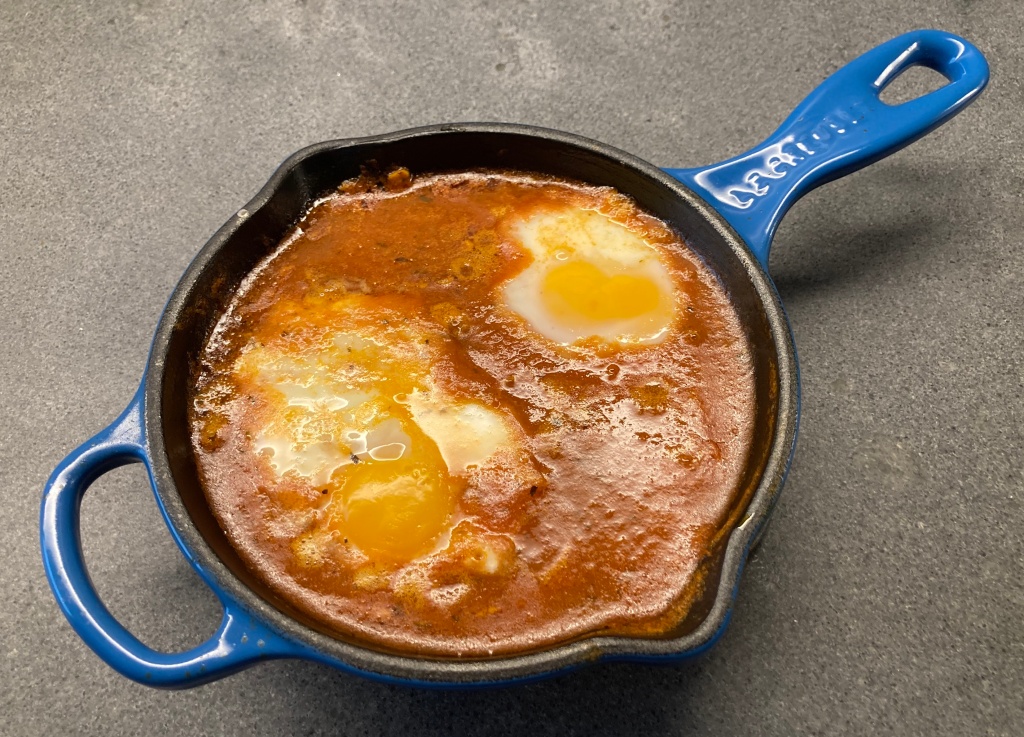
Poaching eggs in water requires a bit of technique or a nice tool. Poaching eggs in tomato sauce is slightly different: you want to keep the white close to the yolk, but it should not envelope it: the yolk must remain visible.

The combination of tomato sauce and egg seems to be a bit odd, but the rich, runny egg in combination with the slightly acidic, aromatic tomato sauce is really nice. Great suggestion for lunch or a hearty breakfast. Feel free to create your own version of this dish, for instance by adding some parsley or cheese. Serve with crusted bread.

In most cases the result is shown in a pan. For good reasons: it does not look very attractive when served on a plate. The fun is definitely in the flavours and aromas.

What You Need

What You Do

Warm the tomato sauce and reduce. Increase the heat until the sauce is nearly boiling, gently add the eggs (as you would do when poaching eggs in water) and reduce heat. Using a small spoon make sure the white remains close to the yolk, without covering it. Wait until the white is set. Perhaps add some freshly grounded black pepper.

Eggs Poached in Tomato Sauce ©cadwu

Mushroom Soup with Pancetta and Thyme

This morning when we looked outside, we saw a grey, foggy city. Knowing it would take hours for the fog to clear, we started thinking about something warm for lunch. Perhaps some soup with crusty bread? We opened our refrigerator. Various mushrooms, thyme, rosemary, cream, a carrot, some left over stock. Yes! We knew what we wanted to cook for lunch: Mushroom Soup with Pancetta. A hearty, rich soup, ideal for a cold, grey day. The combination of mushrooms, pancetta and cream works very well; the celery and leek add complexity and the thyme brings character.

Wine Pairing

It was much later that afternoon before the fog left the city, but since we also had some left over Chardonnay in the fridge, which we enjoyed with our soup, we didn’t mind that much.

What You Need

  • Pancetta
  • Shallot
  • Mushrooms (Best is a Mix of Champignons, Shiitake etcetera)
  • Celery
  • Leek
  • Carrot
  • Garlic
  • Stock (Chicken or Vegetable)
  • Bouquet Garni (Thyme, Rosemary and Bay Leaf)
  • Black pepper
  • Cream
  • Fresh Thyme
  • Olive Oil

What You Do

Keep two strips of pancetta apart (to be grilled just before serving). You probably need 4-6 strips in total. Slice the remaining pancetta and fry in olive oil on medium heat. Remove the pancetta from the pan, chop the shallot and glaze it in the fat and perhaps some extra olive oil. Clean and slice the mushrooms, slice half a stalk of celery, half a leek, a small carrot, chop two gloves of garlic and add this to the shallot. Gently fry for a few minutes. Add the pancetta, the stock and the bouquet garni. Allow to simmer for 30 minutes. Remove the bouquet garni. Blender the soup, pass through a sieve and leave on low heat for 10 minutes. The mushrooms will emulgate the soup, so no need to add a roux. Now it’s time to taste the soup and perhaps add some black pepper. Add cream and fresh thyme and leave for another 5-10 minutes. In the meantime grill the two strips of pancetta until brown and crispy. Cut the stripes in five pieces depending on the size. Serve the soup in a warm bowl with the pancetta on top of it.