Curly Kale with Confit de Canard

Recently we wrote about kale-sprouts, the purple combination of Kale and Brussels sprouts. When working on the post we noticed that we actually never wrote about Curly Kale. This typical winter vegetable (also known as BoerenkoolGrünkohl or Chou Frisé) is not known for its culinary capability, although Cavolo Nero (which is a variety of Kale) has become fairly popular over the last years. Dishes like RibollitaMinestrone or Cavolo Nero prepared with orecchiette and anchovies sound tempting.
Curly Kale is sometimes described as a super food because it contains lots of vitamines and it’s supposed to be good for your eye-sight. Reality is that it’s not simple to turn Curly Kale into something tasty. In 2015 Felicity Cloake (who writes for the Guardian) explains how to make kale crisps. She compares recipes from various authors and decides to make the perfect crisps from…. Cavolo Nero!
Curly Kale itself is typical comfort food. Served with potatoes, bacon and sausages; to be enjoyed with a glass of beer or a glass of Pinot Blanc.
Best is to eat Curly Kale after a wintery period. As soon as the temperature drops below zero, the plant will start breaking down the starch in the leaves into simple sugars. These sugars prevent the plant from freezing and the taste becomes sweeter and less bitter. A process that happens in carrots, turnips, beetroot, kale and Brussels sprouts but not in potatoes.

The traditional Dutch way of cooking Curly Kale is to add the sliced leaves with the potatoes to a pan of salted water, cook until done, drain, then mash with butter, warm milk, nutmeg, and black pepper. It is served with slices of smoked sausage. Hearty, filling and serieously heavy on your stomach.
We prefer a more modern version, highlighting the flavour and the texture of the Curly Kale.

What You Need
  • 400 grams of Fresh Curly Kale leaves
  • 1 small Potato
  • 1 Shallot
  • 1 Garlic Clove
  • Butter
  • Nutmeg
  • Black pepper
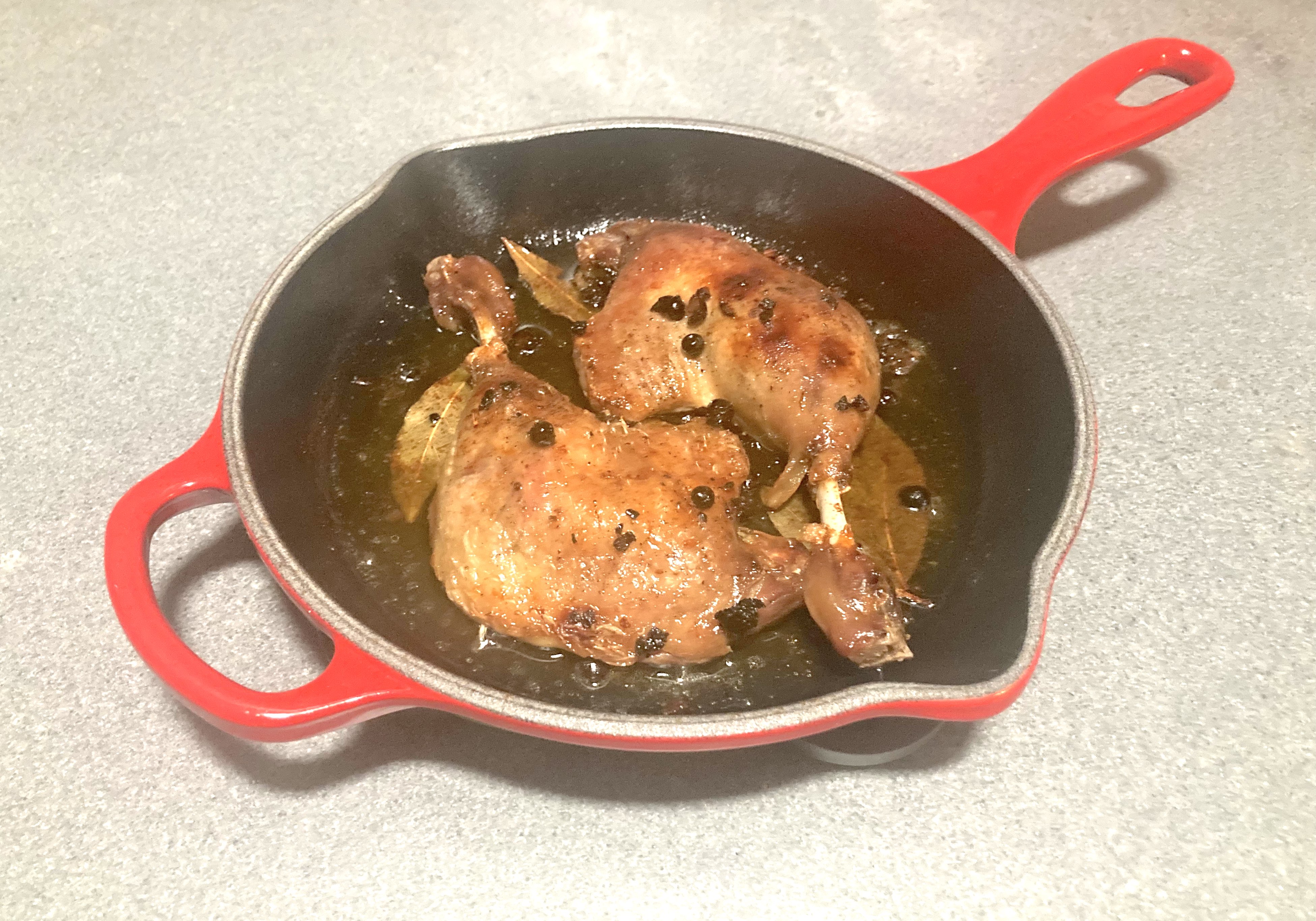
  • Confit de Canard
What You Do

Set your oven to 180 °C or 355 °F. Reheat and fry the confit de canard. Chop the shallot, finely chop the garlic, peel the potato and dice, strip the curly kale from its stems and slice the leaves. Add a generous amount of butter to the pan, gently fry the shallot for a few minutes, then add the garlic. After one minute or so add the sliced kale and allow to simmer. Add the diced potato, combine and leave to simmer for a few minutes. Add some water to the pan. Cook for 15-20 minutes until the potato is ready. Best is if the water has evaporated by this time. In the meantime, the duck should be ready. Poor the duck fat in the pan, mash very briefly (you want to keep the structure of the potatoes), add nutmeg and black pepper. The mash should be about the kale, with the onions, garlic and potato supporting it. Serve immediately on a warm plate.

Confit of Duck: a home made alternative

The traditional way of making Confit of Duck is not complex. It’s a bit time consuming and it requires some planning, that’s all. The principle is to cure the meat in salt with various herbs (thyme, cumin, rosemary) and garlic. After 24 hours or so the duck is washed with water, patted dry and then slow cooked in goose or duck fat for several hours. When ready cool and store in fat.

We take a different approach by slow cooking the duck legs in olive oil. The result is remarkable: juicy, full of flavours and aromas, provided you use first class duck (label rouge for instance). If not, the meat can become dry and tough. Another benefit: we don’t cure the meat so it’s not salty at all.
We serve the confit with celeriac mash. It’s light, nutty and refreshing compared to a mash made with potatoes.

Wine Pairing

Best choice is a full bodied, red wine with ripe fruit and smoothness. We decided to open a bottle of Herdade de São Miguel Colheita Seleccionada 2020 as produced by Casa Relvas. Such a pleasure! Its colour is deep ruby and the aromas made us think of ripe black fruit and dark cherries with some spiciness. The wine is well balanced with a nice structure and smooth tannins. Works very well with the juicy duck and the mash with its creamy texture and lemonish, celery flavours.

What You Need

  • For the Confit
    • 2 Duck Legs
    • Juniper berries
    • 4 Bay Leaves
    • Olive Oil
    • (optional) Garlic
  • For the Celeriac Mash
    • 1 Celeriac
    • Slice of Lemon
    • Cream
    • White Pepper
    • Nutmeg

Confit

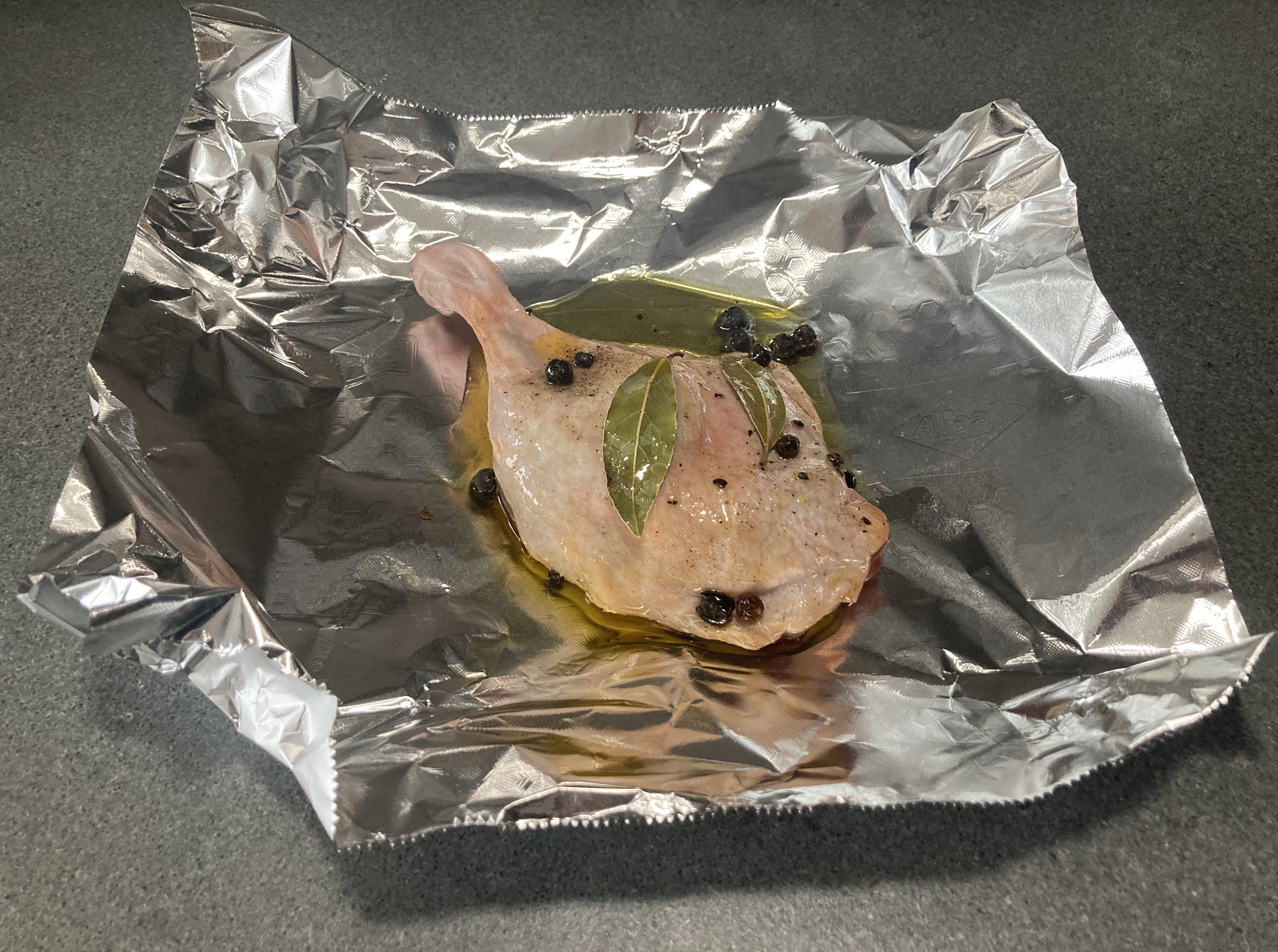
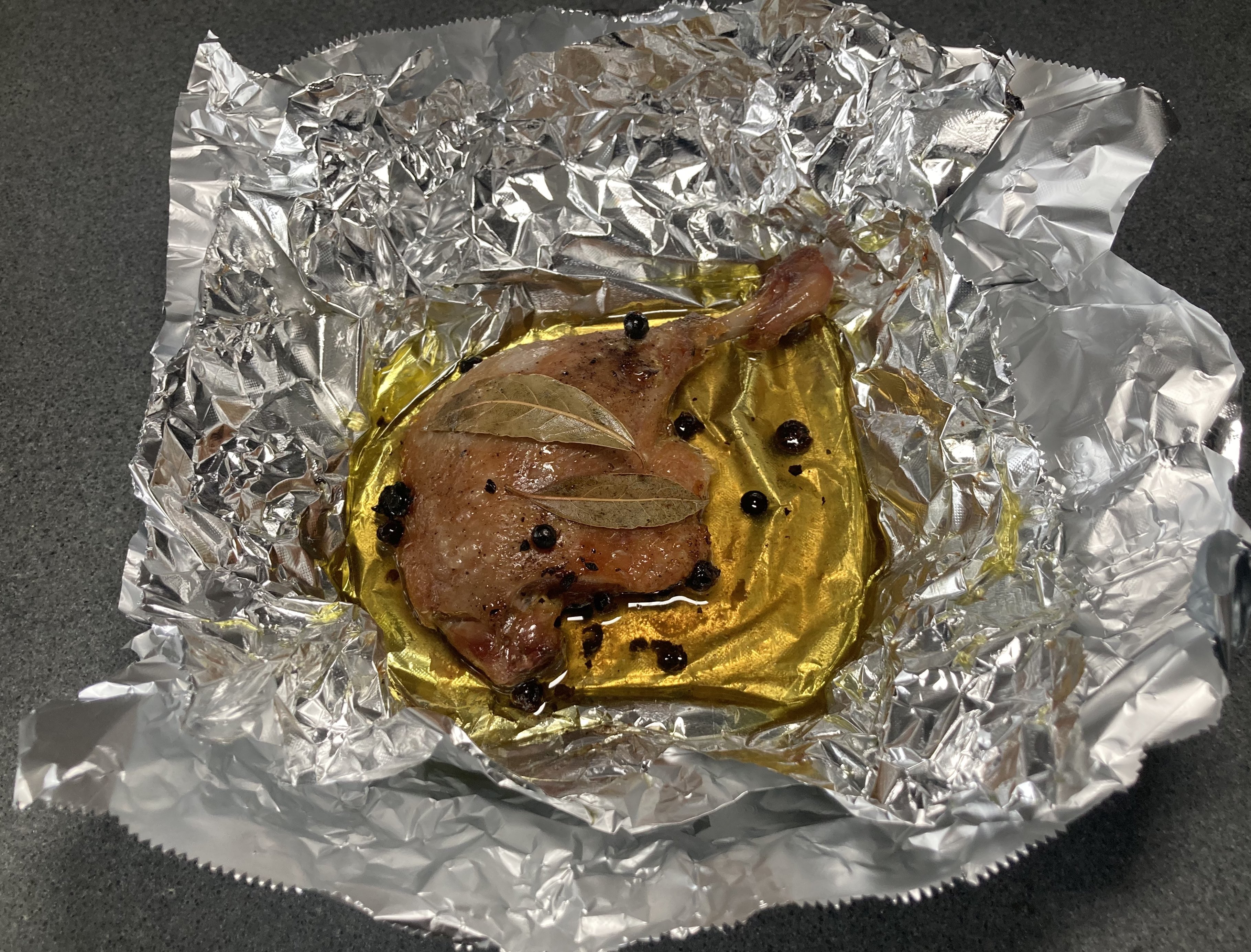
Take a sheet of aluminium foil and place the leg in the middle. Add lightly crushed juniper berries and two bay leaves. Perhaps some crushed garlic. Add a generous amount of olive oil and make sure everything is covered. Wrap foil around the duck. Take a second sheet of foil and wrap it around the package, making sure it’s closed. Repeat with the second leg. Transfer both packages to an oven at 120 °C or 240 °F. After one hour reduce the heat to 100 °C or 210 °F. After in total 4 to 5 hours, depending on the size of the legs, remove the legs from the oven, open the package and let cool. Then transfer to the refrigerator for use later on.

Heat the oven to 200 °C or 390 °F. Put the legs in an iron skillet, transfer to the oven and 15-20 minutes later the legs are ready. If the skin is not yet crispy, use the grill for 2 or 3 minutes.
Another idea is to pull the meat and use it to top a salad.

Mash

The Celeriac Mash: clean and dice the celeriac. Cook in minimum water with a nice slice of lemon until nearly done. Remove the lemon and drain. Add cream. Put on low heat for a few minutes; the celeriac should absorb the cream. When the celeriac is done, use a blender to create the puree. Pass through a sieve. Perhaps add extra lemon or cream. Just before serving add white pepper. Serve with freshly grated nutmeg.