The Art of Sauces: Remoulade

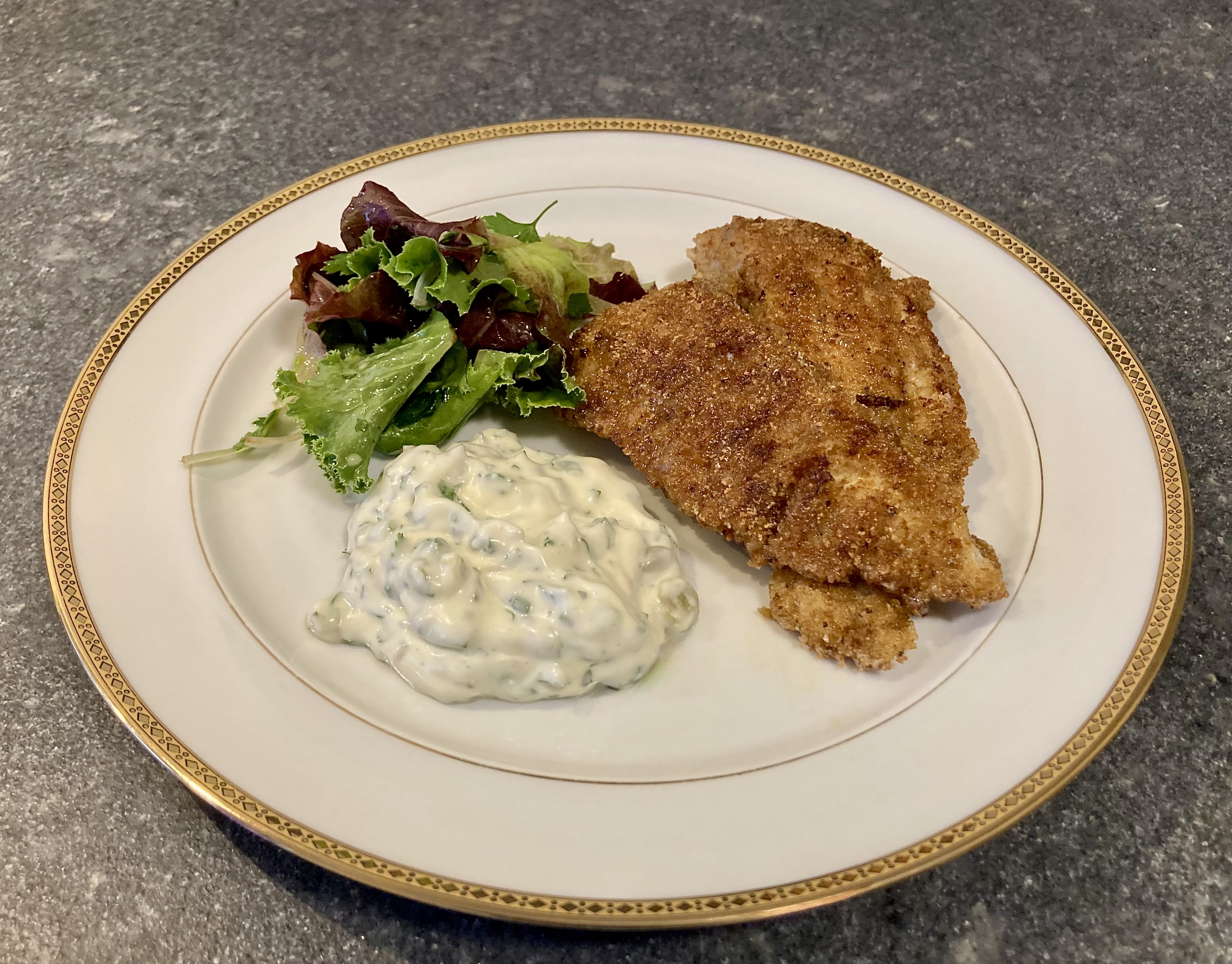
A few months ago we read an article in a Dutch wine magazine about pairing wine with a combination of fried cod, remoulade and a small salad. A nice challenge given the acidity in both the salad and the sauce plus the richness of the fried fish.

Remoulade is a sauce that goes very well with cold meat and fried or smoked fish. It combines mayonnaise with mustard, cornichons, capers, lemon and various herbs. Additional ingredients include anchovies, shallot and horseradish. Herbs could be parsley, tarragon, chives and chervil.
Turn it into a traditional French starter by adding celeriac (celery root).

One of the first recipes for remoulade (actually two recipes) was published in London in 1733 by Vincent La Chappelle, chef to the Earl of Chesterfield, in volume 1 of his book The Modern Cook.  Both versions contain oil, shallot, garlic, lemon, parsley, mustard, cullis (meat broth) and capers. Other ingredients of the first version (hot remoulade) are gravy, wine and cloves. Additional ingredients of the second version are green onions and anchovies.

Wine Pairing

According to the magazine’s wine expert the flavours in the dish are round and filming. The expert suggests a white wine with some oak or a white wine from a warmer country. We decided to drink a glass of  Verdejo made by Castelo de Medina with 100% verdejo grapes. The wine is well balanced, fresh and full bodied. It has a delicate bitterness which works very well with all components in the dish.

What You Need
  • Remoulade
    • 200 ml Mayonaise
    • teaspoon of Mustard
    • 2 Cornichons
    • teaspoon of Capers (in brine)
    • ½ small Shallot
    • Lemon Juice
    • 2 tablespoons of mixed herbs (Parsley, Chervil and Chives)
  • Fish
    • Cod, Hake, Haddock, Weever or another firm white fish
    • one Egg
    • Chapelure
  • Salad
    • Mâche, Mesclun
    • dressing made with olive oil, lemon and mustard
What You Do
  1. Remoulade
    1. Make the mayonnaise
    2. Very finely chop the shallot
    3. Dry and slice the cornichons and the capers
    4. Chop the herbs
    5. Combine all ingredients
    6. Add lemon juice to taste
    7. Transfer to the refrigerator for a few hours
  2. Fish
    1. Beat the egg
    2. Heat a non stick pan
    3. Add oil to the pan
    4. Coat the fish with egg
    5. Coat the fish with chapelure
    6. Fry the fish until golden
  3. Dish
    1. Make a dressing by combining olive oil. lemon and mustard
    2. Toss the salad with the dressing
    3. Serve the fried fish with the remoulade and the salad
PS

Comparing the list of ingredients used by Chef La Chapelle you wil notice that modern remoulade doesn’t contain garlic or cullis. He didn’t use mayonnaise for the simple reason that the first recipe for mayonnaise was published in 1828, nearly one hundred years later.

Cod with Miso

Marinating is such an interesting way of preparing food. It can be used to make food (meat) softer, to add flavour or colour, it can be acidic, it can be enzymatic, sometimes it requires only a few minutes, sometimes it takes days.

One of our favourite recipes by Antonio Carlucci is a salad made with maitake, fresh scallops, crab and shrimps. It’s an amazing result, with lots of pleasant flavours, also thanks to the cilantro, dill and parsley. Part of the fun is that the scallops are not seared but prepared with a marinade of lemon, a process that takes a few minutes only.

In this case we want to add flavour (and a bit of colour) to already very tasty cod. The duration depends on the shape of the fillet, in our case it was 30 minutes. You will taste delicious cod with a touch of umami and sweetness and you will smell the aromas of the marinade. The pickles will give the dish a crunchy and briny touch.

Wine Pairing

We enjoyed a glass of our favourite sake: Junmai Taru Sake as produced by Kiku-Masamune. The sake is matured in barrels made of the finest Yoshino cedar, which is reflected in its aroma and flavor. The sake will clear your palate and allow for the more intense taste of the marinated cod.

If you decide to pair the dish with a white wine, then we suggest an aromatic, fresh and fruity wine, with aromas of citrus and apple. The wine should be uplifting and juicy with a light character.

What You Need
  • Fillet of Cod
  • 1 tablespoon of Miso
  • 1 tablespoon of Mirin
  • ¼ tablespoon Soy Sauce (preferably with less salt)
  • ½ tablespoon of Rice Vinegar
  • 1 teaspoon of Mustard
  • 1 teaspoon of Sesame Oil
  • Pickled Cucumber
What You Do
  1. Combine miso, mirin, soy sauce, rice vinegar, sesame oil and mustard. Be careful with the soy sauce, you’re looking for a balanced mixture.
  2. Dry the cod and leave to marinate in the mixture for 30 minutes.
  3. Transfer the cod without excess marinade and fry in a warm pan until done.
    • The fish should be opaque and flaky. Its internal temperature 60 – 63 °C or 140 – 145 °F
    • The sugars in the marinade burn easily, so the pan shouldn’t be too warm.
  4. Serve on a warm plate with the pickles.
Variations

You can also prepare this dish with haddock (although it’s perhaps too delicate), ling or pollack.
If you want a spicier marinade, then add grated fresh ginger. Crushed cilantro seeds will add more depth to the taste.

Cod with Miso ©cadwu

Cod in Green

“Perhaps you would like to try ling? It’s similar to cod, perhaps more delicate.” We’re always happy to try something new, so we said “yes” to our fishmonger and bought a nice slice of ling. It’s an impressive fish with a length of 200 cm and its weight can be 30 kg. There is no data available on the size of the population per region because it’s a solitary, deep water species, which makes it a ‘fish to avoid’.
We prepared the ling and unfortunately it wasn’t our most successful kitchen experiment. Taste and texture were very good, the combination with blue cheese didn’t work and frying ling turned out to be a mistake. Next time we will stew ling in a green sauce, like Paling in ‘t Groen (Eel in Green or Anguilles au vert) we decided.
A few days later.
“We would like to have some ling please.”
“Sorry, no ling today.”
“Ah, pity! What would you suggest as an alternative?”
“Cod!”, our fishmonger said, smiling.
Since eel is critically endangered, we decided to make Cod in Green.

Wine Pairing

Lots of fresh, aromatic flavours in this dish, making it light and uplifting. We would suggest a glass of Chardonnay, perhaps one with a touch of oak. We decided to open a bottle of Coteaux Varois en Provence rosé, produced by Estandon and made with grenache, cinsault en syrah grapes. Fruity, a touch spice and with a great finish.

What You Need
  • For the Sauce
    • Watercress
    • Parsley
    • Chervil
    • Dill
    • 50 ml Double Cream
    • 100 ml Fish Fond
    • 65 ml Noilly Prat
  • For the Fish
    • 200 grams of Cod
    • Butter
What You Do
  1. Combine cream, fond and Noilly Prat
  2. Stir well and reduce until it thickens. This may take 15 minutes or more
  3. In parallel remove the stems of a generous amount of watercress and chervil. Be less generous with the parsley. Add some dill
  4. Poach this for 20 seconds in boiling water
  5. Remove and transfer to an ice bath
  6. Drain and blender until you have a smooth, green mixture
  7. When the sauce starts to thicken, fry the cod in butter until it’s nicely browned and opaque
  8. Four minutes before the cod is ready, add the green mixture to the reduced sauce and warm through and through
  9. Do not boil
  10. Add the sauce to a deep plate and serve the fish on top of the sauce. Garnish with chervil
Cod in Green ©cadwu
Cod in Green ©cadwu

Cod Cheeks

Cod has been a popular fish for hundreds of years. Much appreciated for its taste and structure. Its popularity unfortunately also means it has been heavily overfished. During the nineties the population dropped significantly. Thanks to various restrictions, cod is slowly on its way back to recovery, especially in the Northeast Atlantic Ocean, although it is still on the red list in many countries. Sea Food Watch provides a very helpful buying guide.

When you buy cod, in most cases you buy cod fillets. But what happens to the remainder, what happens for instance to the head? You could roast it in the oven, you could use it to make stock (don’t forget to remove the skewers), in some countries dried cod heads are appreciated as a delicacy, but in reality, most fish heads seem to end up in animal food or biofuel.

Recently our fish monger surprised us by selling cod cheeks, an absolute delicacy. They are moist with a firm structure and have a delicate taste. Great to combine with parsley, capers and lemon. Or make a batter with beer, flower and egg, coat the cheeks and fry them in oil at 180 °C or 360 °F.

Wine Pairing

A medium bodied white wine will do very well in combination with the Cod Cheeks, for instance an unoaked Chardonnay or Chenin Blanc. We enjoyed a glass of Clin d’Oeil, Saumur Blanc from the Loire region in France produced by Les Vignobles Edonis. It’s a dry wine with clear acidity, fruit, green apples, some minerality and length.

What You Need

  • 200 grams of Cod Cheeks
  • All Purpose Flower
  • Egg
  • Bread Crumbs
  • Butter
  • Pepper
  • Tartar Sauce

What You Do

  1. Carefully remove the skin and white membranes of the cod cheeks
  2. Separate the egg, whisk the egg yolk
  3. Heat a pan and add butter
  4. Dry the cod cheeks with kitchen paper, dust with flower, then dip in the egg yolk and coat with bread crumbs
  5. Fry until golden
  6. Add some black pepper and serve on a warm plate
  7. A dish to share!
PS
  • Make your own bread-crumbs by using old, stale but originally very tasty bread. Obviously, we use our home-made bread.
    Toast the bread and let cool. Cut in smaller bits and then use a cutter or blender to make the crumbs. They keep very well in the freezer, so best to make in advance, when you have some left over bread.
  • Make your own tartar sauce by combining mayonnaise, pickles, lemon juice, capers, dill and Dijon mustard.
Cod Cheeks ©cadwu
Cod Cheeks ©cadwu

Weever

Fish and Chips, such a tasty combination, especially when the fish is fried with beer-based batter and served with triple-cooked chips, mushy peas and tartare sauce. Commonly it is made with cod or haddock. We prefer haddock because of its flavour and more importantly its texture. Both haddock and cod are expensive and in these days of high inflation we are keen to find a cheap alternative.

That’s why we recently tried this dish with weever, also known as Pieterman in Dutch and Vive in French. We were not disappointed, not at all. Excellent texture, taste a bit stronger compared to haddock but nevertheless yummy.
Weever is actually a really interesting fish. Weevers hide in the sand, waiting for prey. Their defence is based on a poisonous dorsal fin which makes it very painful when you step on it or want to get gold of them. Therefore it is unpopular with anglers, making it bycatch. And because of that, weever is not expensive. Great combination: save money and enjoy delicious food!

Drink Pairing

A nice, cold beer will go very well with this dish. Wine wise the choice is yours: unoaked Chardonnay, Semillon, dry Riesling, Rueda, Chenin Blanc or Picpoul de Pinet. The wine must be fresh, a touch citrussy and have balanced acidity.

What You Need
  • For the Haddock, Cod or Weever
    • Boneless Fillet
    • All Purpose Flour
    • Breadcrumbs (see below)
    • Egg
    • Butter
    • Olive Oil
    • Black Pepper
  • For the Pickled Radish
    • Red Radishes
    • Shallot
    • White Wine Vinegar
    • Sugar
  • Mayonnaise
What You Do – Pickled Radish
  1. Take a cup of white wine vinegar, add it to a bowl, add sugar, perhaps some water (depending on the acidity of the vinegar), mix very well and taste
  2. The mixture should be both sweet and sour
  3. Slice the radishes and the shallot
  4. Add to the mixture, stir and leave in the refrigerator for a few hours
  5. Over time the colours will blend
  6. The vegetables will keep well for a few days
  7. Feel free to use the same approach with other (firm) small vegetables
What You Do – Haddock, Cod or Weever
  1. Pat the fillet dry with kitchen paper
  2. Check if there are really no bones
  3. Take three plates, one with flour, one with beaten egg, one with breadcrumbs
  4. Coat the fillet with flour, then dip it into the egg mixture and finally coat with the crumbs
  5. Fry in hot butter (with olive oil) until lovely golden brown
  6. Serve immediately on a warm plate
What You Do – Breadcrumbs
  1. Also known as chapelure
  2. Use old, stale but originally very tasty bread. Obviously, we use our home-made bread
  3. Toast the bread and let cool
  4. Cut in smaller bits and then use a cutter or blender to make the crumbs
  5. They keep very well in the freezer, so best to make in advance, when you have some left over bread

Fish Cakes

They are so tempting! The crunchy crust, the flaky texture and the flavour, especially when combined with mayonnaise and lemon. When we see them at the supermarket or at the fishmonger, we can’t always resist buying them. But we should resist the temptation because most fish cakes should be called salty potato cakes. Hardly any fish, limited herbs, the structure of mashed potato and lots of salt to disguise the lack of real flavour.

It’s not a lot of work to prepare your own fish cakes, so be brave and ignore the factory-made ones. The recipe is very flexible, you could make a Thai version (Tod Mun Pla) with lemon grass, red curry, onions and garlic, a traditional version with stockfish, or cakes with salmon, with shrimps etcetera. To be served with Tartar sauce, sweet chili sauce, dill sauce or perhaps hoisin. We prefer Jean Beddington‘s fish cakes (served with a beetroot chutney) or a more traditional version that focuses on the fish, with herbs and black pepper in a supporting role, breaded with our home-made breadcrumbs.

Wine Pairing

Let’s be flexible, a nice glass of beer or a not too complex white wine, it’s all fine. The salad, its dressing and the lemon will be rather present. Perhaps a Verdejo, Pinot Blanc or a Picpoul de Pinet?

What You Need

  • For the Cakes
    • 225 grams of Haddock
    • 100 grams of Potato
    • 1 egg yolk
    • Parsley
    • Chives
    • Black Pepper
    • Butter
  • 1 Egg
  • Breadcrumbs
  • Olive Oil and Butter
  • Salad with a dressing made of Olive Oil and White Wine Vinegar
  • Mayonnaise
  • Lemon

What You Do

It’s best to make the mixture one day ahead. This allows for the flavours to integrate.
Gently fry the haddock in butter. You’re looking for a light golden color, just to give it some extra flavour. When nearly done, transfer to a plate and let cool. Cook the potato until soft. Let cool. Use a fish knive to make fish flakes. Use a fork to mash the potato. Chop lots of parsley and chives. Combine fish (and its juices), potato, egg yolk, herbs and a generous amount of black pepper. Let cool and store in the refrigerator until the next day.
Beat the egg, add a few drops of lemon to the mayonnaise and heat a heavy iron skillet or a non-stick pan. Make 4 fish cakes. Coat them with egg, then cover with breadcrumbs and fry in butter and/or olive oil on all sides. In total 6-10 minutes. Serve with a salad, mayonnaise and a wedge of lemon.

PS

Making your own breadcrumbs is simple and worthwhile. The breadcrumbs at the supermarket are made of cardboard; yet another product you shouldn’t buy. Toast slices of old bread and let cool. Cut in smaller bits and then use a cutter or blender to make the crumbs. Done. They keep very well in the freezer.

Fish Cakes by Jean Beddington

Jean Beddington: a culinary, passionate creative! She was chef at five restaurants, owned her own successful restaurant, and still is an inspiration to many. One of her motto’s is ‘seemingly simple’, not with the intention to impress but with the intention to surprise and enhance the sensation when enjoying her food and the way it is presented.

Background

In her book Absolutely Jean Beddington she writes about her background, her youth in England, her eagerness to cook, the holidays with her father when they would stay at budget hotels and eat at Michelin Star restaurants, her travels, her years in Japan and her education (she studied Arts and Chemistry). When she moved to the Netherlands, she decided to become a chef, which is the obvious choice for someone with such a talent. She was one of the first to bring new ingredients to the classic French cuisine. For instance, she began using cilantro and yuzu. She was also inspired by the Japanese way of presenting food: beautifully designed and served on a variety of plates. She began doing this when most guests still expected bread and garlic butter at the beginning of their lunch or dinner.

Books

She published several books. One is dedicated to stock: the basis of soups, sauces and dishes. She explains how to make stock and how to create delicious food, for instance green vegetables in stock with couscous, yogurt and harissa sauce. 

Her book Absolutely Jean Beddington is very dear to us. It has three main chapters: the first one is called Glossy with beautifully presented food, the second one is called Real Time with food as you could expect to eat at her restaurant (which is closed, unfortunately) and our favourite chapter is called Daily. Indeed, recipes that are easy to follow and help prepare tasty, wonderful food, every day.

Fish Cakes

We prepared her fish cakes with a beetroot, ginger, apple and onion chutney. The fish cakes are intriguing and the chutney is the perfect accompaniment. Yummy!

Cod and Horn of Plenty

The magic of a great combination: only two ingredients supported by butter, olive oil and white pepper. It made us think of James Tanner’s inspiring Take 5 Ingredients. Sometimes you need various cooking techniques and lots of ingredients. Sometimes the combination of only 5 ingredients is all you need to make a perfect dish.

Why perfect? Both the fish and the mushroom are clearly present and nicely balanced. As if the combination brings out the best of both. The butter supports the richness of the fish and the aromas are delicate. The texture of the cod is soft and a touch flaky; the Trompettes de la Mort have a more fibrous and chewy texture. Excellent mouthfeel!

Wine Pairing

You’re looking for a wine that has minerality, a touch of oak and has sufficient body and length, for instance a Chardonnay.
We enjoyed our Cod and Horn of Plenty with a glass of Chablis, Antonin Rodet, Premier Cru, Montmains. It has a clear and pale gold colour. It comes with mineral notes and a touch of lemon. The taste is delicate and persistent with aromas of fresh citrus. It goes very well with the ‘long’ taste of the dish and the citrus is ideal with the cod and butter.

What You Need

  • 150 grams of Cod
  • 100 grams of Horn of Plenty
  • Butter
  • Olive Oil
  • White Pepper

What You Do

Make sure the mushrooms are fresh and dry. They become soggy and smelly easily. Clean the mushrooms thoroughly with a piece of kitchen paper. This can be time consuming. You may want to cut the cod in two. Fry the cod in olive oil with some butter in a non-stick pan. In a second pan fry the mushrooms in olive oil. This may take 5 minutes or so. Transfer the mushrooms from the pan to a warm plate with kitchen paper. When the cod is ready, serve immediately on a warm plate with some white pepper and sprinkle the mushrooms on top.

  • Cod and Horn of Plenty ©cadwu
  • Horn of Plenty ©cadwu

Cod with Bleu d’Auvergne

Bleu d’Auvergne is amongst our favourite cheeses. It’s creamy, semi-hard, moist, powerful, pungent and not too salty. It was created around 1850 in France when a farmer combined cow milk curd with the mould of rye bread. He also noticed that the cheese benefits from increased aeration using needles (similar to the process used when making Stilton cheese). Nowadays Bleu d’Auvergne is a Protected Designation of Origin (PDO), just like the other excellent cheeses from that region (for example Saint-Nectaire and Cantal).
For some reason Bleu d’Auvergne combines extremely well with cod. We tried other combinations, experimented with adding butter, cream or crème fraîche but we always return to this one. It’s a tribute to both the fish and the cheese.

Wine Pairing

The combination may be very specific; wine pairing is not too difficult. In general a fairly present, white wine will be great choice. Could be a Verdejo from Spain, a mildly oaked Chardonnay or a glass of your favourite white wine. No reason to open a bottle of Chablis; the flavours are too bold for a really elegant wine.

What You Need

  • Skinless Cod Loin
  • Bleu d’Auvergne (preferable mature)
  • Olive Oil

What You Do

Heat a heavy cast iron skillet through and through, add olive oil, dry the cod with kitchen paper and fry on the firm side (where the skin used to be) until it’s nice and golden. Flip the fish, reduce the heat and start adding chunks of cheese. It will melt, but make sure you still have these blue bits in there. Baste the fish with the melting cheese. Check the cuisson of the cod (the fish must be opaque and flaky) and serve on a warm plate.

  • Cod with Bleu d’Auvergne ©cadwu
  • Blue d'Auvergne ©cadwu

Lentils with Cod and Cilantro

Lentils are healthy, easy to work with, not expensive, nutritious and high in fiber, protein and iron. Lentils have been around for a long time, so you would expect lentils to be popular, but for some reason they are not. Lentils can be used to prepare soups, salads, dahl, burgers, curry, biscuits (sablés) and so much more.
The three basic types are Green or Brown lentils, Red lentils and Black or Beluga lentils. Red lentils are often dehusked and then split, making them perfect for cooking soup.

In most cases we prefer Du Puy lentil from Sabarot because of their great taste and the fact that they hold their beautiful shape, even when cooked. Sabarot also produces lentil flour; ideal for biscuits, pancakes and waffles.

Beware of fake Du Puy lentils! They have names like ‘Le Puy lentils’ or ‘Dupuis lentils’. All nasty marketing. The real Du Puy lentils come with an Appellation d’Origine Controlee (Protected Designation of Origin).

Wine Pairing

We very much enjoyed a glass of Spanish Verdejo. In our case a bottle of Monteabellón Rueda 2019. In general wines made from the Verdejo grape combine very well with fish. The wine comes with the right acidity, giving freshness to the wine. It has floral aromas typical for the Verdejo grape. You may also recognize the aromas of banana and exotic fruit.

What You Need

  • Shallot
  • Olive Oil
  • Cilantro Seeds
  • Green, Du Puy or Beluga Lentils
  • Mild Fish Stock
  • Cod
  • Butter
  • Fresh Cilantro
  • White Pepper

What You Do

Chop the shallot (seize lentil) and glaze gently in olive oil. In the mean time check the lentils for small pebbles; wash them. Once the shallot is glazed, add the lentils and the crushed cilantro seeds. Heat for a few minutes, as you would do with risotto rice. Add the mild fish stock and leave to simmer on low heat for approximately 20 minutes, depending on the size (and your preference of course). In parallel fry the cod in butter in a non-stick pan. Just before the lentils are ready, add half of the finely cut cilantro to the lentils and mix.
Timing is all. The lentils should be cooked, all liquid evaporated and absorbed and the cod just done. Meaning the cod is opaque and the flakes can be separated easily. And overcooked meaning you can see those nasty small white bits of egg white and the fish becomes dry.
Serve the cod on top of the lentils and sprinkle some cilantro over the lentils and cod. Maybe add a touch of white pepper.

PS In case you think cilantro tastes like soap, feel free to replace the fresh cilantro with parsley. Cilantro seeds do not trigger the soap-like taste.