Spicy Pumpkin Soup

It’s the time of year to enjoy simple, seasonal, rich and flavourful food, for instance spicy pumpkin soup. The trick in this case is in the coconut milk or cream. Coconut milk contains something like 15 grams of fat per 100ml. For this soup you need 25+ grams of fat per 100ml. The fat enhances the coconut flavour and it combines very well with the spicy and aromatic character of the soup (ginger, chili, djeroek poeroet).

What You Need (for 4)
  • Small Pumpkin
  • Large Shallot
  • 2 large Garlic Cloves
  • 4 cm Fresh Ginger
  • Chili Pepper
  • Olive Oil
  • 8 leaves of Djeroek Poeroet  
  • Coconut Cream
  • Cilantro
What You Do

Wash the pumpkin and chop. If the pumpkin is organic, then you don’t need to peel it. Peel and chop the shallot, garlic and the ginger. Ground dried chili pepper. Gently fry the shallot in olive oil. Add chilli pepper. Add ginger. Stir, mix and add pumpkin. Stir and add garlic. Now add the vegetable stock, the djeroek poeroet and allow to simmer for 30 minutes. If the pumpkin is soft, remove the djeroek poeroet and blender the mixture. Taste and adjust. Add 6 spoons of coconut cream, 1 by 1, mix and taste. When you’re happy with the flavours, leave the soup on low heat for 15 minutes. Serve with lots of chopped cilantro.

Spicy Pumpkin Soup ©cadwu

Kimchi Soup

Kimchi Soup

A very tasty soup, nice as a starter to your Korean evening or as a quick and nourishing lunch. Kimchi soup can be made with pork belly or with tofu. We prefer the vegetarian option.
It’s not difficult to prepare kimchi from scratch (see below) but you can also buy kimchi from your local Korean shop.

Here is what you need (soup)

  • Kimchi
  • Onion
  • Garlic clove
  • Spring onion
  • Soybean paste (Korean Doenjang or Japanese Miso)
  • Red chili paste (Korean Gochujang)
  • Fish sauce
  • Tofu

Start by chopping the onion, the garlic and the spring onion. Keep some spring onion for decoration. Fry the garlic and onions in some oil. Add the soybean paste, the red chili paste and the chopped kimchi. Stir fry the mixture because this will enhance the flavours. Add water and leave for 15 minutes. Taste the soup and add fish sauce, soybean paste or red chili paste to your taste. Leave to simmer for another 15 minutes. Then add chunks of tofu and allow to simmer for another 5 minutes. Decorate with spring onion.

Kimchi background

Hipster food or the traditional Korean way of preserving cabbage? The latter of course. But we must admit, all the foodie-talk about Kimchi inspired us to join a workshop at Mediamatic in Amsterdam. Marrit Kuyng Ok Schakel ran an excellent workshop and not only did she share her passion for Korean food and Kimchi, she also showed us how to make our own Kimchi using white cabbage.

Making Kimchi is all about fermentation: a controlled biological process to change ingredients into food that can be preserved. Fermentation is at the heart of our food production. Beer, cheese, wine, bread, yoghurt, tea, coffee, classic Dutch haring et cetera: fermentation is an essential aspect.


Here is what you need (kimchi)

  • Chinese Cabbage
  • Salt
  • Garlic
  • Ginger
  • Red chili paste (Korean Gochujang)
  • Fish sauce
  • Spring Onion

The quickest way to make kimchi is by thinly slicing the cabbage, add salt, grated ginger, sliced garlic, red chili paste and fish sauce. The preparation is simple: just mix with your hands (do so for 5 minutes) store in a jar and wait for 5 – 10 days. The fermentation will produce some carbon dioxide so make sure to open the jar on a daily basis. The smell could be rather powerful in the beginning. In this case the amount of salt required depends on how much fish sauce was used. We suggest tasting the mixture and expect between 1% and 2%.

The better way to make kimchi? Slice the cabbage, starting at the bottom, but not completely. Tear the halves apart. Leave the cabbage in water with salt (5% is recommended) for 1-2 hours. Remove the cabbage, wash with cold water and taste if not too salty. If so, wah a bit more. Make a mixture of red chili paste, fish sauce, garlic and ginger. Using your hands, gently work the paste into the cabbage until all leaves are thoroughly coated. Move to a jar and leave to ferment

Also try making kimchi with Daikon, White Cabbage or Pak Choi. We will continue the experiment by using chicory.

Londonderry Soup

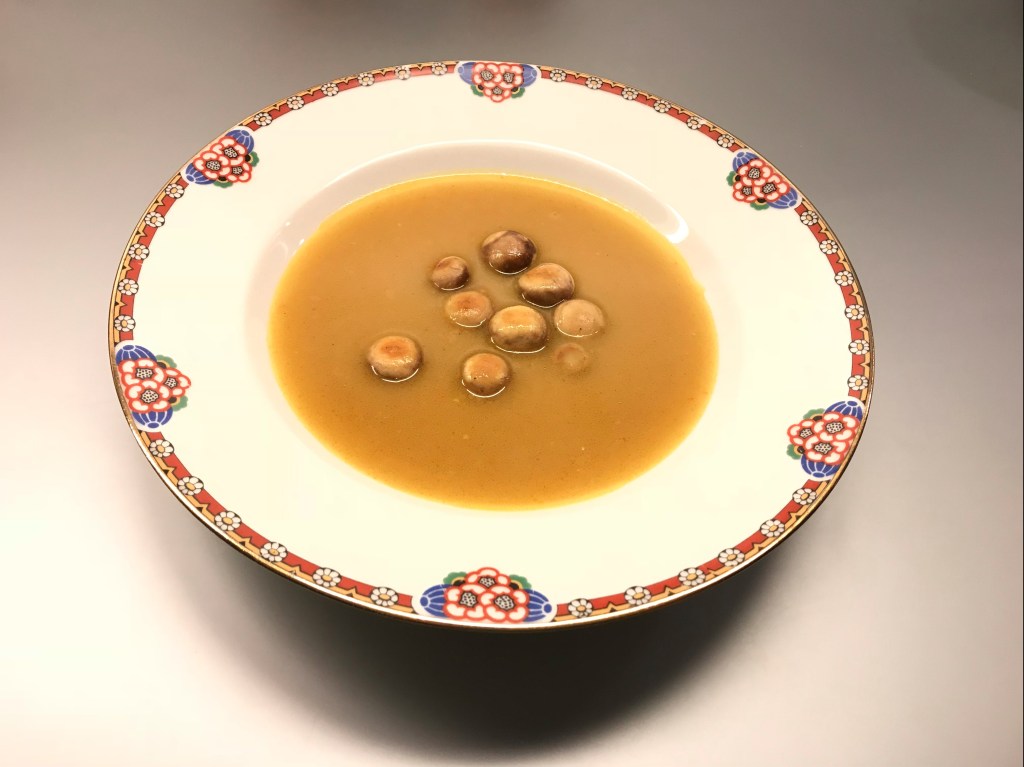
Sunday afternoon, my mother in the kitchen, asking us what we would like to eat as a starter. Would we like vegetable soup with broken vermicelli or Londonderry soup? My favourite! Londonderry soup! Monday meant school but Sunday was all about Londonderry Soup!
My mother seemed less keen to prepare Londonderry soup because, depending on the chili and the curry, it could be too spicy to her taste. The vegetable soup was more predictable.
As always in life, things change. I moved to another city, she became less interested in cooking and so here we are today: I haven’t tasted the soup for years. Time to start cooking.
The Londonderry soup I tasted as a child seems to be a Dutch and Belgium phenomenon. And a rather undefined one. Some use veal stock, others chicken. Some add mushrooms, others rice. Also used are chili, sambal, cayenne pepper, parsley, egg, meat balls et cetera. And to make things even more confusing, in the UK it’s known as a pea soup. Which is not at all what my mother used to prepare. Plus no-one seems to know what the origin is of the name.
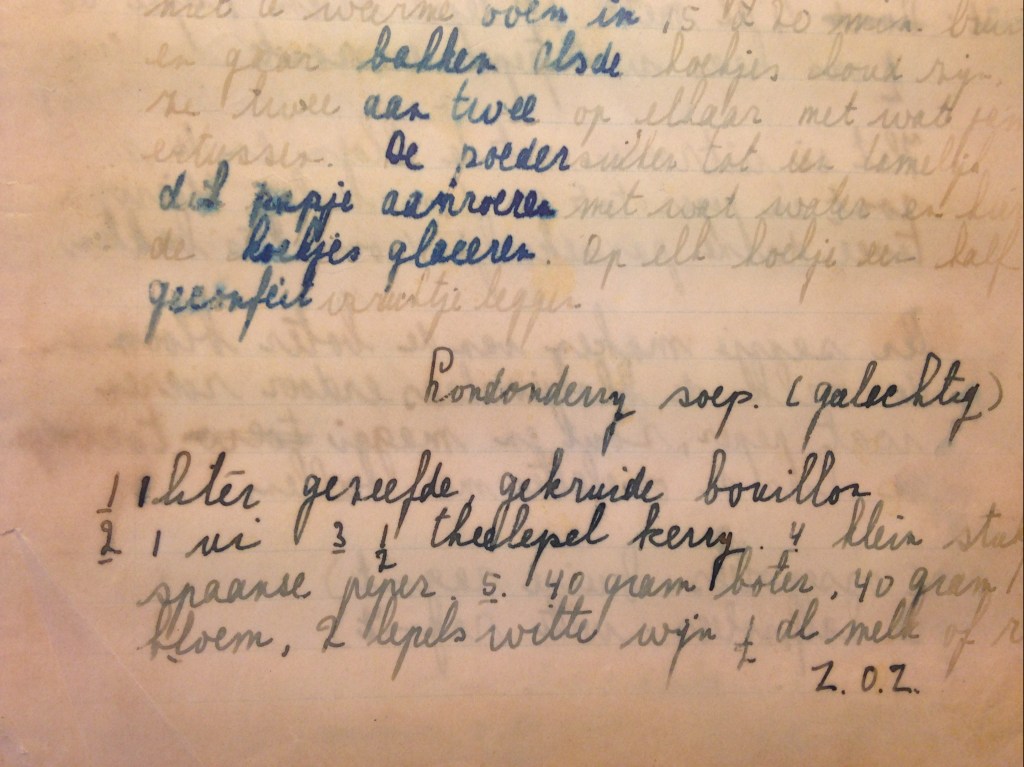
So we decided to follow the recipe my mother included in her ‘kookschrift’, which is a notebook with recipes she learned as a young woman.

What You Need

  • Light Stock (Veal or Chicken)
  • A Shallot
  • Curry Powder
  • Chili
  • Equal amount of Flower and Butter
  • Button Mushrooms
  • Single Cream

What You Do

  1. Start by glazing the chopped shallot in butter
  2. Add the chili (my mother used 4 small slices, but feel free to use more!) and the curry powder
  3. The curry powder should be spicy and powerful
  4. Make sure the curry is fried, allowing for the flavors to develop
  5. Add the flour and start making a roux
  6. Add the warm stock, step by step, take your time, and create the soup
  7. Leave it for 15 minutes to integrate
  8. In parallel gently fry the very small mushrooms (so called button mushrooms)
  9. Pass the soup through a sieve
  10. Use a spoon to capture all the flavors of the shallot and the chili
  11. The soup should be completely smooth
  12. Now things become unclear in my mother’s recipe. She suggests adding white wine just before serving (which will add acidity plus the taste of alcohol which is not great) or single milk or cream. Milk will only weaken the taste of the curry. Cream however will give a velvety mouthfeel when tasting the soup, which is great in combination with the spicy curry. So we added a touch of single cream
  13. Leave the soup for 5 minutes on low heat, allowing for the cream to cook
  14. Just before serving add the gently colored button mushrooms

Thanks Mum!