How to Make a Roulade (part 2)

Earlier we wrote about ‘butterflying’ meat, a technique that allows you to turn a bigger piece of meat into a roulade. Ideal for pork loin or turkey. But what to do when you have smaller pieces of meat and butterflying is not possible? Then it’s a matter of flattening the meat, for instance with a hammer. Better to ask your butcher to do it for you with the head (blade) of a butcher’s axe: easy, quick and a much better result. Thin is better!
Once you have flattened pieces of meat it’s a bit of a puzzle to create the roulade. Just give it a try and see what works best. When you think you have the right combination, make sure the kitchen twine is in place and the filling ready.
Obviously, you want to match the filling with the side dishes. We served the roulade with caponata and decided to make a filling with sage and thyme.

Wine Pairing
homemade roulade: chicken thighs, sage and pancetta. Served with caponata

We enjouyed a non-oaked Nero d’Avola from Sicily. The ruby red coloured wine has aromas of cherries and plum. The taste is fruity and long with subtle tannins. Great combination with the Mediterranean flavours in both the roulade and the caponata.

What You Need
  • 4 Boneless Chicken Thighs
  • 1 small Shallot
  • 1 clove of Garlic
  • 10 leaves of Sage
  • Thyme
  • Butter
  • Pancetta
  • Olive Oil
  • Lemon
  • Black Pepper
What You Do
  1. Ask your butcher to flatten the chicken thighs
  2. Chop the shallot and the garlic
  3. De-vein the sage
  4. Remove the thyme leaves from the stalk
  5. Grate the butter
  6. Add olive oil to a heavy iron skillet and gently fry the shallot
  7. After a few minutes reduce the heat
  8. Add garlic and thyme. Stir
  9. Add some lemon juice
  10. Allow the filling to cool
  11. Put strings of kitchen twine on your work top
  12. Decide on the pattern for the meat and put it on top of the kitchen twine. This way you can easily roll up the meat and tie the twine
  13. Cover the meat with sage
  14. Spread the mixture over the sage. Keep the edges free
  15. Add grated butter
  16. Cover with slices of pancetta
  17. Roll up the meat
  18. Tie with kitchen twine
  19. Tightly wrap in plastic foil and transfer to the refrigerator for at least 2 hours
  20. Remove the roulade from the refrigerator and allow to rest at room temperature for 30 minutes
  21. Preheat your oven to 180 °C or 350 °F
  22. Remove the foil
  23. Put the roulade on a rack (this way it will brown evenly)
  24. Add water to the pan
  25. Fry in the oven until the internal temperature is between 70 °C and 75 °C, or 160 °F and 165 °F
  26. Transfer to your worktop, wrap in aluminium foil and allow to rest for 10 minutes
  27. Serve with caponata

Easy Mushroom Pie

Hurray! The mushroom season has started! Last Friday we bought beautiful golden chanterelles (girolles) and white beech mushrooms (shimeji). It’s the time of year to enjoy wonderful dishes such as Cèpes à la Bordelaise or Salad with Mushrooms and Smoked Duck. Will there be bay boletes this year? Or the intriguing Japanese Matsutake? It’s been some time since we last saw these on the market, and we would really love to make Matsutake with Spinach and Ginger again.
We decided to celebrate the start of the season by making an easy Mushroom Pie, packed with rich flavours, nuttiness and a touch of autumn.

Wine Pairing

We treated ourselves to a bottle of Pinot Noir from the Elzas region, made by Sophie Schaal. She produces wine in France and South Africa. The grapes are handpicked and then naturally fermented before ageing in French oak barrels for 10 months. The result is a wine with a deep ruby colour. The aromas suggest black fruit and a touch of vanilla. The taste is well balanced with soft tannins and length.
In general, you’re looking for a wine with red fruit and refined tannins. Some earthiness will match very well with the mushrooms and the taleggio.

What You Need
  • For the Pastry
    • 100 grams of Flour
    • 50 grams of Water
    • 10 grams of Olive Oil
    • 1 gram of Salt
  • For the Filling
    • 250 grams of firm Mushrooms (shiitake, golden chanterelles, beech mushrooms, button mushrooms)
    • 1 Organic Egg
    • 50 grams of Taleggio
    • 50 ml Double Cream
    • Thyme
    • 1 small Garlic Clove
    • Black Pepper
    • Olive Oil
    • 2 slices of Bacon (optional)
What You Do
  1. Combine flour, salt, water and olive oil
  2. Kneed for a minute and store in the refrigerator for at least 30 minutes.
  3. Clean the mushrooms and slice if necessary
  4. (Optional) Fry the bacon, let dry on kitchen paper and crumble. Add to the egg mixture (step 11)
  5. Lightly fry the mushrooms in a heavy iron skillet
  6. Transfer the mushrooms to a plate and let cool
  7. After 30 minutes: preheat the oven to 180 ˚ C or 355 ˚ F
  8. Combine the egg with the cream
  9. Add lots of thyme and black pepper
  10. Add grated garlic
  11. Add the mushrooms
  12. Slice small cubes of taleggio
  13. Add the cheese to the mixture
  14. Roll out the dough with a rolling pin on a lightly floured surface.
  15. Coat a 22 cm or 9-inch round baking tin with oil or butter
  16. Place the dough in the baking tin
  17. Add the mixture and distribute evenly
  18. Transfer to the oven for 35-40 minutes or until nice and golden
  19. Allow to cool for a few minutes
  20. Remove from the tin and let cool on a wire rack
  21. Serve lukewarm
PS

It tastes even better the next day!

An easy to make mushroom pie with rich flavours
Mushroom Pie ©cadwu

Herb Roasted Chicken

The first time we had chicken prepared this way was in a lovely restaurant in Vence, France. The restaurant was called Auberge des Seigneurs and offered a wide range of beautiful dishes from the days of King François I, such as blue trout, tian, chicken and lamb cooked on a spit before an open fire in the dining room. Ah, Madame Rodi, those culinary evenings, the wines from the Domaine de Rimauresq, and your infinite hospitality, dear memories.
The chicken was a special treat. It was juicy, tasty and rich. The chicken was rubbed on the inside with a very intense paste. A wonderful idea because the powerful rub flavoured the whole chicken, not just the outside. The result was aromatic, flavourful and light.
Since we don’t have a spit with an open fire at home, we had to find another way of roasting our chicken to perfection. An oven dish? A chicken sitter?
We think the best way to roast your chicken is using a baking rack over a roasting pan filled with water. The rack will guarantee an evenly cooked and golden chicken, the water helps keeping the meat juicy and the skin crispy.
We served our chicken with slow cooked fennel. 

Wine Pairing

We enjoyed a glass of red wine made with cabernet sauvignon grapes from the Pays D’Oc In France, produced by Abbotts & Delaunay. The wine is ruby red, it has aromas of dark fruit and the taste is long and velvety. Its fruitiness combines beautifully with the aromatic chicken.
In general we suggest an intense, fruity, easy to drink red wine.

What You Need
  • For the Rub
    • 2 twigs of Rosemary
    • 5 twigs of Thyme
    • 3 leaves of Sage
    • Salt
    • Oil
  • Organic Chicken
  • Black Pepper
  • For the Fennel
    • 1 Fennel
    • Olive Oil
    • Pastis (optional)
What You Do
  1. Finely chop rosemary, thyme and sage
  2. Transfer to a mortar, add a teaspoon of salt and make into a paste. It must be very aromatic and salty
  3. Add some oil, just to make it a bit smoother
  4. Rub the inside of the chicken
  5. Tie the legs together with kitchen twine
  6. Transfer the chicken to the refrigerator and allow to rest for a few hours (at least two)
  7. Preheat your oven to 350 °F or 180 °C (with fan)
  8. Pat the chicken dry with kitchen paper
  9. Add a layer of water to the roasting pan
  10. Cook until golden and done. The internal temperature should be 165 °F or 75 °C. In general, a chicken needs 30 minutes per 500 grams
  11. Allow to rest for 5 – 10 minutes
  12. Serve on a warm plate with black pepper (and slow cooked fennel)
PS
  • Slice the fennel, add olive oil to a pan, add the fennel, put the lid on the pan and leave on low heat for an hour or so. Stir and check every 15 minutes. Add a splash of pastis to enhance the taste.
  • Normally we use the leftovers to make chicken stock. Due to the intensity of the rub this stock will be okay if you want to make Mediterranean flavoured soups, for instance one with zucchini. 

Coq au Vin

A classic French dish and one of our favorites. Warm, rich and full of flavors. Obviously the dish is about two ingredients: chicken and wine. Use (organic) chicken, preferably with the bone, so a whole chicken, legs or drumsticks. A classic Coq au Vin is made with Bourgogne (Burgundy), a relatively expensive red wine from France made from Pinot Noir grapes. According to some people the wine you use for the stew must also accompany the dish. Which would mean that some of your beautiful Bourgogne ends up in the stew. Not the best idea! We think that the background of this ‘rule’ is about the quality of the wine you use for the stew: in this case you’re looking for a nice, medium bodied red wine with aromas of dark fruit; one you would be perfectly happy to drink. So not some left over red wine, or a wine you didn’t like. A perfect stew requires quality ingredients, that’s all.
Earlier we thickened the sauce using mushrooms; in this version we use Beurre Manié, the combination of butter and flour, which gives the sauce a rich, velvety feel.

Wine Pairing

We decided to open a bottle of Merlot, produced by Le Fat Bastard. An easy to drink red wine with the right aromas and a hint of wood. Worked beautifully with the richness of the sauce, the depth of the mushrooms and obviously the chicken!

What You Need

  • 4 Drumsticks
  • Slice of Pancetta or Bacon
  • 10 Pearl Onions
  • 100 grams Button Mushrooms
  • 2 Garlic Gloves
  • 1 Carrot
  • Chicken Stock
  • Red Wine
  • Bouquet Garni (Bay Leaf, Parsley, Thyme, Rosemary)
  • Black Pepper
  • Olive Oil
  • Soft Butter
  • Flour

What You Do

Cube the strip of pancetta or bacon in, peel the onions, slice and quarter the carrot, peel and finely chop the garlic. Add olive oil to a warm heavy pan. Begin by frying the pancetta or bacon until crispy. Remove from the pan and let drain on kitchen paper. Add (whole) pearl onions and carrot to the pan and fry until golden. Remove from the pan and let drain on kitchen paper. Add chicken to the pan and fry until golden. When golden add the garlic and fry for 3 minutes on medium heat. Add pancetta, carrot and onions back to the pan. Add chicken stock and red wine. The chicken should be nearly covered. Add bouquet garni and leave to simmer on low heat for 45-60 minutes, depending on the size of the chicken.
Clean the mushrooms with kitchen paper and fry them gently in a skillet. Remove chicken and bouquet garni from the pan. Transfer the chicken to an oven at 60 °C or 140 °F. Discard the bouquet. Reduce the liquid. Use a fork to combine 20 grams of butter with 20 grams of flour (or more of both, depending on the amount of liquid). Add the Beurre Manié to the liquid, stir and allow to simmer and thicken for some 15 minutes. Return the chicken to the sauce, add the fried mushrooms, black pepper and allow to integrate for 5 minutes. Serve with a fresh green salad (a vinaigrette of olive oil, white wine vinegar and Dijon mustard will be great) and crusted bread.

Coq Au Vin ©cadwu
Coq Au Vin ©cadwu

Chicken with Morels

A few weeks ago we bought the first fresh morels of the season. They looked beautiful but unfortunately, they were very bland. Not the typical pancake, buttery taste, not the intriguing aroma. Pity, but worth a try.
This week we bought some great looking dried morels at our favourite epicerie. Dried morels are as tasty as fresh morels, which makes them very different from all other mushrooms. Dried cèpes are such a disappointment. We bought 15 grams and talked about preparing veal with morels and madeira. Monsieur Max, who runs the epicerie, mentioned he preferred to combine them with chicken. Great idea, we said, let’s do that.

The dish relies on the quality of the chicken, the morels and the white wine. Ideally this is Vin Jaune, a wine produced in the Jura in the far east of France and made from Savagnin grapes. This wine is often compared to Fino Sherry, but we think it has more character and length. It also not fortified, so no alcohol was added.
We served the chicken and morels with fried oca. A combination that worked very well, because the oca brought freshness to the dish. Perhaps its oxalic acid?

Wine Pairing

We opened a bottle of Arbois Savagnin 2018. This complex, white wine is made from the same Savagnin grape and is also produced in the Jura. It comes with aromas that will make you think of nuts, curry and even umami. When tasting it, you may think the wine is off, given it is slightly oxidized. In this case it’s a good thing. Enjoy the savoury, nutty taste of the wine in combination with the various flavours in the dish.

What You Need
  • 3 organic Chicken Thighs
  • Butter 
  • 1 Shallot 
  • 15 grams dried Morels
  • 50 ml Arbois Wine
  • 50 ml Double Cream
  • 1 Egg Yolk
What You Do

Check if the morels are clean. If not, use a brush to clean them or rinse with water. Soak the morels in fairly warm water for at least 30 minutes, depending on the quality. In the meantime, finely slice the shallot lengthways. Pat the chicken thighs dry and halve. Fry the thighs in butter until golden brown, perhaps 4 minutes. Set aside and cover with aluminium foil. Fry the shallot in the remaining butter on low heat for a few minutes. Drain the morels, pat dry with kitchen paper and halve lengthways. Keep the soaking water. Add the morels and combine. Leave on low heat for a few minutes. Add the wine and leave to reduce by half. Add some morel juice and reduce. Add cream and allow to warm through and through. Allow to simmer for a few minutes, add the chicken. Leave on low heat until the chicken is done, perhaps 15 minutes. Now it’s time to taste the sauce and see if you have enough. Happy? Beat one egg yolk. Slowly add the mixture from the pan to the egg yolk (this is called ‘marrying the sauce’). Then transfer the mixture to the pan. Warm carefully, otherwise it will split. To serve, place the chicken pieces on a warm plate with some morels on top. Cover with the rich, aromatic sauce.

Chicken with Fennel and Sage

We start 2024 with a series of simple and tasty recipes. It’s such fun to prepare delicious food with only a handful of ingredients. James Tanner is author of Takes 5: Delicious Dishes Using Just 5 Ingredients with over 90 recipes, ranging from Roasted Red Bell Peppers with Anchovies to Scones. Short shopping lists, easy recipes and tasty results: what more can you ask for!

This dish combines fennel with chicken, pancetta and sage. The mild anise flavour of the fennel works very well with the pancetta. The aromatic, slightly bitter flavour of sage is great with the chicken. And believe it or not, after having simmered in butter for some 15 minutes the dish comes together. Rich, fresh and uplifting.

Wine Pairing

A light to medium bodied red wine will be great with the dish. Unoaked, fruity, not too complex: a wine made with Pinot Noir, Tempranillo or perhaps a red wine from the Beaujolais.

What You Need
  • Organic Chicken Thighs (boneless)
  • Small Fennel
  • 6 Leaves of Sage
  • Pancetta
  • Butter
  • Black Pepper
What You Do
  1. Halve the thighs and fry in butter
  2. In the meantime dice the fennel
  3. When the chicken is nicely coloured, add the fennel
  4. Combine, wait for a few minutes
  5. Dice the pancetta
  6. Devein and chop the sage
  7. Add pancetta and sage to the pan and allow to simmer on low heat for some 15 minutes
  8. Add black pepper just before serving
  9. You could decorate with some fennel leaves.

PS

Takes 5: Delicious Dishes Using Just 5 Ingredients was published in 2010 and is available (probably second hand) via the well-known channels for something like 20 US dollar or Euro.

Nothing Fancy!

Recently we reviewed Nothing Fancy by Alison Roman as part of the inspiring cookbook review project by Bernadette. The subtitle of Nothing Fancy is ‘Unfussy food for having people over’, and it contains ‘low-stress and high impact’ recipes. A book that promises to help you serve colourful plates, casually roasted meat and desserts, even when you’re struggling timewise. An interesting idea, having guests over for dinner or lunch, serving tasty food, remaining relaxed and enjoying every minute of it.

We prepared three dishes and asked our panel (Carolien, Hans and Joke) for their thoughts.

Tomato Salad

The first dish we prepared was a Tomato Salad with Anchovies and Fennel Seeds, a combination of ripe and tasty tomatoes with fennel flavoured oil and anchovies. Our panel was very happy with the salad. The combination of tomatoes and fennel is a trouvaille and the salty, umami flavour of the anchovy gives the salad an extra dimension. It’s great to serve as a salad on its own. It will also combine very well with swordfish or skate.

Green Pea Salad

The second dish (a Salad with Green Peas, Black Olives and Burrata) was very easy to make and absolutely delicious. We added some extra grated lemon and mint. Our panel was pleasantly surprised by the refreshing flavour, the aroma and the velvety, juicy mouthfeel.

Roasted Chicken

The third dish was casually Roasted Citrus Chicken with Herbs. The recipe suggests setting your oven to 230 °C or 450 °F. Isn’t that a bit too hot, we thought? But okay, let’s do as suggested and follow the recipe. We transferred the chicken to the hot oven. Five minutes later we were busy turning off the smoke alarm. Our panel had a good laugh (although we couldn’t hear them very well because of the noise). So far for remaining relaxed!

The chicken is marinated for a number of hours in a mix of lime and lemon juice, orange juice, soy sauce, olive oil, sambal and garlic cloves. Then fried in the oven on 180 °C or 355 °F and served with some cooking liquid, caramelised lemon and orange slices and a generous amount of herbs (Cilantro, Parsley, Rosemary, Thyme and Oregano)

We served the citrus chicken with a glass of red wine made by Domaine La Tour Beaumont in the French Loire region. It is made using Gamay grapes, well known from the Beaujolais region. A very fruity, juicy wine that should be served slightly chilled. We also served a glass of zero alcohol rosé produced by Domaine de L’Arjolle, made with Cabernet Franc and Syrah grapes. The wine is dry, aromatic and has long lasting taste (raspberry, strawberry). Beautiful colour, not sweet (as many other zero alcohol wines) and light. Both worked beautifully with the chicken and the herbs thanks to the lightness and the fruity flavours.

(Y) our Shelf

Should this book be on (y)our shelf? Definitely yes if you’re looking for tasty food that doesn’t require too much work. If you want to remain relaxed while cooking and entertaining, be sure to test the recipes before having people over, because some aspects of the recipes may need adjusting.

Nothing Fancy by Alison Roman is available via your local bookstore or the usual channels for US$ 20.00 or € 30,00.

Oyakodon

Hope you enjoyed Netflix’s The Makanai: Cooking for the Maiko House as much as we did. Two friends (Kiyo and Sumire) move from rural Japan to Kyoto, following their dream of becoming maiko’s. Once in Kyoto it turns out that their dreams are very different. Kiyo is passionate about food and becomes the person to prepare the makanai, the food for the people living in the Maiko house. Every episode shows Japanese food, from dumplings in red bean soup to baked sweet potato and onigiri (rice balls).

The first dish Kiyo prepares for the house is Oyakodon, a rice dish with egg and chicken, a popular dish in Japan. Easy to make, nutritious and the flavours and aromas are very satisfying. On Cooking With Dog you’ll find a helpful video showing you how to make Oyakodon. 

San Francisco based chef Namiko Hirasawa Chen (founder of Just One Cookbook, an award winning blog about food) was brave enough to cook all the food shown in the series. Obviously you’ll find all makanai recipes on their website.

What You Need

  • 100 grams of Chicken Breast (skin off)
  • 1 medium White Onion
  • 2 Eggs
  • 100 ml Dashi
  • 2 tablespoons Mirin
  • 2 tablespoons Soy Sauce
  • Mitsuba (or a mix of Parsley and Cilantro)
  • Rice

What You Do

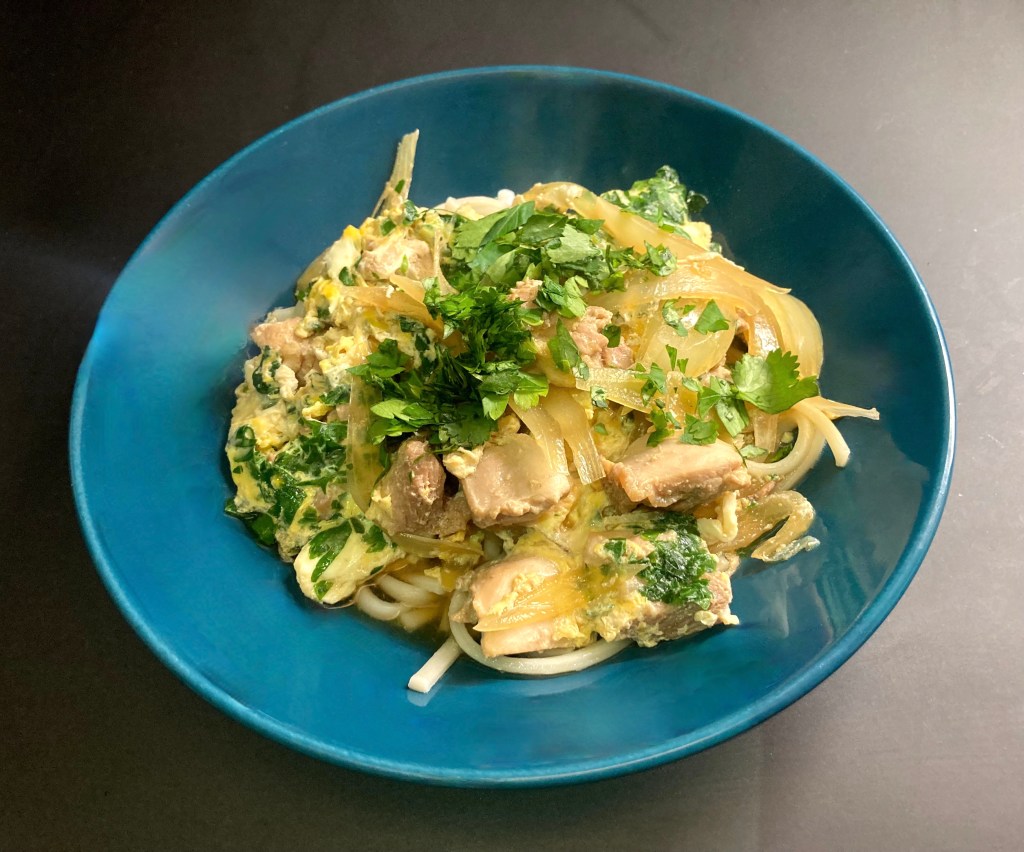
Make sure your dashi is full of flavours, perhaps a bit stronger than usual. Make a broth with mirin and soy sauce. Peel the onion and slice from top to bottom (banana shaped slices). Chop the chicken breast in comfortable slices. Add the onion and the chicken to the broth, cover the pan with a lid and cook until nearly done. Add half of the mitsuba (or the combination of parsley and cilantro). Add the eggs to a bowl and lightly beat the eggs but don’t mix. You should be able to distinguish the white and the yolk easily. Add the first half to the broth and use chopsticks to distribute the combination in the pan. Wait for a few moments and add the second half. Serve over a bowl of warm rice. Decorate with mitsuba.

PS

Perhaps you noticed that we used udon for our oyakodon, basically because we love udon, but it should be served with rice. Most (all?) recipes suggest adding sugar. We think the mirin brings sufficient sweetness to the dish, but feel free to add just a bit of sugar.

Chicken with Almonds and Ginger

Reading (very) old recipes allows you to discover new combinations, techniques and flavors, or better said, discover forgotten combinations, techniques and flavors.

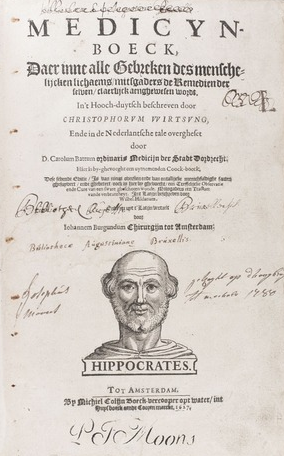
The University of Amsterdam is home to the Special Collections, the material heritage of the University. One of the collections is related to recipes, cookbooks, books on etiquette, nutrition, food et cetera. The oldest cookbook is Eenen seer schoonen ende excelenten Cocboeck, inhoudende alderley wel geexperimenteerde cokagien, van ghebraet, ghesoden, Pasteyen, Taerten, toerten, Vlaeijen, Saussen, Soppen, ende dier-gelijckeOock diversche Confeyturen ende Drancken, etc. by medical doctor Carel Baten (Carolus Battus) and was published in 1593. The book contains some 300 recipes for stews, roasts, poached food, pies, cakes, sauces and soup. It was published as an annex to his Medecijn Boec (medicine book). 

Luilekkerland

In 2018 Onno and Charlotte Kleyn published Luilekkerland (named after the painting by Pieter Bruegel de Oude). It’s a great book on 400 years of cooking in the Netherlands. They must have spent months at the Special Collections going through various cookbooks and manuscripts with recipes. They created ‘a magical mystery tour’ through the kitchens of the past.
In the book they describe one of the recipes of Carolus Battus: een sause op eenen gesoden capoen. Or in English: poached Capon with sauce. 

Capon is very expensive, so like Onno and Charlotte we go for chicken. Our recipe is for 2 chicken thighs, but we could also imagine making a roulade and then serving a slice of chicken roulade with the sauce.
The surprise is in the sauce: the combination of bread, ginger and almonds is tasty and complex. The sauce may appear to be filming and fat, but actually it’s not. The texture of the sauce is interesting as well: the bread will make the sauce a bit porridge-like and the crushed almonds prevent the sauce from being smooth.
Our version is a bit closer to 2022: we’re not the biggest fans of poaching and we don’t see the need for sugar in the sauce.

Wine Pairing

Best is to go for a white wine with a touch of sweetness, for instance a Gewürztraminer. This will combine very well with the somewhat unusual flavors in the dish.  If you go for a glass of red wine, then we would suggest a pinot noir, nice and earthy.

What You Need

  • 2 Organic Chicken Thighs
  • Chicken Stock and Optional
    • Leek
    • Carrot
    • Celeriac
    • Onion
  • Olive Oil
  • Butter
  • 15 grams of White Almonds
  • 1 – 2 cm of Fresh Ginger
  • 100 ml of Dry White Wine
  • Slice of Toasted Bread

What You Do

If your chicken stock needs a boost, then add the vegetables and let simmer for 15 minutes or so. Best is to make your own stock.
In a small skillet heat the butter and olive oil. Fry the chicken until nearly done. In parallel blender the almonds and the toasted bread. Grate the ginger. Add the white wine and the ginger to the mixture and blender. Add some stock and blender for a few seconds. Transfer the mixture to a pan and warm over medium heat. It requires attention, so keep an eye on the sauce and stir every minute or so. The sauce will thicken so you will probably need to add more stock. Transfer the chicken to a warm oven and let rest. Deglaze the pan with some stock and add this liquid to the sauce. Stir well. Now it’s time to taste and adjust. Remember the taste is new, so take your time. Serve the chicken with the sauce. 
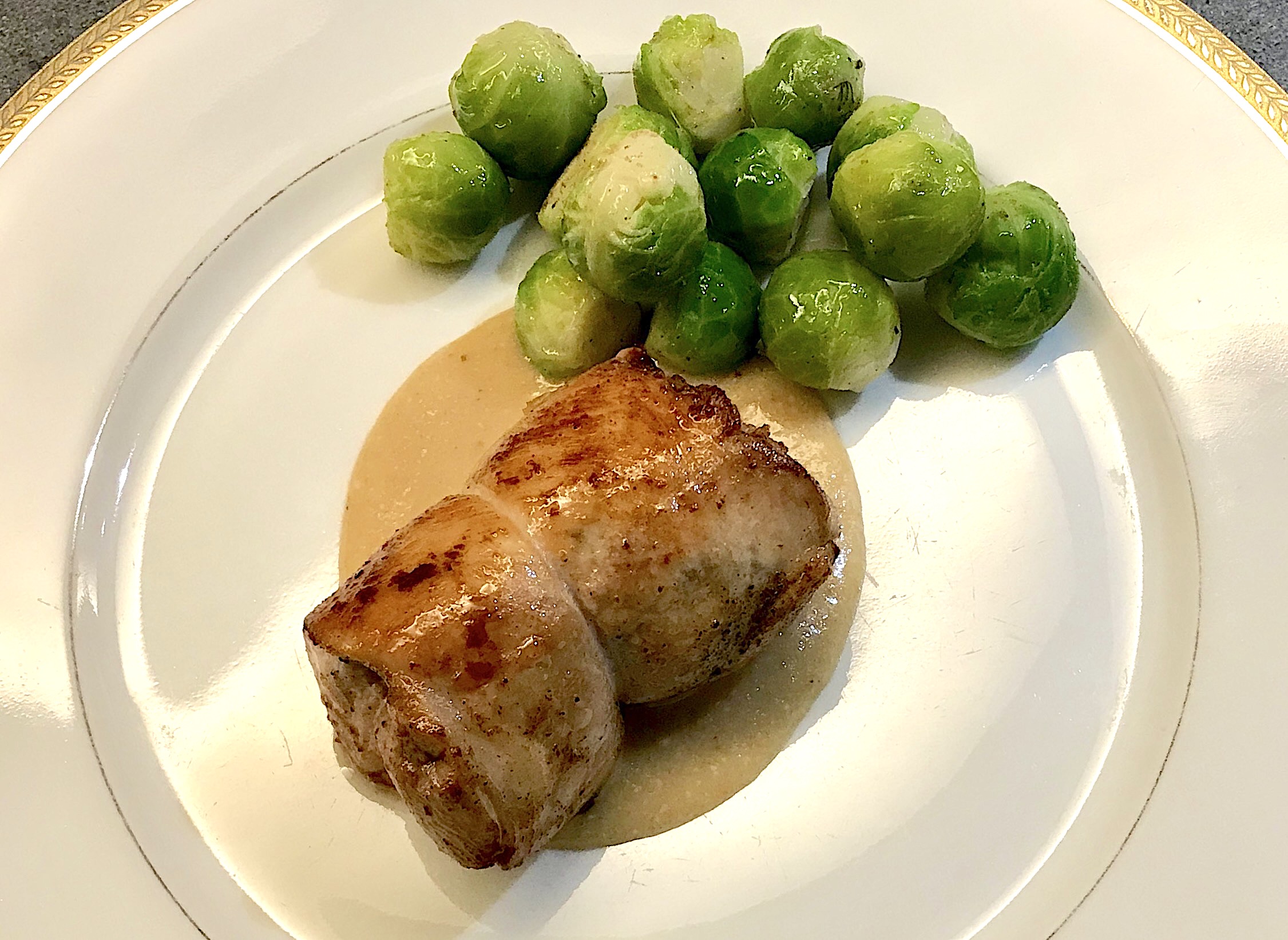
We enjoyed the chicken as a main course with some Brussels sprouts, olive oil and nutmeg.

Coq au Vin

One of our favourites for a grey, wintery evening. Warm, rich and full of flavours.
Let’s first talk about the chicken: we prefer using chicken thighs, organic, obviously. Great texture, layered and a bit of fat. You could also use chicken legs, but then we suggest removing the main bone; you don’t want to struggle while eating.

The second main ingredient is the red wine. A classic Coq au Vin is made with Bourgogne, a relatively expensive red wine from France made from Pinot Noir grapes. According to some people the wine you use for the stew must be the same that accompanies the dish. Which would mean that part of your beautiful Bourgogne ends up in the stew. Hm. We think that the background of this ‘rule’ is about the quality of the wine you use for the stew: it must be a nice, dry, red wine; one you would be perfectly happy to drink. So not some left over red wine, or a wine you didn’t like. A perfect stew requires quality ingredients, that’s all.

The third main ingredient is the pearl onion, that lovely small, silver onion. Great to pickle, but for a Coq au Vin you need fresh ones.

Wine Pairing

We enjoyed our Coq au Vin with a glass of Révélation Pays d’Oc Syrah-Viognier produced by Badet Clément. It’s a full-bodied wine with flavours of blackberry and spices. Touch of oak as well. The 15% Viognier gives the wine a nice, light touch. Great wine for a very reasonable price.

What You Need

  • 2 Chicken Thighs
  • 4 strips of Pancetta or Bacon
  • 14 Pearl Onions
  • 100 grams Mushrooms
  • 2 Garlic Gloves
  • Chicken Stock
  • Red Wine
  • Water
  • Bouquet Garni (Bay Leaf, Parsley, Thyme, Rosemary)
  • Black Pepper
  • Chopped Parsley
  • Olive Oil
  • Snow Peas (Mangetout)
  • Nutmeg

What You Do

Clean and quarter the mushroom, slice the strips of pancetta or bacon in four, peel the onions, slice the thighs in two or three, peel the garlic and chop. Add olive oil to a warm heavy pan. Begin by frying the pancetta or bacon until crispy. Remove from the pan and let drain on kitchen paper. Add (whole) pearl onions to the pan and fry until golden. Remove from the pan and let drain on kitchen paper. Add mushrooms to the pan and fry until golden. Remove from the pan and let drain on kitchen paper. Add chicken thighs to the pan and fry until golden. When golden add the garlic and fry for 3 minutes on medium heat. Add pancetta, mushrooms and onions to the pan. Add chicken stock, red wine and perhaps some water. The chicken should be nearly covered. Add bouquet garni and leave to simmer on low heat for 30-45 minutes, depending on the size of the chicken. 

Remove chicken, mushroom, pancetta, garlic and bouquet garni from the pan. Discard the bouquet. Return one or two mushroom to the liquid. Transfer the remaining ingredients to an oven at 60 °C or 140 °F. Blender the liquid for one minute. Reduce the liquid until it has reached the right consistency. The fun is that a liquid thickened with blended mushrooms doesn’t split. Return the ingredients to the sauce and boil the snow peas. Combine the coq au vin with the parsley, add some black pepper. Steam or quickly cook the peas, coat with excellent olive oil and add some freshly grated nutmeg.

Coq Au Vin ©cadwu
Coq Au Vin ©cadwu