
Clafoutis

Cherries, cherries, cherries! We love their rich, sweet taste, the touch of tartness and their firm, succulent texture! They just want to be eaten, one after the other. So what better summer dessert than Clafoutis?

Should you use whole cherries or pitted ones? Not removing the pits is less work for you (obviously) and it reduces the risk of a soggy Clafoutis. Unpitted cherries will give a subtle almond flavour to the clafoutis. On the other hand, you don’t want to bite into a pit while enjoying your dessert. Also important: the pits contain amygdalin, a toxic compound that can also be found in almonds, apple seeds and apricot stones.
We decided to pit the cherries and compensate for the lack of almond taste by adding some almond flour to the batter.
If you decide to remove the pits, make sure you remove all of them!

Finally, yes, you can replace the cherries with fresh apricots, berries, peaches or prunes. The result is called a Flaugnarde. But nothing as tasty as Clafoutis made with fresh cherries!

What You Need
  • 2,5 dl of regular Milk
  • 2 Eggs
  • 30 grams of plain Flour
  • 10 grams of Almond Flour
  • 20 grams of Sugar
  • 500 grams of Cherries, pitted
  • 10 grams of Butter
What You Do
  1. Pre heat the oven to 180° Celsius or 350° Fahrenheit
  2. Whisk together the eggs, plain flour, almond flour and sugar
  3. Bring the milk almost to a boil
  4. Stir the milk into the mixture
  5. Butter a large, shallow baking dish, add cherries to the dish
  6. Make sure the bottom is nicely covered with cherries; no need to have two layers of cherries
  7. Pour the mixture over the cherries
  8. Bake (lower third of the oven) for 20 minutes
  9. Add a few dots of butter
  10. Continue baking for another 20 minutes or until the Clafoutis is golden
  11. Leave to cool for 60 minutes or so, this will enhance the taste
  12. Clafoutis should be served luke-warm
  13. You could decorate the clafoutis with icing sugar
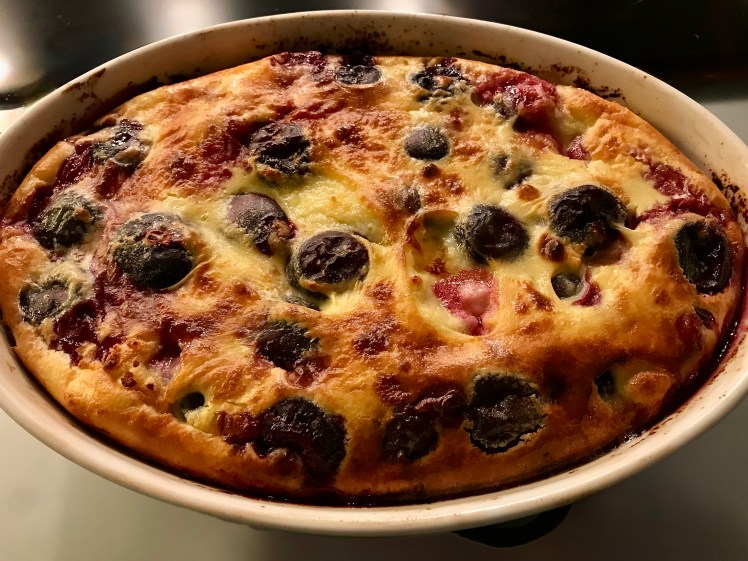
Clafoutis ©cadwu made with fresh cherries, milk, sugar, all purpose flour, butter and almond flour
Clafoutis ©cadwu

Far Aux Mirabelles

Far Breton is a delicious dessert from the French region Bretagne. Originally there are two versions of Far: a savoury one with buckwheat, butter, milk, eggs, salt and lard (to be served as a side dish) and a sweet one with wheat flour, butter, milk, eggs, sugar and (optional) raisins. The savoury version is a component of the traditional dish Kig ha Farz (meaning ‘meat with far’). The sweet version is better known and nowadays made with prunes, preferably Pruneaux d’Agen. Easy to make and always a pleasure to serve.

Mirabelle (plums) are a speciality from the French region Alsace-Lorraine. The fruit is relatively small, sweet and full of flavour. Often used to make jam or eaux-de-vie. The season is fairly short (a few weeks in August and September only). When you see Mirabelle plums at your greengrocers, then don’t hesitate and buy them. Enjoy them as they are or turn them into Far Aux Mirabelles!

What You Need
  • 80 grams of Plain Flour
  • 2 organic Eggs
  • 50 grams of Sugar
  • 350 ml Milk
  • 15 grams of Butter
  • 500 grams of Mirabelle Plums
  • 15 ml Eaux-de-Vie de Mirabelle (optional)
  • Butter to coat dish
What You Do

Set the oven to 170 °C or 340 °F traditional. Wash, dry and halve the Mirabelle plums. Discard the pits. Add butter to the milk and heat until lukewarm and butter dissolved. Combine flour and sugar. Add one beaten egg and mix. Add the second beaten egg and mix. Add the milk and whisk until you have a smooth batter.  Coat the baking dish with butter, add the halved Mirabelle plums and the batter. After 40 minutes increase the heat to 190 °C or 375 °F and fan forced for 5 minutes. We prefer the far to be beautiful golden brown even though it seems that a Far Breton is supposed to be much more browned.
Enjoy the far lukewarm as a dessert or the next day cold with a cup of coffee. No need to dust with icing sugar. 

PS

Perhaps you recognize the combination of ingredients. The Far Breton is indeed similar to Clafoutis and Flaugnarde. Far is supposed to be denser than Clafoutis, originates from Bretagne and is made with prunes, whereas Clafoutis originates from the Limousin and is made with cherries. And Flaugnarde? With apricots?
Oh well, let’s simple enjoy these easy to make and delicious desserts.