Two or three times per week we enjoy the taste of fresh home-made no-knead bread. The crust, the flavours, the aromas! And how about the singing of the bread when it’s just out of the oven? Baking your own bread is such a pleasure.
Our recipe for no-knead bread is based on a recipe published by Jim Lahey, owner of Sullivan Street Bakery, New York. It was published in the New York Times in 2006 and can also be found in his excellent book My Bread. The process is time consuming (it’s 24 hours from start to finish) but not labour intensive. The recipe is based on slow-rise fermentation. With only 1 gram of instant yeast in combination with 18+3 hours of rest the yeast will do a wonderful job. The dough will be perfect. And kneading, as you would expect, is not required.
Normally we bake our bread with blue poppy seed and brown linseed. Today we bake a luxurious bread with hazelnuts, raisins and cinnamon.
What You Need
200 grams of Whole Grain Flour
230 grams of Plain White Flour
1 gram Instant Yeast
70 grams Hazelnuts (peeled and roasted)
130 grams Raisins
2,5 grams Cinnamon
4 grams Salt (this is less than usual, most recipes for bread would suggest 8 grams)
345 grams Water
Additional Flour
Bran
What You Do
Mix flour, yeast, cinnamon and salt. Add water and create one mixture. Let rest in a covered bowl for 18 hours. Soak the raisins for 10 minutes in warm water. Remove excess water. Cover your worktop with a generous amount of flour. Remove the dough from bowl and flatten somewhat. Cover the middle third with one quarter of the raisins and hazelnuts. Fold the lower third on top of the middle third. Cover with the second quarter. Fold the top third on top the the middle third. Cover the centre with a quarter of the raisins and hazelnuts. Fold the right part on top of the centre. Ad the last quarter of raisins and hazelnuts on top of the centre and fold the fold the left part on top of it. Dust with additional flour and let rest on a towel dusted with flour and bran for 3 hours. Check that the pot (and the handles!) can be used in a really hot oven. Transfer the pot to the oven and heat your oven to 235˚ Celsius or 450˚ Fahrenheit. Put the dough, seam side up, in the pot, close it and bake for 30 minutes. Remove the lid and bake for 15 minutes or until it is nicely browned. Let cool on a wire rack for at least an hour before slicing it. Enjoy with a generous amount of butter.
Recently we reviewed RecipeTin Eats Cookbook: Dinner by Nagi Maehashi as part of the cookbook review project by Bernadette. It is a beautifully designed book with lots of great pictures. It is also a very positive and inviting book. In 2023 it was awarded Australian Book of the Year and it made the New York Times Best Sellers list. Nagi’s very popular website offers over three hundred recipes and videos. She has over one million followers on Instagram. Her philosophy on food and cooking is based on four principles: fast, creative, clever and fresh. And cost conscious as well!
Nagi also runs a food bank, RecipeTin Meals, where she and her team (including three full time chefs) make homemade meals which are donated to the vulnerable.
RecipeTin Eats Cookbook: Dinner contains not only over 150 recipes, but also recipes for basic sauces, stock, bread, a glossary and a table with internal cooked temperatures. All very helpful. Not so helpful are the indexes (don’t expect the obvious table of content) and the way the recipes are grouped in the book. The recipe index for instance comes with categories such as everyday food and what I do with a piece of…. Perhaps a bit too creative?
Every recipe in the book has a QR-code. Scan it and you have a helpful video guiding you through the recipe.
RecipeTin Eats Cookbook is a cookbook with lots of international dishes such as Beef Wellington, Mussels in White Wine, Sauce Bolognese and Chilli Con Carne; no recipes with kangaroo or ostrich. We decided to make three dishes from the book, a salad with an Asian touch, a Moroccan dish with chicken and a blueberry tart with an almond filling. Our esteemed panel (André, Carolien, Hans, Joke, Martine and Rutger) was happy to join us on a sunny evening in May and talk about the three dishes. And the wine, of course!
We decided to make a Prawn Salad with Coconut Lime dressing because of the dressing. We expected the combination of Chinese Cabbage (or wombok in Australia), coconut, mint, cilantro and prawns to be tasty and refreshing.We served the dish with a glass of Pinot Grigio produced by Corte Vittorio.
A fresh and easy to drink wine with aromas of citrus and green apple. In general, you’re looking for a light white wine with pleasant acidity and fresh aromas. The panel was unanimous: refreshing, lots of flavours that go together very well, great colours, new flavours, love the way the apple combines with the cabbage, great on a summer evening, would like to make this myself, could I have the recipe?
The One Tray Moroccan Baked Chicken with Chickpeas comes with lots of flavours, baharat being one of them. A spice blend unknown to us. Fortunately, we could find it at our Turkish supermarket. Think cinnamon, cumin, nutmeg, ginger. The chicken is marinated for 24 hours in a mixture of lemon juice, oil and baharat.
It is then fried in the oven with chickpeas (coated with ginger and turmeric), fennel and tomatoes. We served the Moroccan chicken with excellent crusted bread and a glass of full-bodied Italian red wine, produced by Stefano Accordini. The wine is made from 90% Corvina Veronese and 10% Merlot grapes. It aged for four months in oak barrels, which adds to the warmth and flavours of the wine. A very affordable wine with aromas of blackberry, plum and chocolate. In general, you’re looking for a full bodied, rich red wine that goes very well with flavours like nutmeg, cumin and cinnamon.
The panel liked the presentation, the colours, the aromas and the preparation of the chickpeas in the oven. The flavours were nice, but a bit bland. It could have done with more spices. Although the chicken marinated in the refrigerator for 24 hours, the flavours of the baharat were not really present in the meat.
Dessert was Blueberry Tart with Almond Filling. The heading of the recipe says prep time 45 minutes, 4 hours of cooling and chilling, 1 hour cook time. Sounds doable? In reality it’s a bit more work. The dough needs to be made, cooled, fitted in the tin, transferred to the freezer, in to the oven, baked blind,
cooled and then filled with an almond cream that must be mixed, cooled, added to the tin, topped with blueberries, baked, topped with more blueberries and baked for another 20 to 25 minutes. Still there? The idea of freezing the dough in the tin was great because it allowed us to do this step a few days earlier.
The panel liked the tart, the moist filling, well balanced, not too sweet, great crust and the combination of almond and blueberry was very tasty.
All three recipes required some adjustment: when we tasted the salad before serving it, we found the dressing needed extra mint and fish sauce. We also added more berries to the tart.
Should this book be on your shelf? The panel feels it’s a great, colourful, well-designed cookbook but that the number of recipes that are new or bring something specific (like the salad and the chicken we prepared) is rather limited. We would have liked to see more of Nagi, and perhaps of Australia, in the choice of recipes. One member of the panel decided to buy RecipeTin Eats Cookbook: Dinner, given the idea that if you would prepare one of Nagi’s recipes per week you would be sure to have at least one fast, tasty, colourful and creative meal per week. Very true!
RecipeTin Eats Cookbook: Dinner by Nagi Maehashi is available via your local bookstore or the well-known channels for approximately 30 euros or 30 US$. Prices may differ.
Het Receptenboek van mevrouw Marselis (The Recipe Book of Mrs. Marselis) published in 1790 gives a wonderful insight in the household and kitchen of an upper middle-class family in the 18th century. Mrs. Marselis (the lady of the house) wrote down instructions for her cook. Mrs. Marselis enjoyed dinners and lunches when she was visiting friends and family, she read cookbooks and collected recipes. Back home she explained to her cook how to prepare the food that she wanted to be served to her family and guests. Unfortunately she doesn’t include menus, so it’s not clear how her meals looked. She probably served various dishes at once (Service à la Française) as was custom until the mid-19th century.
The cook and her staff (perhaps 4 people) worked many hours in the kitchen downstairs to prepare cakes, beef, fish, chicken, pies, cookies, veal, soups, ragouts etcetera. You won’t find many recipes for vegetables because these were considered to be phlegmatic (slimy, cold, wet) and perhaps even more important, vegetables were eaten by the lower classes.
500 Recipes
She does include a recipe for snow peas: these are cooked in butter and water. Adding chopped onion is optional. When the peas are soft, the cook adds some sweet cream and one or two beaten eggs. And one for spinach: it is cooked until really well done, then chopped and stewed with butter, nutmeg and stock.
Some of the recipes are intriguing, for instance: shrimps are cooked in water with vinegar, anchovies, peppers and mace. When done, the shrimps are combined with cold butter to be served with salmon. Others are very tempting, for instance ravioli with a filing made of veal, parsley, pepper, nutmeg, mace, Parmesan cheese and butter. Sounds yummy!
Mushrooms are also on the menu, so we decided to follow Mrs. Marselis instruction and prepare mushrooms cooked in cream. It’s a rich, tasty sauce that enveloped the pasta very nicely. The combination of mushrooms and nutmeg works remarkably well. One to prepare more often! Recipe this week on Thursday, July 14th. The pasta was our own idea; Mrs. Marselis doesn’t mention what the sauce is supposed to accompany.
Het Receptenboek van mevrouw Marselis, in Dutch only, is out of print. A second-hand copy will cost approximately € 15,00.
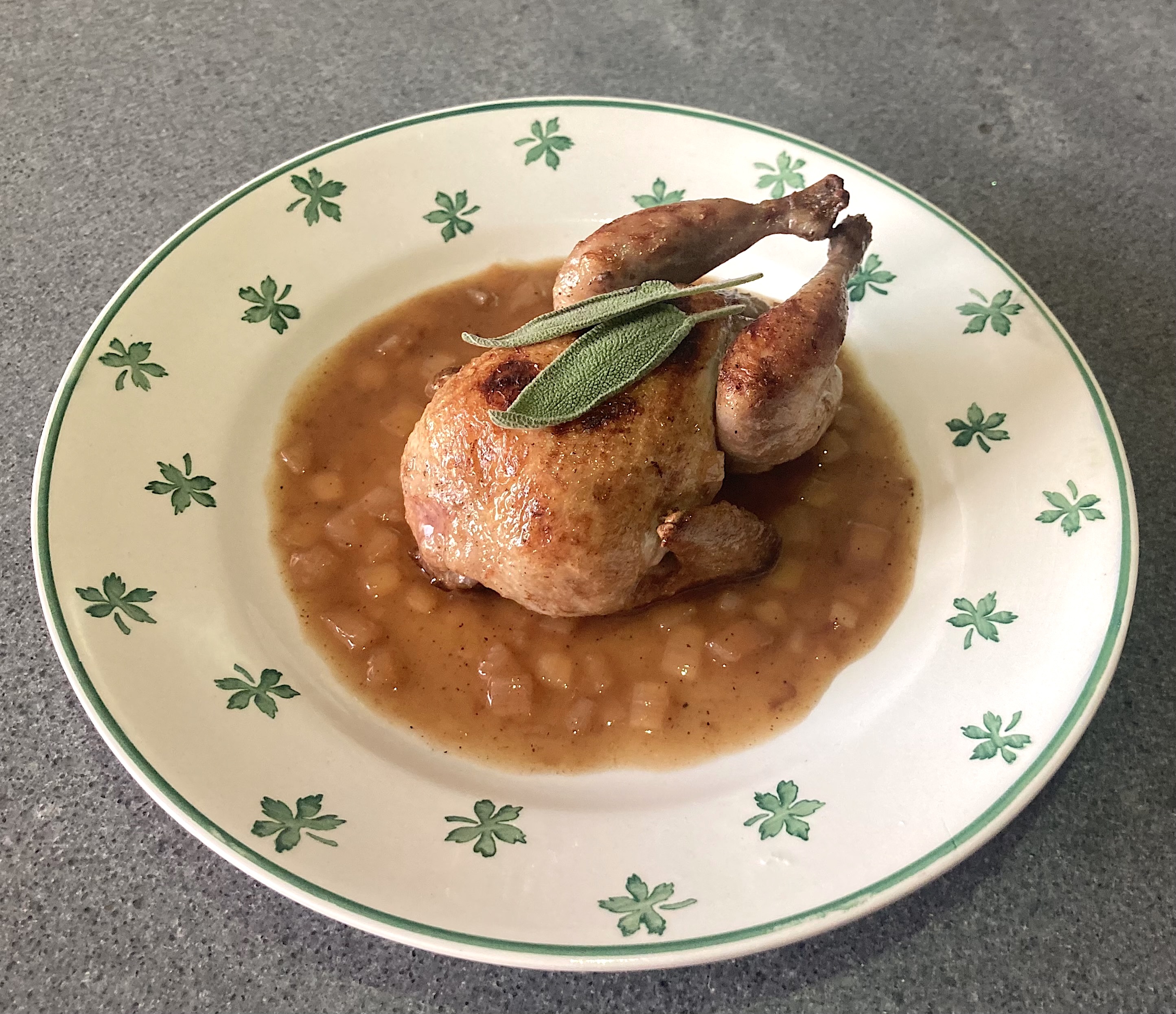
A few excellent ingredients is sometimes all you need to cook a wonderful dish. In this case you need quail, shallot, olive oil, butter, sage and Marsala. We love the delicate, pleasantly intense flavour of quails. They are great to combine with strong flavours like bay leaf, pancetta and prunes but in this case, we follow a recipe by Claudia Roden, as published in her excellent book The Food of Italy. We tweaked it a bit, so please buy Claudia Roden’s book when you want to make the original. Marsala is a fortified wine from Sicily. Perhaps you know it as something sold in small bottles, especially for cooking purposes. Never buy this nasty product because it can’t be compared to real Marsala. Same story for the small ‘Madeira’ bottles. Quails must be sufficiently fat and undamaged. We prefer the French label rouge quails. Not cheap, but a wealth of flavours.
Wine Pairing
The dish comes with a gentle, intense and slightly sweet taste thanks to the sage, the marsala and the quail. You could go for a medium bodied red wine. We enjoyed a glass of Domaine Vico Corse Le Bois du Cerf Rosé 2021 with our quail. This is an exceptional rosé from Corsica. It is made from grenache and sciacarello grapes. It is medium bodied and fresh with aromas of red fruit. Its taste is complex, long and fruity.
Clean the inside of the quail with a bit of kitchen paper and remove anything that’s left. Check for remaining feathers and shafts. Gently fry the chopped shallot in butter and olive oil until soft. Remove the shallot from the pan, increase the temperature and fry the quails until golden-brown. Reduce the heat, add shallot and sage. Pour in marsala and stock. Cook the quails for 20 minutes until done, turning them over regularly. Transfer the quails to a warm oven (60˚ C or 140˚ F). Reduce the sauce, taste, add black pepper, perhaps some freshly chopped sage and diced cold butter to thicken the sauce. Serve the quail on top of the sauce. Claudia Roden serves the quails with risotto.
There are not many cities that can rightfully claim to have their own ‘cuisine’. The French city of Nice is one of them. Just think about Salade Niçoise, Bagna Caude, Tourte aux Blettes and Socca. Strongly influenced by Italian cuisine it is flavourful, rich and varied.
Hélène Barale was owner and chef of the restaurant Chez Hélène in the Rue Beaumont, number 39 in Nice. Here she prepared delicious, regional and traditional food. Ravioli à la Niçoise, gnocchi’s, panisses, pissaladière, ragout de mouton, loup grillé, pattissoun, everything freshly cooked in her kitchen for 150 guests per day.
Three examples
Panisses are made with chickpea flour, water, salt and olive oil. You make a hot dough, allow it to cool and set, then cut it into chips and deep fry. Serve with black pepper. Delicious. Obviously you also want to know what Pattissoun is! If you search for it, you will find references to a nicely shaped squash, but Hélène Barale’s recipe is for a cake. She makes it with flour, yeast, sugar, raisins, orange zest, rum and eau de fleurs d’oranger (orange flower water). Sounds absolutely lovely. Another very tasty recipe is for an omelette with artichokes. It’s a combination of onions, garlic, artichoke and eggs. Straightforward recipe, yummy result.
Retirement
She retired at the age of 88 in 2004. For a few years the restaurant was a museum, but it is now closed. Thankfully her daughter Paule Laudon wrote down 106 recipes of his mother’s cuisine. Her style is very clear so it’s not too difficult to prepare the dishes. The book looks like a cahier and it is edited with much love and care. It comes with an interesting introduction by Paule Laudon, the text of Nissa La Bella, which is the unofficial anthem of the city (O la miéu bella Nissa/Regina de li flou/Li tiéu viehi taulissa/Iéu canterai toujou/etcetera, meaning something like O my beautiful Nice/Queen of all flowers/Your old rooftops/I will always sing of you/etcetera) and pictures of the restaurant. The book does not contain pictures of the dishes.
La cuisine Niçoise d’Hélène Barale (in French only) was first published in 2006 and is now in its 11th edition. You can buy it via the usual channels and the French publisher for € 15,90.
In 1990 Claudia Roden published The Food of Italy, a book based on her articles in the Sunday Times. She researched Italian cuisine for over a year, traveling throughout the country, visiting cities and villages, talking to people and enjoying their way of preparing food.
If you open The Food of Italy, you will notice that the table of contents is very much a list of regions. Every chapter begins with an introduction that helps you understand the region. For instance, when she writes about Lombardy, she writes about themes like economy, the countryside (Lago Maggiore, Lago di Como), the cuisine, the renaissance, its main products (rice), meat (Lombardy is known for its pigs), cities (Milan being its main city) and of course its wine (sparkling wine from Franciacorta). After having read the introduction, you will have a much better understanding of the dishes from that region.
Traditional and Local
The book is about traditional local food. When she was once asked why she would write such a book when all the world is changing and cooking is becoming more global and becoming the same all over the world, she answered “What appeals and fascinates and touches the heart is that what distinguishes Italy, which recalls her past and is part of the prestigious heritage and traditions.” We couldn’t agree more!
We prepared a dish from Lombardy, a simple and very tasty combination of Quail, Shallot, Sage, Butter, Oil and (dry) Marsala. It is served with Risotto. In one of our next posts we will describe the dish in more detail.
The Food of Italy is available via your local bookshop or the usual channels for something like 20 euro or US dollar (paperback). A beautifully illustrated hardcover is also available. Other publications by Claudia Roden include books on Mediterranean Food (thus paving the way for chefs like Yotam Ottolenghi), on the joy of Outdoor Eating, on Picnics, Coffee and Spanish Food.
PS
Marsala is a fortified wine from Sicily. Perhaps you know it as something sold in small bottles, especially for cooking purposes. Never buy this nasty product. It has nothing to do with Marsala. Same story for the small ‘Madeira’ bottles. It’s a bit of a challenge but try to buy dry Marsala for this dish and next time you’re making Tiramisu, use sweet Marsala.
We have all been there, you read a recipe, you decide to prepare the dish, only to find that some essential information is missing, that the ingredients are impossible to find or that the result is something completely different. For instance, we once decided to prepare a fairly complex dish. It consisted of four components, one being a popcorn-like version of saffron rice. The steps were not too challenging: cook sushi rice with saffron, dry for 2 days and then fry in oil on 180 °C or 355 °F for 10 minutes until the rice looks like popcorn. Sounds do-able, doesn’t it? Apart from the ‘like popcorn’. All rice turned out fat and golden-brown. Finally, we figured it out: we had to use a neutral oil with a very high smoking point, for instance refined sesame seed or avocado oil. But that information wasn’t provided in the recipe. Why not, we wonder, isn’t the goal of a recipe to help the reader prepare it? So why not provide all the necessary information?
(In case you wonder what the smoking point of oil is, it’s the temperature on which the oil breaks down. That’s when it may release unhealthy, damaging chemicals and nasty flavours. Olive oil has a relative low smoking point which is why you should pay careful attention to your pan when using it for frying.)
Je Sais Cuisinier
Ginnete Mathiot approach to recipes is clearly based on an ambition to educate, to transfer and share knowledge. She was born in 1907 in Paris and pursued a career as a teacher and inspector in home economics and as an author of many cookbooks. She didn’t own a restaurant, she never worked as a chef, she wasn’t a tv-celebrity. She was focused on sharing recipes and useful household and kitchen information. Millions of copies of her cookbooks were sold and many more benefitted from her knowledge and experience.
When she was 25 years old she published her classic Je Sais Cuisinier. Today the book is known as La Cuisine pour Tous. The English version is titled I Know How to Cook. It is a very useful cookbook with recipes that truly help you to prepare a dish. She also wrote excellent books on patisserie and preserves.
When you leave through I Know How to Cook you will notice helpful sections on spices, aromatic vegetables and flavourings, you’ll see a well written glossary of essential cooking terms, seasonal suggestions and many more aspects of food.
Given the time of year we looked for the artichoke-section of the book. Such a delicious vegetable! She includes a recipe for Artichoke Hearts Printanière (artichoke hearts with a filling of mushrooms, shallot, boiled egg, ham and artichoke, grilled in the oven) and for Artichokes à la Barigoule. This is a classic dish from the Provence region. The artichoke hearts are stuffed, wrapped in bacon, fried and then cooked in a sauce with carrots and onion. The artichoke is then served with the (strained) sauce. Next week we will publish our vegetarian version of this classic.
Her books (in French, Italian and English) are available via your local bookstore and the usual channels.
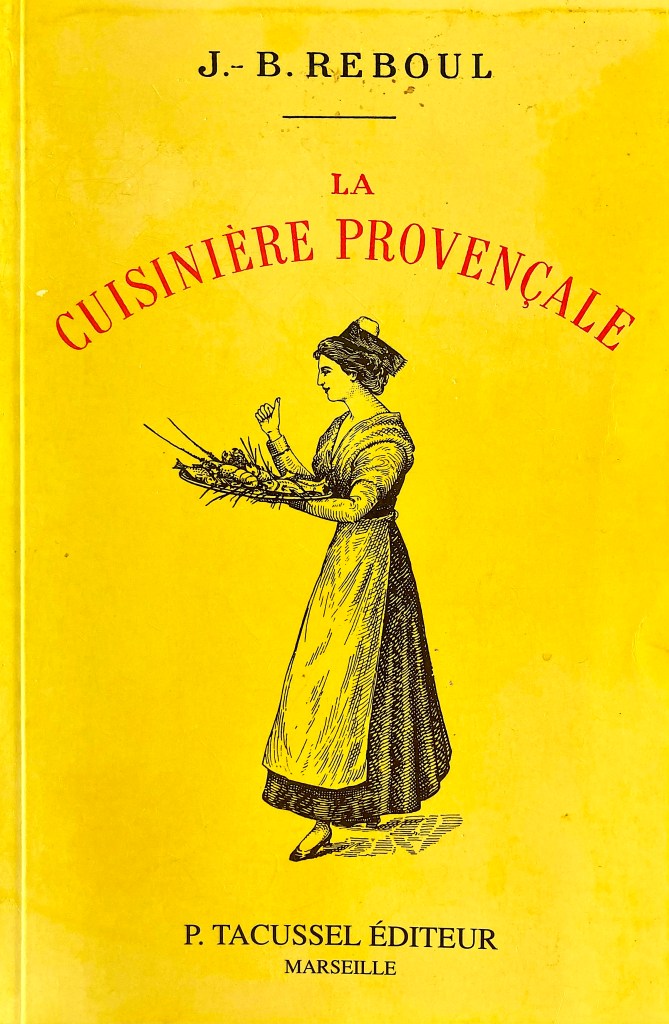
When we’re not completely sure about a sauce or a dish, we search for a recipe and inspiration in La Cuisinière Provençale. This comprehensive cookbook was first published in 1897 and was written by Jean-Baptiste Reboul. It includes 1119 recipes for an enormous variety of dishes and it provides background information on fish, meat and vegetables. It also gives traditional, seasonal, French suggestions for lunch and dinner for every day of the year. For instance for today, the third Monday of May, the two course lunch consists of moules farcies aux épinards et tendrons de veau bourgeoise. Or in English, mussels stuffed with spinach and veal tenderloins with carrots and onions. You will find chapters about soups, hors d’œuvres, typical Provençal dishes, fish, sauces, mutton, veal, vegetables, eggs, jams and everything else you can think of.
This is one of the few cookbooks that uses the concept of formulas. For example: the recipe for Truite à la Meunière is very short: it simple states a few specific steps and then refers to formula 135, the one for Loup à la Meunière. We like this concept because it supports the idea that you can and should be flexible with ingredients. If for instance you can bake a pie with chard, then it’s probably a similar formula to bake a pie with wild spinach or beet leaves.
The recipes do not come with a separate list of ingredients, so you must make your own shopping list while reading the recipe. Not great, but we got used to it. The advantage is of course that the publisher could squeeze in even more recipes in the book.
Our Favourites
Daube Provençaleis one of our favourites from this book. It is not too much work and you can also be fairly flexible with the recipe, as long as you use excellent, marbled beef. Well known chef Hélène Barale (La Cuisine Niçoise, Mes 106 Recettes) uses beef, veal and pork with tomatoes and dried mushrooms, Hilaire Walden (French Provincial Cooking) suggests marinating the beef in red wine and adds orange peel and olives whereas La Cuisinière Provençale suggests adding vinegar to the marinade but doesn’t use tomatoes, mushrooms or olives. We use carrots, shallot, garlic, mushrooms, black olives and red wine to make an intense, heart-warming stew.
La Cuisinière Provençale (in French only) is for sale via your local bookstore or the well known channels for 25 Euro or US dollar.
Think about the US, think about food and you’ll end up thinking about fast food, pale fries, endless portions of meat and bagels and waffles, sweetened orange juice and blueberry muffins with too much sugar. Which is such a pity, because the US cuisine is so much more and diverse. Just think about, eh, well, yes, eh…
The Shop
Which is exactly the reason why we bought The Silver Palate Cookbook, written by Julee Rosso and Sheila Lukins, with Michael McLaughlin. It’s the story of two young, motivated people, Julee and Sheila, one from marketing with a passion for cooking and the other a graduate from Le Cordon Bleu in Paris. Both were trying and struggling to balance work, family, hobbies and interest. One day they came up with the idea of setting up a shop where people could buy great food, to take home and ‘graciously serve as their own’, solving one of the problems in their own life. And so, mid-July 1977, they opened their gourmet food shop in New York, selling Tarragon Chicken Salad, Nutted Wild Rice, Giant Chocolate Chip Cookies, Cheese Straws and on and on.
The Book
The shop was more than successful and in 1981 they were asked to write a cookbook. It was published in 1982 and not much later it was published in various languages. The Silver Palate Cookbook was a huge success, and still is.
The book includes a wealth of recipes, ranging from finger food, dazzlers, soups, pasta to game, stew pots, vegetables, sweets and brunch drinks. The book is very well designed, with beautiful drawings and pictures. Next to the recipes you’ll find interesting background information and tips. It’s a pleasure to read recipes for dishes such as Glazed Blueberry Chicken (with homemade blueberry vinegar and thyme, so not overly sweet at all!), Clam Chowder or Sorrel Soup.
The 25th Anniversary Edition of The Silver Palate cookbook is available via your local bookstore and the well-known channels for approximately US$ 17,00 or € 22,00.
Michel Guérard (27 March 1933 – 19 August 2024) was probably one of the most influential French chefs. He was one of the founders of the Nouvelle Cuisine (basically the style of cooking with a minimum of butter, eggs and cream) and the inventor of the Cuisine Minceur: the slimming kitchen. Enjoy a three-course lunch or dinner without consuming too many calories.
In his restaurant Les Prés d’Eugénie in the southwest of France you can enjoy his slimming food. It’s a bit too expensive for our budget (the menus cost between € 275 and € 310 per person), so we were very happy to buy one of his books.
Sauce Vierge
Once upon a time, there was a simple sauce called Sauce Vierge. It wasn’t difficult to prepare, just beat butter until soft, then add lemon juice, salt and pepper and continue beating until fluffy. Serve with asparagus, leeks or other boiled vegetables. It was not the most exciting sauce ever and Sauce Vierge could easily have been forgotten.
The Nouvelle Cuisine changed the recipe by replacing the butter by olive oil. The new Sauce Vierge became a star. It was turned into a warm sauce and ingredients like garlic, tarragon, basil, parsley and chervil were added. Sauce Vierge became the ideal sauce to accompany fish.
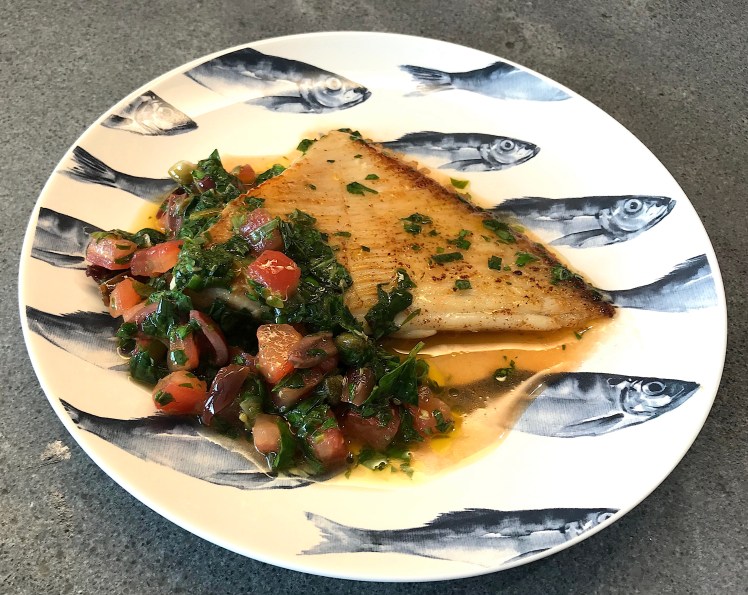
In 1977 Michel Guérard published his recipe of Sauce Vierge, including crushed coriander seeds and diced tomatoes. His suggestion is to serve it with sea bass and a puree of watercress. We serve the sauce with fried skate.
Sauce Vierge was a star, but the name wasn’t ideal. The term Antiboise became popular, especially outside of France. Antiboise is named after the city of Antibes in the south of France.
Books
La Cuisine Minceur was published in 1976, followed by Cuisine Gourmande in 1979 and many other books, including a Best Of (2015). His books are available via your local bookstore, the well-known channels (also second hand) and his webshop.
Wine Pairing
Given the powerful flavours (capers, olives, herbs, skate) we suggest a fresh white wine with lots of fruit and easy to drink. Our choice was a Verdejo produced by Mocen (Spain). In general you’re looking for an easy to drink, white wine with intense aromas (tropical fruit). The flavours should be fresh, dry, fruity, round and balanced.
What You Need
Skate (or Sea Bass)
Olive Oil
Garlic
Lemon
Excellent Tomatoes
Basil
Parsley
Chives
Black Olives
Capers
Black Pepper
Butter
What You Do
Heat some olive oil
Add the crushed garlic glove
Let it rest on low temperature until the oil is infused
Peel and seed the tomatoes
Chop in small cubes
Cut the olives lengthwise in 8
Cut the capers
Roughly cut all the herbs
Fry the skate in oil and/or butter until brown
Remove the garlic
Add lemon juice and tomatoes; mix
Serve the skate on a plate, add the herbs, the olives, the capers and black pepper to the sauce, mix and serve the sauce on top of the fish.






 Cook and Drink