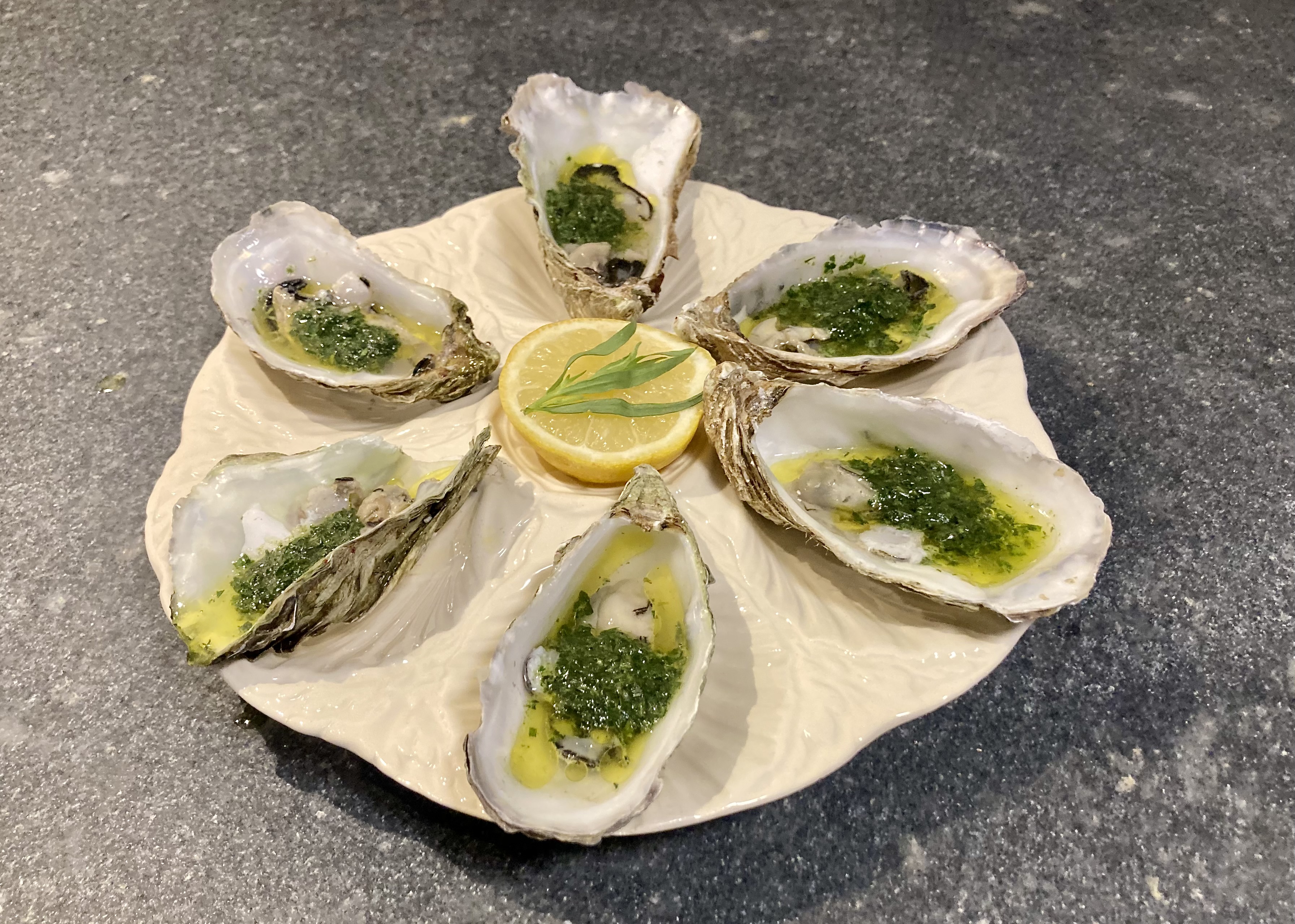
Oysters With Tarragon

Enjoying oyster begins by deciding which oysters to buy. Should they be small or large, should the taste be creamy and sweet or lean and juicy? If an oyster looks creamy (opaque) then it will taste creamy.

Next decision: raw or cooked? We think the best way to eat an oyster is to eat it raw. You will taste the saltiness, the texture and all of its flavours. The usual way to counter the saltiness is by adding a bit of lemon or mignonette but you could also go for something spicy like Tabasco, horseradish or perhaps wasabi. Don’t add something sweet because the oyster has its own sweetness.
In most cases cooked or steamed oysters are covered with lots of overwhelming ingredients, in an attempt to hide the taste of the oyster. Most likely the oyster will be overcooked and its structure rubbery and nasty. If you trust the chef, go for Steamed Oysters with Black Bean Sauce or for Oysters Rockefeller. Or even better: prepare our quick and easy Oysters with Tarragon, a delicious combination of warm (but not cooked) oyster and velvety anise flavours.

And finally: how to eat an oyster? Eating means chewing and tasting. Please don’t “drink” an oyster. If you do, you will only taste sea water.

Wine Pairing

When eating oysters, your wine must have some minerality. Think Chablis, Picpoul de Pinet, Sancerre or Sylvaner. We enjoyed a glass of Pommery Royal Brut champagne. The wine is elegant and uplifting, it comes with subtle notes of brioche and apple, a fine mousse and the perfect acidity with the oysters. Its freshness works very well after the intense taste of the oyster and the tarragon.

What You Need
  • 6 or 12 Oysters
  • Butter
  • Lots of Tarragon
  • White Pepper
  • Lemon Juice
What You Do
  1. Buy lean (not creamy) oysters, for instance the ones from the Île de Ré
  2. Combine butter and finely chopped tarragon with some white pepper
  3. Taste and add more tarragon
  4. Store in the refrigerator
  5. Scrub each oyster under cold, running water
  6. Open the oyster
  7. Use your knife or a spoon to detach the muscle underneath the oyster from the bottom shell
  8. Remove any small bits of broken shell or sediment
  9. Remove some of the liquid
  10. Add one or two drops of lemon juice to every oyster
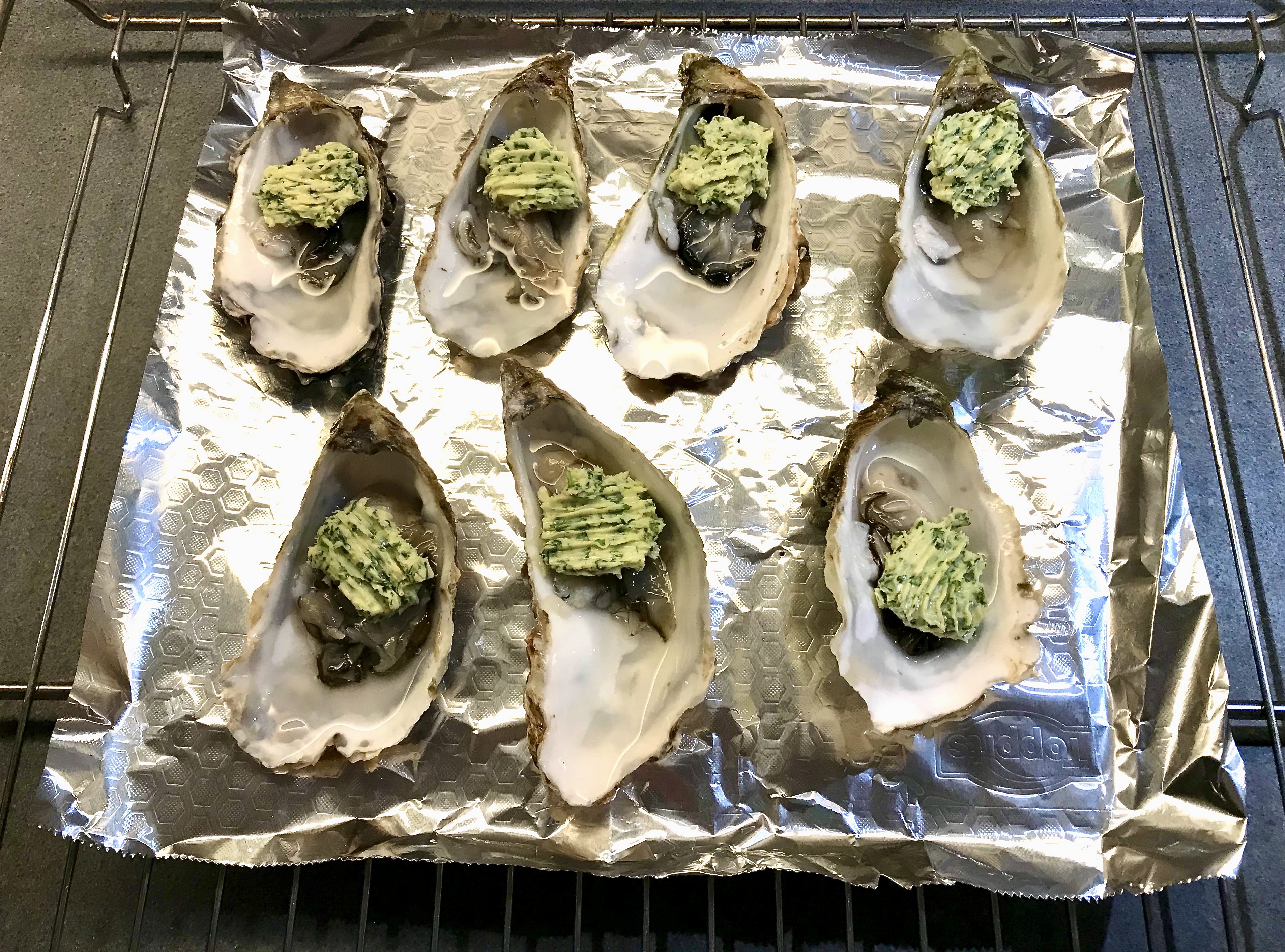
  11. Top with a teaspoon of tarragon butter
  12. Make sure you have everything ready (plate, tongs, wine, guests)
  13. Transfer the oysters to the oven and place as close to the grill as possible
  14. Set your oven to grill or broil and leave the oysters for 3 or 4 minutes in the oven
  15. Transfer the oysters to a plate and serve immediately
  16. 🥂Happy New Year!🥂


Pike Perch with Shrimps and Dill

Pike Perch (zandersnoekbaarssandre) is one of the tastiest, flavour-packed freshwater fish. The flesh is white, firm and lean and the taste is delicate, mild and perhaps a touch sweet. It combines very well, for instance with this delicious shrimp-based sauce with dill. It seems to be a bit of work, but when you prepare the bisque-like sauce in advance, then it’s actually a very quick recipe.

Wine Pairing

We opened a bottle of Domaine Font-Mars Picpoul de Pinet 2022. This is a white wine from the South of France between Narbonne and Montpellier. The terroir (think calcareous soil, clay, quartz) is influenced by the sea, which is reflected in the mineral taste of the wine.
If you feel like spending more money, then we suggest a glass of Chablis. In general you’re looking for a refreshing, unoaked white wine with minerality and fresh acidity.

What You Need

  • Pike Perch fillets
  • Butter
  • For the Bisque
    • 300 grams of unpeeled small Grey Shrimps
    • Tomato Paste
    • 1 Shallot
    • 1 Garlic Clove
    • Dill
    • Olive oil
    • Saffron
    • Cognac
    • Salt
    • Butter

What You Do

Start by peeling the shrimps. It’s a very simple, mindfulness exercise. Remove the heads and discard. Use the shells for the bisque and transfer the bodies of the shrimps to the refrigerator. Chop the shallot and the garlic. Gently glaze the shallot for 10 minutes or so in olive oil. Add the shells and the garlic. Increase the heat for a few seconds.  Add some water. Stir. Add tomato paste, dill and saffron. Add a splash of cognac and a pinch of salt. Allow to simmer for 20 minutes. Pass the liquid through a fine sieve. Make sure you get all the lovely juices. Reduce the liquid until it’s powerful. Cool and set aside.
Transfer the shrimps from the refrigerator. In a non-stick pan heat some butter and fry the pike-perch. In parallel warm the bisque. Use ice cold butter to make the sauce thicker and richer. Plate up by creating a pool of sauce. Place the fried fish somewhat in the middle of the sauce. Add the shrimps and finish with some fresh dill.

Pike Perch with Shrimps and Dill ©cadwu

Fromage de Fribourg

When reading La Cuisine Niçoise d’Hélène Barale: Mes 106 recettes, we noticed that she uses only one kind of cheese in her recipes. Not Parmesan, not Pecorino, but Fromage de Fribourg. She adds it to her fish soup, to her ravioli, to her tourte de blette and to various other dishes. But what is Fromage de Fribourg?

It’s also known as Vacherin Fribourgeois and it originates from the region around the Swiss city Fribourg. It’s a semi-hard, creamy cheese made with raw cow milk. It matures for at least 6 weeks in a damp cellar. Its taste is aromatic, floral, full-bodied and lasting, with a touch of sweetness, bitterness and umami. It is used in a fondue called moitié-moitié (50% Gruyère and 50% Fribourg). It’s also possible to make a fondue with Fribourgeois only, using three ingredients: water, cheese and garlic.

Obviously we wanted to taste this cheese and we assumed that in the home town of Hélène Barale we would be able to buy it. We found a great cheese shop and bought a nice slice of this complex cheese. At home we decided to make an omelet with spinach, following a recipe from Hélène Barale for Omelette aux Blettes.

Omelet

For this omelet you need spinach, shallot, garlic, bay leaf, egg and freshly grated Vacherin Fribourgeois. No thyme, black pepper or salt. We were much surprised by the perfectly balanced flavours of spinach, cheese and eggs. Wonderful omelet.
You’ll find all the details you need in La cuisine niçoise d’Hélène Barale: Mes 106 recettes.

Wine Pairing

We enjoyed our omelet with a nice glass of Côtes de Provence Rosé. You could also enjoy it with an unoaked Chardonnay.
If you decide to eat the cheese as dessert, then we suggest a glass of full bodied red wine (Bordeaux, Côtes du Rhône etcetera).

PS

From a culinary point of view we think we understand why Madame Barale favored Fromage de Fribourg. If it’s her personal choice, something typical for the Niçoise cuisine, a culinary trend or perhaps because she was fond of Fribourg, that remains a mystery to us.

Cod and Horn of Plenty

The magic of a great combination: only two ingredients supported by butter, olive oil and white pepper. It made us think of James Tanner’s inspiring Take 5 Ingredients. Sometimes you need various cooking techniques and lots of ingredients. Sometimes the combination of only 5 ingredients is all you need to make a perfect dish.

Why perfect? Both the fish and the mushroom are clearly present and nicely balanced. As if the combination brings out the best of both. The butter supports the richness of the fish and the aromas are delicate. The texture of the cod is soft and a touch flaky; the Trompettes de la Mort have a more fibrous and chewy texture. Excellent mouthfeel!

Wine Pairing

You’re looking for a wine that has minerality, a touch of oak and has sufficient body and length, for instance a Chardonnay.
We enjoyed our Cod and Horn of Plenty with a glass of Chablis, Antonin Rodet, Premier Cru, Montmains. It has a clear and pale gold colour. It comes with mineral notes and a touch of lemon. The taste is delicate and persistent with aromas of fresh citrus. It goes very well with the ‘long’ taste of the dish and the citrus is ideal with the cod and butter.

What You Need

  • 150 grams of Cod
  • 100 grams of Horn of Plenty
  • Butter
  • Olive Oil
  • White Pepper

What You Do

Make sure the mushrooms are fresh and dry. They become soggy and smelly easily. Clean the mushrooms thoroughly with a piece of kitchen paper. This can be time consuming. You may want to cut the cod in two. Fry the cod in olive oil with some butter in a non-stick pan. In a second pan fry the mushrooms in olive oil. This may take 5 minutes or so. Transfer the mushrooms from the pan to a warm plate with kitchen paper. When the cod is ready, serve immediately on a warm plate with some white pepper and sprinkle the mushrooms on top.

  • Cod and Horn of Plenty ©cadwu
  • Horn of Plenty ©cadwu

Scallops with Winter Truffle

Just One?

Scallops, or Coquilles Saint Jacques, can be delicate, special and tasty. But very often they are basic, chewy and tasteless. The reason is very simple: the ready-to-cook scallops were frozen, shipped from Canada or China and quickly defrosted, maybe days before you bought them as ‘fresh’. The result is on your plate.
The solution is also simple: buy fresh scallops. Then the flavours and aromas will overwhelm you. The structure of the meat (either raw or cooked) will be exactly as it should be.
Agreed, fresh scallops are much more expensive. But the advantage is that one per person is all you need, so yes, just one per person.

Combining fresh and thinly sliced raw scallops with thinly sliced black winter truffle is a marriage made in heaven. Just a few drops of olive oil and black pepper and your starter is ready. We go for a slightly more complex preparation, bringing various flavours together: earthiness and umami from the truffle with sweetness, light acidity and bitterness of the Noilly Prat, with the sweetness and sharpness of the leek, the crispiness of the leek and the truffle with the soft structure of the scallops. And of course: the colours are amazing as well.

You may also like

And in case you’re not sure how to open and clean a scallop: this is an excellent video that will show you how.

Wine Pairing

We enjoyed our scallops with a glass of Chablis, Antonin Rodet, Premier Cru, Montmains, 2016. It has a clear and pale golden colour. It comes with mineral notes and a touch of lemon. The taste is delicate and persistent with aromas of fresh citrus. It goes very well with the ‘long’ taste of the dish and the citrus is ideal with the scallop and the Noilly Prat. Combining the scallops with a Pinot Blanc or Pinot Gris will also work, as long as the wines are delicate, fresh and not sweet.

What You Need

  • 2 Scallops
  • Olive Oil
  • Butter
  • White of Leek
  • Noilly Prat
  • White Pepper
  • Black Winter Truffle

What You Do

Begin by opening and cleaning the scallops. Clean the two bottom shells because we will use them to serve the scallop. Now thinly slice the leek. Warm the Noilly Prat, allowing for the alcohol to evaporate. Add the leek and allow to cook very gently for 5 minutes. Use a non-sticky skillet with a dash of olive oil and a little butter to fry the scallops. The trick is to fry them until 1/3 has changed colour, then turn them and fry the other 1/3. Add some leek to the shell, a bit of sauce, then the scallop, a touch of white pepper and the thinly sliced black winter truffle on top.