
Caponata
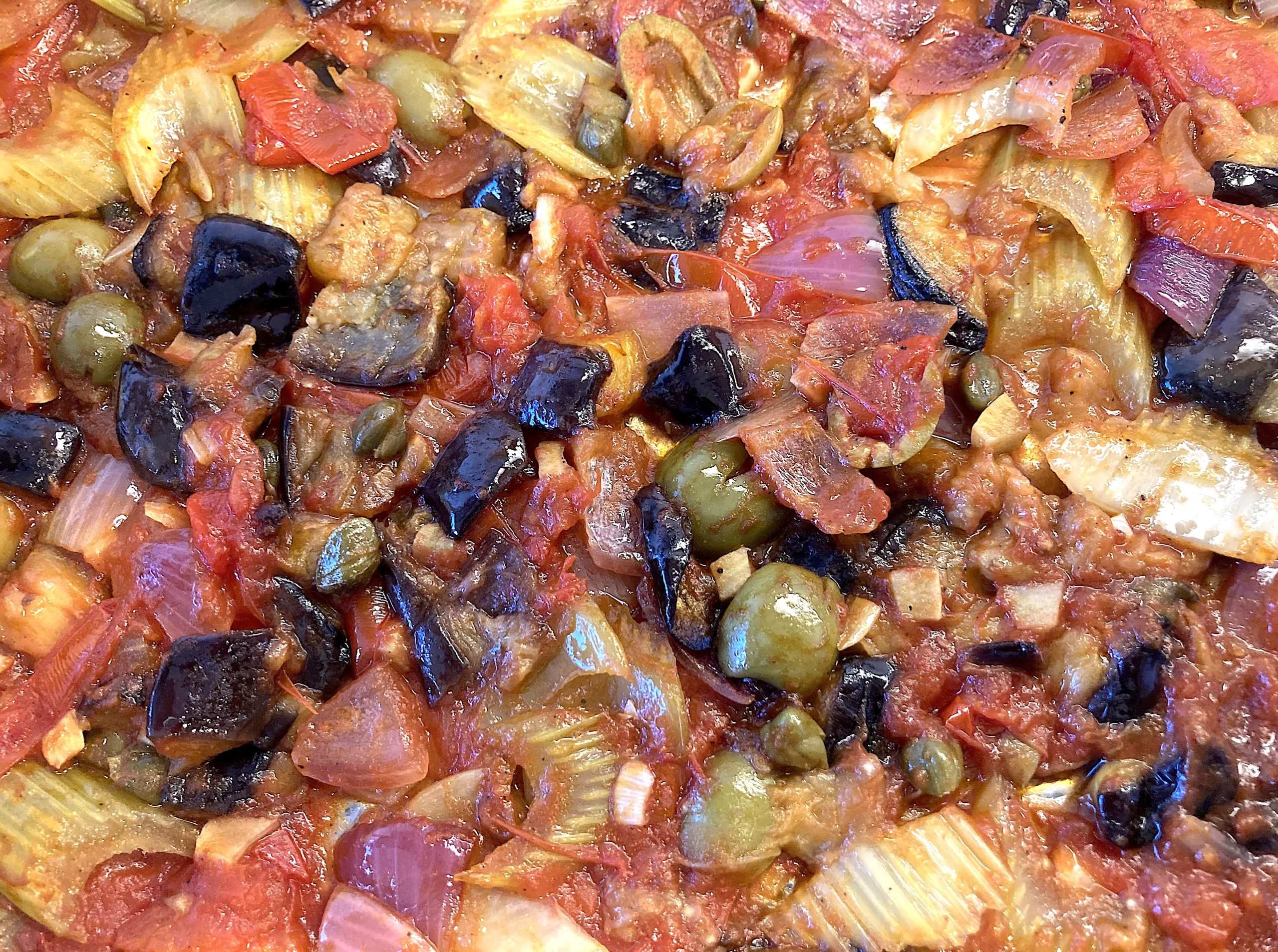
This very tasty dish originates from Sicily and is a mixture of chopped and fried vegetables. Eggplant (Aubergine), Tomatoes, Celery, rRed Onion and Green Olives are the main ingredients. The vegetables are prepared and served in an agrodolce sauce, so sweet and sour. Although we’re not keen on using sugar in a salad, in this case the combination of sugar and vinegar is perfect.
Perhaps the ingredients make you think of Ratatouille. Caponata and Ratatouille are very different dishes. Capanota is about fried vegetables, about crunchy celery, about sweet and sour.
Food and Wine Pairing
We served our Caponata with a roulade of pork with sage, rosemary, pancetta, black olives and black garlic. A dish we enjoyed with a glass of Barbera del Monferrato 2022, produced by Livio Pavese. In general, we suggest a full-bodied red wine with perhaps a touch of oak. Some acidity to balance the caponata and dark fruit (plums, blueberries).
The next day we served the Caponata with a roulade of chicken with pancetta, Parmesan Cheese and sage. A dish we enjoyed with a glass of Spätburgunder from the Pfalz area in Germany. In general, we suggest a medium bodied red wine with aromas of red fruit. Medium tannins and balanced acidity. Its taste dry, aromatic, fruity, juicy with a touch of strawberry.
You could also add some canned tuna (in olive oil) and serve the Caponata with crusted bread as a starter, perhaps accompanied with charcuterie and a glass of Crémant or Prosecco.
What you Need (recipe for 4)
- 2 Aubergines
- 400 grams excellent ripe Tomatoes
- 10 Green Olives
- Capers
- 30 grams Tomato Puree
- 4 cloves of Garlic
- 4 small Red Onions
- 3 stalks Celery
- Tablespoon of Caster Sugar
- Tablespoon of White Wine Vinegar
- Black Pepper.
What You Do
Best to prepare Caponata one day ahead.
- Wash the vegetables.
- Slice the eggplant lengthwise in 8 and then in chunks. Drizzle with salt and mix. Put the chunks in a sieve and let rest above a bowl for one or two hours.
- Coarsely chop the onion.
- Quarter the tomatoes. Remove the internal hard bits and the pits and put these aside. Slice the outer part of the tomato lengthwise in three.
- Roughly cut the remainder of the tomatoes, add to a sieve and use the back of a spoon to capture the juices.
- Coarsely chop the garlic.
- Halve the olives.
- Use a knife to peel the back of the celery stalks, or ribs. Slice.
- Combine the tomato puree, black pepper, the caster sugar, the vinegar and the tomato juice.
- Set your oven to 140 °C or 285 °F.
- Discard the liquid of the eggplants, wash of the salt, dry with kitchen paper and fry the chunks in a generous amount of olive oil until golden.
- Transfer to a baking tray in your oven.
- Fry the onions and the celery until somewhat translucent. Add these to the baking tray.
- Now add the olives, the capers, the garlic, the tomato mixture and the tomatoes. Mix. Perhaps add a splash of water.
- Cover the baking tray with aluminium foil.
- After 20 minutes it’s time to mix the vegetables. Check if you need to add extra water.
- After another 20 minutes, remove and discard the foil, mix and increase the temperature to 160 °C or320 °F.
- Now you need to keep an eye on the mixture. It may take 10 to 20 minutes for the liquid to somewhat evaporate, but you don’t want the dish to become dry.
- When ready, let cool and transfer to the refrigerator.



 Cook and Drink