Fried Prawns with Garlic and Samphire

Shrimps and prawns are subtle, delicate and tasty. Popular food in many countries, just think shrimp cocktail, stuffed eggs with shrimps and of course, fried prawns with garlic and lemon.
For this recipe you need large, wild or organic prawns. We strongly suggest using ones that are not yet cleaned. It’s not difficult to clean shrimps and they taste much better than factory cleaned shrimps.
We serve the prawns with samphire. It’s a crunchy and salty vegetable that brings lots of colour and flavour to the plate. It can be eaten raw but it’s better to cook or steam it for a minute or two. The history of samphire goes back to the 14thcentury when the ashes of the marsh samphire (rich on sodium carbonate) were used to make glass. 

Wine Pairing

We enjoyed our Prawns with a glass of Picpoul de Pinet produced by Gérard Bertrand. A dry white wine, with a pale straw yellow color. It has aromas of citrus and gooseberries. The wine is full and round with minerality which is typical for a Picpoul de Pinet.
Recently we combined the prawns with a white wine made by Casa Relvas in Portugal. The wine is made with antão vaz and viognier grapes. Subtle aromas, gentle acidity and a nice finish.
You could also combine the prawns with a glass of Chablis, Verdejo or Soave.

What You Need
  • Six large Prawns
  • Garlic
  • Olive Oil
  • Black Pepper
  • 50 grams of Samphire
  • Crusted Bread
  • Lemon (optional)
What You Do
  1. Use scissors to cut the shell of the prawn. Start behind the head and cut towards the tail. Just before the tail turn 90 degrees and make a cut around the prawn
  2. Remove the head, the shell and the legs of the body. Keep the tail on the prawn.
  3. Remove the black vein (the prawn’s intestines) and the slurry (if any)
  4. Wipe clean with kitchen paper
  5. Transfer the prawns to the refrigerator
  6. Wash the samphire
  7. Coarsely slice the garlic
  8. Heat a pan with water
  9. Dry the prawns and fry them in a skillet in olive oil (depending on the size maximum 4 minutes in total) on both sides and on the back.
  10. When the prawns begin to colour, add the garlic and reduce the heat
  11. Coat the prawns with the oil and the garlic in the pan
  12. Cook the samphire for one minute maximum (or steam for two minutes)
  13. Drain the samphire
  14. Serve on warm plates with some black pepper and lemon (if using)
  15. Enjoy with crusted bread
Fried prawns with Garlic and Samphire ©cadwu

Confit of Duck: a home made alternative

The traditional way of making Confit of Duck is not complex. It’s a bit time consuming and it requires some planning, that’s all. The principle is to cure the meat in salt with various herbs (thyme, cumin, rosemary) and garlic. After 24 hours or so the duck is washed with water, patted dry and then slow cooked in goose or duck fat for several hours. When ready cool and store in fat.

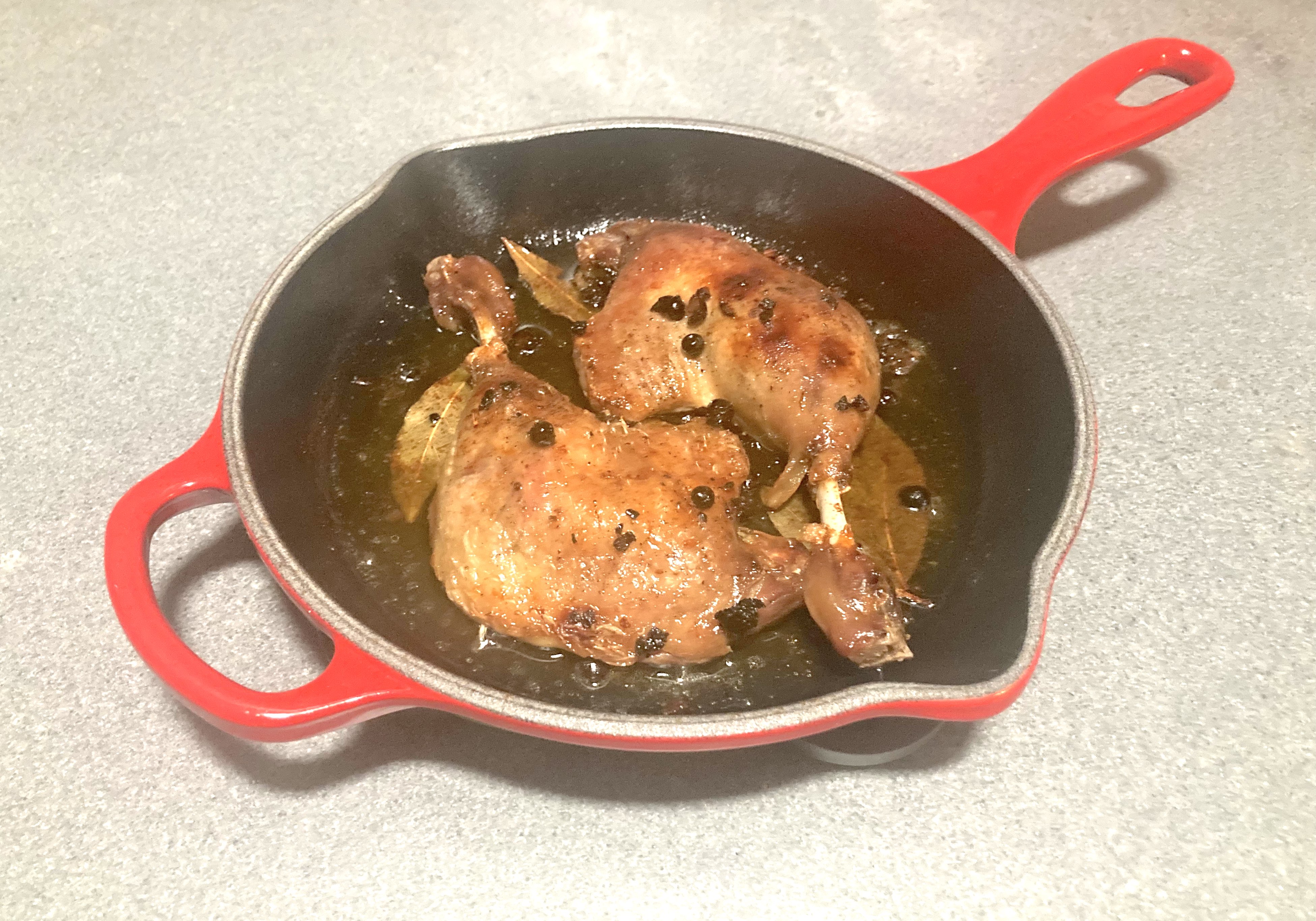
We take a different approach by slow cooking the duck legs in olive oil. The result is remarkable: juicy, full of flavours and aromas, provided you use first class duck (label rouge for instance). If not, the meat can become dry and tough. Another benefit: we don’t cure the meat so it’s not salty at all.
We serve the confit with celeriac mash. It’s light, nutty and refreshing compared to a mash made with potatoes.

Wine Pairing

Best choice is a full bodied, red wine with ripe fruit and smoothness. We decided to open a bottle of Herdade de São Miguel Colheita Seleccionada 2020 as produced by Casa Relvas. Such a pleasure! Its colour is deep ruby and the aromas made us think of ripe black fruit and dark cherries with some spiciness. The wine is well balanced with a nice structure and smooth tannins. Works very well with the juicy duck and the mash with its creamy texture and lemonish, celery flavours.

What You Need

  • For the Confit
    • 2 Duck Legs
    • Juniper berries
    • 4 Bay Leaves
    • Olive Oil
    • (optional) Garlic
  • For the Celeriac Mash
    • 1 Celeriac
    • Slice of Lemon
    • Cream
    • White Pepper
    • Nutmeg

Confit

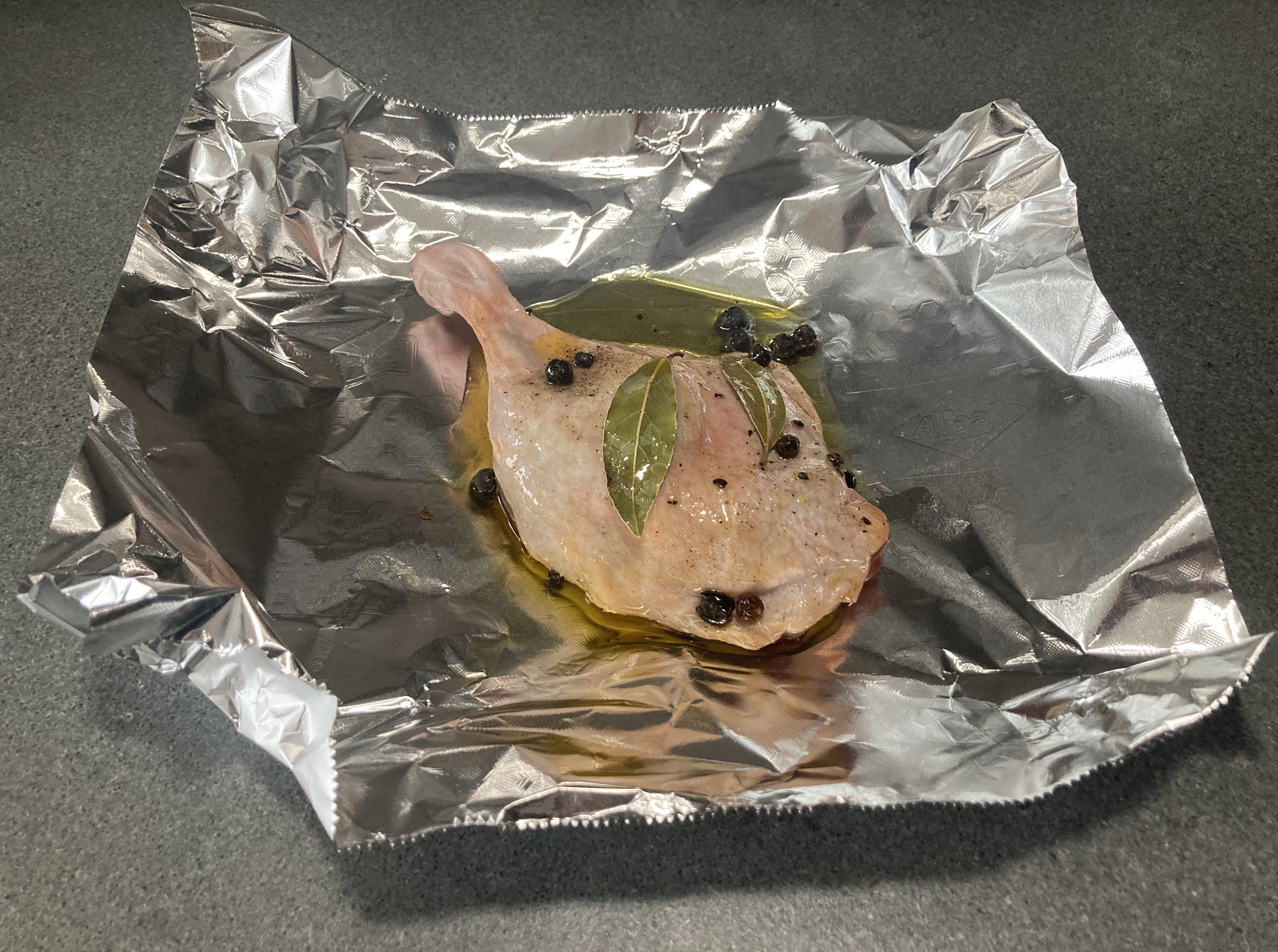
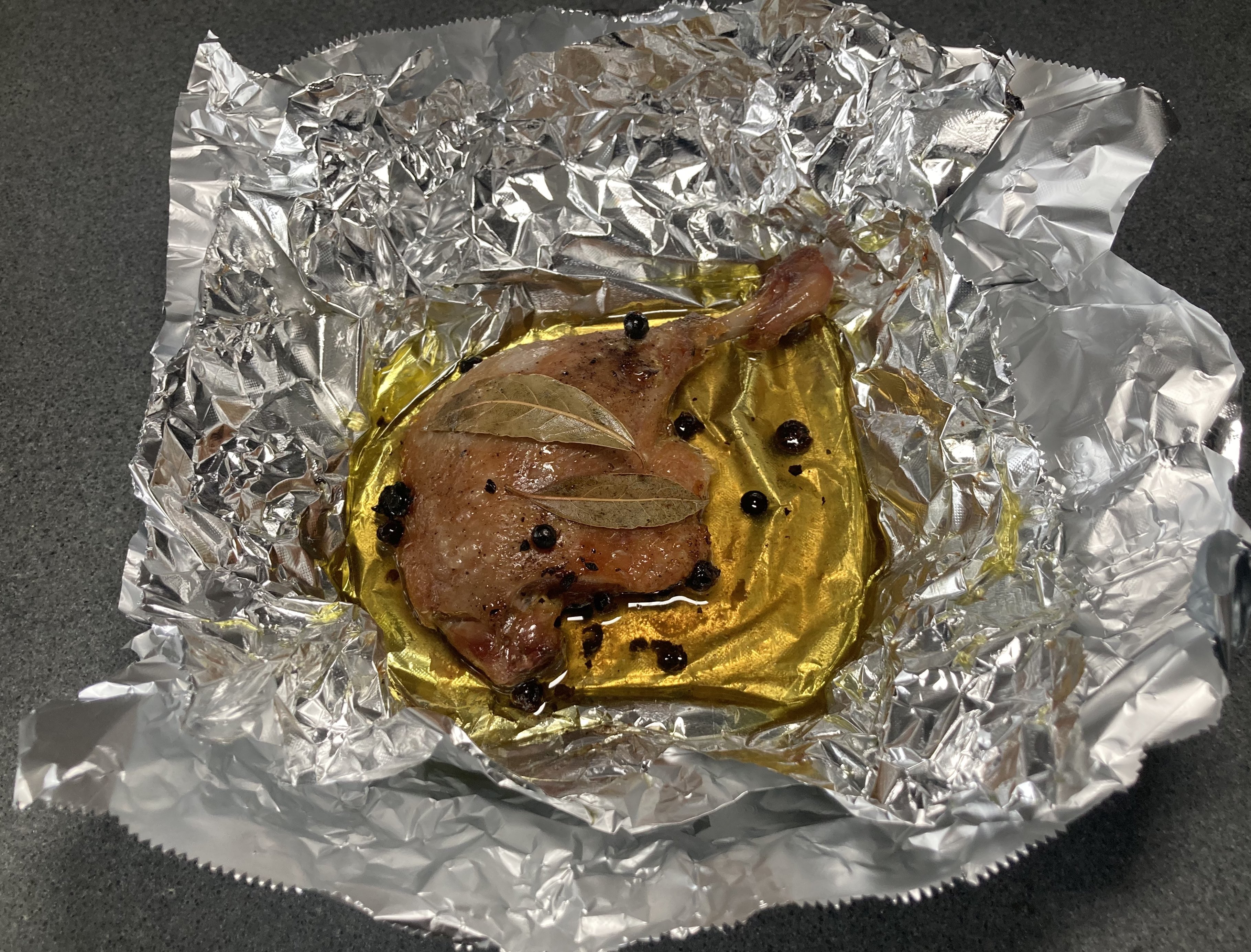
Take a sheet of aluminium foil and place the leg in the middle. Add lightly crushed juniper berries and two bay leaves. Perhaps some crushed garlic. Add a generous amount of olive oil and make sure everything is covered. Wrap foil around the duck. Take a second sheet of foil and wrap it around the package, making sure it’s closed. Repeat with the second leg. Transfer both packages to an oven at 120 °C or 240 °F. After one hour reduce the heat to 100 °C or 210 °F. After in total 4 to 5 hours, depending on the size of the legs, remove the legs from the oven, open the package and let cool. Then transfer to the refrigerator for use later on.

Heat the oven to 200 °C or 390 °F. Put the legs in an iron skillet, transfer to the oven and 15-20 minutes later the legs are ready. If the skin is not yet crispy, use the grill for 2 or 3 minutes.
Another idea is to pull the meat and use it to top a salad.

Mash

The Celeriac Mash: clean and dice the celeriac. Cook in minimum water with a nice slice of lemon until nearly done. Remove the lemon and drain. Add cream. Put on low heat for a few minutes; the celeriac should absorb the cream. When the celeriac is done, use a blender to create the puree. Pass through a sieve. Perhaps add extra lemon or cream. Just before serving add white pepper. Serve with freshly grated nutmeg.