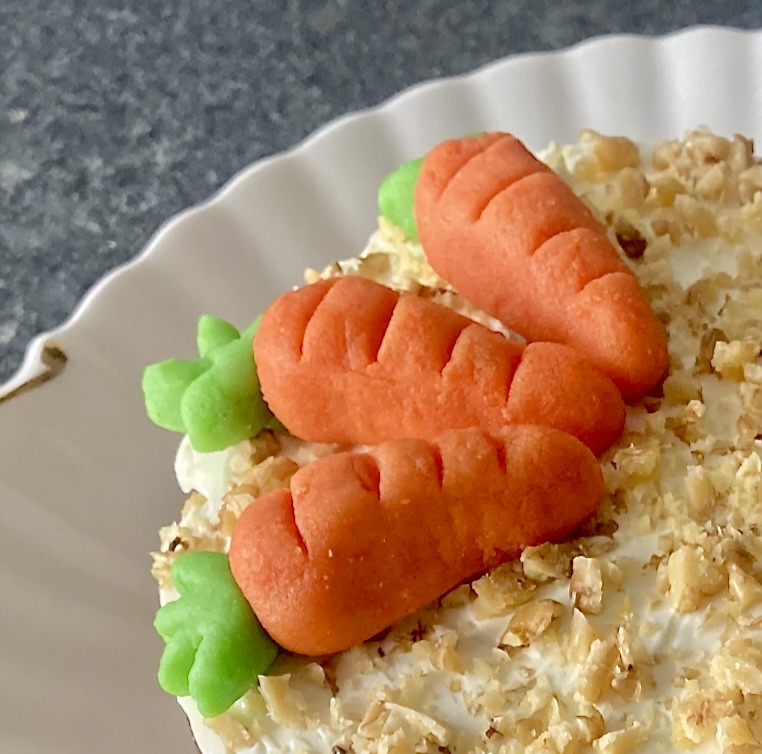
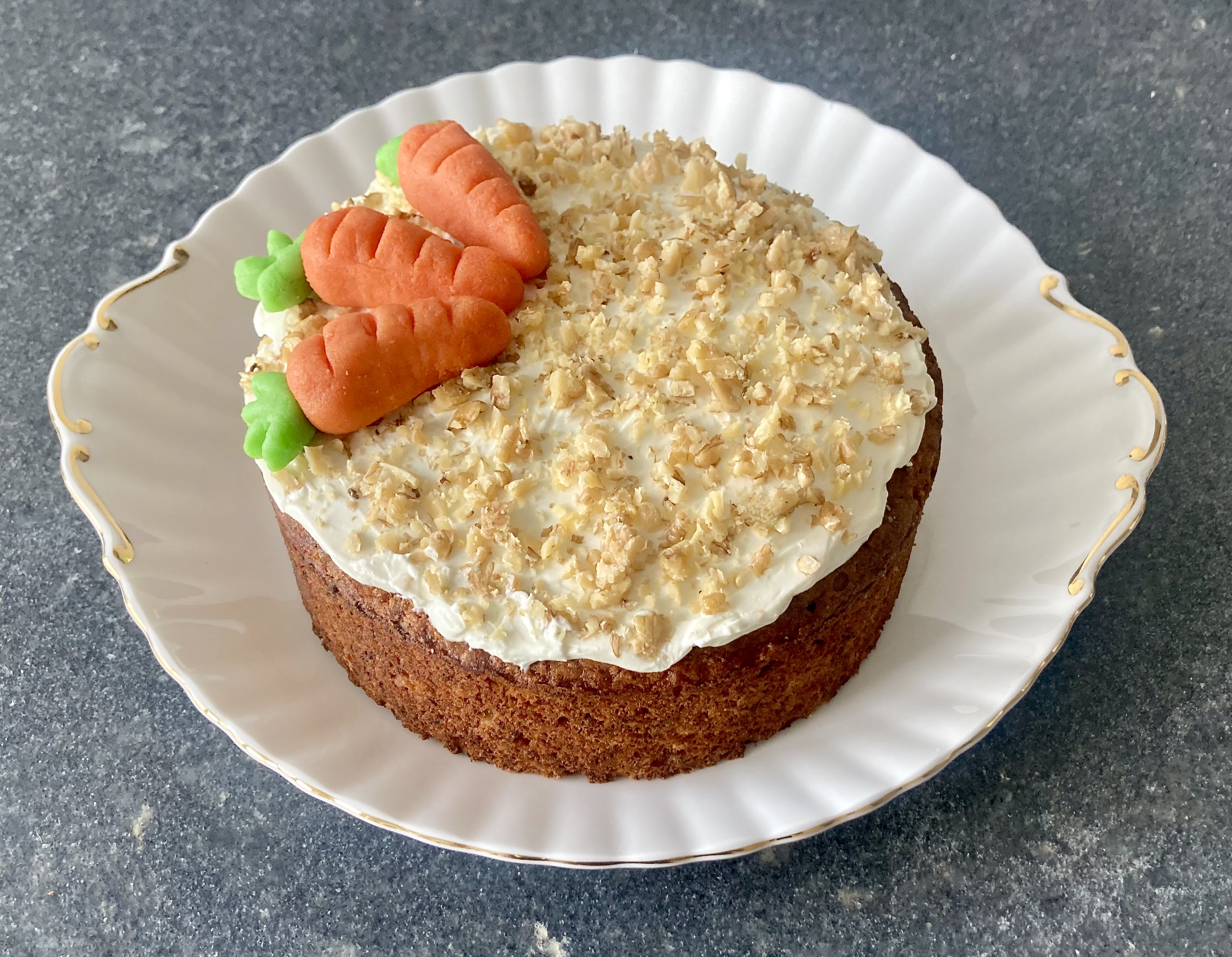
Royal Carrot Cake

Today, April 27th, we celebrate the birthday ol King Willem-Alexander of the Netherlands. Hip hip hurray!
The Dutch royal family is also known as ‘de Oranjes’, which is reflected in the use of the colour orange when referring to Dutch royalty. There is no link between the royal family and the colour. The ‘orange’ in their name refers to the French city of Orange, a Principality one of his ancestors inherited in 1544.
Over the years we prepared Orange SabayonQueen’s SoupOrange and Almond CakeBouchée à la Reine, Orange FlanCanard à l’OrangeBaba au Mandarine Napoléon and Orange Parfait on this day.

This year we prepare a Carrot Cake. Given its English origin we thought it would be best to use an English recipe as a starting point. What better cookbook to use than Harrods Book of Traditional English Cookery by Hilaire Walden! It includes recipes for dishes such Jugged Kippers, Rabbit in the Dairy and Dorset Apple Cake. Buy this wonderful book via the usual channels for a few euros or dollars.

Bake the cake 2 days before serving. Add the topping, transfer to the refrigerator and serve cold.

The recipe is for a 19 cm (7,5 inch) baking tin and the cake will serve 8 people.

What You Need
  • Cake
    • 125 grams of Butter
    • 150 grams of light Brown Sugar
    • 3 Organic Eggs
    • 3 teaspoons of Orange Rind
    • 15 ml of Lemon Juice
    • 175 grams of Flour
    • 8 grams of Baking Powder
    • 35 grams of ground White Almonds
    • 75 grams of chopped Walnuts
    • 50 grams of White Raisins
    • 250 grams of grated Carrot
  • Topping
    • 200 grams of Soft Cheese
    • 1 teaspoon of Honey
    • 1 tablespoon of Lemon Juice
    • 25 grams of chopped Walnuts
    • 45 grams of white Marzipan for the carrots
    • 10 grams of white Marzipan for the green part
    • Food colouring: Red, Yellow and Green
What You Do (Cake)
  1. Preheat your oven to 180 °C or 350 °F, traditional
  2. Coat a round cake tin with butter
  3. Coarsely grind the almonds
  4. Coarsely grind the walnuts
  5. Sift flour and baking powder and combine
  6. Soak the raisins for 10 minutes; discard the water
  7. Grate the carrot
  8. Grate the orange rind
  9. Melt the butter until soft 
  10. Combine butter and sugar until relatively fluffy
  11. Combine flour, baking powder, chopped walnuts and almonds
  12. Separate the eggs
  13. Whisk the egg whites until stiff
  14. Add the egg yolks to the butter and sugar mixture, combine
  15. Add orange rind, raisins and lemon juice to the mixture, combine using a spoon
  16. Add the combination of flour, baking powder and nuts to the mixture
  17. Add carrots to the mixture and combine
  18. Fold in the egg white
  19. Transfer to the oven for 50 minutes
  20. Leave to cool on a wire rack
  21. Keeps well on room temperature for at least 2 days
What You Do (Topping)
  1. Make 3 small orange balls
  2. Press these into the shape of a carrot
  3. Use a knife to make a few superficial slices
  4. Roll out the green marzipan, cut out 3 circles and create the green part
  5. Beat cheese, honey and lemon juice
  6. Taste and adjust; we added extra lemon juice
  7. Spread evenly over the cake
  8. Sprinkle with walnuts
  9. Decorate with three carrots
  10. Once you’ve added the topping, store in the refrigerator
Carrot Salad with Fennel Seeds

Inspired by the Portuguese and Moroccan cuisine we make a very tasty, quick and easy carrot salad. Ideal to accompany fish or a rich stew. The salad is full of flavours: fennel and carrot obviously, but you could also taste chervil and perhaps tarragon. Light, refreshing and the texture of the carrot is inviting.

We prefer preparing the salad with winter carrots because they seem to have more flavour and structure than the regular ones.
We use fennel seeds in this recipe. Alternatively, you could use cumin (always great with carrots) or coriander (cilantro) seeds.

What You Need

  • One Winter Carrot
  • Olive Oil
  • White Wine Vinegar
  • One Garlic Clove
  • Fennell Seeds
  • Parsley
  • Black Pepper

What You Do

Prepare 24 hours before serving.
Clean and thinly peel the carrot. Cook for 5-10 minutes until al dente. Let cool. Quarter lengthwise and slice. Make a dressing by combing olive oil and vinegar (ratio 2:1 or 3:1). Peel the garlic clove and finely chop. Take ¼ teaspoon of fennel seeds and use a mortar to crush the seeds until you have powder. Add the fennel seed powder and the garlic to the dressing and combine. Taste and adjust. Chop a nice amount of parsley. Add the carrots and the parsley to the dressing and combine. Use cling film to seal the bowl and transfer to the refrigerator. Gently mix the salad every 2-4 hours.
Just before serving add some fresh black pepper.

Sand Carrots

We were chatting to our favourite greengrocer. Anything special this week? Yes, absolutely, we’ve got Carottes des Sables, also known as sand carrots. The carrots grow in sand in the French Normandy region. The sand has been fertilized with seaweed for many years. The carrots grow slowly and don’t develop a fibrous core, as other carrots do. Furthermore, they are not stored in cool warehouses. Immediately after the harvest they are transported to the greengrocer or the kitchen, covered with sand, to keep them fresh and aromatic. A culinary treat, appreciated by Michelin star chefs.

The carrots are simply delicious and look wonderful. The colour is vibrant orange. We tasted carrot as carrot should taste, crunchy, a touch sweet and fresh.

You could braise the carrots in stock with star anise and finish with butter. We decided to keep it simple and give all credits to the carrot. We served them with a pork medallion with apricots and prunes. A combination that worked very well.

Wine Pairing

The sweetness of the carrots is leading. We opened a bottle of St. Amour, one of the ten crus of the Beaujolais, produced by Maison Jean Loron. An elegant red wine with aromas of strawberries, cassis and chocolate. The tannins are soft and pleasant. The taste is a wonderful balance of strawberries, raspberries and blueberries.

In general you’re looking for a light or medium bodied wine, with character and fruity aromas. Could be a Malbec, perhaps a blend of Syrah and Grenache?

What You Need
  • Sand Carrots
  • Butter
What You Do
  1. Wash the carrots carefully
  2. Slice, add to a pan with a bit of water and butter
  3. Cook until you’re happy with the firmness of the carrot. By then the water should have evaporated
  4. You could serve them with fresh parsley, cilantro, cinnamon or black pepper
  5. We were perfectly happy with this simple preparation!

Mirepoix

A combination of three ingredients that is essential when preparing stocks, stews and sauces: onion, carrot and celery (ratio 2:1:1). It’s intriguing that this combination works so well. All three bring sweetness when cooked, the combination is balanced and it brings depth to the result.

The celery could be a bit confusing: should it be celeriac, the root (knob) or celery, the fibrous stalks? Some suggest using the root in winter and the stalks in summer. We suggest using the stalks in all cases. They are very aromatic and they come with a touch of saltiness, very different from the root.

When for instance you want to make a beef stew, then first sear the beef, remove it from the pan, perhaps add some oil or butter and then add the mirepoix. Leave to simmer on low heat for 15 minutes or so or until soft. It’s all about creating flavours and aromas. Make sure you don’t brown the mirepoix. 

Another approach is to add it to (cold) water. This works well when making a white stock. And of course, when you want to make a powerful, tasty vegetable stock.

What You Need

  • 1 Large Onion
  • 3 Celery Stalks
  • 1 Carrot
  • 1 Leek
  • 1 Small Tomato
  • 2 Garlic Cloves
  • 1 Bouquet Garni (Parsley, Bay Leaf, Thyme)

What You Do

In the Netherlands an extended version of Mirepoix is fairly standard: onion, carrot, celery and leek (ratio 1:1:1:1) , also known as WUPS (Wortel, Ui, Prei en Selder). We prefer this version because the leek seems to bring extra flavours. Or perhaps because we’re Dutch?
Clean and dice the celery, the carrot, the leek and the tomato. Peel and chop the onion and the garlic. Add all ingredients and the bouquet garni to a pan with cold water and allow to simmer for one hour or so. Pass through a sieve and decide if you want to reduce the liquid. It freezes very well, so ideal to make ice cubes for use in sauces.

Mirepoix ©cadwu
Mirepoix plus extra ingredients for vegetable stock ©cadwu

Guineafowl with Ras el Hanout

Preparing guineafowl can be a bit of a challenge: easily overcooked and quickly dry. Guineafowl has more structure and less fat compared to chicken plus it’s much firmer. The good news is that guineafowl has lots of flavour, perhaps a bit gamey, but not overpowering. So great to combine with nice ingredients such as morels or with grappa, junipers, sage, white wine and pancetta (as included in The River Cafe Classic Italian Cookbook, written by Rose Gray and Ruth Rogers).

Ras el Hanout is a mix of some twenty plus spices such as coriander, cumin, cinnamon, nutmeg, fenugreek, fennel, cardamom, turmeric and many more. Ras el Hanout is complex, layered, warm, a touch sweet and bitter. It works beautifully with the guineafowl and the various vegetables. 

Wine Pairing

Enjoy your guineafowl with a not too complex, medium bodied, fruity red wine. Grapes such as Grenache, Carménère, Carignan. We enjoyed a glass of Merlot, produced by Les Ormes de Cambras from the French Pays d’Oc region. A round, fruity wine with aromas of berries and subtle tannins. Also available as Bag in Box!

What You Need

  • Guineafowl
    • Guineafowl (Supreme preferred, but Leg is also fine)
    • Teaspoon of Ras el Hanout
    • 2 Garlic Gloves
    • Olive Oil
    • White Onion or Shallot
  • Vegetables
    • 1 Sweet Potato
    • 1 Carrot
    • Cinnamon
    • Olive oil
    • Teaspoon of Soy Sauce
  • Ratatouille

What You Do

Crush the two garlic gloves and mix with some olive oil and ras el hanout. Rub the meat with the mixture and leave to marinate in the refrigerator for a few hours.
Pre-heat the oven to 180 ˚C or 355 ˚F. Add the two legs of guineafowl to a shallow dish with generous olive oil and chopped onion. Cook for 10 minutes. Turn the legs upside down and cook for another 10 minutes. Turn them a second time, skin up, for 10 more minutes. If you want a bit more colour, then set the oven to 200 ˚C or 390 ˚F.
In parallel peel the potato and the carrot. Dice and slice. Cook separately (the carrot needs more time) until tender but firm. Combine the vegetables, add olive oil, a teaspoon of grated cinnamon and a teaspoon of soy sauce. Mix well, making sure the vegetables are nicely coated. Leave on very low heat for 10 minutes. This will help integrate the flavours. (You wonder why we add soy sauce? Its umami will bring the flavours of the potato and the carrot together plus the saltiness will give the dish the required push. And because it’s one teaspoon only, you will not be able to recognise it).
The ratatouille is optional. Make it the day before, with relatively small slices and cubes of vegetables, add some tomato puree, making it nearly paste like.

Guineafowl with Ras el Hanout ©cadwu