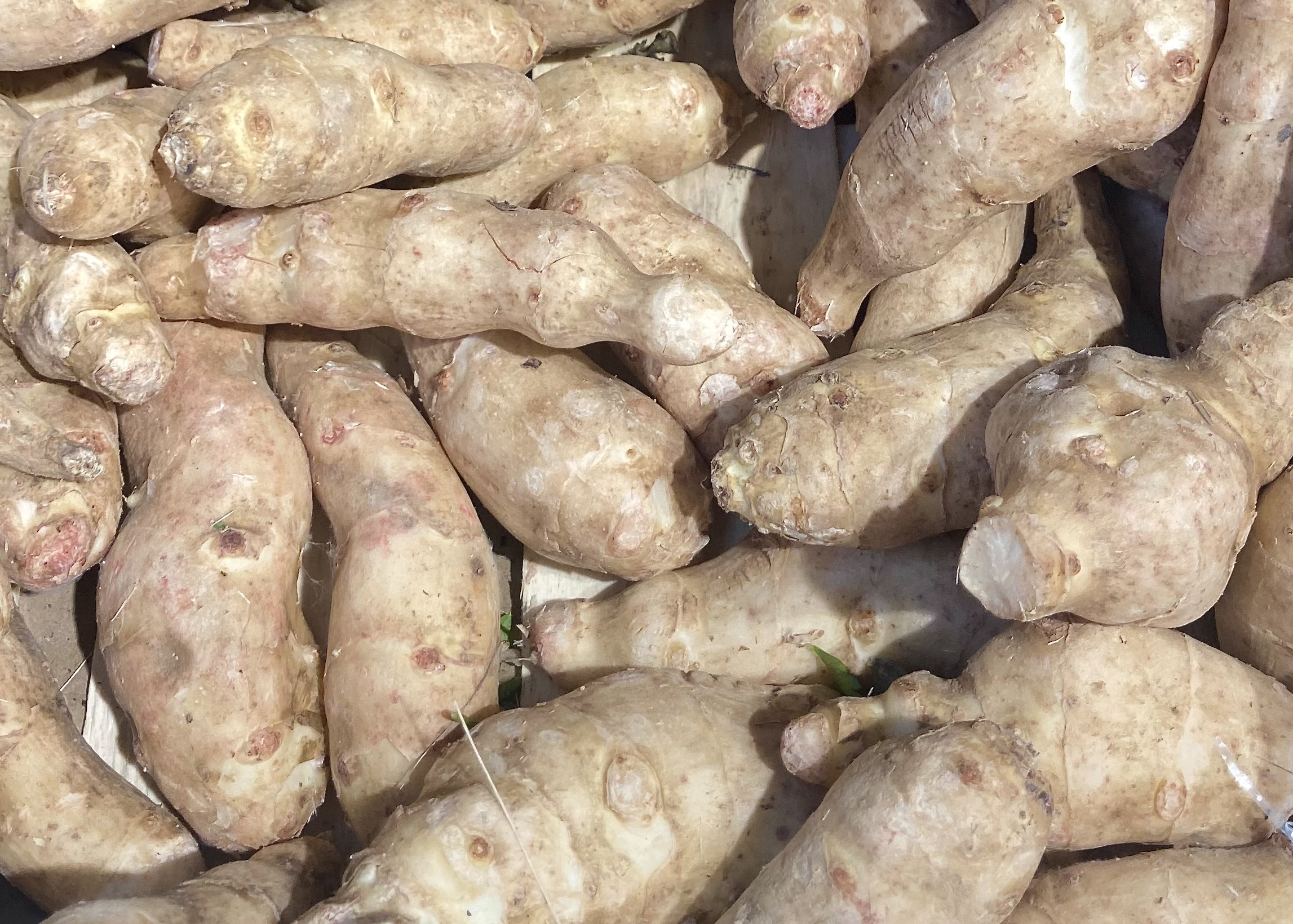
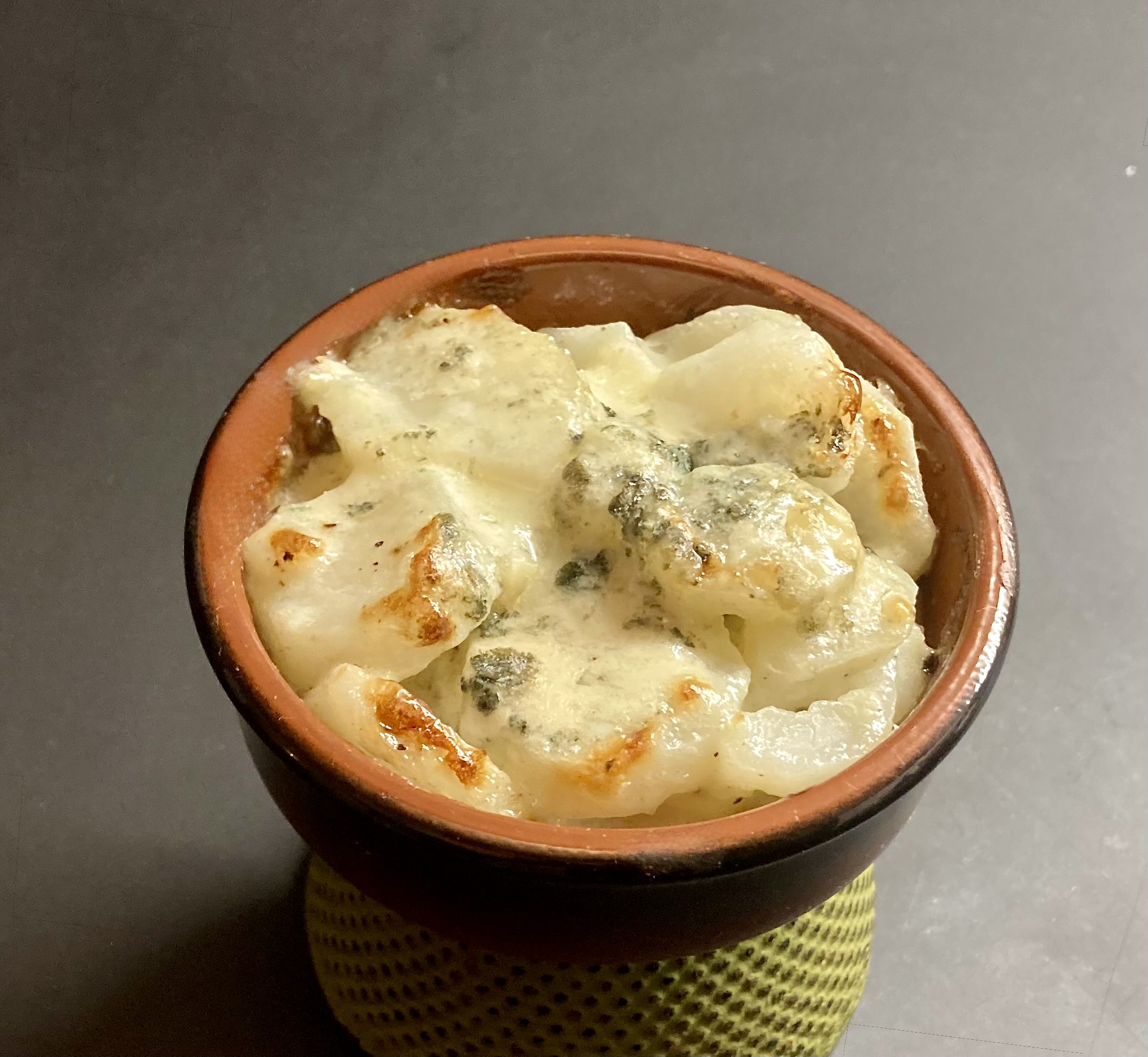
Always fun to shop at our organic supermarket and see what forgotten vegetables they have. This week they offered oca, Jerusalem artichoke (Helianthus Tuberoses), parsnip, black radish and helianthus, which was new to us. We bought a few of the helianthus roots and when at home we started thinking about ways to prepare them. Both Jerusalem artichoke and the helianthus roots are a touch sweet and nutty. A purée perhaps? We then noticed a recipe for a tartelette with blue cheese. Great idea, but not so sure about the combination with pastry. After a few minutes we came up with the recipe below. The helianthus roots are creamier than the Jerusalem artichokes and this worked very well in the combination with blue cheese and crème fraîche.The dish is rich with a touch of freshness.
Wine Pairing
In general, we suggest a full bodied, well balanced red wine, with aromas of black fruit, perhaps liquorice and with supple tannins.
What You Need
Roots of the Helianthus Strumosus
Crème Fraîche
Roquefort
What You Do
Clean the roots and cook in boiling water for perhaps 5 minutes. They become soft very quickly. Drain and let cool. In parallel use a fork to combine equal parts of crème fraîche and Roquefort. Slice the roots and combine with the mixture. Place in ramekins and transfer to the oven at 200 °C or 390 °F for a few minutes, until hot and golden. You can also place them under the grill for a few minutes.
Sometimes we dream of having a small garden, with perhaps a few roses, herbs, peonies and definitely a fig tree. Being able to pick figs, all summer long, and enjoy the abundance of the tree, it sounds like magic to us. Figs don’t do well in a pot on a balcony, so we depend on greengrocers and the market. And that’s where we struggle: when you want to buy figs, you’ll notice they’re fairly expensive and hard to find. The ones we bought yesterday were individually wrapped in paper, as if they were very exclusive chocolates. But since we love fig jam, we simply had to buy them.
Wine Pairing
Homemade fig jam combines very well with Foie Gras, toasted bread and a glass of Sauternes, for instance this very affordable Dourthe Grands Terroirs. This wonderful, sweet wine from the French Bordeaux region made from late-harvest grapes affected by noble rot, comes with flavors like apricot, tropical fruit, honey and gently toast. Drinking Sauternes has become less popular, also because it’s often positioned as a wine to accompany your dessert. A concept that seems to be a bit old fashioned. Why not try a glass of Sauternes with some excellent blue cheese, a chocolate cake or simply on its own as aperitif?
What You Need
500 grams of Fresh Figs
100 grams of Sugar
1 Lemon
What You Do
We recommend using only 100 grams of sugar, so 20% of the weight of the figs. Therefore the jam must be stored in the refrigerator and the jar must be finished shortly after opening it. That’s why we prefer using small jars and cooking small quantities of jam. Start by washing the figs. Remove the stems. Cut the figs in small chunks, add to a pan. Add the sugar and the juice of one lemon. Put on medium heat, for at least 60 minutes, no lid needed (but be careful if the fruit is not ripe). During the cooking process the jam will become bright red. Use a fork to mash some of the figs. We think using a blender ruins the texture. Make sure your jars are perfectly clean. Fill the jars, close the lid and cool in a cold-water basin. When cool, transfer to the refrigerator.
Bleu d’Auvergne is amongst our favourite cheeses. It’s creamy, semi-hard, moist, powerful, pungent and not too salty. It was created around 1850 in France when a farmer combined cow milk curd with the mould of rye bread. He also noticed that the cheese benefits from increased aeration using needles (similar to the process used when making Stilton cheese). Nowadays Bleu d’Auvergne is a Protected Designation of Origin (PDO), just like the other excellent cheeses from that region (for example Saint-Nectaire and Cantal). For some reason Bleu d’Auvergne combines extremely well with cod. We tried other combinations, experimented with adding butter, cream or crème fraîche but we always return to this one. It’s a tribute to both the fish and the cheese.
Wine Pairing
The combination may be very specific; wine pairing is not too difficult. In general a fairly present, white wine will be great choice. Could be a Verdejo from Spain, a mildly oaked Chardonnay or a glass of your favourite white wine. No reason to open a bottle of Chablis; the flavours are too bold for a really elegant wine.
What You Need
Skinless Cod Loin
Bleu d’Auvergne (preferable mature)
Olive Oil
What You Do
Heat a heavy cast iron skillet through and through, add olive oil, dry the cod with kitchen paper and fry on the firm side (where the skin used to be) until it’s nice and golden. Flip the fish, reduce the heat and start adding chunks of cheese. It will melt, but make sure you still have these blue bits in there. Baste the fish with the melting cheese. Check the cuisson of the cod (the fish must be opaque and flaky) and serve on a warm plate.
A glass of white wine, perhaps a glass of Crémant d’Alsace or maybe even a glass of Champagne; such a great way to start dinner (or lunch when you feel like treating yourself). You enjoy some bread with homemade Tapenade, or a few nice olives. All good. And then suddenly the chef presents you her or his Amuse-Bouche. Something very special and an indication of the chef’s talent. But in most cases it’s something on a spoon and not very special.
A bit of background: amuse-bouche is actually not a French term. Restaurateurs made it up because they think amuse-gueule (the correct term) is a bit harsh. ‘Gueule’ can refer to both humans and animals. And ‘ferme ta gueule’ is far from polite. So restaurateurs started using ‘bouche’, to eliminate the impression that they think their guests have a snout.
Some say the concept of the amuse was invented by the Nouvelle Cuisine in the 1960s. Not really. In 1946 Francis Ambrière, in his book Les Grandes vacances, writes “… Une côtelette à midi. Quelques amuse-gueule à l’heure du goûter. Et le soir, ô splendeur, un gigot bien saignant, le premier gigot depuis l’an 40!”
Today’s amuse-gueule is a dish in its own right that amuses the mouth, fools your appetite and makes you want to start on the first course. Small, tasty, full of flavours and maybe a bit out of the ordinary.
We use a traditional coddler for this amuse-gueule, but you could also use a small ramequin. No spoon, please.
Wine Pairing
Typically the amuse-gueule is combined with your aperitif. We combined this amuse gueule with a glass of German Sekt, to be more precise with a glass of Reichsrat von Buhl – Pfalz – Sekt – Spätburgunder Brut rosé 2016, which is a superb pale pink wine, made from 100% Pinot Noir and produced by one of the leading wineries in Germany. Think red berries, brioche, a delicate texture with a nice mousse, fresh acidity and a long-lasting aftertaste.
What You Need (for 4)
One Egg
Four Medium Sized Raw Prawns
75 grams Spinach
½ Shallot
A Generous Tablespoon of Crème Fraiche
Dill
Blue Cheese
Chives
4 Edible flowers
What You Do
Start by cleaning the prawns, removing the head, the shell and the vein. We used Argentine red shrimps. The meat is fairly soft and they become beautifully red when cooked. Fry the shrimps is some olive oil for 3 minutes. Remove the shrimps from the pan, set aside and let cool. Gently fry the shallot in the same pan for 10 minutes until glazed. Remove from the pan and let cool. In a different pan quickly cook the (dry and clean) spinach in some olive oil. Keep stirring! Drain if so required, set aside and let cool. Cut the prawns in smaller bits. Chop the spinach using a large knife. Whisk the egg until completely smooth. Now add the (cool) bits of prawn, the spinach and the shallot. Whisk with a spoon. Add the Crème Fraiche. Add some chopped dill (depending on your taste), a bit of blue cheese (not too much, just to add a dimension to the dish) and a generous amount of chives. Mix. Coat the coddlers or ramequins with butter. Add the mixture to the coddlers or ramequins. Heat your oven to 170° Celsius (or 340° Fahrenheit). Place the coddlers or ramequins in a shallow dish. Add boiling water up to 2/3 of the height of the coddler or ramequin. Close the oven and reduce the temperature to 120° Celsius (or 250° Fahrenheit). After 30 minutes au bain marie your amuse-gueule should be ready. Test with a needle. Let cool. If using a coddler, remove and dry the lid, add the flower and close.



 Cook and Drink