
Comme chez Soi

June 19th, 1926. Georges Cuvelier opens Chez Georges, a small neighbourhood restaurant in Brussels. One of the regulars told the chef: “Georges, chez vous, on mange comme chez soi” (meaning “Georges, in your restaurant one eats like at home”) which was meant as a compliment. The comment triggered a name change.

Georges Cuveliers daughter Simone married Louis Wijnants. Together they owned and managed the restaurant, now called Comme chez Soi. They focused on Belgian cuisine, local ingredients and quality. In 1966 their son Pierre Wijnants took over. He would become one of the finest and most celebrated chefs of Belgium. In 1979 the restaurant was awarded three Michelin stars.

Today the restaurant is owned by Laurence Wynants and Lionel Rigolet. It has one Michelin star.

A five course menu at Comme chez Soi will cost you 195 euro (225 US dollar) and with wine selection 270 euro (315 US dollar) per person. This summer the restaurant serves courses like cod fillet, candied ginger, parsley coulis, kohlrabi, Ndongo Bella Congo pepper and peach, nectarine, apricot, shortbread and a light lemon thyme mousse with verbena espuma.

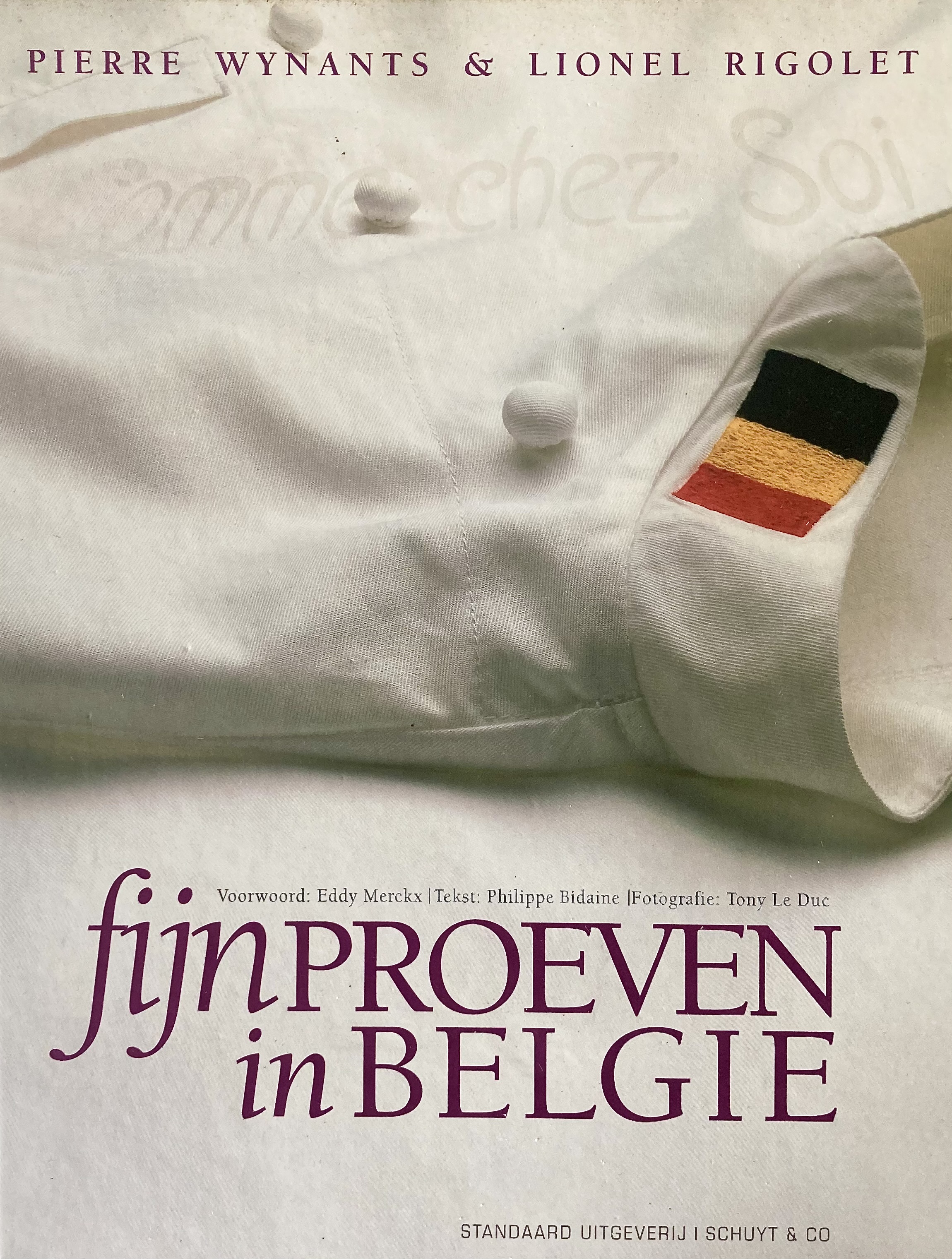
Dining at Comme chez Soi is a bit above our budget, so we very happy to buy Fijnproeven in België, a book that celebrates the cuisine of Belgium. It’s written by Pierre Wijnants and Lionel Rigolet with beautiful photo’s by Tony Le Duc. It features wonderful dishes such as jelly of salmon, tea, lemon and tarragon and soup with cream, eel and hop shoots plus traditional Belgium dishes such as mashed potatoes with onions.

We decided to prepare frog legs with morels, fava beans, green asparagus, chervil, cream and lemon. We replaced the frog legs with organic chicken thighs because the frog population is in decline and frog farms are the worst ever.

The combination was very tasty and surprisingly light, with various textures and a rich sauce. 

The suggestion is to pair the dish with a glass of bourgogne, more specifically a glass of Clos du Cellier aux Moines, Givry Premier Cru, a red wine made with 100% pinot noir grapes from the Côte Chalonnaise in France. We served the dish with a pinot noir made by La Cour Des Dames. In general you’re looking for a red, medium bodied wine with aromas of berries and floral notes. The tannins should be soft or well-integrated. 

PS

The book includes quotes from guests including one that reads “Pourqoi est-ce meilleur que chez moi?” meaning “Why is it better than at my place?”

Authentic Dutch Pepernoten

Today, December 5th (actually December 6th), we celebrate the birthday (actually name day) of Sinterklaas or Sint Nicolas (270-343), patron saint of children (and Amsterdam), the Greek Bishop of Myra (now Demre), currently Turkey, but living in Madrid according to Dutch tradition and arriving end of November per steamboat. He rides a white horse over the rooftops at night and can be in different places at the same time. Very confusing but it makes perfect sense to children.

His assistants, (called Pieten), carry bags with sweets and presents. They used to be Zwarte Pieten (Black Pete) but thankfully that part of the tradition has now changed significantly making the Sinterklaas festivities more inclusive. Piet has become a Sooty Piet (they squeeze down and up sooty chimneys in order to deliver presents).

The celebration is not just about presents and sweets, it is about behaviour: Sinterklaas carries a big book with information about children: who has been good (sweets, presents) and who has been naughty (spanking with the birch rod that is used by Piet to sweep chimneys or being put in a now empty bag and taken back to Spain). Now you know why most Dutch and Belgian children become nervous and restless beginning of December!

Culinary

The culinary aspect of Sinterklaas is about sweets: chocolate letters (the first letter of your name), chocolate coins, marzipan figures, chocolate frogs (in a bathing suit, obviously) and mice (both stuffed with fondant), speculaas (spiced short crust), kruidnoten (as speculaas but slightly different) and pepernoten. Both kruidnoten en pepernoten were thrown through the room, for the children to look for.
The smaller sweets were part of a ritual: in the evening you would put a shoe in front of the fireplace (or a similar apparatus, as long as it was connected to a chimney, things became challenging with the introduction of central heating) and you would sing a traditional Sinterklaas song. If possible you would put a carrot in your shoe for Sinterklaas’ horse. The next morning the sweets would be waiting for you in your shoe. Wonderful memories!

Pepernoten

If you shop these days in the Netherlands, you will see lots and lots of pepernoten. One Dutch company specialises in pepernoten and produces them in over 50 flavours. These pepernoten are actually kruidnoten. In 1593 Carolus Battus mentions Peper-coecxkens. The recipe for the original pepernoot goes back to 1756 when Gerrit van den Brenk writes a book called Volmaakte onderrigtinge, ten dienste der koekbakkers of hunne leerlingen (which translates into something like Perfect lessons for cookie bakers and their pupils). The ingredients are honey, white rye flour, potash and grinded anise seed. Dutch pâtissier Cees Holtkamp modernized the recipe, enabling us to recreate pepernoten.

What You Need
  • 50 grams of Brown Caster Sugar
  • 75 grams of Honey
  • 150 grams of White Rye Flour
  • 2 grams of Salt
  • 20 grams of Water
  • 5 grams of Baking Powder
  • 6 grams of grinded Anise Seed
  • 10 grams of Water
  • Neutral Oil
  • No Pepper (despite the name!)
What You Do

Best option is to watch Cees Holtkamp preparing pepernoten with support from his granddaughter Stella. The video comes with English subtitles. An even better idea is to buy his book Dutch Pastry. It’s available via the usual channels or order it at your local bookstore. Price is approximately 20 – 25 euro or US dollar.
Combine sugar, honey and water in a pan. Heat the mixture without boiling. Remove from heat. Immediately add flour and salt. Use a kitchen aid with hooks to make the dough. It will be very sticky and odd. Allow to rest for a few hours.
Add baking powder, anise seed and water. Kneed, cover with plastic foil and allow to rest until the next day.
Preheat your oven to 180 °C or 355 °F traditional. Make small cubes and use your hands to turn these into balls. Generously coat a baking tin with oil. We used a spring baking tin, which is not what we should have done. It is better to use a seamless baking tin. Wet your hands with oil, coat every ball with oil and add to the tin. The tin must be completely filled, so the balls must touch each other. This way you get the typical rounded-cube-shape of pepernoten. If not, add some aluminium foil to the tin. Transfer to the oven and leave for 20 minutes. Detach the pepernoten as soon as possible.

PS

We could only find whole grain rye flour, which is not suitable for this recipe. Instead, we used all-purpose flour.