Asparagus Salad with Basil and Olives

Over the years we posted a range of recipes with asparagus, such as classic asparagus with ham and eggs, Mediterranean grilled asparagus with Parmesan cheese or Asian asparagus with miso. During one of the first warm evenings of this year we prepared a very tasty, simple salad with green asparagus, basil and black olives. A very limited list of ingredients, but there is no need to add anything else. The olives bring umami, the asparagus sweetness and bitterness, the basil is aromatic, sweet and a touch peppery. A very uplifting combination.

Wine Pairing

Best to enjoy with a nice glass of Rosé: dry, crisp, floral and flavourful. For instance Monte del Frà Bardolino Chiaretto. It’s a wine with delicate scents of berries accompanied by light and refreshing hints of green apples and subtle spicy tones. On the palate the wine reveals juicy sensations of red berries along with an appealing and refreshing acidity.

What You Need
  • Green Asparagus
  • Black Olives
  • Basil
  • Black Pepper
  • Olive Oil
What You Do
  1. Wash the asparagus and dry
  2. Remove the bottom of the asparagus. Be generous, you don’t want to serve a chewy salad
  3. Heat a heavy iron pan, add olive oil
  4. Slice the asparagus and transfer to the pan. Don’t add the tips
  5. Stir.
  6. After 5 minutes add the tips
  7. After another 5 minutes the asparagus will be ready. Taste and leave on medium heat if you feel they need more time
  8. Let cool
  9. Halve the olives
  10. Combine the asparagus with olives, basil and black pepper
Asparagus Salad ©cadwu

Claudia Roden – The Book of Jewish Food, part 1

The cookbook review project by Bernadette is a great way to explore cookbooks. The book of Jewish Food by Claudia Roden was not yet on our bookshelf, so we bought a copy of the 25th edition for 40 euro.  Its subtitle is An Odyssey from Samarkand and Vilna to the present day. The book combines more than 800 recipes with the stories and histories that have shaped Jewish cooking over the centuries. The book showcases the diversity of Jewish food. 

The first time we saw Claudia Roden was during the 2016 Amsterdam Symposium on the History of Food. In 1999 she received the Prince Claus Award in recognition of her exceptional initiatives and achievements in the field of culture. She is author of the classic comprehensive book Food of Italy and member of the jury of the prestigious Johannes van Dam prize, awarded in 2016 to Yotam Ottolenghi. We were far too impressed to actually talk to her. A bit silly, agreed, and we will make up for it in April 2025 during the next Symposium.

The Netherlands

The Dutch Jewish community plays an important role in the Netherlands, and more specifically in Amsterdam. The community was formed in the seventeenth century by people who came from Portugal (Sephardi Jews) and from Germany and Eastern Europe (Ashkenazi Jews). In general the first group was worldly, cultured and well connected to the Dutch upper classes. The second group was poor and unskilled. They worked as market traders, food sellers (for instance pickled vegetables and salted herring with chopped onions, which is still a Dutch treat) and pedlars.

Over the years both groups influenced Dutch cuisine. According to food author and publisher Jonah Freud dishes such as Haringsalade met Bietjes (see here for our version) and Broodje Halfom (a bun with beef liver and salted beef (somewhat similar to pastrami) with white pepper) are typical examples of the Jewish influence on Dutch cuisine. Gemberbolussen (a sweet cake with ginger) and Kugel (a cake with almonds and pears) are still widely available in Amsterdam.

Two Recipes

We decided to make two recipes from the book. Boterkoek is very typical for the Netherlands. A rich combination of lots of butter, sugar, flour and a pinch of salt. Classic and easy to make. We slightly adjusted Claudia Roden’s recipe, inspired by Dutch Pâtissier Cees Holtkamp. Early on during his career he learned how to bake Boterkoek when he worked for a Jewish Bakery. 

The second recipe is for Aliyah, stewed chicken with tomatoes, tamarind, cilantro and basil. An intriguing combination and one we simply had to try. The recipe originates from the Georgian town of Kulashi. This small town was once the home of one of the largest Georgian Jewish communities.

Obviously we decided to enjoy a kosher wine with the Aliyah. We bought a bottle of Barkan Classic Merlot-Argaman 2021. The Argaman grape (an Israeli creation) is combined with Merlot. The result is an intensely coloured red wine with dark fruit, supple tannins and depth. In general, we would suggest a medium to full-bodied red wine with sufficient depth and length.

Your Bookshelf

We think this book should be on your bookshelf. It’s about (Jewish) culture, about how food is part of our shared culture, how we are all connected and how food can help us understand history. It took Claudia Roden 16 years to write it. We can only thank her for this impressive and relevant achievement.

The book of Jewish Food by Claudia Roden is available via your local bookstore or the usual channels for approximately 50 US$ or 40 euro.

Recipes for Joodse Boterkoek and Aliyah on Bernadette’s website.

Asparagus with Basil and Olives

End of June means end-of-season for asparagus, morels and ramson (wild garlic). But let’s not be sad! It’s also the beginning of Summer; time to dine al fresco and serve vibrant, light flavours. We combine the very last white asparagus with green asparagus, black olives and basil. Feel free to use green asparagus only. The dish will lose some of its bitterness and complexity but it’s still a great combination of flavours and aromas.

Wine Pairing

Best to enjoy with a full bodied and elegant red wine. Flavour-wise you’re looking for lots of fruit, mild tannins and a touch of wood. We enjoyed our asparagus with a glass of Cantine Due Palme Salento Il Passo Nero 2019. This wine from Puglia (Italy) is made from late harvested negroamaro grapes. Dark berry fruit, medium full tannins and a beautiful deep colour.

What You Need

  • Asparagus
    • Equal Amount of White and Green Asparagus
    • Basil
    • Black Olives (preferably Cailletier or Taggiasca)
    • Olive oil
  • Lamb Chops
    • Olive Oil
    • Thyme
    • Garlic
    • Black Pepper

What You Do

Peel the white asparagus and cut of the end. Wash the green asparagus and cut of the end. Slice the asparagus in nice chunks (4 centimetres or so). Combine the asparagus with olive oil and a nice amount of black olives. Transfer to the refrigerator.
When ready for your al fresco dinner, heat your oven to 190˚- 200˚ Celsius (or 375˚- 390˚ Fahrenheit). Mix after 10 minutes and again after 20 minutes. The asparagus should now be ready (if not, another 10 minutes should do the trick). Add half of the basil leaves.

If you serve the asparagus with lamb chops: leave the chops to marinate in olive oil, crushed garlic and thyme for 24 hours in the refrigerator. Remove thyme. Heat a heavy iron skillet and fry the chops in olive oil (4 minutes depending on the size). When ready keep the chops warm in aluminium foil. Fry the thyme in the remaining oil. In parallel add more basil leaves to the asparagus and mix.

  • Asparagus with Basil and Olives ©cadwu
  • Ingredients of Asparagus with Basil and Olives © cadwu
  • Asparagus with Basil and Olives Ready to go into the Oven© cadwu

Asparagus with Basil and Olives

Al Fresco

Finally, summer is here (more or less) and the time is right for outdoor dining. You want to enjoy the evening so you’re looking for something you can prepare in advance. Given you’re eating al fresco you want something with powerful flavours and present aromas. A salad is nice, easy and too obvious. Tasty vegetables and ingredients that will make you think of summer. Of course! Olives, basil and asparagus.  Time to begin working on the mise en place.

Wine Pairing

Best to combine with a full bodied and elegant red wine. Flavour-wise you’re looking for red fruit and a touch of spiciness. We enjoyed our asparagus with a glass of La Tour Beaumont Cabernet Franc. This wine is from the Loire region and it is made by Pierre Morgeau, who was awarded the title of Wine Maker of the year 2019 by the renowned Guide Hachette. His focus is on the vineyards, the terroir and the environment in combination with a vinification as natural as possible.

What You Need

  • Asparagus
    • Equal Amount of White and Green Asparagus
    • Basil
    • Black Olives (preferably Cailletier or Taggiasca)
    • Olive oil
  • Meat Balls
    • 250 gram minced meat of Lamb
    • Cilantro
    • Mustard
    • 1 Egg
    • 1 Slice of Old Bread
    • Cumin
    • Pinch of Salt
    • Black Pepper

What You Do

Peel the white asparagus and cut of the end. Wash the green asparagus and cut of the end. Slice the asparagus in nice chunks (4 centimetres or so). Combine the asparagus with olive oil and a nice amount of black olives. Transfer to the refrigerator.
Toast the old slice of bread and let cool. Chop and transfer to the blender. You’ll now have home made chapelure. Beat the egg. Chop the cilantro. Combine all ingredients and create small meatballs. Store in the refrigerator. Mise en place done.
When ready for your al fresco dinner, heat your oven to 190˚ – 200˚ Celsius (or 375˚ – 390˚  Fahrenheit). Add a few basil leaves to the asparagus mixture and transfer to the oven. After 10 minutes mix and add more basil leaves. After again 10 minutes heat a heavy iron skillet and start frying the meatballs in olive oil. In parallel add more basil leaves to the asparagus and mix. After 10 minutes transfer the meatballs to a plate covered with kitchen paper. Add some basil leaves to the asparagus, mix and serve a generous amount of vegetables on a hot plate. Top with 5 meatballs.
PS Feel free to use green asparagus only. The dish will lose some of its bitterness and complexity but it’s still a great combination of flavours and aromas.

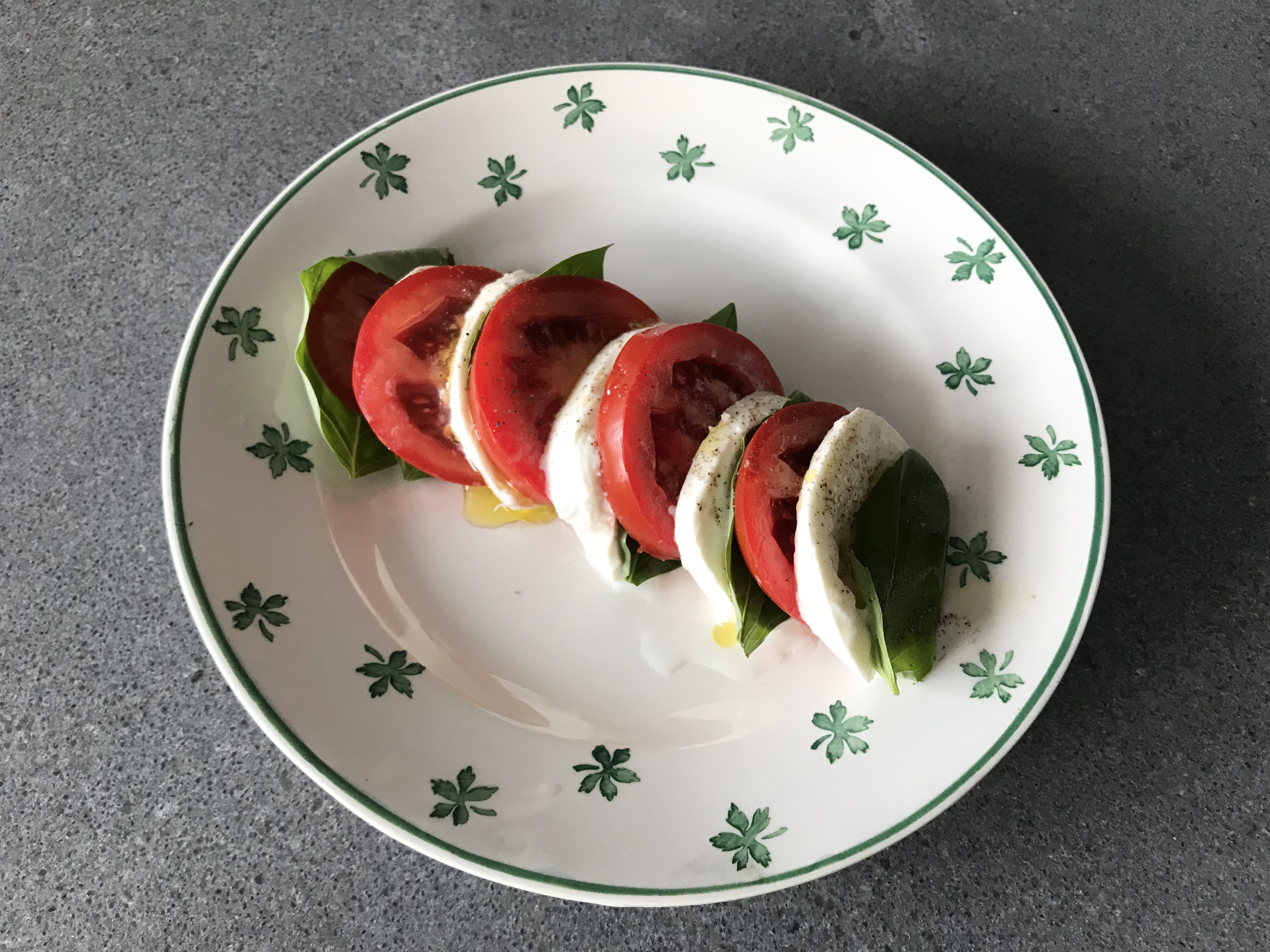
Insalata Caprese

Tomatoes

In 2013 the German culinary press characterised Dutch tomatoes as ‘wasserbomben’, let’s say ‘water balloons’. And they were right. Even more so, many tomatoes were, and still are, tasteless and watery. And since the Netherlands are in the top 3 of tomato exporting countries, you run the risk of buying a red balloon. Which is of course not what you want to do. So if you plan to make one of the simplest and tastiest starters ever, you have to find the best tomatoes ever. Or grow your own of course.

Mozzarella

Meaning Buffalo mozzarella, made from the milk of the Italian buffalo. Since 1993 it’s a DOP (Denominazione di Origine Protetta) and protected under EU law. It’s a young, moist, tasty cheese with a lovely soft, elastic but not chewy texture and it comes with a skin as a result of the shaping and pickling. The taste is more robust than mozzarella made from cow milk and it’s ideal for a salad. The cow version is best used for cooking. The smoked version should be ignored.

Basil

Someone should write ‘The Case of the Dying Basil’. A whodunit in which a clever detective will reveal why the basil plant you buy from the green grocer or supermarket will very likely die within 3 days, regardless what you do. And since they always die on us, we buy ‘fresh’ leaves.
The most used variety of basil is sweet or Genovese basil. Others are Thai basil (slightly spicy with a hint of anise) and red (or purple) basil (similar to sweet basil but more powerful). Alain Passard’s book Collages et Recettes includes a recipe for purple carrots with purple basil and cinnamon. Wonderful colours and a delicate taste.

Insalata Caprese

This salad stands or falls on the quality of the ingredients. And it requires the talent to keep things simple, so you have to stick to the 5 (five!) ingredients, meaning tomatoes, mozzarella, basil, olive oil and pepper. The salad does not come with balsamic vinegar, lettuce, pineapple nuts, salt, honey, croutons, oregano, mustard or a vinaigrette. Five ingredients. That’s it.
You wonder why? Because this way the Insalata Caprese is at its best. Tasty, sweet, rich, moist, fresh and a reflection of Italy and of summer. Adding an ingredient will worsen the concept of the salad and reduce its taste.

Wine Pairing

We suggest an excellent rosé, one with flavour and depth. For instance Monte del Frà Bardolino Chiaretto 2018. You’re looking for a wine with delicate scents of berries accompanied by light and refreshing hints of green apples and subtle spicy tones. On the palate the wine should reveal juicy sensations of red berries along with an appealing and refreshing acidity.

What You Need

  • Two Excellent Ripe Tomatoes, chilled
  • One Ball (125 gram) of Excellent Buffalo Mozzarella
  • Fresh Basil
  • Excellent Olive Oil
  • Fresh ground Black Pepper

What You Do

Slice the (chilled) tomatoes, slice the mozzarella and create the ‘tricolore’. Add fresh black pepper and drizzle generously with olive oil.

Insalata Caprese © cadwu