
Shiitake and Lion’s Mane with Udon

The combination of Lion’s Mane and Shiitake brings lots of umami. It pairs wonderfully with the aromatic ginger, the udon and the soy sauce. The Lion’s Mane is fried and slightly crispy. The overall flavour of the dish is long and complex. The Shiitake is essential in the sauce and the fried Lion’s Mane brings depth and texture. Simple and delicious!

Udon is very popular in Japan and Korea. It’s made with wheat flour, water and salt. It can be served hot or cold. Different from Italian pasta, you don’t need to add salt to the cooking water. Furthermore the noodle has to be rinsed with cold water before using it in a dish, which is an absolute no-go in Italian cuisine.

Wine Pairing

The obvious choice would be a white wine, one with some floral notes and sweetness. However, the taste of the fried lion’s mane allows you to serve a red wine. We enjoyed a glass of Bardolino, made by Monte del Frà from Italy. The grapes used are Corvina, Rondinella and Molinara. It is a well-balanced, vibrant red wine with lots of fruit and a hint of spices. Medium acidity.
In general, you’re looking for a refreshing red wine with lots of fruit that should be served slightly chilled (15°C – 17°C  or 59°F – 63°F).

What You Need
  • 75 grams of Shiitake
  • 75 grams of Lion’s Mane
  • 1 bunch of Udon (90 grams)
  • 2 cm fresh Ginger
  • 2 teaspoons of Soy Sauce (reduced salt)
  • 1 teaspoon of Oyster Sauce
  • Vegetable Stock
  • 1 tablespoon of (Marukin) Concentrated Dashi Stock
  • 2 teaspoons of Sesame Oil
  • (Olive) Oil
  • Black Pepper
What You Do
  1. Clean the shiitake with kitchen paper and remove the stems
  2. Slice the shiitake
  3. Clean the lion’s mane by removing discoloured and/or soft parts
  4. Slice the lion’s mane (1 cm or 0.5 in)
  5. Peel the ginger and chop finely
  6. Cook the udon according to the instruction on the package in boiling water (no salt needed)
  7. Heat a heavy iron pan, add some oil and fry the shiitake, reduce heat
  8. Add ginger
  9. After a few minutes add vegetable stock, soy sauce, oyster sauce and concentrated dashi stock to the pan with the shiitake
  10. Add oil to a second heavy iron skillet and fry the lion’s mane until golden
  11. When the udon is ready, drain and rinse thoroughly with cold water
  12. Add the udon to the pan with the shiitake and the sauce, combine and adjusts
  13. Perhaps you need to add some extra vegetable stock
  14. Warm through and through
  15. Add black pepper
  16. Taste and adjust
  17. Just before serving add some sesame oil
  18. Plate up and serve the lion’s mane on top of the dish
PS

We love using Marukin Concentrated Dashi Stock in combination with udon and mushrooms. You can make your own by adding some mirin and soy sauce to a cup of strong dashi.

Shiitake and Lion's Mane with Udon ©cadwu made with ginger, soy sauce, dashi, mirin and sesame oil
Shiitake and Lion’s Mane with Udon ©cadwu

Asparagus Salad with Basil and Olives

We wanted to celebrate the end of the Dutch season for white asparagus with something special, perhaps grilled asparagus with Parmesan cheese or asparagus with miso. Normally the season ends on June 24th, the feast day of Saint John the Baptist. This year the season started very early (March 7th) and probably ended early, so we were too late. No final dish with white asparagus this year!

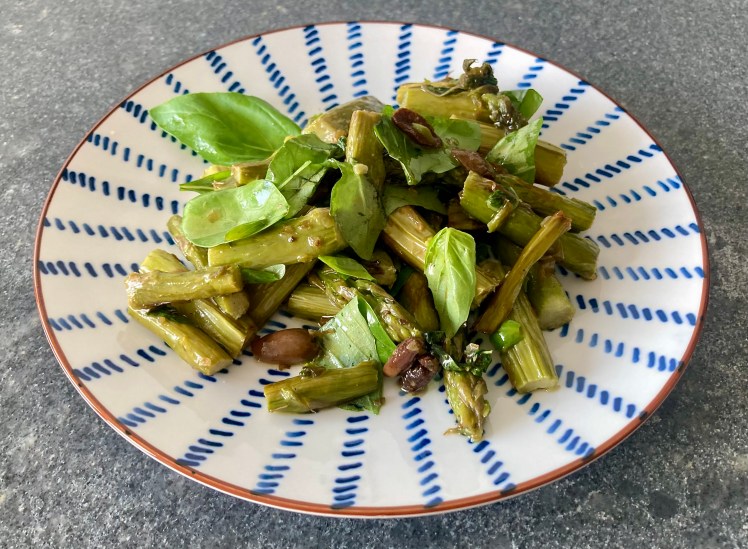
We decided to prepare a very tasty salad with green asparagus, oregano, basil and black olives. A very limited list of ingredients, but there is no need to add anything else. The olives bring umami, the asparagus sweetness and bitterness, the basil and oregano are aromatic, sweet and a touch peppery. A very uplifting combination.

Wine Pairing

We enjoyed a glass of Verdicchio, a dry white wine made by Tenuta Colpaola in Italy. The wine has a very nice balance of fruit (green apples) and acidity, body and freshness. The wine has a beautiful, deep yellow colour, medium body and complexity, making it ideal with the various flavours of the dish.
In general we suggest a dry white wine with sufficient acidity and character, to balance both the asparagus and the olives.
You could also serve the salad with a glass of dry, crisp, floral and flavourful rosé, for instance Monte del Frà Bardolino Chiaretto. It has delicate aromas of berries accompanied by light and refreshing hints of green apples and subtle spicy tones. The refreshing acidity works very well with the salad as a whole.

What You Need
  • 350 grams of Green Asparagus
  • 10-15 Black Olives (Taggiasca preffered, pitted)
  • 1 generous teaspoon of Dried Oregano
  • Basil
  • Black Pepper
  • Olive Oil
What You Do
  1. Pre-heat your oven to 190 °C or 375 °F
  2. Wash the asparagus and dry
  3. Remove the bottom of the asparagus. Be generous, you don’t want to serve a chewy salad
  4. Halve the olives
  5. Slice the asparagus (chunky)
  6. Add asparagus, dried oregago and olives to a (cast iron) oven dish
  7. Add olive oil, be generous!, and combine
  8. Transfer to the oven
  9. After 10 minutes mix
  10. Leave in the oven for another 10 minutes
  11. Transfer to the kitchen top and let cool
  12. Leave in the refrigerator until ready to serve
  13. Just before serving add lots of basil
  14. Add black pepper to taste
Salad with Green Asparagus ©cadwu and black olives, oregano and excellent olive oil
Salad with Green Asparagus ©cadwu

Asparagus Salad with Basil and Olives

Over the years we posted a range of recipes with asparagus, such as classic asparagus with ham and eggs, Mediterranean grilled asparagus with Parmesan cheese or Asian asparagus with miso. During one of the first warm evenings of this year we prepared a very tasty, simple salad with green asparagus, basil and black olives. A very limited list of ingredients, but there is no need to add anything else. The olives bring umami, the asparagus sweetness and bitterness, the basil is aromatic, sweet and a touch peppery. A very uplifting combination.

Wine Pairing

Best to enjoy with a nice glass of Rosé: dry, crisp, floral and flavourful. For instance Monte del Frà Bardolino Chiaretto. It’s a wine with delicate scents of berries accompanied by light and refreshing hints of green apples and subtle spicy tones. On the palate the wine reveals juicy sensations of red berries along with an appealing and refreshing acidity.

What You Need
  • Green Asparagus
  • Black Olives
  • Basil
  • Black Pepper
  • Olive Oil
What You Do
  1. Wash the asparagus and dry
  2. Remove the bottom of the asparagus. Be generous, you don’t want to serve a chewy salad
  3. Heat a heavy iron pan, add olive oil
  4. Slice the asparagus and transfer to the pan. Don’t add the tips
  5. Stir.
  6. After 5 minutes add the tips
  7. After another 5 minutes the asparagus will be ready. Taste and leave on medium heat if you feel they need more time
  8. Let cool
  9. Halve the olives
  10. Combine the asparagus with olives, basil and black pepper
Asparagus Salad ©cadwu

Farfalle with Fennel and Zucchini

It was our last evening in Paris and we wondered what to do? Book a table at a nice local restaurant? Or enjoy drinks and dinner in our lovely apartment? Obviously, we decided to stay in. We looked in our refrigerator, did some shopping and sat down with a nice glass of Pinot Blanc and some shrimps. The plan was to make a rich, creamy pasta dish with fennel, zucchini and pancetta.
Thanks to the mild aniseed flavour of the fennel, the dish has a surprisingly uplifting taste. The (peeled) zucchini also benefits from the aniseed flavour and remains tasty and present.

Wine Pairing

Being in France we opened a bottle of Côtes du Rhône produced by Maison M. Chapoutier. This is a red wine made with Grenache, Mourvèdre and Syrah grapes. The wine has some fruit, a touch of pepper and mild tannins. A traditional French red wine.

If you prefer an Italian wine with the pasta, then we would suggest a glass of Bardolino, for instance the one produced by Monte del Frà. The wine has a beautiful deep red colour, and the aromas made us think of red fruit and perhaps pepper. The wine is medium bodied with some acidity. It will combine very well with both the lightness in the dish and the creaminess.
In general, you’re looking for a fruity red wine with a touch of acidity, for example Chianti Classico, Montepulciano or Barbera.

What You Need

  • 1 small Fennel
  • 1 small Zucchini (Courgette)
  • 1 Shallot
  • 80 grams of organic Pancetta
  • 1 Garlic Clove
  • 1 Bay Leaf
  • Piment Doux
  • Cream
  • Parmesan Cheese
  • Black Pepper
  • Olive Oil
  • Farfalle

What You Do

  1. Finely chop the shallot and the fennel
  2. Add olive oil to a warm skillet and gently fry the shallot and the fennel
  3. Peel the zucchini, slice and quarter
  4. Dice the pancetta
  5. Chop the garlic
  6. Now add the zucchini and the pancetta to the pan
  7. Increase the heat and fry for one or two minutes, just to add colour
  8. Reduce the heat, add the garlic, the bay leaf and the piment doux
  9. Add the farfalle to the boiling water and cook according to the instruction on the package
  10. Leave the pan on low heat for a few minutes
  11. Now add the cream and the Parmesan cheese
  12. Stir and taste
  13. When the farfalle is ready, add it to the pan
  14. Combine and add some cooking liquid to the sauce if needed
  15. Remove the bay leaf, add some fresh black pepper and serve
  16. We decorated the dish with a slice of grilled pancetta
Farfalle with Fennel and Zucchini ©cadwu