White Asparagus with Sauce Périgueux à la Kimizu

The French Périgord is the truffle heart of France. The region is also known for its culinary products, such as Confit de Canard, wines from Bergerac and MonbazillacFoie Gras and Sauce Périgueux. This sauce is a classic in the French kitchen. Its basis is a white sauce made with shallot, a reduction of white wine, (goose) fat, stock and lots of truffle. The ‘original’ recipe of this truffle sauce can be found in La Bonne Cuisine du Périgord written in 1929 by La Mazille. The sauce works beautifully with Tournedos and Magret de Canard. And since white asparagus love truffles, why not combine them with Sauce Périgueux?

We don’t think a roux-based sauce will go very well with asparagus, so we combined two recipes: the flavors of Sauce Périgueux with the lightness and consistency of Japanese Kimizu.

Wine Pairing

We enjoyed our asparagus with a glass of Riesling, produced by Bott Geyl in the French Alsace. This fresh, aromatic, dry white wine with a hint of sweetness and high acidity combines very well with the sweetness of the asparagus and the intense, rich flavor of the sauce. The wine supports the dish perfectly.

What You Need

  • 6 White Asparagus
  • 1 Small Truffle
  • For the Sauce
    • 1 Shallot
    • 1 Glass of Dry White Wine
    • 3 Black Peppercorns
    • ½ tablespoon Simple White Vinegar
    • Two Cubes of Jus de Truffe*
    • 2 egg yolks
  • White Pepper

What You Do

Chop the shallot, crush the peppercorns coarsely, add to a pan and add a glass of white wine. Leave to simmer for 20 minutes. Add a splash of white vinegar. Leave to simmer for 10 minutes. Add the two cubes of jus de truffe and leave to simmer for another 10 minutes. Pass through a sieve. If all is well you should have 4 tablespoons of liquid. If necessary reduce. Set aside and leave to cool.
Peel the asparagus and steam for 20 minutes, depending on the size. When there is still 10 minutes on the clock, start working on the sauce. Whisk the two egg yolks well, add the 4 tablespoons of liquid, mix and heat in the microwave on 30% power. Start with one interval of 10 seconds, stir, followed by an interval of 5 seconds, stir and continue with intervals of 5 seconds until you have the right consistency. Total time in the microwave will be approximately 60 seconds. Allow to cool for a minute or two. In the meantime grate the truffle. Serve the sauce over the asparagus, add some white pepper and sprinkle the truffle over the sauce and the asparagus.

* Best to buy a can of jus de truffe and freeze the content in an ice cube bag.

  • White Asparagus with Sauce Périgueux à la Kimizu ©cadwu
  • White Asparagus and Truffle ©cadwu
  • Bott Geyl Riesling ©cadwu
  • Jus de Truffes (Chabert-Guillot) ©cadwu

White Asparagus with Chervil

A salad can be an excellent starter of your lunch or dinner, provided it’s one with lots of flavour and gentle acidity. For instance a Salade Ni­çoi­se, a Salade Caprese or a salad of White Asparagus and Chervil.

Chervil is a very delicate herb. It tastes like anise, but it is much more refined. Chervil looses its taste almost immediately when heated. The salad needs to be prepared well in advance, allowing for the flavours to be well integrated.

Honey can easily ruin a salad (and sugar will always ruin a salad). In this case we use only a touch of honey to create an environment for the sweetness of the white asparagus. The honey should act as a trigger.

The salad is a great example of the complexity of white asparagus: you will taste the sweetness and the freshness of the asparagus. The mouth feel of the salad is very nice, because the asparagus will be both juicy and crispy, with the chervil, honey and vinegar in a supporting role.

After having mixed the salad you will notice that the asparagus and chervil absorb the dressing. During the time in the refrigerator the asparagus will loose some juices, which is actually the beginning of a great dressing.

Wine Pairing

Combining salad and wine is not straightforward. Especially the acidity of the dressing creates a challenge. One solution is to use verjuice and not vinegar. Verjuice is made by pressing unripe grapes. The idea is that verjuice links to wine, whereas classic vinegar or lemon juice would compete with wine. In this case we choose a wine that reflects the flavours of the salad: a hint of anise, a touch of sweetness and florality. Typical notes you will find in a wine from the Alsace region, for instance a Pinot Blanc or a Pinot Gris.

What You Need

  • 2 White Asparagus per person
  • Excellent Olive Oil
  • White Wine Vinegar or Verjuice
  • Lots of Chervil
  • Touch of Honey
  • White Pepper

What You Do

Steam the asparagus for 10 minutes. Let cool. Dry with kitchen paper if needed. Prepare a dressing with the olive oil and vinegar. Chop the chervil and add to the dressing. Add a touch of honey and stir well. Add some white pepper. Taste the dressing: it should be a balance, meaning that none of the ingredients is overly present. Now slice the asparagus in nice chunks, let’s say 3 centimetres long. Mix, cover and transfer to the refrigerator for 6 hours. Mix the salad every two hours. Check the taste after 4 hours, you may want to adjust. Mix the dressing just before serving.

White Asparagus with Ham, Egg, Potatoes and Parsley

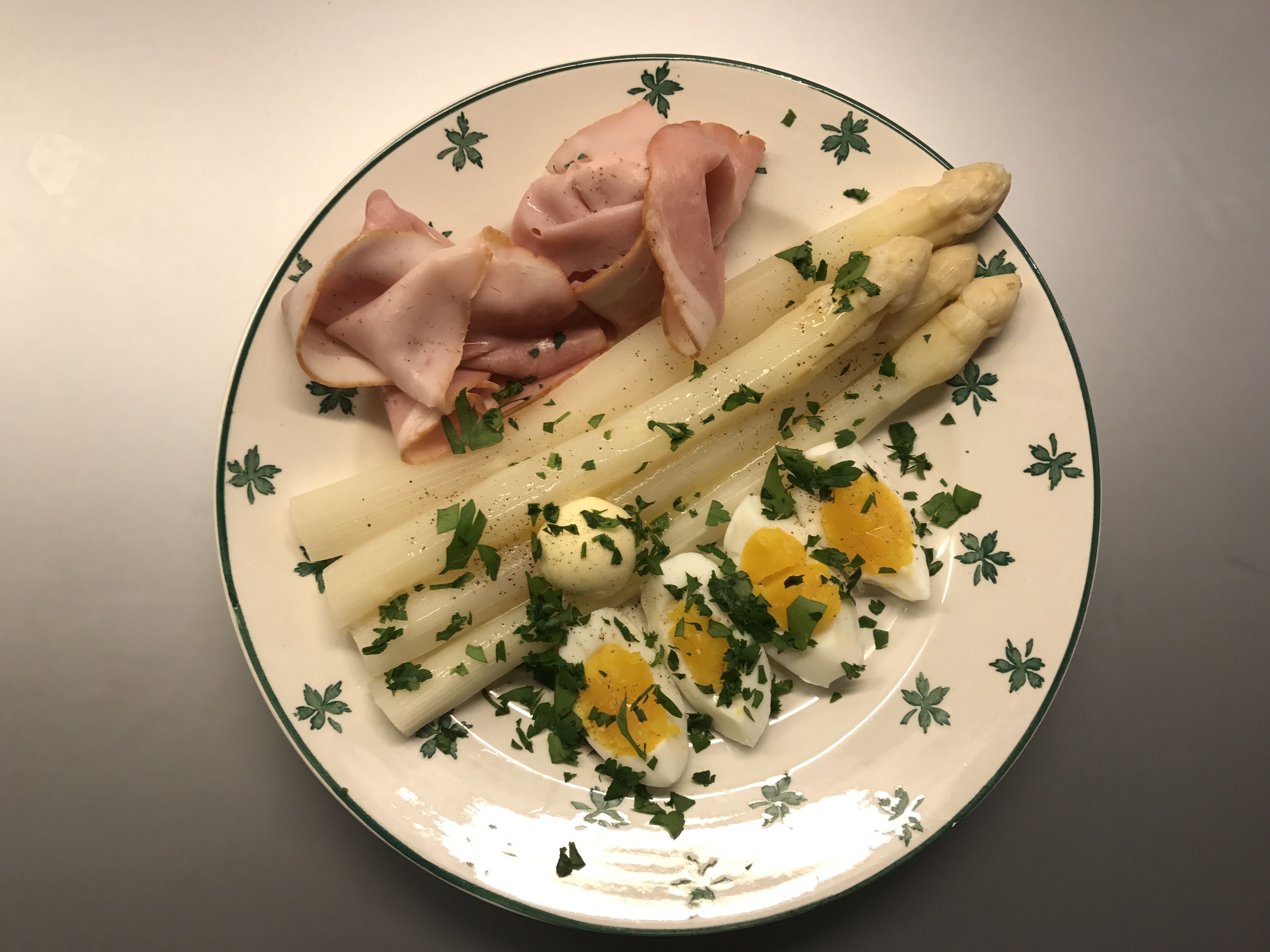
Finally, it’s spring. The season of white asparagus, morels and many more primeurs. This dish brings together white asparagus with eggs, excellent ham, butter, small potatoes and parsley. Taste the slight bitterness and sweetness of the asparagus, the umami of the potato and enjoy the velvety feeling on your palate as a result of the butter and the egg.
Don’t be tempted to boil white asparagus in water with butter, lemon, sugar or salt. Steaming is by far the best way to prepare them. We love our Russel Hobbs food steamer! Simple, straightforward and the result is a tribute to spring.

Wine Pairing

Ideally we would serve a dry Muscat from the Elzas with our asparagus. The delicate, slightly sweet but dry taste, the hint of bitterness and the rich aromas work very well with white asparagus. Muscat to us means the smell of fresh fruit. As if you taste the original grape. A wonderful wine and a wonderful combination.
Fortunately asparagus are fairly flexible when it comes to wine: a Pinot Blanc or Pinot Gris will also be fine.

We opened a bottle of Vinho Verde from Portugal. A light and vibrant wine with clear notes of citrus and floral aromas that combined rather well with the flavours of the asparagus. Not the most exquisite combination, but it worked for us.

What You Need

  • 6 or 10 White Asparagus
  • 2 Eggs
  • 100 gram Excellent, Organic Ham
  • Small Firm Potatoes
  • Parsley
  • Butter
  • White Pepper

What You Do

Peel the asparagus and steam them for 20 minutes. Steam the eggs medium (10 minutes), making sure the yolk is firm but not dry. Wash the potatoes and steam them for 15 minutes. Timing depends on the size. Melt the butter. Peel the egg and cut in four. Chop the parsley. Serve the asparagus and eggs on a plate. Coat the potatoes with butter and parsley. Dress the plate with ham (please make sure it has a bit of fat) and potatoes. Poor the remaining melted butter over the asparagus. Sprinkle the parsley over the egg. Add some white pepper.

White Asparagus with Ham, Egg, Potatoes and Parsley ©cadwu

White Asparagus with Summer Truffle

Spring and Summer

Time to celebrate! Summer has just begun and the Asparagus season has come to a close. So let’s bring the two together in this slightly extravagant dish. It is earthy, slightly bitter and sweet, velvety and complete.
The Summer Truffle (Tuber Aestivum) is not as intense and overwhelming as the Winter Truffle. It should be used immediately and preferably grated. It loses its taste when heated, so don’t use it for your Tournedos Rossini. This dish should be luke warm, so an excellent environment for a Summer Truffle. Take your time to appreciate the delicate combination in your plate.

Wine Pairing

We drank a glass of Pinot Blanc made by Bott Frères (Ribeauvillé, France) with our Asparagus with Summer Truffle. This dry, fresh wine has a bouquet of well-ripened fruit. It comes with just a touch of sweetness.
A glass of Gewürztraminer is also a good choice with this dish, provided it has a touch of sweetness only.
Parsley is essential because it brings freshness to the dish; nicely balanced with the velvety taste of the egg and butter. And butter is the ideal bridge between egg, asparagus and truffle. So your wine needs to have a certain suppleness.

What You Need

  • 4 Asparagus
  • 2 Eggs
  • 25 grams of Butter
  • 20 grams of Summer Truffle
  • Parsley
  • Black Pepper

What You Do

Cook or steam the asparagus. Make sure they are just done. Cook the eggs for 8-9 minutes. The yolk should not be completely firm. Cool the eggs in cold water, peel and mash with a fork. Add the finely chopped parsley and some black pepper. Taste. Melt the butter.
Put two asparagus per person on the plate, pour the warm butter over the asparagus, making sure they are fully covered, add the egg and finish by sprinkling the grated truffle. Poor a glass of excellent Pinot Blanc and enjoy the start of summer by eating the very last of this years asparagus.

Asparagus with Basil and Olives

Al Fresco

Finally, summer is here (more or less) and the time is right for outdoor dining. You want to enjoy the evening so you’re looking for something you can prepare in advance. Given you’re eating al fresco you want something with powerful flavours and present aromas. A salad is nice, easy and too obvious. Tasty vegetables and ingredients that will make you think of summer. Of course! Olives, basil and asparagus.  Time to begin working on the mise en place.

Wine Pairing

Best to combine with a full bodied and elegant red wine. Flavour-wise you’re looking for red fruit and a touch of spiciness. We enjoyed our asparagus with a glass of La Tour Beaumont Cabernet Franc. This wine is from the Loire region and it is made by Pierre Morgeau, who was awarded the title of Wine Maker of the year 2019 by the renowned Guide Hachette. His focus is on the vineyards, the terroir and the environment in combination with a vinification as natural as possible.

What You Need

  • Asparagus
    • Equal Amount of White and Green Asparagus
    • Basil
    • Black Olives (preferably Cailletier or Taggiasca)
    • Olive oil
  • Meat Balls
    • 250 gram minced meat of Lamb
    • Cilantro
    • Mustard
    • 1 Egg
    • 1 Slice of Old Bread
    • Cumin
    • Pinch of Salt
    • Black Pepper

What You Do

Peel the white asparagus and cut of the end. Wash the green asparagus and cut of the end. Slice the asparagus in nice chunks (4 centimetres or so). Combine the asparagus with olive oil and a nice amount of black olives. Transfer to the refrigerator.
Toast the old slice of bread and let cool. Chop and transfer to the blender. You’ll now have home made chapelure. Beat the egg. Chop the cilantro. Combine all ingredients and create small meatballs. Store in the refrigerator. Mise en place done.
When ready for your al fresco dinner, heat your oven to 190˚ – 200˚ Celsius (or 375˚ – 390˚  Fahrenheit). Add a few basil leaves to the asparagus mixture and transfer to the oven. After 10 minutes mix and add more basil leaves. After again 10 minutes heat a heavy iron skillet and start frying the meatballs in olive oil. In parallel add more basil leaves to the asparagus and mix. After 10 minutes transfer the meatballs to a plate covered with kitchen paper. Add some basil leaves to the asparagus, mix and serve a generous amount of vegetables on a hot plate. Top with 5 meatballs.
PS Feel free to use green asparagus only. The dish will lose some of its bitterness and complexity but it’s still a great combination of flavours and aromas.

The Art of Sauces: Gribiche

Sauce Gribiche is a classic French sauce, made with boiled egg yolks, oil, various herbs (chives, chervil, parsley, tarragon), cornichons and capers. Sauce Gribiche is ideal with cold meat and fish. It’s a great combination of flavours and textures, also thanks to the chopped egg white.
As with mayonnaise the oil you use is an important ingredient. The range of flavours in Sauce Gribiche allows you to use a combination of oils, depending on the dish it should accompany. For instance olive oil when you’re looking for a more powerful sauce or arachis (peanut) oil when the sauce should be more delicate.
In this case we use chives only because especially tarragon would be too much for the asparagus. Chives give it a touch of onion, which is exactly what the sauce needs.

Wine Pairing

We enjoyed our Asparagus with sauce Gribiche with a glass of Macon (Louis Jadot Mâcon Villages Grange Magnien). The wine (100% chardonnay) comes with some gentle acidity and minerality, which is great with the acidity of the Sauce Gribiche. It’s fruity with a floral scent.

What You Need

  • Sauce Gribiche
    • Two Eggs
    • Dijon Mustard (1 teaspoon)
    • Olive Oil (100 ml)
    • (White Wine) Vinegar (1 tablespoon)
    • Black Pepper
    • Chives
    • Cornichon
    • Capers (in brine)
  • Asparagus

What You Do

Start by boiling the eggs, making sure the yolk is completely set. Depending on the size add them to boiling water and leave them in simmering water for 12 minutes. We steamed them for 15 minutes. Cool quickly, peel and separate the white from the yolk.
Once cool cut the white in very small bits and store. Push the egg yolk through a sieve. It should be a powder-like substance. Add the mustard and stir well until it’s a smooth paste. Continue stirring and very slowly add the olive oil, as if making a mayonnaise. Which is basically what you’re doing anyway! Main difference is that cooked yolk is less powerful when it comes to emulsifying. So the amount of olive oil you can add is limited and the process is more challenging.
Once you’ve added the olive oil, add white wine vinegar, whisk, taste and decide if more mustard, vinegar or pepper is needed.
Now add the chopped egg white, the finely chopped chives, the drained and chopped capers and the thinly sliced cornichon.
The sauce should be ‘stable’ so feel free to store in the refrigerator.
Steam or cook the white asparagus and enjoy!
PS It’s actually a very tricky sauce, one that splits easily. If it does, no worries, just add a tea spoon of (home made) mayonnaise and the problem is solved.

White Asparagus with Wild Garlic (Ramson) and Morels

Ramson, Wild Garlic, Daslook, Bear Leek, Ail des Ours, Bärlauch: so many names for this great plant: Allium ursinum is one of the highlights of spring. Powerful, pure and tasty. Some say you should only eat the leaves before the plant starts to bloom. But then you can’t combine the leaves and the tasty white flowers in your dish, so we suggest ignoring that idea. The flowers are (if you’re lucky) just a touch sweet because of the nectar. It can be harvested from the wild, but some garden centers also sell ramson.
The taste is a combination of onion and garlic, but much greener, longer lasting and with a touch of bitterness at the end. You can turn the leaves into a strong pesto, but better use it as herb with for instance potatoes or gnocchi. See our recipe for Farfalle with Ramson (or Wild Garlic) and Parmesan Cheese.

Johnny Acton and Nick Sandler included two recipes in their classic book Mushrooms (published by Kyle Books and still available via for instance Amazon and other channels). One is a combination of Cod, Trompette des Morts (Black Trumpet) and Ramson. The other one is an intriguing combination of white Asparagus, Morels and Ramson.

Wine pairing

We suggest a full-bodied white wine with a fine acidity. For instance Herdade São Miguel, Colheita Seleccionada. The wine comes with distinctive minerals, along with excellent harmony and a long and well-balanced finish. It works well with the slight bitterness and sweetness of the asparagus; the gently onion and garlic taste of the ramson and the pancake-like taste of the morels.

What You Need

  • 6 White Asparagus
  • Morels (but even dried porcini will work)
  • Ramson
  • Chicken Stock
  • Crème Fraîche
  • Garlic
  • Butter
  • Shallot
  • Mushrooms by Johnny Acton and Nick Sandler


Asparagus with Hollandaise

A Three Course Meal in One Thousand seconds

Many years ago Belgium television broadcasted a program called Duizend Seconden. In this show Herwig Van Hove, Chef and professor in chemistry) would create a three-course meal in 1000 seconds (or less). The show was hosted by Felice (Dré Steemans) who also assisted the Chef when necessary. During the show Herwig van Hove would not only show how things had to be done, but he would also explain why. He came up with the great yet simple idea to create Hollandaise using a microwave.

We all know that sauces like Hollandaise, Béarnaise and many more rely on raising the temperature in a controlled and slow way. That’s why we learn to use a bowl, a pan with gently simmering water, carefully avoiding direct contact between the bowl and the water, whisk, and whisk some more. Some add the butter gradually; others start with the complete mixture. Some add mustard (which is always a great way of creating smoothness and enhancing consistency) and others add corn starch (strictly forbidden). Others dash of to the supermarket and buy some hideous powder (you wouldn’t do that of course).
Back to Herwig van Hove: the crucial part is to add warmth to the mixture in a controlled and slow way. So why not use a microwave? It gives you all the control you need for a perfect Hollandaise.
We would love to add a link to YouTube, but alas, none of their many shows is on the channel.

Wine Pairing

We enjoyed our Asparagus and Hollandaise with a glass of Petit Sois, 2015, (produced by Bodegas Costers del Sio, Spain) which is a blend of Viognier, Chardonnay and Muscat. The Viognier brings a touch of freshness to the dish, which works well with the lemon in the Hollandaise. Combining white asparagus with Muscat is a classic. The Chardonnay is a bridge to the buttery aspect of the sauce. So the wine in your glass has multiple links to what’s on your plate, which makes it a truly wonderful dish.

What You Need

  • One Egg Yolk
  • 50 grams of Butter
  • 1 tablespoon of Water
  • ½ tablespoon of Lemon Juice
  • White Pepper
  • 4 Asparagus

What You Do

Melt the butter in the microwave on low power (10-30% of the power of your microwave, depending on the specifics of your oven). Make sure the butter is luke warm. Now whisk the yolk a bit, add the water and the lemon juice and whisk some more. Add this mixture to the butter and whisk some more. Now transfer to the microwave and give it let’s say 10 seconds of 30%. Remove from oven and whisk. Repeat. You will now feel the consistency changing. If not, don’t worry, just repeat the step. Towards the end of the cooking move to steps of 5 seconds on 10% power. Whisk, play and feel free to find your own way (it also depends on the amount of water in the butter, the temperature of the egg et cetera). When the Hollandaise is ready take it out of the oven, continue whisking gently and cool slightly in a bath of cold water.
In parallel steam the asparagus (depending on the size 25 or 30 minutes; they should be well done for this dish). Serve the asparagus with just a bit of white pepper and a generous helping of Hollandaise.


White asparagus with Egg, Ham, Parsley and Butter

A Classic

White asparagus is such a great vegetable! In this recipe we describe the classic way of serving asparagus: A la Flamande. This way you will be able to taste the slight bitterness and sweetness of the asparagus. The butter and egg bring a feeling of velvet to your palate, which is ideal to taste the asparagus. The parsley and white pepper give a touch of sharpness to the dish.

Wine Pairing

Serve the white asparagus with a dry Muscat from the Elzas. The delicate, slightly sweet but dry taste, the hint of bitterness and the rich aromas work very well with white asparagus. Muscat to us means the smell of fresh fruit. When drinking it is if you’re tasting the original grape. Wonderful wine and wonderful combination.
We recently combined the asparagus with a Riesling (2015, Trocken, Meulenhof) from the German Mosel region. Worked very well.

What You Need

  • 3 or 5 White Asparagus per person
  • 2 Eggs
  • 100 gram Ham
  • Parsley
  • Butter
  • White Pepper

What You Do

Steam the white asparagus and cook or steam the eggs medium, making sure the yolk is not set but also not running. Peel the egg and cut in four. Chop the parsley. Serve the asparagus and eggs warm on a plate. Dress the plate with ham (please make sure it has a bit of fat) and butter; sprinkle the parsley over the plate. Add some white pepper.
As an alternative warm the butter and pour it gently over the asparagus.

White Asparagus with Egg, Ham and Parsley

Grilled Asparagus with Parmesan Cheese

We enjoyed this dish as a starter when in Milan, on a beautiful evening, eating al fresco and enjoying the wonderful combination of the sweetness and bitterness of the asparagus, the slightly caramelised sugars as a result of grilling the asparagus and the salty and sweet cheese. A glass of Pinot Grigio was all we wanted. In Milan they served us green asparagus, but it works even better with white asparagus.
This is typically a dish you would make when the asparagus season is at its high and outside temperatures feel like summer. You could drink a Pinot Grigio, a Muscat from the Alsace region or a Rose with character. Remember the wine needs to combine with a range of very diverse flavours in the dish.

Here is what you need:

  • 2 Asparagus per person
  • Olive Oil
  • Parmesan Cheese
  • Black Pepper

Peel the asparagus and cook or steam until slightly tender. Depending on the size we would say 10-15 minutes in the Russel Hobss steamer. Leave and let cool. Take a plate, add some oil to the plate and use it to cover the asparagus in oil. Heat the pan and grill the asparagus for 4*1 minute, making sure you have a lovely brown (not too dark) pattern. Serve on a plate, add some grated Parmesan cheese and pepper. Add a generous drizzle of very good olive oil.