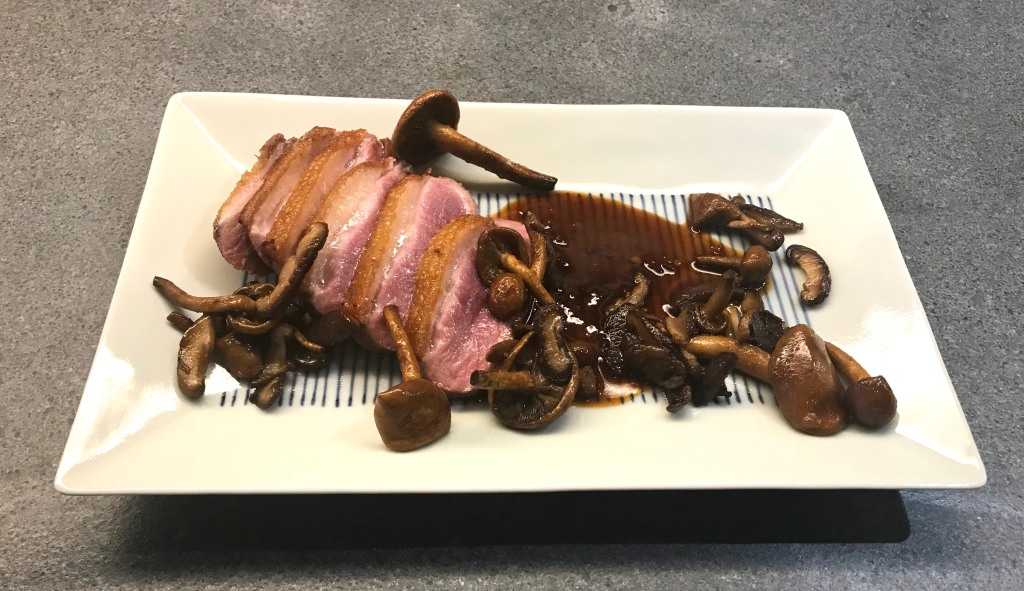
Neck of Lamb, Asian style

We can hear you thinking, ‘Shouldn’t that be rack of lamb?’.

Isn’t it interesting how much we are focused on specific parts of an animal? We love our steak, but what to do with an oxtail? We love pork loin, but how about the pig’s nose? And we enjoy grilled rack of lamb, but how about the neck?
Supermarkets know everything about our focus and preferences. So if you would like to cook pig’s feet (or trotters), kidneys, liver, sweetbread or lamb’s neck: where to go? Try finding a ‘real’ butcher, one that buys the whole animal, not just the popular parts.

Lamb’s neck is very underrated. Some feel it’s okay for your dog only, but that’s silly. When cooked slowly it becomes tasty, nicely structured, juicy and tender.
It combines very well with strong flavours such as ginger, cilantro seeds, star anise, soy sauce and the leaves of the Makrut or Thai lime (also known as Djeroek poeroet or Djeruk purut). You will get a flavourful, complex sauce in combination with lovely, aromatic meat.

Wine Pairing

If you decide to pair with white wine: we enjoyed our Neck of Lamb with a glass of Alsace Gewurztraminer, Cave de Beblenheim. The wine has a beautiful gold colour, and an expressive aromas of roses. The palate presents a nice structure with a fruity and spicy association which of course goes very well with the oriental twist to the stew. In general we suggest an aromatic white wine with just a touch of sweetness.

If you decide to pair with red wine: a few weeks later we enjoyed the dish with a glass of Cinsault, produced by Domaine Coudoulet. This is a relatively light wine, to be served chilled (12 °C or 54 °F). Cinsault is a grape native to the south of France. It was somewhat forgotten but is now gaining popularity. It has a floral nose, with aromas of raspberry and fresh fruit on the palate and discreet tannins.

What You Need
  • 300 grams Neck of Lamb
  • Olive Oil
  • Shallot
  • Fresh Ginger (4 cm, depending on your taste)
  • 1/2 red Chili
  • 1 Garlic Clove
  • Noilly Prat
  • Cilantro Seeds
  • Star Anise
  • Low Salt Soy Sauce
  • 4 leaves of Djeroek Poeroet
What You Do
  1. Cut the meat in not too small cubes – they will shrink during the cooking process
  2. Fry the meat in oil, giving it a nice colour. If so required, do so in multiple batches
  3. In the mean time cut the shallot, peel the ginger and slice, remove the seeds from the chili and cut the garlic clove (but not too fine)
  4. Remove the meat from the pan and glaze the shallot, chili, ginger and garlic
  5. Add a splash of Noilly Prat, the crushed cilantro seeds, the star anise, some low-salt soy sauce and the djeroek poeroet
  6. Stir
  7. Transfer the meat back to the pan and add water, making sure the meat is just covered
  8. Leave to simmer for 6 hours in total
  9. Check the pan every hour, stir and add water is so required
  10. Also check if the djeroek poeroet and/or chilli are not overpowering
  11. After 5 hours check the taste, perhaps add soy sauce, remove the djeroek poeroet or the star anise
  12. After 6 hours cool the stew and transfer to the refrigerator. You could also decide to transfer it to the freezer for use at a later date
  13. The following day remove as much of the fat as possible
  14. Warm the stew, check taste and tenderness
  15. You may want to reduce the liquid in a separate pan
  16. Warm through and through
  17. (Optional) thicken the sauce with potato starch, this way your sauce will remain transparant
  18. Serve with steamed Pak Choi with oyster sauce

PS Looking for a nice starter? Why not serve with Hot and Sour Soup?
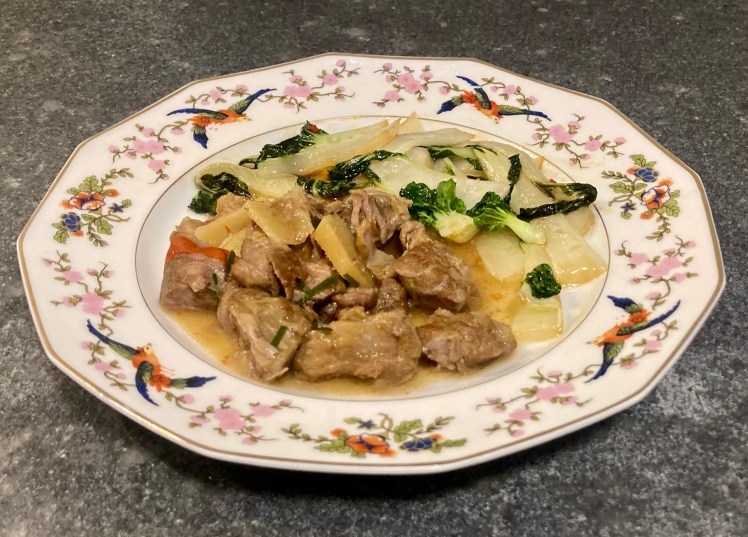
Neck of Lamb Asian Style ©cadwu with djeroek poeroet, ginger, soy sauce and cilantro seeds
Neck of Lamb Asian Style ©cadwu

Lamb Shank with Star Anise, Ginger and Djeroek Poeroet

The obvious way to prepare lamb shanks is to fry them briefly in oil en butter and then cook them for hours in red wine with a bouguet garni of rosemary, thyme, parsley, sage and perhaps lavender. Maybe add a small tomato to help the sauce. We take a different approach by adding strong flavors like ginger, cilantro seeds, star anise, soy sauce and the leaves of the Makrut or Thai lime (also known as Djeroek Poeroet or Djeruk Purut). You will get a full, complex sauce in combination with tasty, juicy, tender and aromatic meat.

Wine Pairing

The obvious choice would be a glass of Pinot Blanc or Pinot Gris. We once enjoyed the dish with a glass of Gewurztraminer from the Alsace. A touch of spiciness and sweetness, which worked really well with the star anise and ginger.
Combining the lamb shanks with red wine is more challenging. Our choice was a bottle of Cuvée Equinoxe produced by Domaine d’Arjolle, from the Languedoc region in France. The wine is made with 100% merlot grapes. It has an intense ruby ​​color and aromas of red fruit. The flavour is soft and long, with a touch of sweetness and oak. A soft, not too complex Syrah could also be very nice with the lamb shanks.

What You Need
  • 2 Lamb Shanks
  • Shallot
  • Olive oil
  • Fresh Ginger (4 cm, depending on your taste)
  • 1/2 red Chili
  • 2 Garlic Cloves
  • Noilly Prat
  • teaspoon of Cilantro Seeds
  • 2 Star Anise
  • Low Salt Soy Sauce
  • 6 leaves of Djeroek Poeroet
What You Do

Fry the meat in olive oil, giving it a nice colour. In the mean time cut the shallot, peel the ginger and slice, remove the seeds from the chili and cut the garlic clove (but not too fine). Remove the meat from the pan and glaze the shallot, chili, ginger and garlic. Add the Noilly Prat, crushed cilantro seeds, star anise, some low-salt soy sauce and the djeroek poeroet. Stir. Transfer the meat back to the pan and add some water, perhaps 3 cm. Leave to simmer for 4 – 6 hours in total. Check the pan every hour and add water if so required. After 6 hours remove the shanks from the sauce and cool. Reduce the sauce, let cool and transfer to the refrigerator. The following day remove as much of the fat from the sauce as possible. Warm the sauce together with the shanks, check taste and tenderness.
Serve with steamed Bok Choy tossed with sesame oil or with rice.

Lamb Shank ©cadwu
Lamb Shank ©cadwu

Duck with Soy Sauce and Mushrooms

In his book Yamazato, Kaiseki Recipes: Secrets of the Japanese Cuisine, author and Michelin Award winning chef Akira Oshima includes a recipe for breast of duck, marinated in a soy-based sauce, served with Belgian endive (chicory) and karashi (Japanese mustard). A mouth-watering dish. The book contains some 20 recipes that are technically challenging (at least, we think so) and well written.

In general the combination of duck and soy sauce works really well. It’s all about sweetness and umami. The Japanese mushrooms (shiitake, enoki, nameko and/or shimeji) add nuttiness and texture to the dish.
We use soy sauce and tsuyu: a mix of soy sauce, mirin and dashi, ideal for making a tempura dip and great to give extra flavor to the sauce.

Wine Pairing

We enjoyed our duck with a glass of gewurztraminer (full bodied and long lasting with aromas of lychees and roses) but there are many options in this case. Perhaps a nice rosé or a sake with a touch of sweetness?

What You Need

  • Breast of Duck
  • Japanese Mushrooms
  • Soy Sauce (preferably with less salt)
  • Tsuyu
  • Chicken Stock
  • (Olive) Oil
  • Mirin
  • (optional) Sake

What You Do

  1. Start by cleaning the breast of duck
  2. Heat a non-stick pan
  3. Fry the duck, straight from the fridge, for 12 minutes on the skin-side and 2 minutes on the meat-side in a non-stick pan
  4. Wrap in foil, making sure the skin is not covered.
  5. Clean the pan with kitchen paper and fry the sliced mushrooms for 5 minutes or so in oil until ready
  6. Set aside and keep warm
  7. Add soy sauce, tsuyu and chicken stock to the pan and reduce
  8. Add a splash of sake and some mirin
  9. Add liquid of the duck
  10. Let simmer for a few minutes, add the mushrooms and make sure they are coated with the sauce
  11. Let simmer for 5 minutes
  12. Slice the duck, add liquid to the sauce, stir and serve.
Duck with Soy Sauce and Mushrooms ©cadwu

Duck Breast with Sichuan Pepper

Why call something pepper when actually it is not hot and spicy like black pepper or chili? Perhaps because of the shape? The Chinese name is huā jiāo, meaning something like flower pepper. Actually it is a dried berry from western China. Other names are Szechuan Pepper, Chinese Prickly Ash, Mala Pepper et cetera. The quality may vary, depending on the actual species used. The taste has two components: the aroma of citrus and an intriguing tingling effect on the tongue.
The Sichuan cuisine combines it with chili pepper, star anise and ginger.

Wine Pairing

A cup of Jasmine Tea is an excellent choice. You could also go for white wine, for instance a German Riesling or Gewurztraminer. We decided to go for a Pinot Noir from La Cour Des Dames. In general you’re looking for a red wine with aromas of berries, floral notes and delicate wood. The tannins should be soft or well-integrated.

What You Need

  • Duck Breast
  • Sichuan Pepper
  • Light Soy Sauce
  • Normal Soy Sauce
  • Mirin
  • Chicken Stock
  • Corn Starch

What You Do

  1. Start by warming a non-stick frying pan
  2. Add the Sichuan pepper (we suggest one or two teaspoons)
  3. Gently roast the peppers until you can smell their lovely aroma
  4. Transfer the berries to a mortar and let cool
  5. Take the duck breast from the refrigerator, clean it if necessary and transfer to the now hot non-stick frying pan. By starting with cold meat, you will get the best result: crispy fat, a golden brown colour and seignant meat
  6. Fry the duck breast for 2 minutes, then reduce the heat, give it 10 more minutes on the fat-side and finish with 2 or 3 minutes on the meat-side
  7. Wrap the breast in foil, making sure the fat is not covered
  8. Crush half of the Sichuan peppers
  9. Add stock to the pan, soy sauce, crushed Sichuan pepper and a teaspoon of mirin
  10. Stir and add liquid from the duck
  11. The duck must rest for 10 minutes, so occasionally add liquid and stir the sauce
  12. Taste the sauce and adjust
  13. When ready, make the sauce thicker using corn starch
  14. Coarsely crush the remaining Sichuan peppe.
  15. Slice the meat and serve with the sauce
  16. Sprinkle the remaining Sichuan pepper on top of the meat.

We served the duck breast with a combination of stir fried (Chinese, napa or oxheart) cabbage, spring onion, chili pepper and sesame oil.

Duck Breast with Sichuan Pepper ©cadwu

Neck of Lamb with Star Anise, Ginger and Djeroek Poeroet

We can hear you thinking, ‘Shouldn’t that be rack of lamb?’.

Isn’t it interesting how much we are focused on specific parts of an animal? We love our steak, but what to do with an oxtail? We love pork loin, but how about the pig’s nose? And we enjoy grilled rack of lamb, but how about the lamb’s neck?
Supermarkets and butchers know all about our focus. So if you would like to cook pig’s feet (or trotters), kidneys, liver, sweetbread or lamb’s neck: where to go? Try finding a ‘real’ butcher, one that buys the whole animal, not just the parts that can be sold directly.

Lamb’s neck is very underrated, inexpensive and tasty. Some feel it’s okay for your dog only, but we completely disagree. When cooked slowly for hours it is great. Tasty, well structured, juicy and tender.

The obvious way to prepare the lamb is to fry it briefly in oil en butter and then cook for hours in red wine with a bouguet garni of rosemary, thyme, parsley and sage. Maybe add a small tomato to help the sauce. We take a different approach by adding strong tastes like ginger, cilantro seeds, star anise, soy sauce and the leaves of the Makrut or Thai lime (also known as Djeroek poeroet or Djeruk purut). You will get a full, complex sauce in combination with lovely, aromatic meat.

We very much enjoyed our Neck of Lamb with a glass of Alsace Gewurztraminer, Cave de Beblenheim. The wine has a beautiful gold colour, and an expressive nose with rose notes. The palate presents a nice structure with a fruity and spicy association which of course goes very well with the oriental twist to the stew. In general we suggest an aromatic white wine with just a touch of sweetness.

What You Need
  • 300 grams Neck of Lamb
  • Shallot
  • Olive Oil
  • Fresh Ginger (4 cm, depending on your taste)
  • 1 red Chili
  • 1 Garlic Clove
  • Noilly Prat
  • Cilantro Seeds
  • Star Anise
  • Low Salt Soy Sauce
  • 4 leaves of Djeroek Poeroet
What Yoi Do
  1. Cut the meat in not too small cubes – they will shrink during the cooking process
  2. Fry the meat in oil, giving it a nice colour. If so required, do so in multiple batches.
  3. In the mean time cut the shallot, peel the ginger and slice, remove the seeds from the chili and cut the garlic glove (but not too fine)
  4. Remove the meat from the pan and glaze the shallot, chili, ginger and garlic
  5. Add the Noilly Prat, crushed cilantro seeds, star anise, some low-salt soy sauce and the djeroek poeroet
  6. Stir
  7. Transfer the meat back to the pan and add some water, making sure the meat is just covered
  8. Leave to simmer for 6 hours in total
  9. Check the pan every hour and add water is so required
  10. Also check if the djeroek poeroet and/or chilli are not overpowering
  11. After 5 hours check the taste, add soy sauce, remove the djeroek poeroet or the star anise if so required
  12. After 6 hours cool the stew and transfer to the refrigerator. You could also decide to transfer it to the freezer for use at a later date.
  13. The following day remove as much of the fat as possible.
  14. Warm the stew, check taste and tenderness and continue to simmer if so required.
  15. When the meat is ready you may want to reduce the liquid.
  16. Serve with steamed Pak Choi, tossed with sesame oil.

PS

As an alternative use 2 lamb shanks.