
Pear and Chocolate Pie

A few weeks ago, we were very pleased to win the Great Bloggers Bake Off award in the pie-category with a Pear and Almond Pie. A delicious, uplifting combination that works very well thanks to the crème fraîche and the calvados. The Bake Off is organised by A Jeanne in the Kitchen.

Pear and chocolate is a match made in heaven, that’s why we decided to make a Pear and Chocolate Pie. The result is a rich, intense flavoured pie. A small slice with an espresso will make for a very nice dessert.

What You Need

  • Dough
    • 50 grams White Caster Sugar
    • 100 grams soft Butter
    • ½ teaspoon grated Lemon Peel
    • Pinch of Salt
    • ½ Egg
    • 3 grams Baking Powder
    • 150 grams All Purpose Flour
  • Almond Paste
    • 225 grams of White Caster Sugar
    • 250 grams of Almond Flour
    • One Egg
    • Lemon zest
  • Filling
    • 200 grams Chocolate
    • 50 grams Double Cream
    • 50 grams Sugar
    • 1 Egg
    • 1 Egg Yolk
    • Pears, preferably Doyenné du Comice (or Conference)
  • Decoration
    • Whipped Cream
    • Cinnamon Powder

    What You Do

    Start by making the Dough. Beat the egg. Combine sugar and butter until smooth. Add Lemon zest and salt. Mix. Add the egg. Mix. Combine baking powder and flour. Pass through a sieve and add to the mixture. Best is to use a kitchen mixer with kneading hooks. Wrap in foil and transfer to the refrigerator for at least two hours. The dough freezes well so not a problem if you’ve made too much.

    Now make the Almond Paste. Combine almond flour and sugar. Add one beaten egg and (optional) lemon zest. Mix until you have a paste. Keeps well in the refrigerator for a week and in the freezer for months. You could also use 250 grams of white almonds. Grind these and continue as if almond flour. In this case you need half the quantity (or less).

    Preheat the oven to 180 °C or 355 °F. Coat your pie tin with butter (we used a 15 cm, 6 inch tin). Roll out the dough, it should be 5 mm (0.20 inch). Line the tin with the dough. Don’t worry if the dough breaks; it’s easy to repair. Remove the excess dough. Line with aluminium foil or parchment paper, add baking beans and bake the pie blind for 15 minutes.

    When the pie is in the oven, it’s time to make the Filling. We used cooking chocolate, that makes life a lot easier. Add the broken chocolate to the cream and melt gently in the microwave (set to low power) or au bain-marie. Add sugar. Allow to cool. Lukewarm is fine. Beat the egg.

    Use almond paste to make a thin layer on the bottom of the pie. Take half of the chocolate mixture and (using a spatula) add a layer of chocolate on top of the almond paste. Add the egg to the remaining chocolate, mix well and make a third layer. Peel the pears, quarter and push the pears into the mixture. Bake in the oven for 20 minutes (depending on the pears and the mixture).
    Allow to cool and then remove from the tin.
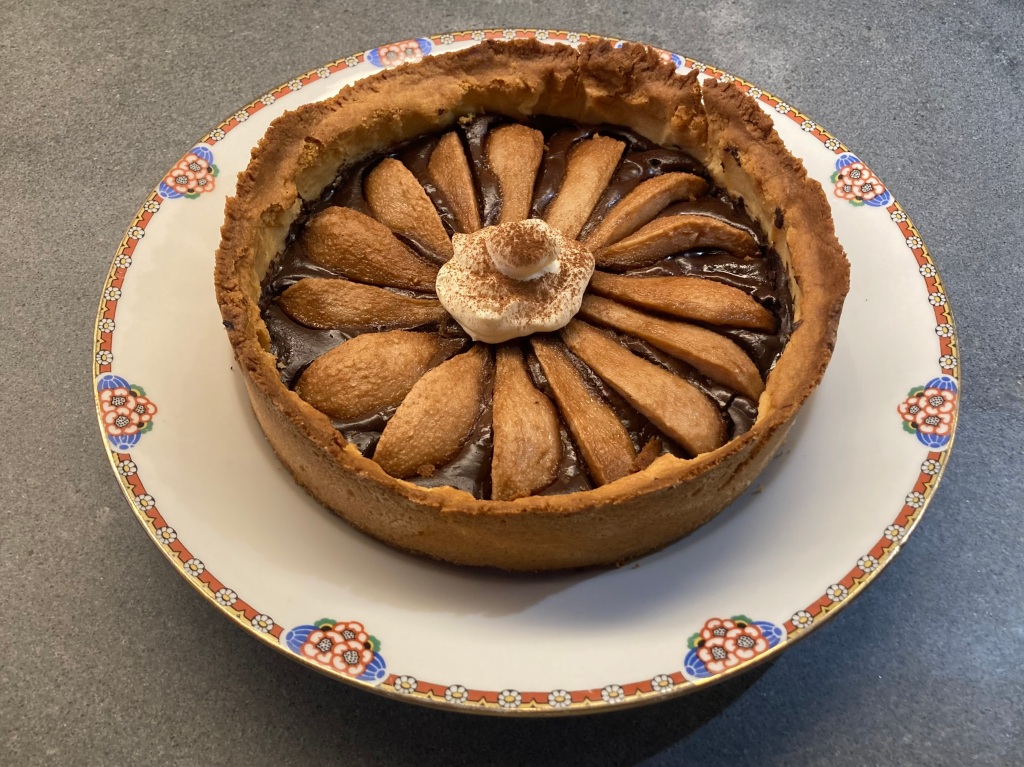
    Pear and Chocolate Pie ©cadwu
    Pear and Chocolate Pie ©cadwu

    Pear and Almond Pie

    Only a few weeks to go before we can enjoy fresh, new pears and apples. Time to start thinking about a traditional Dutch apple pie, about stuffed apples with raisins and cinnamon, about a chocolate-pear pie and of course about this classic pear and almond pie. Rich in taste with a crunchy crust and a soft, light, creamy filling. A very taste dessert but also great with a cup of tea in the afternoon.

    We begin by making the dough. It freezes well, so it’s a great idea to make a bit extra.

    What You Need
    • 50 grams of White Caster Sugar
    • 100 grams of soft Unsalted Butter
    • Egg (beaten)
    • ½ teaspoon of Lemon Zest
    • 1 gram of Salt
    • 3 grams of Baking Powder
    • 150 grams of All Purpose Flour
    What You Do

    Adding an egg to the dough makes its flavour richer and the dough will be easier to handle when lining the baking tin. The lemon in the crust will work very well in combination with the pear and the sweetness of the filling. Start by combining the sugar and the butter. Use a hand mixer with kneading hooks. When mixed, add halve of the beaten egg, then add the lemon zest. Combine salt, baking powder and flour. Pass through a sieve and add to the mixture. Use the kneading hooks to mix. When done, remove from the bowl and wrap in foil. Store in the refrigerator for at least two hours.

    The filling is a combination of almond paste, crème fraîche and pear. We used Conference, but you could also use the very aromatic Doyenne du Comice. 

    What You Need
    • 50 grams of Almond Paste
    • ½ egg
    • 100 grams of Crème Fraîche
    • 10 grams of Calvados
    • 2 or 3 pears
    What You Do

    Preheat your oven to 200 °C or 390 °F. Roll out the dough, it should be 4-5 mm (0,15-0,20 inch). Coat your pie tin with butter (we used a 15 cm, 6 inch tin). Line the tin with the dough. Don’t worry if the dough breaks; it’s easy to repair. Remove the excess dough. Peel the pears and slice in nice chunks. Combine the almond paste, the egg, the crème fraîche and the calvados until the mixture is smooth. Add the mixture to the tin, Add the pear. Transfer to the oven for in total 40 minutes. After 20 minutes reduce the heat to 160 °C or 320 °F. Allow to cool and then remove from the tin.

    PS

    In case you want to make your own almond paste, then combine 250 grams of almond flour with 225 grams of sugar. Add one beaten egg and (optional) lemon zest. Mix until you have a paste. Keeps well in the refrigerator for a week and in the freezer for months.
    You could also use 250 grams of white almonds. Grind these and continue as if almond flour.

    Tartelette aux Myrtilles

    We love seasonal products and although blueberries seem to be available all year round, however, we think they are best during summer. We use them to make a tartelette. Works very well as dessert, but also nice with a cup of afternoon tea.
    Earlier we baked the tartelette shell ourselves, based on a recipe of Dutch patissier Cees Holtkamp. You could of course also rely on a French classic, for instance Tarte Tatin by Ginette Mathiot. You could also buy the shell and focus on the filling.

    What You Need (Filling)

    • 500 grams of Blueberries
    • Gelatine
    • Sugar
    • Lemon Juice
    • Cream Cheese
    • Double Cream

    What You Do (Filling)

    Wash the blueberries. Keep a handful apart (to be used as decoration). Cook the blueberries with a touch of water and sugar for let’s say 5 minutes. Blender and keep on low heat. Add lemon juice to taste. Follow the instruction on the package of the gelatine. The idea is to thicken the blueberry mixture somewhat, but not to create a gummy layer. Add the gelatine, stir, transfer to the refrigerator and allow to set.
    Whip the double cream and the add some cream cheese. We used Philadelphia Original Soft Cheese but you could also use Mascarpone for a fresher result. Taste and perhaps add more cream cheese or some lemon juice.

    What You Need (Pâte Sucrée)

    • 50 grams of Butter
    • 125 grams of All Purpose Flour
    • 40 grams of Sugar
    • 1 Egg
    • Pinch of Salt

    What You Do (Crust)

    We use tartelette moulds with a diameter of approximately 7 centimetres (2,75 inches). The butter must be soft but not warm (18 °C or 65 °F). Beat the egg. Combine flour, sugar and salt. Dice the butter and knead with the mixture. You could use a hand mixer with kneading hooks. When well mixed, add the egg and knead until you have a nice dough. Leave to rest in the refrigerator for at least two hours.
    Coat the moulds with butter. Remove the pastry from the refrigerator. Place it on a floured surface and roll it out with a rolling pin. Perhaps dust the dough with flour. Divide the dough into 6 portions and make small circles. Press the pastry onto the bottom and to the sides. Cut of overhanging dough. Transfer to the refrigerator for at least 30 minutes.
    Preheat the oven to 175 °C or 350 °F.
    Line with parchment paper and use dry beans to fill the moulds. Blind bake for 10 minutes. Remove the paper and the beans. Bake for another 10 minutes. When golden brown, remove the tartelette from the mould and let cool on a grid.

    Assemble

    When cool and ready to serve, add the blueberry jam, the cream cheese mixture and decorate with remaining blueberries. The tartelette keeps well in the refrigerator for an hour or two. If you store them longer, then the blue of the berries will blur the cream cheese mixture.

    Tartelette aux Myrtilles ©cadwu
    Tartelette aux Myrtilles ©cadwu

    Classic Dutch Apple Pie

    Let’s enjoy some real Dutch comfort food, let’s make a classic Dutch Apple Pie, one that is rich and full of flavours. Could be eaten warm, could be served with whipped cream, as long as you use lots of apples, just the right amount of cinnamon and don’t forget to add some lemon zest to the dough.

    Apple-wise you’re looking for a tart apple, one that will keep its structure when cooked. If the apple is very high in acid content (for instance the Belle de Boskoop, another Dutch classic, also known as Goudrenet) then you risk having compote in your pie. We prefer using Jonagold. Widely available, tasty, just the right firmness and not expensive.

    Making a classic Dutch apple pie is a bit of work, especially when everything is homemade: the dough (shortcrust), the almond paste and the pie itself. Just keep thinking of the delicious result!

    What You Need (Dough)

    • 50 grams of White Caster Sugar
    • 100 grams of soft Unsalted Butter
    • ½ Egg (beaten)
    • ½ teaspoon of Lemon Zest
    • 1 gram of Salt
    • 3 grams of Baking Powder
    • 150 grams of All Purpose Flour

    What You Do

    Adding an egg to the dough makes its flavour richer and the dough will be easier to handle when lining the baking tin. The lemon in the crust will work very well in combination with the cinnamon and the sweetness of the filling. Start by combining the sugar and the butter. Use a hand mixer with kneading hooks. When mixed, add halve of the beaten egg, then add the lemon zest. Combine salt, baking powder and flour. Pass through a sieve and add to the mixture. Use the kneading hooks to mix. When done, remove from the bowl and wrap in foil. Store in the refrigerator for at least two hours. The dough freezes well, so it’s a great idea to make a bit extra.

    What You Need (Almond Paste)

    • 250 grams of Almond Flour
    • 225 grams of Sugar
    • 1 beaten Egg
    • (optional) Lemon Zest

    What You Do

    You could also use 250 grams of White Almonds. Grind these and continue as if Almond Flour.
    Combine the flour and the sugar. Add the beaten egg and lemon zest. Mix until you have a paste. Keeps well in the refrigerator for a week and in the freezer for months.

    What You Need (Classic Dutch Apple Pie)

    • 300 grams of Shortcrust Dough
    • 60 grams of Almond Paste
    • 700 grams of Jonagold
    • 30 grams of Sugar
    • Cinnamon
    • 30 grams of Raisins
    • 30 grams of Currents
    • Butter
    • 1 beaten Egg

    What You Do

    Start by soaking the raisins and currents for 10 minutes in hot water. Drain and squeeze gently. This way the raisins will be tasty and moist. Preheat your oven to 200 °C or 390 °F. Peel the apples, remove the core and chop coarsely. Combine with the raisins, currents, sugar and cinnamon. Roll out the dough, it should be 4-5 mm (0,15-0,20 inch). Coat your pie tin with butter (we used a 15 cm, 6 inch tin). Line the tin with the dough. Don’t worry if the dough breaks; it’s easy to repair. Remove the excess dough. Roll out the almond paste and cover the bottom of the pie with it. Now add the apple mixture, make sure it’s a bit compact. Make strips from the remaining dough and use them to make a criss cross pattern (lattice) on top of the pie.

    Transfer to the oven for in total 40-50 minutes. After 20 minutes reduce the heat to 160 °C or 320 °F and brush the strips with beaten egg. Allow to cool and then remove from the tin.

    Scones

    A few weeks ago, our local supermarket promoted original, traditional English clotted cream, scones and strawberry jam, obviously. We bought a jar but couldn’t find the scones. The clotted cream ended up in the refrigerator and we forgot about the scones. Fortunately, clotted cream keeps very well so when we spotted the jar some two weeks later, we decided to open it and taste the cream. Yummy! So, all we needed for our Cream Tea were scones. And since we couldn’t find them, we baked them ourselves.

    What You Need

    • 250 grams of Self Raising Flour
    • 2/3 teaspoon Baking Powder
    • 75 grams of Butter (room temperature)
    • 30 grams of Sugar
    • 120 grams of fresh Whole Milk
    • 125 grams of Raisins
    • One egg
    • Pinch of Salt

    What You Do

    Start by soaking the raisins for 10 minutes in hot water. Drain and squeeze gently. This way the raisins will be tasty and moist. Lightly beat the egg, just enough to combine the white and the yolk. Now combine self raising flour, baking powder, butter and sugar until you have a crumbly pastry. Best is to use a hand mixer with kneading hooks. This may take some time. When well mixed, add half the egg and the milk. Make a smooth dough. Fold in the raisins and store the result in the refrigerator for one hour. Preheat your oven to 210 °C or 410 °F. Roll out the dough. We used a 7-centimetre (cookie) cutter. Coat the top of the scones with beaten egg. Allow to rest for 15 minutes. Coat the scones for the second time. Bake the scones for some 10 minutes. Keep an eye on your oven because the scones will bake very quickly!

    Serve with a generous amount of English clotted cream and strawberry jam. The best way is to split the scone in two, cover each half with clotted cream and put the strawberry jam on top.

    PS

    If you want to see how our favourite Dutch Pâtissier Cees Holtkamp makes scones (in his home kitchen, supported by his granddaughter), then this video will help. It’s in Dutch (with YouTube provided subtitles). Please note that his list of ingredients is slightly different.

    Scones ©cadwu
    Scones ©cadwu

    Royal Orange and Almond Cake

    April 27th we celebrate the birthday of King Willem-Alexander of the Netherlands. Hip hip hooray!
    The Dutch royal family is also known as ‘de Oranjes’, which is reflected in the use of the colour orange when referring to Dutch royalty. Actually, there is no link between the royal family and the colour. The ‘Oranje’ in the name refers to the French city of Orange, a Principality one of his ancestors inherited in 1544.

    Nevertheless, over the years we prepared Orange Sabayon, Queen’s Soup, Bouchée à la Reine, Orange Flan and Canard à l’Orange on this day. What better way to celebrate a birthday than by baking a cake, a flavourful, moist Orange and Almond cake?

    What You Need

    • One large Orange
    • 3 Eggs
    • 100 grams Fine Caster Sugar
    • 125 grams of Almond Flour
    • 3 grams of Baking Powder

    What You Do

    Wash the orange and cook it (meaning the whole orange) for 2 hours in some water. Let cool.
    Preheat the oven to 170 °C or 340 °F. Coarsely cut the orange, remove the pits and blender the orange until you have a marmalade-like consistency. Add the baking powder to the almond flour and mix. Beat the eggs and the sugar until light and airy. This may take 5 minutes. Add the blended orange and mix gently. Add the almond flour and the baking powder. Mix. Coat a baking spring form (18 cm or 7 inch) with butter, add the mixture and transfer to the oven for 40-45 minutes. The cake will rise only a little during the baking process. When ready, leave the cake to cool in the tin.

    Orange and Almond Cake ©cadwu
    Orange and Almond Cake ©cadwu

    Eton Mess

    For some reason we were talking about summer, about typical summer food, about strawberries, green peas, melon, okra, peaches, spinach and new potatoes. Of course, most of these are available all year round, but we like to enjoy the season. Today was different, we really wanted to eat strawberries and we decided to make Eton Mess.
    According to Hilaire Walden in her excellent Book of Traditional English Cookery the strawberry dessert is eaten on June 4th in Eton during a picnic for pupils and parents of Eton College, as part of the annual prize giving ceremony. Others say it was first served during the annual cricket match between pupils of Harrow School and Eton College.
    One anecdote is that a chef planned to make Pavlova but it collapsed, the other anecdote is that the Pavlova was perfect but a dog sat on it, making a mess, an Eton Mess.

    Mascarpone is sometimes added to the cream, but that’s a bit over the top. No need to add sugar to the cream because the meringue is sufficiently sweet. Hilaire Walden suggests soaking the strawberries for two hours or longer in kirsch, an idea we liked. She also suggests using ready-made meringues, which make it even easier to make Eton Mess.

    What You Need

    • Strawberries
    • Raspberries (optional)
    • Kirsch (or Brandy)
    • Cream
    • Merengue
    • Lemon Zest

    What You Do

    Clean the fruit, chop, place in a bowl and sprinkle with kirsch or brandy (one or two small tablespoons per portion). Leave in the refrigerator for at least two hours. Whip the cream. Add some lemon zest, mix. Start assembling the Eton Mess: first a layer of merengue crumbles, then fruit, then whipped cream, then a second layer, same order but make sure you can see some of the red fruit. Serve immediately.

    PS

    In case you want to make your own (French) meringues: you need 2 egg whites and 100 grams of (finely granulated) sugar. The weight ratio should be 1:2, egg white to sugar. Set your oven to 90 °C or 190 °F. Whip the egg whites until somewhat stiff. Start slowly adding the sugar and continue whipping until the egg white mixture shows stiff peaks. Pipe the mixture on a baking sheet, transfer to the oven for 2 hours. The shape of the meringues is not important because you will need crumble for the Eton Mess

    • Eton Mess ©cadwu
    • Book of Traditional English Cookery - Hilaire Walden

    Bitter Orange

    One of our favourite dishes is Duck Breast with Orange Sauce. Not difficult to make and the result is always tasty. Use a combination of fresh orange juice, thyme, rosemary, butter, Mandarine Napoléon, Cointreau, chicken stock and/or orange peel to make a tasty, not to sweet sauce. Mandarine Napoléon is preferred because it gives bitterness and depth to the sauce. The juicy meat, the sweetness of the duck and the orange, the nice aromas, the herbs and the velvety mouthfeel of the sauce make this an excellent combination.

    Last week we were lucky, very lucky when we spotted Orange Amère on our local market. Bitter Orange! Also known as Seville Orange, Bigarade Orange or Pomerans. Finally! The ideal ingredient to make Orange Curd, Marmalade and of course Orange Sauce.

    We bought a handful and as soon as we were at home, we wanted to taste it. The Bitter Orange does not contain much juice, their seize is similar to that of a clementine and the seeds are relatively big. The taste is sweet and gentle at first, and then you have bitterness, some astringency and length. Wow! We rushed to our butcher, bought an excellent magret de canard and later enjoyed a perfect Duck Breast with Orange Sauce.

    Bitter Oranges are normally available from late December until the end of February. Ask your greengrocer!

    Our suggestions: Duck Breast with Orange Sauce and Orange Curd.

    • Bitter Orange ©cadwu
    • Duck Breast with Bitter Orange Sauce ©cadwu

    Mousse au Chocolat

    Crème Brulée, Ile Flottante, Crêpes Suzette and Mousse au Chocolat: four classic French desserts. It’s tempting to buy them ready-made, especially Mousse au Chocolat is popular in supermarkets, but why not make your own?

    From 1992 until 2002 Belgian cook Herwig van Hove and host Dré Steemans (better known as Felice Damiano) had a weekly program on television called ‘1000 seconds’. In these 1000 seconds (just under 17 minutes) Herwig van Hove would prepare a three-course meal. Sometimes he took a short cut by serving cheese as dessert, but very often he would prepare three courses. His recipe for Mousse au Chocolat is quick and easy. The result is a delicious Mousse au Chocolat, one that will keep well for at least 24 hours.

    What You Need (for 4)

    • 2 fresh organic Eggs
    • 35 grams of fine Sugar
    • 100 grams of Dark (Cooking) Chocolate
    • 165 grams of Cream
    • Raspberry (to decorate, optional)

    What You Do

    You will need 2 bowls plus one larger bowl. Start by separating the eggs. Beat the egg white until firm. In the larger bowl beat the egg yolks and the sugar until ‘ruban’ (meaning thick and pale). Whip the cream until firm. This order allows you to use one wire whisk for all three steps in the process.
    Melt the chocolate with 65 grams of cream in your microwave on very low power. No rush, the result should be lukewarm. This will take 3 minutes or longer. Use a spoon to mix the cream and chocolate until smooth.
    For the next steps you need a spatula. Add the chocolate mixture to the egg yolks and combine. Now fold in the cream using a spatula and then fold in the egg whites. Don’t stir or mix, just fold.
    Fill four nice glasses with the mousse, cover with cling foil and transfer to the refrigerator. Just before serving decorate with raspberries and perhaps some freshly whipped cream.

    • Mousse au Chocolat ©cadwu
    • Mousse au Chocolat not decorated ©cadwu

    Madeira Cake

    A delicious cake that doesn’t contain Madeira, nor does it originate from the island. The idea is perhaps to serve the cake with a glass of Madeira. We tried it and yes, it works, but you could also serve the cake with a cup of tea or coffee. Let’s forget about the name and enjoy a relatively easy to make traditional British cake. It has a light structure, it is a touch moist and the flavours and aromas are citrusy.
    We think it looks best when made in a round tin.

    What You Need

    • 140 grams of Butter
    • 130 grams of fine Sugar
    • 3 Eggs
    • 170 grams of Self-Raising Flour
    • 25 grams of Almond Flour
    • Zest of 1 Lemon
    • 1 slice of Candied Orange

    What You Do

    Melt the butter in the microwave until very soft but not warm. Line the bottom of a 16 cm (6 inch) round baking tin with parchment baking paper. Butter the inside. Sieve the self-raising flour into a bowl. Set your oven to Traditional (upper and lower heat, no fan), temperature 180 °C or 355 °F.
    Mix the butter with the sugar until yellow and light. Add one egg, mix and add ⅓ of the flour. Mix until you have a smooth batter. Repeat this step twice. Now add the almond flour and the fine lemon zest. Mix. Add the batter to the tin, smooth the top and transfer to the oven.
    It will probably take 45 minutes. Check with a metal pin if the cake is ready. Leave the cake in the tin for 10-15 minutes, then remove from the tin and let cool on a wire rack.
    When cool, decorate with candied orange.

    Madeira Cake ©cadwu
    Madeira Cake ©cadwu