Asparagus with Chervil

One of the classic ways of serving asparagus is à la Flamande (Op Vlaamse wijze) with melted butter, boiled eggs, parsley and nutmeg. The mixture of melted butter and egg is like a sauce, delicious with the asparagus. In this case we add lots of chopped chervil to the mixture of melted butter and eggs, making it a light combination of bitter, crunchy and sweet (the asparagus) and velvety, anise-flavoured and savory (the mixture).

Wine Pairing

Serve the asparagus with a dry, white wine, for instance a glass of Silvaner produced by the German Winery Thörle. The wine comes with freshness, some acidity, minerality and fruit (pear, green apples). Excellent with our asparagus. A dry muscat will also be perfect.
We decided to take a different approach and balance the lightness in the dish with a Portuguese white wine, made from chardonnay grapes and aged for 4 months in oak barrels. It is produced by Casa Ermelinda, a winery some 20 kilometers south of Lisbon in the Setúbal region with over 550 hectares of vineyards and 29 different grape varieties. The barrel aged chardonnay is Intense and comes with a complex bouquet of exotic fruits. The wine is balanced, fresh, elegant and long..

What You Need

  • 4 Asparagus per person
  • 2 Eggs
  • Chervil
  • Butter
  • White Pepper

What You Do

We use our Russel and Hobbs food steamer to prepare the asparagus. An essential kitchen aid for only 50 euro or US dollar. 
Clean and peel the asparagus. Put butter in a cup. Steam them for 10+5+5 minutes. After 10 minutes add the eggs to the steamer basket. After 5 minutes, turn the eggs upside down and place the cup in the steamer basket. Another 5 minutes later everything is ready. Chop the chervil. Peel the egg and mash with a fork, creating a ‘mimosa’ of egg. Combine mimosa and chervil. Add some white pepper. Add the butter to the mixture and combine. Spoon the egg mixture on top of the asparagus.

Asparagus a la Flamande ©cadwu
Asparagus with Chervil ©cadwu

Sea Snails

A Thursday afternoon, we were chatting to our fish monger when he pointed us at something new and would we like to try it? He pointed at Purple Dye Murex or Spiny Dye Murex. In Dutch these sea snails are called Brandhoren of Stekelhoren, in German Herkuleskeule or Brandhorn, in French Murex Épineux or Murex Tinctorial, in Spanish Cañaílla and in Catalan Corn Amb Pues.
The name is intriguing. The French ‘tinctorial’ and the English ‘purple dye’ clearly refer to the milky secretion of the snails. When exposed to air it turns into a powerful and lasting dye, which was used in ancient times to produce purple. You would need lots and lots of snails to get a decent amount of dye, hence the fact that purple is still associated with royalty, dignity and being expensive.
The German name Herkuleskeule refers to Hercules. One day our hero was walking his dog on the beach when the dog bit on a sea snail. The dog’s mouth turned purple and that’s how purple dye was discovered. We love stories like this!
A painting by Peter Paul Rubens shows this scene on the beach, although the snail in the painting looks more like an escargot.

Back to our culinary world. The sea snail is popular in Spain and Catalonia, so we think it’s best to combine a portion of snails with other food (for instance smoked almonds, chorizo, olives, manchego, pimientos de padrón) and serve as tapas.
Another option is to add the snails to a stew but then you wouldn’t see the impressive shells. 
We decided to combine the sea snails with a vinaigrette. A tasty, simple combination.
Next time we will combine the Purple Dye Murex with aioli because we think the snails can do with a more velvety sauce.

Wine Pairing

A glass of Cava, a cold beer or a glass of Vinho Verde will be wonderful. The wine shouldn’t be too complex, and it should bring sufficient acidity to the dish.

What You Need
  • For the snails
    • 200 grams of Purple Dye Murex
    • Small shallot
    • Thyme
    • One Garlic Clove
    • White wine
    • One bay leaf
  • For the dressing
    • Excellent Olive Oil
    • White Wine Vinegar
    • Lemon Juice
    • French Mustard
    • Red Onion
What You Do
  1. Ask your fish monger if the snails are clean
  2. If not, you will have to soak them a number of times for a few hours in salty water
  3. Heat a pan with water and add chopped shallot, thyme, chopped garlic, bay leaf and wine
  4. After 15 minutes add the snails
  5. Allow to simmer for between 10 to 30 minutes. We cooked our snails for 20 minutes, but that was perhaps too long. Ask your fish monger for advice
  6. In the meantime, finely chop the small red onion and make a vinaigrette
  7. Allow the snails to cool until lukewarm or at room temperature
  8. Serve with the vinaigrette and other tapas
Purple Dye Murex ©cadwu

Oyster Mushroom Salad

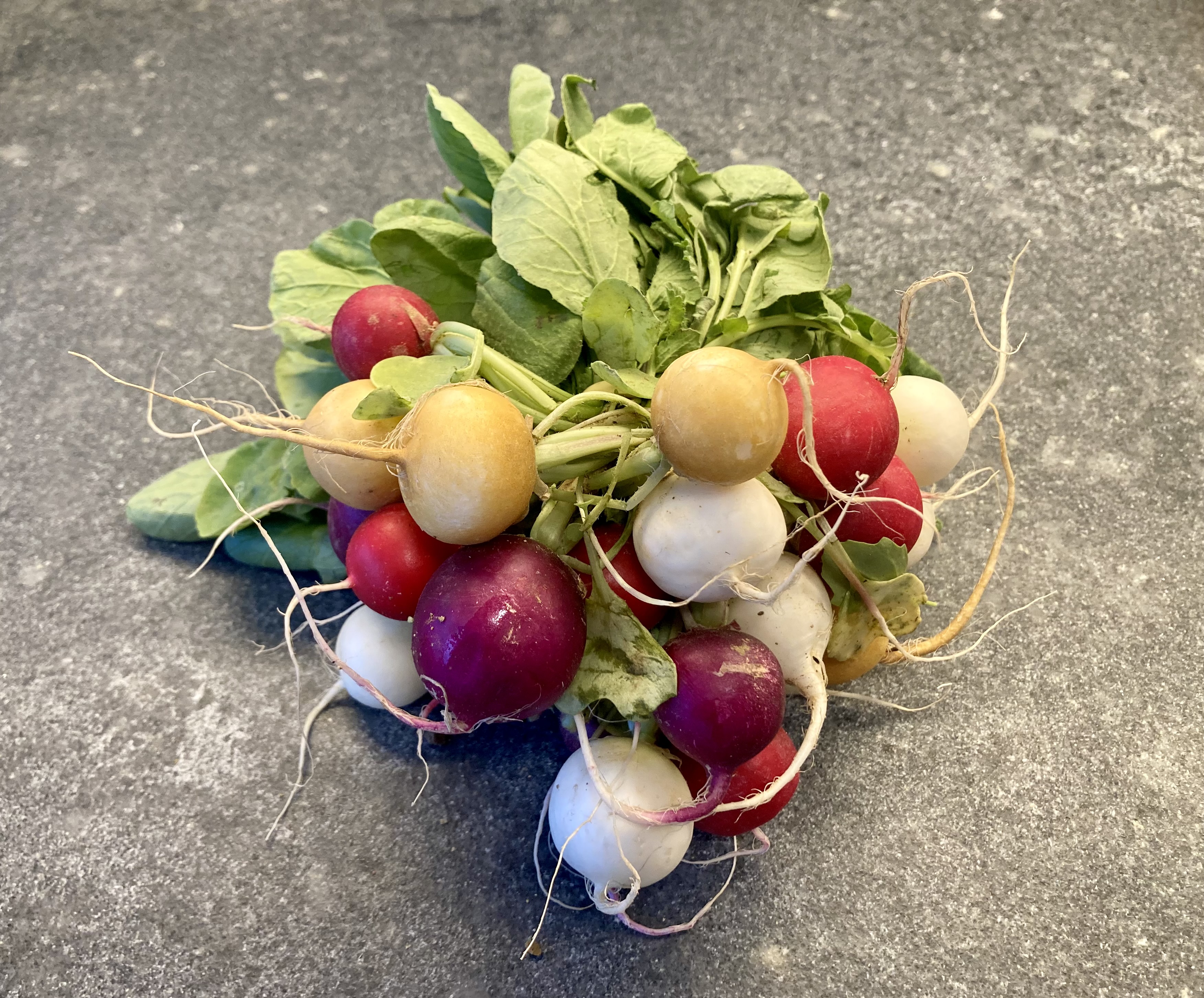
A few weeks ago, we posted a recipe for a salad with fried and marinated white button mushrooms. A rich, velvety salad with some acidity and lots of umami. This mushroom salad combines raw oyster mushrooms with radishes, sesame oil, mirin and cilantro. It’s both colourful and flavourful!
In general eating raw mushrooms is not a good idea. Some mushrooms contain mycotoxin that could be carcinogenic to humans. If you want to be 100% sure, it’s best to cook your mushrooms (and forget about this delicious salad!).
The variety we used is the Golden Oyster Mushroom (Pleurotus Citrinopileatusand its colour makes the salad even more vibrant. This mushroom is native to China, Japan and Russia. The ones we bought are cultivated. Compared to the more common grey oyster mushroom the caps are smaller in size and their taste is sweeter.
Another colourful oyster mushroom is pink (Pleurotus Djamor). Its taste is somewhat bitter. Perhaps not the best choice for a salad. If cooked well, it is supposed to taste like bacon, but by then it has lost all its colour.
Cultivated oyster mushrooms can be eaten raw. If you’re not sure, ask your greengrocer.

Wine Pairing

The salad comes with a range of flavours and obviously some acidity, which is important when choosing your wine. Perhaps a white wine with even more acidity? Or a wine that adds flavours or aromas to the dish? We decided to drink a glass of Vinho Verde with our salad, produced by Adega De Monção. This Portuguese white wine is made from Alvarinho and Trajadura grapes. Some citrus, slightly tropical, with notes of apples and pear. Tasty, elegant and refreshing. In general, you’re looking for a refreshing, easy to drink wine that has some acidity and flavours that make you think of apple, apricot or peach.

What You Need
  • 100 grams Golden Oyster Mushrooms
  • (Coloured) Radishes
  • For the Dressing
    • Excellent Olive Oil
    • Rice Vinegar
    • Mirin
    • Light Soy Sauce (we used Tsuyu)
    • Sesame Oil
  • Cilantro
What You Do

Wash the radishes and slice vertically in eight or six, depending on the size. Make the dressing. Add the sesame oil as the last ingredient because it’s very present. Combine the radishes with the dressing and the thinly sliced cilantro. Leave for a few minutes. Combine with the golden oyster mushrooms and serve immediately.

Charlotte Aux Asperges

May is our peak season for white asparagus: great quality and reasonable prices. Which is very helpful because for this relatively small Charlotte you need lots of very tasty asparagus. Our Charlotte has a 16-centimetre diameter, and it requires 18 asparagus. The Charlotte has four components: the bottom made from potatoes and seasoned with nutmeg, the filling made from an asparagus mousse with ham, the side, made from halved asparagus tips and the decoration. The combination of fried potatoes, asparagus (soft in the mousse and with a gentle crunch in the tips) and egg is delicious. 

Wine Pairing

We enjoyed a glass of Pinot Blanc from the German Mosel region made by Dr. Loosen. The wine is dry and fresh with some acidity and minerality. Notes of pear, apple and citrus. It worked very well with the Charlotte. In general you’re looking for a subtle white wine, given the delicate flavors of the Charlotte.

What You Need
  • For the Filling
    • 50 grams Cream
    • 50 grams Ham
    • 13 grams of Gelatine
    • 18 asparagus
  • For the Bottom
    • 1 large Potato
    • Nutmeg
    • Butter
    • Salt
  • For the Decoration
    • Two eggs
    • Parsley
    • Black Pepper
What You Do
  1. The recipe is for a springform with a diameter of 16 cm
  2. The bottom of the Charlotte is a Paillasson de Pomme de Terre. See our post about Alain Passard
  3. Peel and grate the potato
  4. Add salt and nutmeg
  5. Bake in a heavy iron skillet with lots of butter for 15+10 minutes until golden
  6. From time to time you may need to add extra butter. Do this by slipping small dots of butter down the sides of the pan
  7. In parallel peel the asparagus and cut of the tips
  8. Steam the tips for 10 minutes
  9. Steam the eggs for 12 minutes
  10. Allow the tips to cool
  11. Peel the eggs and set aside
  12. Quarter the remainder of the asparagus and cook in water for at least 20 minutes or until very well done
  13. Blender the asparagus chunks with some of the cooking liquid until very smooth. You will need approximately 400 grams of this mixture
  14. Use the back of a spoon to pass the asparagus mixture through a sieve
  15. Transfer the potato to the bottom of the springform
  16. Coat the side of the form with neutral oil
  17. Halve the tips and add these to the form, with the cut to the outside. See picture
  18. Follow the instructions of the gelatine
  19. Whip the cream until thick
  20. Finely chop the ham
  21. Heat some of the asparagus liquid, when warm, add the gelatine
  22. Now it’s time to combine cream, ham and asparagus mixture
  23. Cool the mixture and add gently to the springform
  24. Allow to cool for at least 2 hours
  25. Just before serving make mimosa of egg with parsley and black pepper.

Small Artichokes (Carciofo Violetto)

The season of artichokes depends on the variety and where you are based. In Italy it’s from mid-winter until early spring, in other countries from March to June, or September and October.
An artichoke should feel heavy, look fresh and the leaves should be closed. If the leaves are wide open, the artichoke is older and it could be dry with lots of choke (the hairs) and dry inner leaves.
The artichokes we use in this recipe are special. Not only are they vibrant purple, they are also small with hardly any choke. In Italy they are called Carciofo Violetto. Tasty as you would expect from an artichoke and easy to eat because the texture of the leaves is not stringy.

Wine Pairing

It’s not straightforward to pair artichokes with wine. According to various researchers this is due to cynarin, a chemical especially found in the leaves of the artichoke. When the wine and the cynarin meet in your mouth, the natural sweetness of the wine is enhanced, making it taste too sweet. Pair artichokes with a bone-dry, crisp, unoaked white wine with clear, present acidity. For instance, Sauvignon Blanc, Grüner Veltliner or Albariño.
The Carciofo Violetto artichoke in combination with the olive oil, Parmesan cheese and browned garlic (bitter, nutty) is less demanding when it comes to wine. We enjoyed it with a nice glass of Côtes de Provence rosé.

What You Need
  • Small purple Artichokes
  • Olive Oil
  • 2 Cloves of Garlic
  • Parmesan Cheese
What You Do
  1. Preheat your oven to 180 °C or 355 °F
  2. Cook the artichokes for 5 minutes in boiling water.
  3. Allow to cool and remove the outer leaves. Be generous, it’s better to remove too many!
  4. Halve the artichokes and place them in a shallow oven dish
  5. Drizzle with olive oil
  6. Transfer to the oven for 5 minutes
  7. In the meantime, grate Parmesan cheese, chop the garlic and mix
  8. Spread the mixture on top of the artichokes
  9. Wait for the cheese and the garlic to colour, perhaps 5 minutes
  10. Serve immediately.
PS

Other recipes with artichokes you may like:

Flammkuchen

We continue our series of very simple, tasty dishes by preparing Flammkuchen (Tarte Flambée in France, Feuerfleck in Austria). The dish originates from the Alsace. The first part of the name refers to fire and flames. The story is that bakers baked bread in wood fired ovens. The oven would initially become too hot, and the bakers had to wait for the oven to cool and reach the right temperature. The Flammkuchen would be the indicator. If it was ready within two minutes or so, then the temperature was right. If it would burn, the oven was too hot, but nothing was wasted. 

The dough of Flammkuchen is extremely simple, but also a bit puzzling. In all cases it’s flour, salt, olive oil and water. Some suggest adding egg yolks, others yeast. Adding yeast makes it into a bread dough. Doesn’t it seem obvious that the bakers would use the already prepared dough? Adding egg yolks seems odd too us. Why make a more expensive dough for a product that was to be used as an indicator only?

Back to yeast or no yeast. Which brings us to the question: isn’t Flammkuchen a kind of pizza? They do look very similar, and both are baked in a hot oven, but there are differences. Traditionally Flammkuchen are covered with crème fraîche, lardons and thinly sliced onions. The Flammkuchen should be very thin and very crispy. We think the bakers didn’t use their bread dough but made a quick, simple dough with the sole aim to test the temperature of the oven. Perhaps only water and flour?

Another difference is that Flammkuchen were not on the menu of restaurants until the 1960’s. Probably you would buy them at the local bakery or make them at home. Thanks to the global popularity of pizza, Flammkuchen have gained some visibility.

Drink Pairing

Flammkuchen are tasty, crispy, flavourful and not complex. Enjoy with a glass of white wine, with a beer, or your favourite drink.

What You Need
  • For the Dough
    • 250 grams of Flour
    • 2 tablespoons of Olive Oil
    • 125 ml Water
    • Pinch of Salt
  • Crème Fraîche
  • Black Pepper
  • Mushrooms (we used Trompettes de la Mort)
  • Red Onion
What You Do
  1. Pass the flour through a sieve
  2. Add a pinch of salt and mix
  3. Add water and olive oil and quickly turn the mixture into a dough using your hands
  4. Don’t kneed too long
  5. Leave on room temperature for an hour
  6. Pre-heat your oven to 220 °C or 430 °F
  7. Roll out until very thin, 2 millimetre is perfect.
  8. Add black pepper to the crème fraîche and mix
  9. Place the dough on baking or parchment paper in a baking tray, cover with a layer of crème fraîche, add mushrooms and sliced onion
  10. Bake for 10-12 minutes or so and serve immediately.

Baking Flammkuchen on a higher temperature is preferred, but then you can’t use baking or parchment paper. Best is to use a pizza stone. The baking time will be 3 to 5 minutes on 300 °C or 570 °F.

Flammkuchen ©cadwu
Flammkuchen ©cadwu

Curly Kale with Confit de Canard

Recently we wrote about kale-sprouts, the purple combination of Kale and Brussels sprouts. When working on the post we noticed that we actually never wrote about Curly Kale. This typical winter vegetable (also known as BoerenkoolGrünkohl or Chou Frisé) is not known for its culinary capability, although Cavolo Nero (which is a variety of Kale) has become fairly popular over the last years. Dishes like RibollitaMinestrone or Cavolo Nero prepared with orecchiette and anchovies sound tempting.
Curly Kale is sometimes described as a super food because it contains lots of vitamines and it’s supposed to be good for your eye-sight. Reality is that it’s not simple to turn Curly Kale into something tasty. In 2015 Felicity Cloake (who writes for the Guardian) explains how to make kale crisps. She compares recipes from various authors and decides to make the perfect crisps from…. Cavolo Nero!
Curly Kale itself is typical comfort food. Served with potatoes, bacon and sausages; to be enjoyed with a glass of beer or a glass of Pinot Blanc.
Best is to eat Curly Kale after a wintery period. As soon as the temperature drops below zero, the plant will start breaking down the starch in the leaves into simple sugars. These sugars prevent the plant from freezing and the taste becomes sweeter and less bitter. A process that happens in carrots, turnips, beetroot, kale and Brussels sprouts but not in potatoes.

The traditional Dutch way of cooking Curly Kale is to add the sliced leaves with the potatoes to a pan of salted water, cook until done, drain, then mash with butter, warm milk, nutmeg, and black pepper. It is served with slices of smoked sausage. Hearty, filling and serieously heavy on your stomach.
We prefer a more modern version, highlighting the flavour and the texture of the Curly Kale.

What You Need
  • 400 grams of Fresh Curly Kale leaves
  • 1 small Potato
  • 1 Shallot
  • 1 Garlic Clove
  • Butter
  • Nutmeg
  • Black pepper
  • Confit de Canard
What You Do

Set your oven to 180 °C or 355 °F. Reheat and fry the confit de canard. Chop the shallot, finely chop the garlic, peel the potato and dice, strip the curly kale from its stems and slice the leaves. Add a generous amount of butter to the pan, gently fry the shallot for a few minutes, then add the garlic. After one minute or so add the sliced kale and allow to simmer. Add the diced potato, combine and leave to simmer for a few minutes. Add some water to the pan. Cook for 15-20 minutes until the potato is ready. Best is if the water has evaporated by this time. In the meantime, the duck should be ready. Poor the duck fat in the pan, mash very briefly (you want to keep the structure of the potatoes), add nutmeg and black pepper. The mash should be about the kale, with the onions, garlic and potato supporting it. Serve immediately on a warm plate.

The Art of Sauces: Ravigote

A classic, French sauce, traditionally served with Tête de Veau, but in general great with cold meat and cold, poached fish. A very simple, easy to make sauce with just the right acidity to brighten up your cold starter. The warm version is made with a broth, the cold one with oil, vinegar and mustard, as you would prepare a vinaigrette.
No eggs?
Indeed, no eggs. If you look at the list of ingredients, you could think of Remoulade or Tartare Sauce (both mayonnaise based) or Gribiche (made with hard boiled eggs). Ravigote is different, it’s light and uplifting. Just give it a try next time you serve cold meat or fish as a starter. Forget about the mayonnaise and enjoy this delicious, flavourful sauce.
We served our Ravigote with Pâté de Tête Persillé and crusted bread.

Wine Pairing

We enjoyed a glass of white Pontificis, made with Viognier and Chardonnay grapes by Badet- Clément. This is an oaked dry wine from the Languedoc-Roussillon region in France. It is elegant, with some oak, clear acidity and some bitterness. Creamy, with some vanilla, butter and perhaps tropical fruit. In general you’re looking for a white wine with clear acidity, oak and balance.

What You Need

  • Coarse Mustard (Moutarde à l’Ancienne
  • White Wine Vinegar
  • Oil (Sunflower, Avocado)
  • 3 Cornichons
  • 8 Capers
  • 1 Shallot
  • Parsley
  • Tarragon
  • Chervil
  • Black Pepper

What You Do

  1. Finely chop the shallot, slice the cornichons, halve the capers
  2. Chop the herbs
  3. Combine a spoonful of mustard with the same amount of vinegar
  4. Slowly add the oil until you have the right consistency and flavour
  5. Add more vinegar to get the right acidity
  6. Happy? Add shallot, cornichons and capers
  7. Mix
  8. Add a generous amount of parsley, tarragon and chervil
  9. Finish the sauce with black pepper.

PS

The amount of tarragon depends on the type of tarragon and your personal preference. There are actually three types: French tarragon (intense and aromatic, the one to use in the kitchen), Russian tarragon (limited flavour, no complexity) and Mexican (a touch of anise, but not even close to French tarragon). 

Pork with Enoki

It’s nearly the end of the mushroom season in Europe. It’s hard to find chanterelle (girolle), and nearly impossible to buy fresh cèpes. The black winter truffle (Tuber melanosporum) is an exception. It’s available until March, but the price may be prohibitive. Better to focus on cultivated mushrooms, such as enoki, available at your local Asian supermarket. A delicious mushroom with a pleasant texture and aroma. Its flavour is mild, a bit sweet and fruity. You can use it raw in a salad, in a soup or combine it with soba noodles. A few weeks ago, we wrote about an omelette with enoki and a light soy sauce. The result is a lovely sweet, rich and intriguing dish.
Combining enoki with pork is also a great idea. Feel free to adjust the recipe and make the sauce spicier or sweeter or thicker. The result will be tasty given all three elements in the dish bring some kind of sweetness.

Wine Pairing

You could emphasize the Asian influence by serving a glass of Pinot Gris, Riesling, Chenin Blanc or perhaps Soave. In general you’re looking for a light or medium bodied, unoaked, dry white wine with nice acidity. Benefits are minerality and florality. A glass of Côtes de Provence rosé will also be a good choice.
If you want to focus on the flavours of the pork, we suggest a glass of Beaujolais or a glass of wine made with Grenache (France) or Garnacha (Spain) grapes.

What You Need

  • Organic Pork Tenderloin
  • 100 grams of (Golden) Enoki
  • Soy Sauce
  • Light Soy Sauce (we used Tentsuyu)
  • Stock
  • Oyster Sauce
  • Black Bean Sauce (optional)
  • Red Chili Paste (optional)
  • Olive Oil

What You Do

Fry the pork in olive oil until pink. Turn on a regular basis. Remove the stem (bottom) of the enoki. Fry in olive oil for maximum one minute. Add some (vegetable stock), soy sauce, oyster sauce, black bean sauce and red chili paste and create a not overly sweet, intense sauce. We like some spiciness, hence the chili paste. Serve the meat on top of the enoki mixture.

Tomato and Halloumi Salad

A simple and lovely salad, one that works very well as a starter with some crusted bread. Tomatoes, a touch of mint, parsley and warm halloumi. One of the first times we made this we used homegrown, ripe and tasty tomatoes. We also prepared the dish using tomatoes that were rather bland. That wasn’t much of a success.
The history of halloumi goes back centuries. Nowadays it’s a cheese made of goat’s and sheep’s milk. Sometimes cow’s milk is added to the mixture. In the EU it’s a protected product and must be produced in Cyprus. Because of its high melting point it’s ideal to grill or fry, although it can remain a bit firm and chewy. During the final phase of the production process the cheese is salted and sprinkled with chopped spearmint leaves.
Mint is also an essential ingredient of the salad. We tend to use it only occasionally because mint can be overpowering. It works very well in combination with the cheese and the tomatoes. It gives a boost to the flavours without being overly present.

Wine Pairing

A glass of rosé, a simple unoaked white wine or a beer will be great with the salad. When looking for a wine to go with a salad, make sure to think about the acidity. In general a more acidic salad requires a more acidic wine. The combination will make the wine fruiter and the salad softer. In this case the tomatoes, the dressing and the capers bring acidity. However, marinating the tomatoes makes the salad softer and emphasises the sweetness of the tomatoes. 

What You Need

  • Six excellent, tasty, ripe Tomatoes
  • 6 leaves of Mint
  • Parsley
  • Olive Oil
  • Vinegar
  • Teaspoon of Capers (in brine)
  • Black Pepper
  • Halloumi

What you Do

Core and slice the tomatoes. Chop the parsley and the mint. Combine oil and vinegar, add tomatoes, mix and add the herbs. Transfer to the refrigerator for a few hours. Mix every hour.
Slice the halloumi and fry on medium heat in olive oil. Turn regularly. Add the capers to the salad, mix, top with the fried halloumi and serve immediately with crusted bread.

Tomato and Halloumi Salad ©cadwu