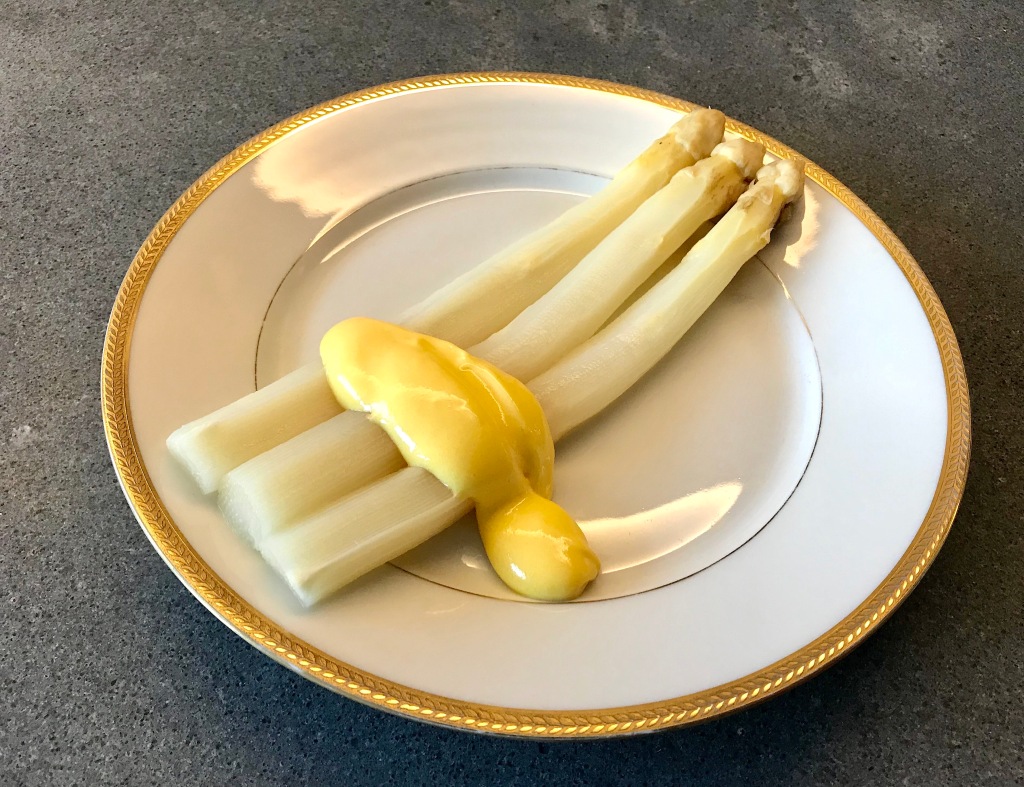
Asparagus with Kimizu

The combination of white asparagus and Hollandaise is classic. The sweetness and bitterness of the asparagus together with the velvety, rich flavours of the sauce is just perfect.

A few years ago we enjoyed Kimizu-Ae (white asparagus with Kimizu) at Yamazato in Amsterdam. We were immediately intrigued by this combination. The Kimizu is a rich and light sauce; it comes with a velvety feeling, a touch of sweetness, a bright yellow colour and perfect acidity. So yes, the next day we prepared our own Kimizu.

Kimizu is based on two main ingredients: egg yolk and rice vinegar. You could add some mirin and a pinch of salt. Kimizu does not contain butter (the egg yolk being the only source of fat) so Kimizu, although it seems similar to Hollandaise, is lighter, easier to digest and fresher.
Many recipes for Kimizu include starch, probably because the cook has trouble making a warm, emulgated sauce. Our advice: never use starch or beurre manié. The consistency is an essential element of the sauce and must be the result of carefully heating the mixture of egg yolk, vinegar, mirin and water.

Using a microwave oven to make Kimizu is a great idea (see our recipe for Hollandaise), although it does require more whipping and more attention compared to making Hollandaise.

Wine Pairing

We enjoyed our Asparagus and Kimizu with a glass of Sancerre, Domaine Merlin Cherrier. This classic wine reflects the chalky terroir of Sancerre beautifully. The combination of Sauvignon Blanc (citrus, minerals) and Kimizu (touch of sweetness, present but not overpowering acidity) works really well. A wine of true class and complexity with a long finish.

What You Need

  • Two Egg Yolks
  • 1,5 tablespoon of Rice Vinegar (depending on the size of the egg yolks and the acidity of the vinegar)
  • 3 tablespoons of Water
  • Teaspoon of Mirin (optional)
  • Pinch of salt (very optional)
  • 6 Asparagus

What You Do

The amount of water you’ll need depends on the acidity of the rice vinegar and the size of the egg yolks. Whisk the two egg yolks, add the rice vinegar, the mirin, the water and whisk some more. Now transfer to the microwave and give it let’s say 10 seconds on 30% power. Remove from oven and whisk well. Repeat. You will now feel the consistency changing. If not, don’t worry, just repeat the step. After 2*10 or 3*10, move to steps of 5 seconds on 30% power. Whisk, whisk again and feel free to find your own way. When the Kimizu is ready, take it out of the oven, continue whisking gently and perhaps cool slightly in a water bath.
In parallel steam the asparagus (depending on the size 20 or 25 minutes; they should be well done for this dish).
Serve the asparagus with a generous helping of Kimizu.

White Asparagus with Kimizu ©cadwu

Takes 5

You can’t have enough cookbooks. Some make you think back of a holiday, others are written by chefs you admire, and some are technical or about specific ingredients. There is always room for just one extra cookbook.

Once in a while, when you’re looking for inspiration, you browse through a number of books, look at the pictures, read recipes and you think: ‘far too many ingredients, far too complicated’ for a not very inspired evening.

James Tanner

Fortunately, you remember one very special cookbook: James Tanner Takes 5: Delicious Dishes Using Just 5 Ingredients with over 90 recipes, ranging from Roasted Red Bell Peppers with Anchovies to Scones. Short shopping lists, easy recipes and tasty results: what more can you ask for! Isn’t it great, Chocolate MousseFigs with Honey or Toad-in-the-hole

James Tanner (1976) is a British chef and author. Together with his brother Chris he runs a restaurant in Kent, The Kentish Hare. He appeared as a tv-chef on shows like Ready Steady Cook (remember The Quickie BagGreen Pepper and Red Tomato?).

Favourite

Our personal favourite is a small chicken (preferably a coquelet, a young rooster) with a paste made of red peppers, pure creamed coconut (santan), lime and cilantro. It’s easy to make and the result is very tasty. Serve it with some bok choy in oyster sauce and you have a lovely meal. He enjoys it with a cold beer, we prefer a glass of rosé, for instance Chiaretto di Bardolino DOC made by Monte del Frà from Italy. A pale, pink wine with floral and fruity aromas. Dry with medium acidity, limited tannins and delicate flavours. Excellent with the chicken and the coconut.

Takes 5: Delicious Dishes Using Just 5 Ingredients was published in 2010 and is available (probably second hand) via the well-known channels for something like 20 US dollar or Euro.

Asparagus à la Flamande

One of the classic ways of serving asparagus is à la Flamande (Op Vlaamse wijze) with melted butter, boiled eggs, parsley and nutmeg. The nutmeg is an essential element of the dish. It enhances the flavour of the asparagus, and it’s a bridge between the egg mixture and the asparagus.
There are two main variations: the first one is to serve the asparagus with small potatoes. Not a great idea, unless you’re hungry, because the potatoes soften, weaken the flavour of the asparagus. The dish is about enjoying asparagus, so why would you add potatoes?
The second variation is to add lemon to the butter and egg mixture. This makes the dish a bit lighter and fresher. If you want to do so, be careful with the wine you serve. You need to balance the acidity in the wine and the food.

Wine Pairing

Serve the asparagus à la Flamande with a dry, white wine. We enjoyed a glass of Silvaner produced by the German Winery Thörle. The wine comes with freshness, some acidity, minerality and fruit (pear, green apples). Excellent with our asparagus.

What You Need

  • 4 Asparagus per person
  • 3 Eggs
  • Parsley
  • Butter
  • Nutmeg
  • White Pepper

What You Do

  1. We use our Russel and Hobbs food steamer to prepare this classic dish. An essential kitchen aid for only 50 euro or US dollar
  2. Clean and peel the asparagus
  3. Steam them for 10+5+5 minutes
  4. After 10 minutes add the eggs to the steamer basket
  5. After 5 minutes, turn the eggs upside down
  6. Another 5 minutes later the asparagus and the eggs are ready
  7. If you like your asparagus softer, then steam for 12-15 minutes.
  8. The eggs should be hard. Depending on the size you may need to steam them a bit longer
  9. In parallel heat a very generous amount of butter
  10. Chop the parsley
  11. Peel the egg and mash with a fork, creating a ‘mimosa’ of egg
  12. Combine mimosa and parsley
  13. Add some white pepper and freshly grated nutmeg
  14. Add the mixture to the butter and combine
  15. Spoon the egg mixture on top of the asparagus
Asparagus a la Flamande ©cadwu

Pasta with Mushrooms and Bell Pepper

Udon is such a wonderful noodle. What better comfort food than a warm soup made with dashi, vegetables, tofu, udon and thinly sliced spring onions? Perhaps some tempura on top of the soup? Or would you prefer a very simple dish, called Mori Udon? The cold udon is served with a sauce of mirin, dashi and soy sauce on the side.
Udon is also a great alternative to Italian pasta, for instance with Caesar’s Mushrooms.

In this recipe we combine udon with roasted bell pepper and Trompettes de la Mort. We’re not sure why, but this combination works really well. Is it because of the smokey aroma of the roasted bell pepper mixed with the aromas of the mushroom? The crispy pancetta in combination with the soft textures of the other ingredients, including the udon? The overall richness and umami thanks to the Trompettes de la Mort?

Wine Pairing

We enjoyed our pasta with a glass of Bianco di Custoza, made by Monte del Frà from Italy. It is a well-balanced, dry white wine, with a fruity nose. Its colour is straw yellow, with pale green highlights. A glass of Soave, made from the Garganega grape, will also be an excellent choice. In general you’re looking for a fresh, aromatic dry white wine. 

What You Need

  • 1 Red Bell Pepper
  • 1 Bunch of Udon
  • 100 grams of Trompettes de la Mort
  • 1 Glove of cooked Garlic
  • 4 slices of Pancetta
  • Black pepper
  • Olive Oil

What You Do

Clean the bell pepper and cut in 4. Transfer to the oven and grill or roast for 10 minutes or until well charred. When still hot, put the bell pepper in a plastic container and close it. After one hour it’s easy to remove the skin of the bell pepper. Slice lengthwise to make nice strips. Set aside.
Slice the mushrooms in two and clean them with a soft brush. Check carefully for grit and other things you don’t like to eat.
Fill a large pan with water (no salt!) and bring to a boil. Add the udon and cook it according to the instruction. When nearly done, add some cooking liquid to a cup and set aside. Drain the udon.
In parallel heat a large heavy iron skillet, add olive oil and fry the mushrooms. Once they become a bit dryer, add the sliced bell pepper. Add the cooked garlic, crush it with a fork and mix. Now add the udon and continue mixing. Add cooking liquid until the pasta is sufficiently moist.
Also in parallel: grill the strips of pancetta (perhaps 5 minutes).
Add some black pepper to the pasta and serve with the grilled pancetta.

Pasta with Mushrooms and Bell Pepper ©cadwu

Classic White Asparagus

One of the classic ways of serving white asparagus is with melted butter, boiled eggs, ham and parsley. Preparing the asparagus this way, will allow you to taste the slight bitterness and sweetness of the asparagus. The butter and egg bring a velvety feeling to your palate, and the parsley and white pepper give a touch of sharpness to the dish. A great way to celebrate spring!

We use our Russel and Hobbs food steamer to prepare this classic dish. An essential kitchen aid for only 50 euro or US dollar. In this case the steamer cooks the asparagus, boils the eggs and heats the butter. Amazing!

A few years ago we enjoyed white asparagus with béarnaise and a small veal schnitzel accompanied by a glass of Silvaner at Café Heider in Potsdam, Germany. When we ordered we were asked how we would like our asparagus. Al dente, of course! If you like them more cooked, then steam them for an extra 5 minutes. 

Wine Pairing

Preferably serve the white asparagus with a dry Muscat from the Elzas. The delicate, slightly sweet but dry taste, the hint of bitterness and the rich aromas work very well with the asparagus. Muscat to us means the smell of fresh fruit. When drinking it is if you’re tasting the original grape. Wonderful wine and wonderful combination.
Or a glass of Silvaner of course. Just make sure the white wine has a touch of sweetness and is aromatic.

What You Need

  • 3 or 5 white asparagus per person
  • 2 Eggs
  • 100 grams Organic Cooked Ham
  • Parsley
  • Butter
  • White Pepper

What You Do

Clean and peel the asparagus. Steam them for 10+5+5 minutes. After 10 minutes add the eggs to the steamer basket. After 5 minutes, turn the eggs upside down and add a cup with cold butter. Another 5 minutes later everything is ready. The eggs will be medium: the yolk is not set but also not running. Peel the egg and cut in four. Chop the parsley. Serve the asparagus and eggs on a plate. Pour the warm butter over the asparagus. Dress the plate with ham (please make sure it has a bit of fat), perhaps some extra butter and sprinkle the parsley over the plate. Add some white pepper. 

Classic white Asparagus ©cadwu

Fish Cakes by Jean Beddington

Jean Beddington: a culinary, passionate creative! She was chef at five restaurants, owned her own successful restaurant, and still is an inspiration to many. One of her motto’s is ‘seemingly simple’, not with the intention to impress but with the intention to surprise and enhance the sensation when enjoying her food and the way it is presented.

Background

In her book Absolutely Jean Beddington she writes about her background, her youth in England, her eagerness to cook, the holidays with her father when they would stay at budget hotels and eat at Michelin Star restaurants, her travels, her years in Japan and her education (she studied Arts and Chemistry). When she moved to the Netherlands, she decided to become a chef, which is the obvious choice for someone with such a talent. She was one of the first to bring new ingredients to the classic French cuisine. For instance, she began using cilantro and yuzu. She was also inspired by the Japanese way of presenting food: beautifully designed and served on a variety of plates. She began doing this when most guests still expected bread and garlic butter at the beginning of their lunch or dinner.

Books

She published several books. One is dedicated to stock: the basis of soups, sauces and dishes. She explains how to make stock and how to create delicious food, for instance green vegetables in stock with couscous, yogurt and harissa sauce. 

Her book Absolutely Jean Beddington is very dear to us. It has three main chapters: the first one is called Glossy with beautifully presented food, the second one is called Real Time with food as you could expect to eat at her restaurant (which is closed, unfortunately) and our favourite chapter is called Daily. Indeed, recipes that are easy to follow and help prepare tasty, wonderful food, every day.

Fish Cakes

We prepared her fish cakes with a beetroot, ginger, apple and onion chutney. The fish cakes are intriguing and the chutney is the perfect accompaniment. Yummy!

Antonio Carluccio’s Oysters with Bianchetto

Last Saturday we were extremely lucky. Not only did we buy the very first fresh morels of the season, we also bought a small bianchetto. This affordable white truffle is available from mid January to the end of April. It is also called March truffle (marzuolo).

In his book Complete Mushroom Book, Italian chef Antonio Carluccio combines fresh oysters with a white wine sabayon and white truffle: Ostriche con zabaglione e tartufo bianco. The result is spectacular. The combination of the distinct aroma of the white truffle with the oyster is intriguing. The sabayon brings everything together in terms of taste, consistency and structure. And just to show you how clever Carluccio’s combination is: the sabayon in itself is not pleasant. We prepared the dish with bianchetto. Maybe less subtle than when prepared with a white truffle, but the result is nevertheless wonderful.

Wine Pairing

With such a great dish you many want to drink a glass of Chablis or Champagne. We enjoyed a glass of Crémant de Bourgogne, produced by Vitteaut-Alberti. A refined wine, soft and with delicate fruit. The bubbles are small and pleasant.

Oysters a la Carluccio © cadwu
Oysters à la Carluccio © cadwu

Quails and Snails in a Green Sauce

Many years ago we were looking for a place to eat in Fréjus. It was our last evening in France before returning home and obviously we were looking for something special, something typical Provençal. The area of our hotel wasn’t very promising, so we were ready to settle for pizza until we saw a small restaurant with a very interesting menu. It offered Tisane de RomarinCailles et Escargots and many other exciting dishes we unfortunately can’t remember. We entered the restaurant and had a perfect evening.

Combining quails and snails isn’t the most obvious idea, but rest assured, it works beautifully, also thanks to the very intriguing green sauce. It took us some time to make the sauce as it should be, but after a few attempts we think this is the right bridge between the quails and the snails.

Of course, we made a note of the name of the restaurant and of course, we lost it. A pity, although preparing this dish brings us back to a lovely evening in Fréjus.

Wine Pairing

Enjoy your Quails and Snails with a glass of Bourgogne: a chardonnay with a touch of oak. The wine must be dry, mineral and medium bodied. We enjoyed a glass of Bourgogne as produced by Louis Jadot. The wine partly matured in stainless steel tanks and partly in oak barrels. The result is a wine that has citrus and apple aromas in combination with oak and vanilla. Great with the freshness of the herbs and the richness of the sauce. It balances very well with both the quails and the snails. Two sides to everything in this dish!

What You Need

  • 2 Quails 
  • 6 Snails (click here when you want to know which snail to buy)
  • For the Sauce
    • 1 Bunch of Parsley
    • ½ Bunch of Tarragon
    • A few Leaves of Young Spinach
    • Cream
  • Vegetable Stock
  • Olive Oil
  • White Pepper

What You Do

Wash the snails with plenty of water. Set aside. Clean the quails. Best is to use the breasts only. (You could also serve the legs, provided you remove the main bone. It’s a bit of extra work, also for your guests.) Make sure you have a warm heavy iron skillet ready and a small pan with warm vegetable stock. Set your oven to 60 °C or 140 °F.

Blanch parsley, tarragon and spinach in boiling water and cool immediately in ice water. Blender parsley, tarragon and spinach with some ice water until you have a very smooth green liquid. Set your blender to turbo! Press using a sieve and store the green liquid. It will remain stable for at least an hour.

Fry the breasts quickly in olive oil. Warm the snails in the vegetable stock. Transfer the breasts to the warm oven. Clean the pan with kitchen paper, add cream and chicken stock. Let reduce for 5-10 minutes or until you’re happy with the consistency. Add liquid from the quails. Stir and taste. Perhaps some white pepper? Add green liquid until you have the right colour and taste. Be very careful, if you overheat the sauce it will lose its vibrant green colour. Serve the breasts and the snails in the sauce.

Quails and Snails in a Green Sauce ©cadwu

Escargots de Bourgogne

We noticed that more and more supermarkets and shops sell snails. Canned, frozen or with garlic butter ready to be cooked in the oven, all very tempting. Snails are high on protein, low on fat, high on minerals, low on calories. A glass of white wine and some crusted bread; what more do you need as a healthy starter?
But before buying snails it’s important to look at the label and find out what kind of snail you’re buying.

The snail used for the classic Escargots de Bourgogne is called Helix Pomatia. It’s protected in many countries. Farming of this snail is not profitable. Excellent taste, expensive and hard to find.
There are three alternatives: Helix Aspera (either the small one called Petit Gris or the large one called Gros Gris) and Helix Lucorum. The last one is considered to be less tasty than the other three, but when prepared well, it’s a very nice, affordable alternative. All three can be farmed.

It could also say Achatina on the label. This is a different kind of land snail, much larger than the first four. It’s taste and texture are okayish.

Sometimes it simply says ‘Escargots’ and ‘Gros’ on the tin. Sounds good, doesn’t it? Well, it may and it may not. Some companies cook larger (sea) snails, chop these, and sell the chunks as ‘Escargots’. The term ‘Gros’ is supposed to make you think of the Gros Gris. Don’t be fooled: they are rubbery, tasteless and a waste of money.

The classic Escargots de Bourgogne are prepared with butter, garlic and parsley. We like to add a bit of tarragon and a pinch of salt. Traditionally they are served in the shell and you need a tong and a special fork to eat them. The ones we use are from a can, so no special equipment required. 

Wine Pairing

The obvious choice is a glass of Bourgogne: a chardonnay with a touch of oak. The wine must be dry, mineral and medium bodied.

What You Need

  • 12 snails
  • Butter
  • Parsley
  • Garlic
  • Tarragon
  • Salt
  • 2 Snail Plates

What You Do

You could of course buy fresh snails (which makes us think of the amazing market in Valencia! So much choice, such excellent quality. Also various kinds of snails, fresh and alive, obviously, also the Caragolus, the snail that is required when you prepare a traditional Paella Valenciana) but otherwise buy them canned. Remove them from the can, wash carefully with lots of water and set aside.

Chop parsley, tarragon and garlic very fine. Using a fork, combine butter, herbs, garlic and a pinch of salt. Transfer six snails to a snail plate, add a chunk of butter to every snail, transfer the snail plate to an oven at 160 °C or 320 °F for 10 minutes or until boiling hot. Serve the snail plate on a cool plain white plate.

Escargots de Bourgogne ©cadwu

Carpaccio

Carpaccio has evolved into an anything-goes combination of something sliced (beef, veal, (smoked) salmon, beetroot) with a dressing and garnished with for instance pine nuts, cheese, lettuce, capers, tomatoes, spring onion etcetera, which is a pity because the original Carpaccio is actually rather perfect.
We’re not culinary puritans but nevertheless we were slightly shocked when we found the next version of Carpaccio in our local supermarket: with wasabi mayonnaise, teriyaki glaze and roasted sesame seeds. Help?

Original Version

Let’s go back to the original Carpaccio as it was created (in 1950) by chef Giuseppe Cipriani of Harry’s Bar in Venice for one of his regular guests, the Contessa Amalia Nani Mocenigo. Her doctor had ordered her to eat uncooked food, especially raw, red meat. Most likely she suffered from anemia. The poor Contessa was used to excellent food, so something raw on a plate wasn’t very appealing. Chef Cipriani created a special dish for her, which he named after, indeed, the Venetian painter Vittore Carpaccio. Some say this was a tribute to the whites and reds as used by Carpaccio.

Sauce

The sauce is a very clever combination of mayonnaise, Worcester sauce, lemon juice, white pepper and milk. The velvety mayonnaise works very well with the lean meat, the acidity of the lemon is a perfect match for the sweetness of the beef and the Worcester sauce brings umami and depth. The milk gives the sauce the right consistency.

Next time when you think about preparing Carpaccio, why not try the original version and forget about all the extra’s.

Wine Pairing

We suggest enjoying your Carpaccio with a glass of Pinot Grigio or a Soave. It should be a fruity, not too powerful wine. Carpaccio is about the flavour of the meat. The sauce and the wine should simply support this. You could also go for a Pinot Noir, provided it has a light character.

What You Need

  • 50 grams of Excellent Tenderloin or Sirloin (per person) thinly sliced, cold but not frozen.
  • (Homemade) Mayonnaise
  • Worcester Sauce
  • Lemon
  • White Pepper
  • Milk

What You Do

Take one or two spoons of mayonnaise and add two teaspoons of Worcester sauce, one or two teaspoons of lemon juice and freshly ground white pepper. Taste and adjust until you have the perfect balance. Now add milk, creating a thinner sauce. Remove the meat from the refrigerator, flatten the meat if so required and transfer to a cold plate. Create a nice pattern with the sauce, using a sauce bottle. Serve immediately.