Cacio e Pepe

It takes only four ingredients to create an international culinary incident: a classic Italian recipe, a well-known British food website, Parmesan cheese and butter. What happened? BBC Good Food published a recipe for a quick and easy lunch meal, called Cacio e Pepe, with Spaghetti, Butter, Black Pepper and Parmesan Cheese. Claudio Pica, president of the Fiepet Confesercenti Roma (an association representing restaurants in Italy) couldn’t disagree more and expressed his astonishment in several letters, including one to the UK Ambassador.

Cacio e Pepe is a traditional, Italian classic, typical for the Lazio region, made with Tonnarelli or Spaghetti, Water, Salt, Pecorino Romano and Black Pepper. No cream, no butter, no olive oil, no Parmesan cheese. And it may seem simple to prepare, but serving Cacio e Pepe requires skills, passion and experience, according to Claudio Pica.

The incident made us think of Sophia Loren adding cream to her Spaghetti Carbonara and Jamie Oliver putting chorizo on his Pizza. Don’t mess with Italian traditions!

Now that we agree on the ingredients, we need to understand how to prepare the dish. The heart of the dish is a sauce made with pasta water and pecorino. We found various ways of making this sauce, ranging from adding pepper and grated cheese to the pasta just before serving (no sauce, just sticky pasta) to a scientific one whereby the sauce is made au bain marie (complicated).

We think the main points of the recipe are:

  • Use less water than usual, because you need starchy water to create the sauce
  • Use less salt in the pasta water because the Pecorino cheese is rather salty
  • The Pecorino must be relatively young, older cheese may make the sauce lumpy
  • The Pecorino must be very finely grated

We humbly present our version of this delicious Italian classic dish.

Wine Pairing

We enjoyed a glass of Pima Luna Frascati with our Cacio e Pepe. This is a white wine from the Lazio region, or to be more precise: from the hills overlooking Rome. The wine is made by wine maker Mauro Merz with malvasia bianca di candia and trebbiano grapes. It’s a light and refreshing wine with hints of green apple and citrus. Notes of slightly bitter almond on the finish. Its freshness matched very well with the creamy Cacio e Pepe. The aroma of the wine comes with a hint of butter, which is a nice connection to the Pecorino.

What You Need
  • 130 grams of Spaghetti
  • 70 grams of Pecorino cheese
  • 2 grams of Black Pepper
  • 1 litre of Water
What You Do
  1. Heat the water in a large pan and add the spaghetti
  2. Warm your plates (50 °C or 120 °F)
  3. Cook the spaghetti for a few minutes. Our spaghetti needed 11 minutes in total; we cooked it for 7 minutes in the pan.
  4. Crush the peppercorns
  5. Roast them in a pan over medium heat until they become very aromatic
  6. Reduce heat and wait for the spaghetti to be somewhat cooked
  7. Add some pasta water to the pan with the toasted pepper
  8. Increase the heat
  9. Transfer the pasta to the pan and combine
  10. Add a large spoon of pasta water to the pan
  11. Leave to cook
  12. Repeat steps 10 and 11 until the pasta is al dente. At this moment the pan should be nearly dry
  13. In parallel add some pasta water to the finely grated pecorino and make a smooth paste
  14. When the pasta is al dente remove the pan from the heat
  15. Allow to cool for perhaps one minute
  16. Quickly add the paste and combine everything in the pan
  17. Add pasta water to reach the right consistency
  18. Serve immediately on warm plates
  19. No need to add pepper or cheese
PS

The Good Food website mentioned they would be happy to post the original recipe. We looked for it, but couldn’t find it. We did however find a recipe for Cacio e Pepe with Gnocchi (and butter and Parmesan cheese, obviously).
Perhaps another letter to the Ambassador? Or one to the Prime Minister?

Paupiette

When you visit a French butcher or supermarket, you are bound to find paupiettes. In general, it is a thin slice of meat, stuffed, rolled up and tied. Lots of possibilities: the outside could be veal, beef, pork, chicken, lamb or even fish. The inside could be meat, or a mixture of meat and vegetables, or a duxelles or well, you get the idea.
In the Provence you will find so called Alouettes sans Tête (meaning larks without a head). A thin slice of beef is stuffed with bacon, parsley and garlic. The alouettes are quickly fried until golden and then cooked in a sauce with onions, wine and various herbs.
In the Netherlands and Belgium a paupiette is called Blinde Vink (meaning blind finch). This is a thin slice of pork or veal, stuffed with minced (pork) meat.  

Preparing paupiettes is not obvious. Many recipes suggest cooking the paupiette in a sauce, but that’s not what we recommend. The paupiettes will be a bit dry and bland. Others suggest transferring the paupiettes to a hot oven, with an even more disappointing result. We think the best way is to quickly fry the paupiettes until golden and then transfer to the oven and braise with some liquid on low temperature.

We asked our favourite butcher to make paupiette de veau (sometimes called melon de veau). A thin layer of veal stuffed with a mixture of minced veal and pork meat, with a generous amount of chopped sage and a hint of salt. It is decorated with two leaves of sage.

Wine Pairing

We enjoyed the dish with a glass of Portuguese red wine, produced by Vidigal. The wine is made with aragonez, castelão and cabernet grapes. The wine has a nice red colour and aromas of fruit and herbs. Its taste is light, with some tannins and a touch of oak. In general, you’re looking for a smooth, easy to drink red wine with character.

What You Need
  • 2 Paupiettes de Veau
  • 1 small Carrot
  • 1 Celery stalk
  • 1 Leek
  • Veal Stock
  • Dried Oregano
  • Olive Oil
  • Butter
  • Black Pepper
What You Do
  1. Pre-heat your oven to 120 °C or 250 °F
  2. Thinly slice carrot, celery stalk and leek.
  3. Heat a heavy iron skillet, add butter and olive oil
  4. Quickly fry the paupiette, top and bottom only
  5. Transfer paupiettes to a plate
  6. Reduce heat
  7. Add carrot, leek and celery
  8. After a few minutes deglaze with veal stock
  9. Add oregano
  10. Transfer the paupiettes back to the skillet
  11. Transfer the skillet to the oven
  12. Leave until the internal temperature is 68 °C or 155 °F
  13. Remove the paupiettes from the skillet and allow to rest for 5 – 10 minutes (depending on the size). You could wrap them in aluminium foil
  14. Put the skillet back on the cooktop or hob
  15. Reduce the sauce, taste, adjust, add black pepper
  16. Serve on a hot plate with potato puree combined with wild garlic, watercress or rapini
Paupiette ©cadwu
Paupiette ©cadwu

Tarte Au Citron

The key to a tasty lemon pie is the quality of the lemon. Sounds obvious but unfortunately not every lemon is tart, aromatic and a touch sweet. Best are lemons used for limoncello: Sorrento (or Femminello), Eureka, Amalfi or Lisbon lemons. In all cases the lemons must be fresh, vibrant yellow, firm, untreated and organic.
The lemons we used needed a small aromatic push, that’s why we added one mandarin to the filling.
This recipe is for a classic tarte au citron or lemon pie. You could also make it with lemon curd, which we will do in a few weeks. 

What You Need 
  • Pâte Sucrée
    • 50 grams of Unsalted Butter
    • 40 grams of Caster Sugar
    • 125 grams of All Purpose Flour
    • 1 gram of Salt
    • 1 Organic Egg
    • Water (optional)
  • Filling
    • 2 Organic Eggs
    • Juice and Zest of 2 Organic Lemons
    • Juice and Zest of 1 Organic Mandarin
    • 50 – 70 grams of Caster Sugar (depending on the flavour of the Lemons)
What You Do
  1. Recipe for a 16 cm or 6 inch form or baking tin
  2. Combine sugar, flour and salt.
  3. Dice butter, add to the mixture and combine. Use a hand mixer with kneading hooks.
  4. Beat the egg and add.
  5. Use your hands to make the dough. It should not be sticky, so it must be easy to make a ball. If too dry, add just a bit of water. If too wet, add some flour.
  6. When done, remove from the bowl and wrap in kitchen foil. Store in the refrigerator for at least two hours. It can be stored for a few days.
  7. Flour your work surface and roll out the pastry to a circle larger than the top of the form. The dough should be approximately 4 mm thick.
  8. Coat the form with butter.
  9. Line the form with the pastry. Press the pastry well into the sides and bottom. Use a knife to remove the excess dough.
  10. Cover and let rest for 30 minutes in the refrigerator.
  11. Preheat the oven to 190 °C or 375 °F.
  12. Use a fork to prick small holes in the pastry.
  13. Line the pastry with greaseproof paper or aluminium foil, add baking beans and bake blind for 15 minutes.
  14. Remove the paper and the baking beans.
  15. Reduce the oven temperature to 160 °C or 320 °F.
  16. Transfer back to the oven for 5 minutes.
  17. Transfer to a wire rack and let cool.
  18. Mix eggs, sugar and zest.
  19. Add the mixture to the pastry case.
  20. Bake for 20 – 30 minutes or until set.
  21. Transfer to a wire rack, allow to cool. Remove from the tin and allow to cool completely.
Tarte Au Citron ©cadwu

Omelette with Chard

Chard (Bietola, Blette, Krautsteil, Snijbiet) was once a popular and cheap vegetable. Today it’s hard to find and when you find it, it can be ridiculously expensive. A pity because it’s a very tasty vegetable. Forgotten for all the wrong reasons.
Chard is the main ingredient of Tourte de Blette, also known as Tourta de Bléa. It comes in two varieties: one sweet, one savoury.
In this dish (also known as Trouchia) we combine the rich flavours of the omelette with a touch of bitterness of the chard. Simple and delicious.

Wine Pairing

The omelette has a rich and creamy texture. You can pair it with a wine that offers contrast (a sparkling wine with notes of citrus for instance) or with one that complements the omelette, for instance a lightly oaked chardonnay. We decided to enjoy a pleasant, fruity rosé from the Var region in France.

What You Need
  • 500 grams of Chard
  • Olive Oil
  • Parmesan Cheese
  • Black Pepper
  • 2 organic Eggs
What You Do
  1. Wash the chard
  2. Remove the stems (and use in another dish, perhaps a curry)
  3. Chop the leaves
  4. Add olive oil to a pan on medium heat
  5. Add the chopped chard and sauté for 5-10 minutes. Duration will depend on the leaves (small, young leaves will be ready in 5 minutes)
  6. Stir occasionally
  7. Let cool
  8. Beat the eggs
  9. Add grated Parmesan cheese and black pepper
  10. Add the chard to the egg mixture
  11. Add olive oil to a relatively small pan on medium heat
  12. Add the mixture and leave for 15 minutes or until baveuse
  13. The omelette can be eaten warm or cold
Variations
  • You could replace the Chard with Spinach or (better) with Water Spinach (also known as Kang Koen or Ong Choy).
  • Some recipes for Trouchia suggest adding chopped parsley and/or basil.
  • We tend to add a few chopped stems to the mixture because it gives the omelette a nice subtle crunch.
  • You don’t want a golden (or even worse: brown) omelette because then the omelette will taste like fried eggs, and it will be firm.
Omelette with Chard ©cadwu

Quiche with Bay Boletes

Bay Boletes are often compared to cèpes (penny bun). Both have a slightly nutty taste and are aromatic. The texture of a bay bolete is a bit softer, smoother and moister. It’s a very common mushroom in Europe, China, Mexico and North America. Sadly, this very tasty, not expensive bolete is hard to find in shops and on markets. If you see them, make sure to buy them immediately. They are great when combined with stronger flavours, in this case with Emmentaler and thyme.

Quiche Lorraine is made with pâte brisée, or shortcrust pastry. The result is a flaky, crumbly crust. Sounds ideal, but we prefer to add some egg to the dough (also known as pâte à foncer). The result is a slightly firmer crust, still crumbly, very tasty and beautiful golden.

The filling of a traditional Quiche Lorraine is a combination of whisked egg, crème fraîche, (optional) milk, lardons (bacon), nutmeg, salt and pepper. The combination of eggs and crème fraîche works very well, also in our quiche.

Wine Pairing

We decided to open a bottle of South African red wine, produced by Kruger, their 2022 Pinot Noir Pearly Gates – Upper Hemel en Aarde. The wine has aromas like dark cherry and a touch of smokiness. The colour is light, pale ruby and the flavour is dry, complex and long. It worked very well the aromatic quiche. In general, we would suggest a gently oaked pinot noir, with some dark fruit and sufficient complexity.

What You Need
  • For the Crust
    • 100 grams Plain Flour
    • 50 grams of cold Butter
    • 12,5 grams of whisked Egg
    • 12,5 grams of cold Water
    • pinch of Salt
  • For the Filling
    • 200 grams of Bay Boletes
    • 2 whisked Eggs (minus 12,5 grams)
    • Crème Fraîche
    • Emmentaler or Gruyère
    • Thyme
    • Olive Oil
    • 2 Cloves of Garlic
    • Black Pepper
What You Do

Dice the cold butter and combine it with flour and salt. Rub the butter in gently with your fingertips until the mixture resembles fine breadcrumbs. Add the egg, continue, then add the cold water. It’s ready when the pastry comes together in a ball and doesn’t stick to the surface. Transfer to the refrigerator and leave for 30 minutes.
Roll out the dough on a lightly floured surface and use it to line a 14 cm (8 inch) loose-bottomed flan tin. Best is 2 millimetres. Prick the pastry with a fork, to prevent air bubbles forming during baking. Transfer to the refrigerator and leave for 30 minutes.
Now it’s time to clean the mushrooms using kitchen paper. Slice. The stems can be a bit unattractive, so we tend to discard them. Fry the mushrooms is a heavy iron skillet in olive oil. Reduce the heat and allow to cook for 5 minutes before adding the chopped garlic and thyme. Leave for 5 more minutes, add black pepper and allow to cool. Combine whisked egg and crème fraîche until it’s a creamy mixture. Add some grated Emmentaler or Gruyere, not too much. Add black pepper and mix.
Preheat the oven to 180 °C or 355 °F.
Add the mushrooms to the pastry case and spread evenly. Pour the mixture in the case, transfer to the oven for 25 – 30 minutes until golden and just set. Serve lukewarm.

PS

You could bake the quiche double-blind, but it’s not necessary.

Caponata

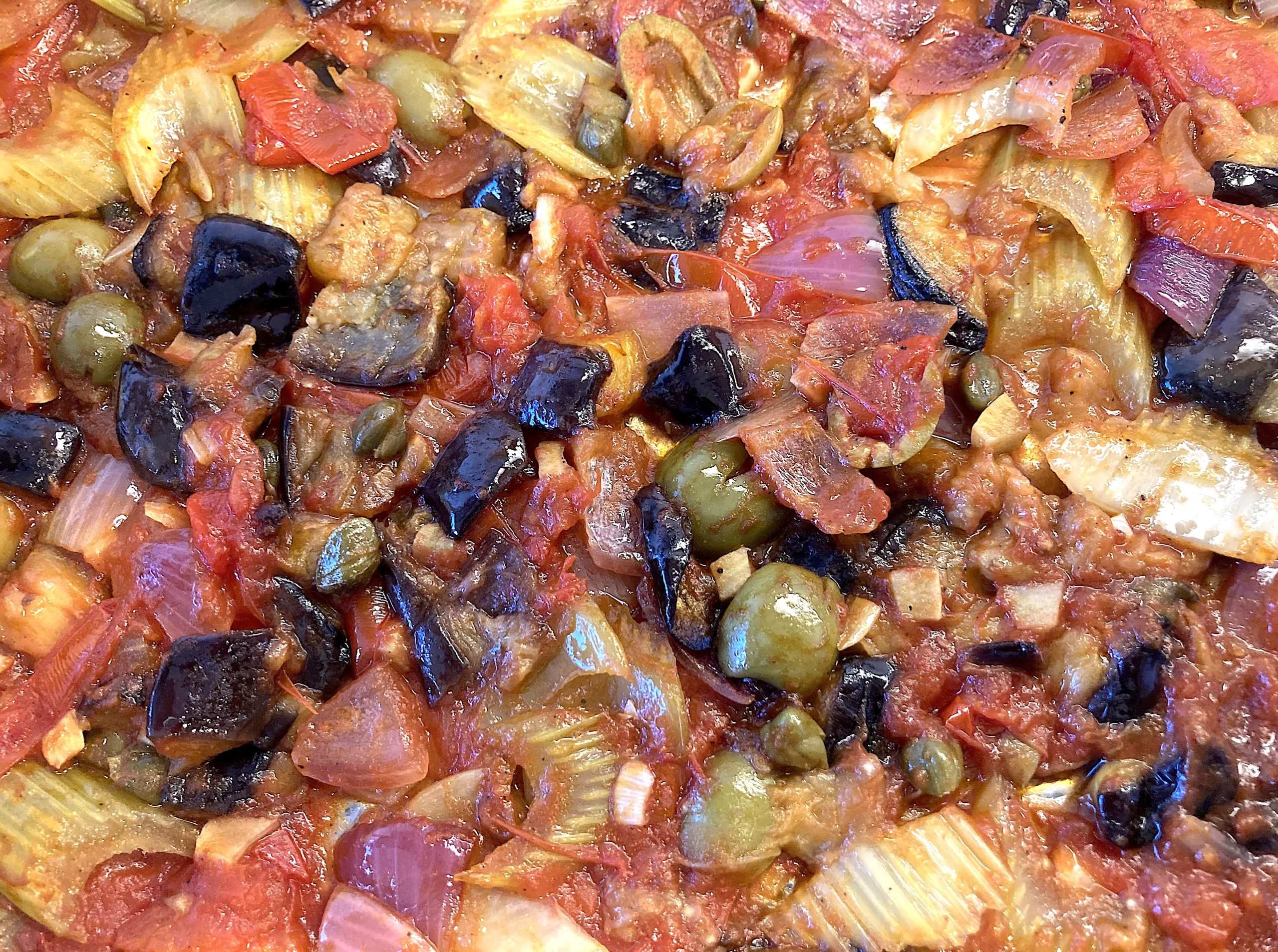
This very tasty dish originates from Sicily and is a mixture of chopped and fried vegetables. Eggplant (Aubergine), Tomatoes, Celery, rRed Onion and Green Olives are the main ingredients. The vegetables are prepared and served in an agrodolce sauce, so sweet and sour. Although we’re not keen on using sugar in a salad, in this case the combination of sugar and vinegar is perfect.
Perhaps the ingredients make you think of Ratatouille. Caponata and Ratatouille are very different dishes. Capanota is about fried vegetables, about crunchy celery, about sweet and sour.

Food and Wine Pairing

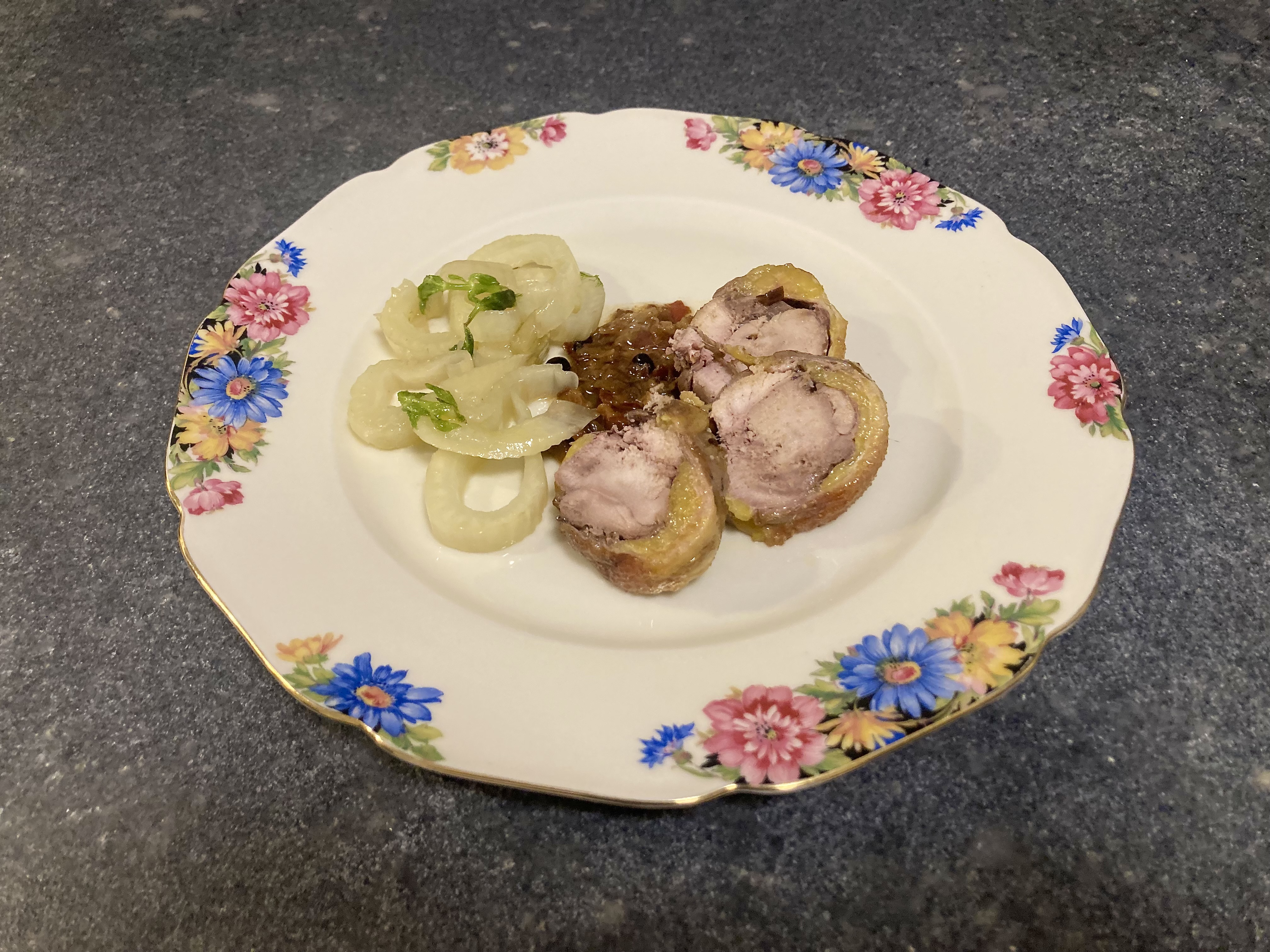
We served our Caponata with a roulade of pork with sage, rosemary, pancetta, black olives and black garlic. A dish we enjoyed with a glass of Barbera del Monferrato 2022, produced by Livio Pavese. In general, we suggest a full-bodied red wine with perhaps a touch of oak. Some acidity to balance the caponata and dark fruit (plums, blueberries).

The next day we served the Caponata with a roulade of chicken with pancetta, Parmesan Cheese and sage. A dish we enjoyed with a glass of Spätburgunder from the Pfalz area in Germany. In general, we suggest a medium bodied red wine with aromas of red fruit. Medium tannins and balanced acidity. Its taste dry, aromatic, fruity, juicy with a touch of strawberry.

You could also add some canned tuna (in olive oil) and serve the Caponata with crusted bread as a starter, perhaps accompanied with charcuterie and a glass of Crémant or Prosecco.

What you Need (recipe for 4)
  • 2 Aubergines
  • 400 grams excellent ripe Tomatoes
  • 10 Green Olives
  • Capers
  • 30 grams Tomato Puree
  • 4 cloves of Garlic
  • 4 small Red Onions
  • 3 stalks Celery
  • Tablespoon of Caster Sugar
  • Tablespoon of White Wine Vinegar
  • Black Pepper.
What You Do

Best to prepare Caponata one day ahead.

  1. Wash the vegetables.
  2. Slice the eggplant lengthwise in 8 and then in chunks. Drizzle with salt and mix. Put the chunks in a sieve and let rest above a bowl for one or two hours.
  3. Coarsely chop the onion.
  4. Quarter the tomatoes. Remove the internal hard bits and the pits and put these aside. Slice the outer part of the tomato lengthwise in three.
  5. Roughly cut the remainder of the tomatoes, add to a sieve and use the back of a spoon to capture the juices.
  6. Coarsely chop the garlic.
  7. Halve the olives.
  8. Use a knife to peel the back of the celery stalks, or ribs. Slice.
  9. Combine the tomato puree, black pepper, the caster sugar, the vinegar and the tomato juice.
  10. Set your oven to 140 °C or 285 °F.
  11. Discard the liquid of the eggplants, wash of the salt, dry with kitchen paper and fry the chunks in a generous amount of olive oil until golden.
  12. Transfer to a baking tray in your oven.
  13. Fry the onions and the celery until somewhat translucent. Add these to the baking tray.
  14. Now add the olives, the capers, the garlic, the tomato mixture and the tomatoes. Mix. Perhaps add a splash of water.
  15. Cover the baking tray with aluminium foil.
  16. After 20 minutes it’s time to mix the vegetables. Check if you need to add extra water.
  17. After another 20 minutes, remove and discard the foil, mix and increase the temperature to 160 °C or320 °F.
  18. Now you need to keep an eye on the mixture. It may take 10 to 20 minutes for the liquid to somewhat evaporate, but you don’t want the dish to become dry.
  19. When ready, let cool and transfer to the refrigerator.

Small Artichokes (Carciofo Violetto)

The season of artichokes depends on the variety and where you are based. In Italy it’s from mid-winter until early spring, in other countries from March to June, or September and October.
An artichoke should feel heavy, look fresh and the leaves should be closed. If the leaves are wide open, the artichoke is older and it could be dry with lots of choke (the hairs) and dry inner leaves.
The artichokes we use in this recipe are special. Not only are they vibrant purple, they are also small with hardly any choke. In Italy they are called Carciofo Violetto. Tasty as you would expect from an artichoke and easy to eat because the texture of the leaves is not stringy.

Wine Pairing

It’s not straightforward to pair artichokes with wine. According to various researchers this is due to cynarin, a chemical especially found in the leaves of the artichoke. When the wine and the cynarin meet in your mouth, the natural sweetness of the wine is enhanced, making it taste too sweet. Pair artichokes with a bone-dry, crisp, unoaked white wine with clear, present acidity. For instance, Sauvignon Blanc, Grüner Veltliner or Albariño.
The Carciofo Violetto artichoke in combination with the olive oil, Parmesan cheese and browned garlic (bitter, nutty) is less demanding when it comes to wine. We enjoyed it with a nice glass of Côtes de Provence rosé.

What You Need
  • Small purple Artichokes
  • Olive Oil
  • 2 Cloves of Garlic
  • Parmesan Cheese
What You Do

Preheat your oven to 180 °C or 355 °F. Cook the artichokes for 5 minutes in boiling water. Allow to cool and remove the outer leaves. Be generous, it’s better to remove too many! Halve the artichokes and place them in a shallow oven dish. Drizzle with olive oil. Transfer to the oven for 5 minutes. In the meantime, grate Parmesan cheese, chop the garlic and mix. Spread the mixture on top of the artichokes. Wait for the cheese and the garlic to colour, perhaps 5 minutes. Serve immediately.

PS

Other recipes with artichokes you may like:

An invitation to Indian Cooking

Recently we reviewed An invitation to Indian Cooking (published in 1973) by Madhur Jaffrey as part of the ongoing cookbook review project by Bernadette. When we leaved through the book we were looking for something special, something new and exciting to prepare. Dal soup (the classic Indian soup made with red lentils, onion, various spices and perhaps ginger or orange) was not on our radar, until we read her recipe. Interesting! Yellow Split Peas? Cloves? Croutons? Let’s start cooking!
The soup was very tasty and uplifting. The split peas brought structure to the soup, making this soup different compared to lentil-based dal soup. The combination of peas and cloves is one to remember. 

Dal Soup ©cadwu
Dal Soup ©cadwu

Asafoetida

We’re always interested in new ways to prepare mushrooms, so when we spotted a recipe with cumin and asafoetida (asafetida) we immediately knew we wanted to prepare this dish. But what is actually asafoetida and where to buy it?
The first thing to know about asafoetida is that it has an extremely powerful aroma. Its taste and smell are a combination of onion and garlic. We bought 25 grams at Jacob Hooy which is Amsterdam’s premium shop for spices. The Dutch name is Duivels Drek and the German name Stinkasant. Both names are a clear indication of its pungent smell.
Mushrooms, tomatoes, various spices and asafoetida: we didn’t know what to expect of the dish. The result was delicious, aromatic (in a subtle way) and a tribute to the tomatoes and mushrooms, with a long-lasting taste. We loved it. Mrs. Jaffrey suggest serving the mushrooms with chapatis or pooris. Recipes are included in her book, obviously!

Mushrooms with Cumin and Asafetida ©cadwu

The Book

An invitation to Indian Cooking by Madhur Jaffrey is a comprehensive introduction to the Indian kitchen, one with reliable, easy to follow, tasty recipes and useful background information. The book includes chapters on meat, chicken, fish, dal, soups, vegetables, chutneys, breads and desserts. Which reminds us of our plan to make Kulfi (ice cream with milk and cardamon pods).
An invitation to Indian Cooking by Madhur Jaffrey is available via your local bookstore or the usual channels for 15 euro or 18 US$.

Recipes can be found on Bernadette’s website.

Scallopini

A very tasty and simple dish from the Italian cuisine: Scallopini. It’s been popular for decades (a recipe is included in La Scienza in Cucina e l’Arte di Mangiar Bene by Pellegrino Artusi, published in 1891) and for very good reasons. A dish like Scaloppine al Limone is rich, refreshing and very tasty.

Scallopini is about thin slices of meat (veal preferred). The meat is dusted with flour and then fried (not browned) very briefly in oil and butter. Transfer from the pan, keep warm and make a sauce in the pan (with lemon and parsley for instance). Transfer the meat back to the pan, coat with the sauce and serve.

Unfortunately, you will find lots of recipes for Scallopini that suggest keeping the meat in the pan while making the sauce. If you do so, your sauce is not sufficiently reduced and the meat will be rubbery because it’s overcooked.

Essentials of Classic Italian Cooking 

In 1992 Marcella Hazan published Essentials of Classic Italian Cooking, a comprehensive overview of the Italian Cuisine. To quote Nigella Lawson: “If this were the only cookbook you owned, neither you nor those you cooked for would ever get bored.” The recipes are well written, clear and helpful. In her book she includes several recipes for Scallopini. One combines veal, ham, anchovies, capers and grappa. Intriguing, but wouldn’t that be a bit too much?
It turned out to be delicious. The veal was tender, juicy and delicious. The sauce had a long, rich intense but subtle taste, one that worked very well with the veal. We balanced the Scallopini with an aromatic fennel mash.

Essentials of Classic Italian Cooking is available via your local bookstore or the usual channels for 25 euro or 30 US$.

Wine Pairing

We enjoyed our Scallopini with a glass of Bardolino, made by Monte del Frà from Italy. The grapes used are Corvina, Rondinella and Molinara. It is a well-balanced, vibrant ruby red wine with lots of fruit and a hint of spices. Medium acidity. In general, you’re looking for a refreshing red wine with lots of fruit that should be served slightly chilled.

What You Need

  • Buy the book is probably the best option!
  • Butter
  • 2 anchovy fillets
  • 2 Veal Cutlets (flattened)
  • 75 grams Pancetta or Guanciale
  • 1 tablespoon Capers (in brine)
  • Grappa
  • Black Pepper
  • Double Cream

What You Do

As with all Scallopini, make sure you have first class veal, nicely flattened, similar to a schnitzel, but perhaps even thinner (but not torn).
In a small pan combine butter and mashed anchovies. Warm gently, creating a warm mash. Dice the pancetta or the guanciale. Fry for a few minutes in a separate pan. Transfer the pancetta to the butter and anchovy combination. Discard the fat. Drain (and somewhat dry) the capers. Chop and add to the mixture. Fry for a minute on relatively high heat and then set aside.
Preheat a heavy iron skillet, medium heat is fine. Add olive oil and butter to the pan. Dust the veal with flour and fry for 30 seconds. Transfer to a dish and keep warm. Remove most of the fat from the pan, deglaze with grappa. Now add the anchovy mixture, juices from the meat (if any) and the cream. Reduce. Add the Scallopini and warm them through and through in the sauce for perhaps 2 minutes. Add some black pepper. Serve immediately on warm plates.

Fennel Mash

Chop the fennel and cook in vegetable stock. Reduce. Add butter, crème fraîche and white pepper. Coarsely blender the mash, perhaps add a drop of Pastis.

Vegetable Stock

It’s all too familiar, you’re reading a recipe, you like what you read until it says, “Use 250 ml home-made broth or dissolve a bouillon cube in 250 ml water”. Hm. The cube is not an option because it’s salty and salty only. Perhaps open a jar of (organic) fond made by Jürgen Langbein? Or make your own?

You only need four ingredients to make a very tasty vegetable stock: onion, leek, carrot and celery. The result is full of flavours, with a touch of sweetness, saltiness and length.

The combination of onion, carrot and celery is known as mirepoix in the French cuisine and as soffritto in the Italian kitchen. A classic when making a stew, a ragu or the aromatic base of a sauce. Adding leek to the combination makes it more complex and tastier.

The celery could be a bit confusing: should it be celeriac, the root (knob) or celery, the fibrous stalks? Some suggest using the root in winter and the stalks in summer. We suggest using the stalks in all cases. They are very aromatic and they bring saltiness to the stock, different from the root.

The stock freezes very well. We have two versions in our freezer, as ice cubes for sauces and small 250 ml containers for risotto, soup, a stew etcetera.
Problem solved!

What You Need

  • 1 Large Onion
  • 3 Celery Stalks
  • 1 Carrot
  • 1 Leek
  • 1 Bouquet Garni (Parsley, Bay Leaf, Chives)
  • Black Pepper Corn

What You Do

Clean and chop the celery, the carrot and the onion. Add all ingredients, some crushed pepper corns and the bouquet garni to a pan with cold water and allow to simmer for one hour or so. Pass through a sieve, taste and decide if you want to reduce the liquid. Use immediately or transfer to your freezer.

PS

Three stalks of celery, you think, but what to do with the remaining ones? The answer is simple, chop the stalks, add to boiling water for 1 or 2 minutes, cool in ice water and freeze. They will be perfect for months. Ready to use as accompaniment with fish, with pork or as an ingredient of your mirepoix or soffritto. Or your vegetable stock, of course.