Sandwiched Parasol Mushrooms

In 2005 Antonio Carluccio published The Quiet Hunt, the Complete Mushroom Book. In this book he describes various mushrooms, discusses their habitat and edibility and of course offers a range of mushroom recipes. Recently we were at a second-hand bookstore, and we spotted La Passion des Champignons. We assumed that this was the French version of The Quiet Hunt, but surprisingly it wasn’t! The original of this book is called A Passion for Mushrooms and was published in 1989. We obviously expected some overlap between the two, but since we saw several new recipes, we decided to buy it. As soon as we were at home, we compared the two books. In a Passion for Mushrooms, you will also find descriptions of various mushrooms plus a range of mushroom recipes. The overlap however is minimal. A Passion for Mushrooms includes some wonderful recipes and combinations we didn’t expect, for instance Filet de Bœuf aux Pleurotes et aux ChanterellesTruite aux Pied BluesRagout de Crevettes Rose et de Morilles and Velouté d’Huitre aux Truffes. The book also includes a chapter on conservation techniques.

We prepared two dishes from the book, Sandwiched Parasol Mushrooms and Halibut with Saffron Milk Cap.

A Passion for Mushrooms is a must have for mushroom-lovers. The book is available via the usual channels and perhaps at your local second-hand bookstore. Prices will vary.

Sandwiched Mushrooms

The Parasol Mushroom is a common mushroom in many countries. It is very tasty and easy to prepare. It has a beautiful juicy and meaty texture, and its flavour is delicate with a touch of lemon. Simply fry the caps alla Milanese or stuff young parasol mushrooms with onion, sage or minced meat. Or in this case, with ham and cheese!
We liked the idea of sandwiching because it allows for a nice amount of stuffing and it keeps the mushroom intact. By frying the sandwiched parasol mushrooms in the oven, the mushrooms will become thin and crunchy. The flavour of the stuffing was more complex than we expected. The combination of ham, cheese and parsley worked very well. Be careful with the breadcrumbs, these are only needed to get the right consistency.

Wine Pairing

A Pinot Grigio from the Italian Alto Adige region will be a great accompaniment. In general, you’re looking for a white, fresh, dry, non oaked wine with floral notes.

What You Need
  • 4 Parasol Mushrooms or large Mushrooms (portabella)
  • Shallot
  • Garlic
  • Egg
  • Breadcrumbs
  • Gruyere or Emmenthaler
  • Parmesan Cheese
  • Ham
  • Parsley
  • Black Pepper
  • Olive Oil
What You Do

Details of the recipe can be found in A Passion for Mushrooms. Buy the book and enjoy this dish and many more!
Finely chop the shallot and fry in olive oil. Clean the mushroom and discard the stem (if using parasol mushrooms, otherwise chop the stems and fry with the shallot). Add finely chopped garlic to the pan. After a few minutes remove from the heat and allow to cool. Chop the ham and the parsley, grate the two cheeses. Whisk the egg, add cheeses, black pepper, parsley and ham. Add the shallot and garlic. Add breadcrumbs. Add half of the mixture on top of a cap and close with another slightly smaller cap. Add oil to a baking tray, add the two sets of mushrooms. Brush with olive oil, sprinkle with some breadcrumbs and then add a few drops of olive oil. Fry in the oven at 180 °C or 355 °F for 20 minutes.

Cordyceps

Bright orange mushrooms that look like spaetzle? Interesting. We pick one up and look carefully: a long stem but without a cap with spores. Odd. We ask if they are edible, and the obvious answer is “yes”. We buy 100 grams and decide to look for details and recipes in our mushroom cookery books when at home.
Hm. No mention of Cordyceps. We visit the Forager Chef (Alan Bergo) and read about the background of the Cordyceps (or better: Ophiocordyceps). Parasite mushroom, infects insects, controls them, takes over, kills and then sprouts a fruiting body from their head. The fruit we just bought…
Fortunately, the Cordyceps we bought are grown on substrates that are not made of insects, which make them less scary. Normally when we find a new mushroom on the market, we taste it raw, but not today.
We quickly wash our hands and watch this BBC video as suggested by Chef Bergo. Interesting, but we prefer the culinary aspects of mushrooms.

Use

In traditional Chinese medicine dried and powdered cordyceps are used. Today it is considered to be superfood, supposedly boosting your vitality and endurance. Fresh cordyceps are used in Chinese soups and hot pots. Chef Bergo uses them in a dish with linguini. He writes: “The cordyceps weren’t mind blowing, but they definitely weren’t bad”.
We decide to make an Asia-inspired salad, with stir fried cordyceps, obviously. The salad tasted great. It was nutty, mild, fresh and the texture of the mushrooms worked beautifully with the crunchy radishes. 

Wine Pairing

Best to drink a white wine with a touch of oak, perhaps a chardonnay. We tried something different, a wine made with a grape called Bouquet 1359. The wine is produced by French winery Abbotts & Delaunay. The grape was developed by Alain Bouquet. It is somewhat similar to the chardonnay grape but more resistant and easier to use in an ecologic environment. It comes with aromas of brioche and yellow fruit; the taste is fresh, long and slightly nutty. 

What You Need
  • 100 grams Cordyceps
  • 1 Scallion
  • Bok Choy
  • White Radishes or Daikon
  • Walnut Oil
  • Jerez Vinegar
  • Light Soy Sauce (we used Tsuyu)
  • French Mustard
  • Olive Oil
What You Do
  1. Clean the mushrooms if necessary
  2. Cook radishes or daikon for 4 minutes in boiling water
  3. Let cool quickly and slice or quarter
  4. Finely slice one or two bok choy stems, depending on the size
  5. Heat a skillet, add some olive oil and fry the mushrooms
  6. After 1 minute add the sliced bok choy and the pre-cooked radishes
  7. Toss, leave for 1 or 2 minutes and allow to cool
  8. Transfer to the refrigerator
  9. When ready to serve, make a dressing by combining walnut oil, soy sauce, Jerez vinegar and a touch of mustard. The mustard will emulsify the dressing
  10. Taste and adjust
  11. Happy?
  12. Then add the dressing to the salad, mix and serve as a side dish or small appetizer.
Inspiration

If you’re into video games you will have recognised cordyceps as inspiration of the action-adventure game The Last of Us, which was the inspiration for the American post-apocalyptic drama television series with the same tittle and produced by HBO.
The 2016 movie The Girl with All the Gifts was also inspired by cordyceps. Two Pokémon species are also based on Ophiocordyceps.

Nasty Details

A few days later we opened Merlin Sheldrake’s impressive book Entangled Life. He explains that the fungus doesn’t turn the insects into zombies but controls it like a puppeteer master. He describes how a specific species of Ophiocordyceps is focused on giant ants. The fungus infects the ant and from that moment on it controls the insect. In the end 40% of the body weight of the ant is mycelium (the network created by the fungus). Through the mycelium the fungus controls the ant. When the Ophiocordyceps is ready to propagate, it steers the ant to a height of approximately 25 cm, ideal for the fungus and its spores. The ant then bites into the main vein of a leaf and locks its jaws. The ant is now in an ideal position for the fungus. This is the moment the fungus kills the ant and the fruit begins to grow.
Very pleased our cordyceps were grown on a substrate of grains!

PS

More mushroom recipes on our mushroom page.

Hazelnut & Raisin Bread

Two or three times per week we enjoy the taste of fresh home-made no-knead bread. The crust, the flavours, the aromas! And how about the singing of the bread when it’s just out of the oven? Baking your own bread is such a pleasure.

Our recipe for no-knead bread is based on a recipe published by Jim Lahey, owner of Sullivan Street Bakery, New York. It was published in the New York Times in 2006 and can also be found in his excellent book My Bread. The process is time consuming (it’s 24 hours from start to finish) but not labour intensive. The recipe is based on slow-rise fermentation. With only 1 gram of instant yeast in combination with 18+3 hours of rest the yeast will do a wonderful job. The dough will be perfect. And kneading, as you would expect, is not required.

Normally we bake our bread with blue poppy seed and brown linseed. Today we bake a luxurious bread with hazelnuts, raisins and cinnamon.

What You Need
  • 200 grams of Whole Grain Flour
  • 230 grams of Plain White Flour
  • 1 gram Instant Yeast
  • 70 grams Hazelnuts (peeled and roasted)
  • 130 grams Raisins
  • 2,5 grams Cinnamon
  • 4 grams Salt (this is less than usual, most recipes for bread would suggest 8 grams)
  • 345 grams Water
  • Additional Flour
  • Bran
What You Do

Mix flour, yeast, cinnamon and salt. Add water and create one mixture. Let rest in a covered bowl for 18 hours.
Soak the raisins for 10 minutes in warm water. Remove excess water. Cover your worktop with a generous amount of flour. Remove the dough from bowl and flatten somewhat. Cover the middle third with one quarter of the raisins and hazelnuts. Fold the lower third on top of the middle third. Cover with the second quarter. Fold the top third on top the the middle third. Cover the centre with a quarter of the raisins and hazelnuts. Fold the right part on top of the centre. Ad the last quarter of raisins and hazelnuts on top of the centre and fold the fold the left part on top of it. Dust with additional flour and let rest on a towel dusted with flour and bran for 3 hours. Check that the pot (and the handles!) can be used in a really hot oven. Transfer the pot to the oven and heat your oven to 235˚ Celsius or 450˚ Fahrenheit. Put the dough, seam side up, in the pot, close it and bake for 30 minutes. Remove the lid and bake for 15 minutes or until it is nicely browned. Let cool on a wire rack for at least an hour before slicing it. Enjoy with a generous amount of butter.

Hazelnut & Raisin Bread ©cadwu

RecipeTin Eats – Dinner

Recently we reviewed RecipeTin Eats Cookbook: Dinner by Nagi Maehashi as part of the cookbook review project by Bernadette. It is a beautifully designed book with lots of great pictures. It is also a very positive and inviting book. In 2023 it was awarded Australian Book of the Year and it made the New York Times Best Sellers list. Nagi’s very popular website offers over three hundred recipes and videos. She has over one million followers on Instagram. Her philosophy on food and cooking is based on four principles: fast, creative, clever and fresh. And cost conscious as well!

Nagi also runs a food bank, RecipeTin Meals, where she and her team (including three full time chefs) make homemade meals which are donated to the vulnerable.

RecipeTin Eats Cookbook: Dinner contains not only over 150 recipes, but also recipes for basic sauces, stock, bread, a glossary and a table with internal cooked temperatures. All very helpful. Not so helpful are the indexes (don’t expect the obvious table of content) and the way the recipes are grouped in the book. The recipe index for instance comes with categories such as everyday food and what I do with a piece of…. Perhaps a bit too creative?

Every recipe in the book has a QR-code. Scan it and you have a helpful video guiding you through the recipe.

RecipeTin Eats Cookbook is a cookbook with lots of international dishes such as Beef Wellington, Mussels in White Wine, Sauce Bolognese and Chilli Con Carne; no recipes with kangaroo or ostrich.
We decided to make three dishes from the book, a salad with an Asian touch, a Moroccan dish with chicken and a blueberry tart with an almond filling. Our esteemed panel (André, Carolien, Hans, Joke, Martine and Rutger) was happy to join us on a sunny evening in May and talk about the three dishes. And the wine, of course!

Prawn Salad with Coconut Lime Dressing ©cadwu

We decided to make a Prawn Salad with Coconut Lime dressing because of the dressing. We expected the combination of Chinese Cabbage (or wombok in Australia), coconut, mint, cilantro and prawns to be tasty and refreshing.We served the dish with a glass of Pinot Grigio produced by Corte Vittorio.

A fresh and easy to drink wine with aromas of citrus and green apple. In general, you’re looking for a light white wine with pleasant acidity and fresh aromas. The panel was unanimous: refreshing, lots of flavours that go together very well, great colours, new flavours, love the way the apple combines with the cabbage, great on a summer evening, would like to make this myself, could I have the recipe?

One Tray Moroccan Baked Chicken with Chickpeas ©cadwu

The One Tray Moroccan Baked Chicken with Chickpeas comes with lots of flavours, baharat being one of them. A spice blend unknown to us. Fortunately, we could find it at our Turkish supermarket. Think cinnamon, cumin, nutmeg, ginger. The chicken is marinated for 24 hours in a mixture of lemon juice, oil and baharat.

It is then fried in the oven with chickpeas (coated with ginger and turmeric), fennel and tomatoes. We served the Moroccan chicken with excellent crusted bread and a glass of full-bodied Italian red wine, produced by Stefano Accordini. The wine is made from 90% Corvina Veronese and 10% Merlot grapes. It aged for four months in oak barrels, which adds to the warmth and flavours of the wine. A very affordable wine with aromas of blackberry, plum and chocolate. In general, you’re looking for a full bodied, rich red wine that goes very well with flavours like nutmeg, cumin and cinnamon.

The panel liked the presentation, the colours, the aromas and the preparation of the chickpeas in the oven. The flavours were nice, but a bit bland. It could have done with more spices. Although the chicken marinated in the refrigerator for 24 hours, the flavours of the baharat were not really present in the meat.

Blueberry Tart with Almond Filling ©cadwu

Dessert was Blueberry Tart with Almond Filling. The heading of the recipe says prep time 45 minutes, 4 hours of cooling and chilling, 1 hour cook time. Sounds doable? In reality it’s a bit more work.
The dough needs to be made, cooled, fitted in the tin, transferred to the freezer, in to the
oven, baked blind,

cooled and then filled with an almond cream that must be mixed, cooled, added to the tin, topped with blueberries, baked, topped with more blueberries and baked for another 20 to 25 minutes. Still there?
The idea of freezing the dough in the tin was great because it allowed us to do this step a few days earlier.

The panel liked the tart, the moist filling, well balanced, not too sweet, great crust and the combination of almond and blueberry was very tasty.

All three recipes required some adjustment: when we tasted the salad before serving it, we found the dressing needed extra mint and fish sauce. We also added more berries to the tart.

Should this book be on your shelf? The panel feels it’s a great, colourful, well-designed cookbook but that the number of recipes that are new or bring something specific (like the salad and the chicken we prepared) is rather limited. We would have liked to see more of Nagi, and perhaps of Australia, in the choice of recipes. One member of the panel decided to buy RecipeTin Eats Cookbook: Dinner, given the idea that if you would prepare one of Nagi’s recipes per week you would be sure to have at least one fast, tasty, colourful and creative meal per week. Very true!

RecipeTin Eats Cookbook: Dinner by Nagi Maehashi is available via your local bookstore or the well-known channels for approximately 30 euros or 30 US$. Prices may differ.

Thank You Betty’s!

Last Friday Restaurant Betty’s in Amsterdam closed its doors after more than 35 years. Betty’s was the place to go if you wanted to enjoy delicious vegetarian food and excellent Vin Nature. The restaurant served a three course surprise meal. Each course was a culinary journey around the world and existed of five or more dishes, each one tasteful and interesting, eloquently introduced by Gido. In 1988 he and his mother Rifka started the restaurant. Rifka specialised in vegan cakes and Gido focused on savoury dishes. Later Gido and Lien transformed Betty’s into a petit bistro. A place where you could enjoy delicious food. The music and ambience were peaceful and relaxing. No rush, take your time, talk about the food and wine with Gido, have a chat with Lien about the spices from Olivier Roellinger, about their choice of organic, local ingredients, their self imported Greek olive oil.
We enjoyed so many delicious dishes, for instance:

  • guacamole made with yoghurt, lime juice and roasted bell pepper
  • date caramelised in salted butter with chili peppers
  • borek with spinach, potato and garam masala
  • slow cooked ratatouille
  • saffron milk caps with artichoke and reduced tomatoes
  • potatoes fried in mustard seed oil with chili peppers, fennel seed and dill, and of course their
  • warm sticky toffee pudding
  • chocolate-chocolate cake and the superb
  • raspberry and white chocolate cake.

Everything homemade and super fresh, always served with love and attention.
Thank you, Gido and Lien, for so many wonderful evenings!

Ottolenghi’s SIMPLE

In 2017 during the Amsterdam Symposium on the History of Food, Yotam Ottolenghi was awarded the prestigious Johannes Van Dam prize, in recognition of his contribution to the culinary tradition. The prize is named after Dutch culinary author and critic Johannes van Dam who was not only known for his reviews of restaurants but also for his massive collection of books on food and drinks. The jury, chaired by Professor Louise O. Fresco, mentioned his passion for vegetables and his talent to bring colour and flavours to his food. She also mentioned his influence on what we eat in general and how he made bold, tasty Mediterranean ingredients and food popular and accessible through his books.
Yotam Ottolenghi is a well-known and very successful chef, patron, restaurateur and cookbook author. If someone says, “This is a recipe from Yotam Ottolenghi”, the suggestion is that the food will be exciting, colourful, vegetable focused, delicious and absolutely modern.
During one of the breaks, we leaved through his books. Great pictures, nice design, well written recipes and the food delectable. Perhaps we should buy one of his books?
For some reason we didn’t.

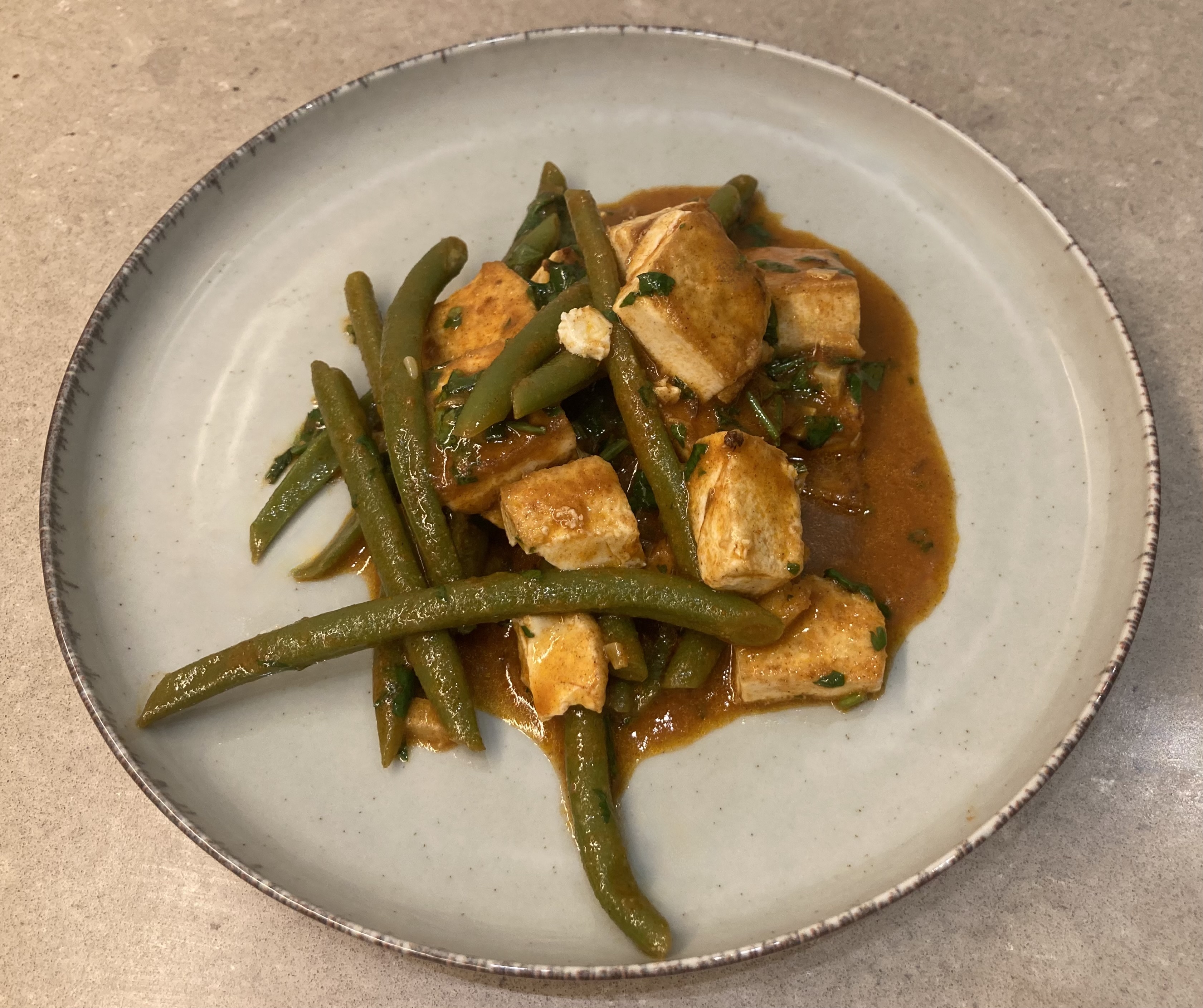
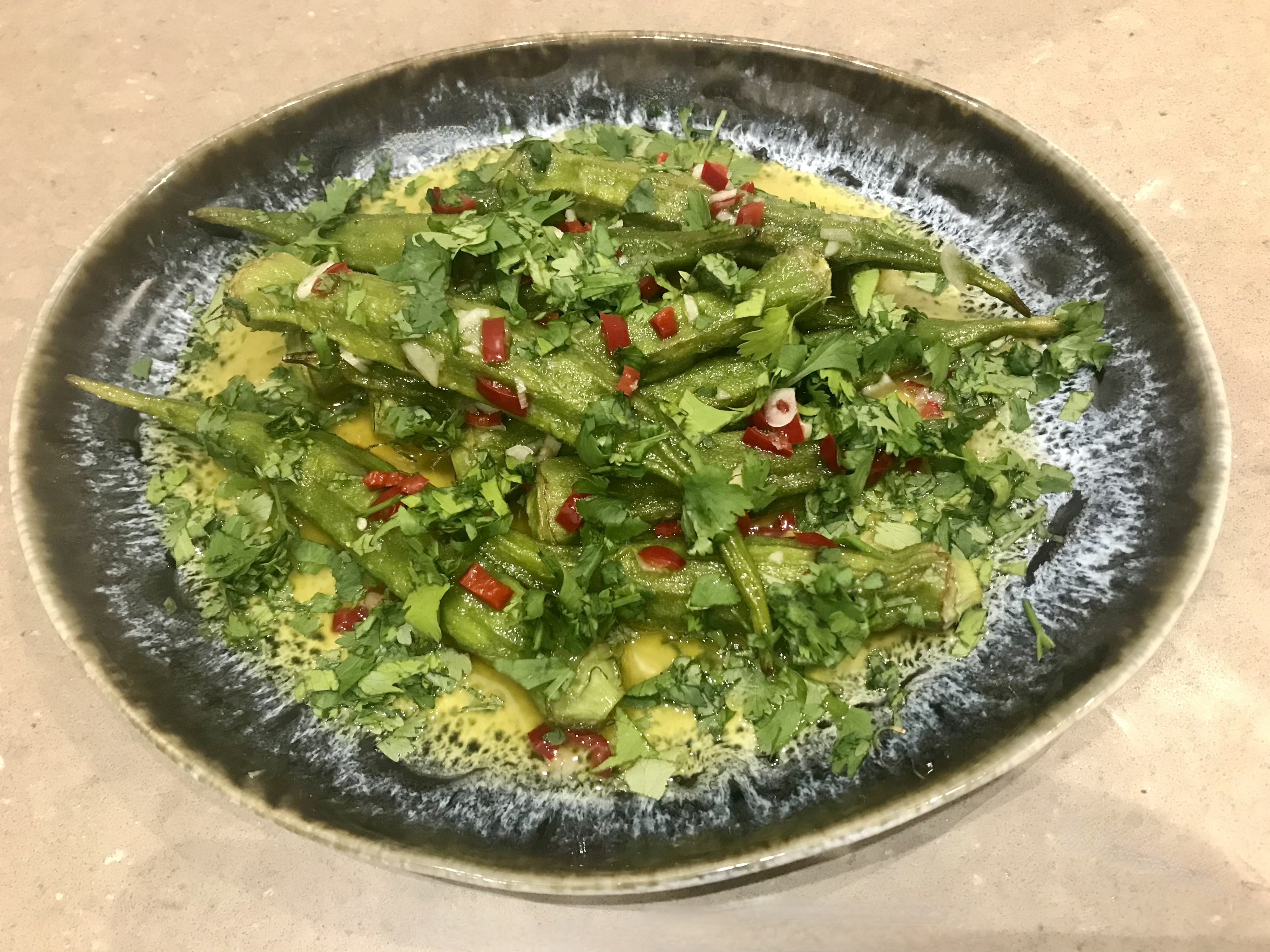
When Bernadette suggested to review SIMPLE, as part of her excellent series of cookbook reviews, we borrowed a copy and decided to make two recipes: Tofu and French beans with chraimeh sauce and Quick okra with sweet and sour dressing. The Tofu-dish is labelled with S, meaning it’s Short on Time. The Okra one is labelled with S and I, meaning it has 10 or less Ingredients and is Short on Time.

Tofu

The tofu dish is a combination of French beans, flour, tofu, sunflower oil, dill, black pepper, salt and coriander. The chraimeh sauce is made with garlic cloves, sweet paprika, caraway seeds, ground cumin, ground cinnamon, green chilli, sunflower oil, tomato paste, caster sugar and lime juice. The result is tasty and flavourful, although, honestly, we think it would be better to leave out the tofu. Then you would have a very nice side dish. The chraimeh sauce will probably combine very well with fish. The recipe for this dish was published in the Guardian.

Okra

We love okra, so we were keen to make the salad. It’s a combination of okra, olive oil, garlic cloves, red chilli, sweet chilli sauce, maple syrup, lime juice, sesame oil, coriander leaf and salted roasted peanuts. We didn’t add peanuts. The salad was very nice and balanced with lots of flavours. One to remember. This recipe was also published in the Guardian.

The Book

We enjoyed both dishes, but we haven’t bought SIMPLE for a number of practical reasons. For instance, the vast majority of the recipes requires you to preheat your oven to 180 °C or 200 °C. Not something you’d like to do on a regular basis if you cook for 2 persons as we do most days. Another practical point is the size of his books: they simply don’t fit in our bookcase. Fortunately he has published many recipes on his website and there are 60 videos available via his YouTube channel.

Should SIMPLE be on your shelf? Probably yes if you’re looking for very tasty dishes, clear instructions, inspirational combinations and beautiful pictures. But we could also imagine that you’re happy reading his weekly recipes in the Guardian! SIMPLE is available via your local bookstore or via the well known channels for 20 US$ or 26 Euro.

Claudia Roden – The Book of Jewish Food, part 2

As contributor to the cookbook review project by Bernadette we reviewed The book of Jewish Food, An Odyssey from Samarkand and Vilna to the Present Day. The book combines more than 800 recipes with the stories and histories that have shaped Jewish cooking over the centuries. The book showcases the diversity of Jewish food. It’s about (Jewish) culture, about how food is part of our shared culture, how we are all connected and how food can help us understand history.

We prepared Joodse Boterkoek and Aliyah, a dish that combines chicken, tomato, tamarind, basil and cilantro. We served it with polenta. Both are delicious!

We also very much liked Fish Balls in Tomato Sauce as prepared by John Rieber. The fish balls are a combination of white fish with ginger and nutmeg. The dish originates from Egypt and Morocco. It will perhaps make you think of Gefilte Fish, a traditional appetizer. The recipe is not complex and the result as prepared by John looks great. One we will be making soon!

Jo Tracey prepared a Goulash Soup with beef, sweet paprika and a touch of chilli. She writes: “I first bought the digital version of this book a few years ago but I never got around to reading it or cooking from it until now. And what a treat it’s been.” The soup is rich and one we would cook on a wintery day.

Robbie Cheadle baked a Honey Cake, made with honey, brandy, coffee, cinnamon, cloves, orange zest, almonds and sultanas. Sounds wonderful! According to Robbie: “This cake is delicious, and we all enjoyed it. The orange zest, coffee, and honey create a lovely symphony of flavors.

Bernadette herself chose a recipe from the Ashkenazi section of the book – Holishes or Stuffed Cabbage Leaves; a dish that appeared frequently in her childhood home. The leaves are stuffed with a combination of beef, rice and onion. The sauce is made with tomatoes, lemon, ginger, apple, raisins and honey. Not the most obvious combination! The result looked absolutely yummy.

The book of Jewish Food by Claudia Roden is available via your local bookstore or the usual channels for approximately 50 US$ or 40 euro. Highly recommended!

Claudia Roden – The Book of Jewish Food, part 1

The cookbook review project by Bernadette is a great way to explore cookbooks. The book of Jewish Food by Claudia Roden was not yet on our bookshelf, so we bought a copy of the 25th edition for 40 euro.  Its subtitle is An Odyssey from Samarkand and Vilna to the present day. The book combines more than 800 recipes with the stories and histories that have shaped Jewish cooking over the centuries. The book showcases the diversity of Jewish food. 

The first time we saw Claudia Roden was during the 2016 Amsterdam Symposium on the History of Food. In 1999 she received the Prince Claus Award in recognition of her exceptional initiatives and achievements in the field of culture. She is author of the classic comprehensive book Food of Italy and member of the jury of the prestigious Johannes van Dam prize, awarded in 2016 to Yotam Ottolenghi. We were far too impressed to actually talk to her. A bit silly, agreed, and we will make up for it in April 2025 during the next Symposium.

The Netherlands

The Dutch Jewish community plays an important role in the Netherlands, and more specifically in Amsterdam. The community was formed in the seventeenth century by people who came from Portugal (Sephardi Jews) and from Germany and Eastern Europe (Ashkenazi Jews). In general the first group was worldly, cultured and well connected to the Dutch upper classes. The second group was poor and unskilled. They worked as market traders, food sellers (for instance pickled vegetables and salted herring with chopped onions, which is still a Dutch treat) and pedlars.

Over the years both groups influenced Dutch cuisine. According to food author and publisher Jonah Freud dishes such as Haringsalade met Bietjes (see here for our version) and Broodje Halfom (a bun with beef liver and salted beef (somewhat similar to pastrami) with white pepper) are typical examples of the Jewish influence on Dutch cuisine. Gemberbolussen (a sweet cake with ginger) and Kugel (a cake with almonds and pears) are still widely available in Amsterdam.

Two Recipes

We decided to make two recipes from the book. Boterkoek is very typical for the Netherlands. A rich combination of lots of butter, sugar, flour and a pinch of salt. Classic and easy to make. We slightly adjusted Claudia Roden’s recipe, inspired by Dutch Pâtissier Cees Holtkamp. Early on during his career he learned how to bake Boterkoek when he worked for a Jewish Bakery. 

The second recipe is for Aliyah, stewed chicken with tomatoes, tamarind, cilantro and basil. An intriguing combination and one we simply had to try. The recipe originates from the Georgian town of Kulashi. This small town was once the home of one of the largest Georgian Jewish communities.

Obviously we decided to enjoy a kosher wine with the Aliyah. We bought a bottle of Barkan Classic Merlot-Argaman 2021. The Argaman grape (an Israeli creation) is combined with Merlot. The result is an intensely coloured red wine with dark fruit, supple tannins and depth. In general, we would suggest a medium to full-bodied red wine with sufficient depth and length.

Your Bookshelf

We think this book should be on your bookshelf. It’s about (Jewish) culture, about how food is part of our shared culture, how we are all connected and how food can help us understand history. It took Claudia Roden 16 years to write it. We can only thank her for this impressive and relevant achievement.

The book of Jewish Food by Claudia Roden is available via your local bookstore or the usual channels for approximately 50 US$ or 40 euro.

Recipes for Joodse Boterkoek and Aliyah on Bernadette’s website.

Thank you Fred!

In 1965 Yolanda and Fred de Leeuw took over Slagerij De Leeuw, previously owned by his father. They turned it into not only the best butcher in Amsterdam, but also the place to go for excellent home-made pastrami, the most delicious Bresse chicken and their smoked sausages. They started importing truffles for Urbani, had the best US beef and later the prestigious Kobe beef. Every Christmas they would have a brochure with an overview of culinary products (all home-made) and exceptional food. How about Chapon de Bresse (en demi-deuil) or Pauillac Lamb?

For Fred and Yolanda it was not about extravagance or running an expensive shop. It was about quality. About offering the very best to their customers. And yes, it was expensive, but it’s better to enjoy excellent pork once a week than eating mediocre meat every day of the week from poor animals stuffed with antibiotics. They retired in 2000, but their philosophy continues to be important.

In an interview with Fred and Yolanda, published last year, they make a number of interesting comments, for instance: “It’s better for everybody to grow less animals on more ground during a longer period. Better for the farmer, better for the animal and better for the consumer.”

We couldn’t agree more. Such a pity we continue to rush to supermarkets, the cheapest salmon, the cheapest chicken, more for less, without worrying too much about animal welfare, quality, taste and the impact on the environment and the climate.

We can hear you thinking: “So you’re saying the poor should eat beans and turnips, leaving the meat for the rich and well to do?”

Of course we don’t.

We’re saying that we all should understand that meat is an expensive product. And that three chicken wings for just €2,90 is only possible if the chickens live an awful life.

We are part of a vulnerable eco-system and we should help protecting it.

Fred de Leeuw passed away on October 21st 2023. We will remember him for his passion for quality and we thank him and Yolanda for sharing it with us. The last time we met, summer 2023, Yolanda and Fred talked with so much enthusiasm about a new restaurant they discovered, a restaurant focused on vegetables.
Fred said: “We’re butchers and we will always be butchers, but you won’t believe how delicious their food is.”

Your Favourites in 2023

Happy New Year! Let’s begin the new year with the 2023 highlights. Your favorite post was No-Knead Bread, We have been baking our own bread for several years, based on the method of no-knead bread (see Jim Lahey’s book My Bread for more detail) and using the ingredients (Blue Poppy Seeds, Linseed) of the French Talmière. The result is delicious!

Another very popular post is the one showing you how to make Kimizu. This is a classic, golden sauce from Japan, made with Egg Yolks, Rice Vinegar, Water and Mirin. We also have a version with Tarragon, let’s say the Béarnaise version of Kimizu. The recipes for Kimizu and Kimizu with Tarragon continue to be very popular. Although this is a classic sauce, we use a microwave to prepare it. An easy and very effective way of managing temperature and consistency.

We love mushrooms. Cultivated ones, like Shiitake, Oyster Mushrooms, Enoki and Champignons de Paris and seasonal ones, such as Morels, St. George’s mushroom, and Caesar’s Mushroom. One of the most popular posts is about Cèpes à la Bordelaise. You can also use more available mushrooms for this great combination. Always a pleasure to serve, with eggs, with meat, with more present fish.
Last year we had lots of Bay Boletes, which was such a pleasure. It’s a fairly common mushroom, as tasty as Cèpes, but much more affordable.

And finally The Queen’s Soup. We didn’t expect too much of this post, but the soup turns out to be very popular.

We were of course very pleased and honored to receive an award for our Pear and Almond pie in the Great Bloggers’ Bake Off.

Let’s start cooking!

Your Favourites in 2023 ©cadwu