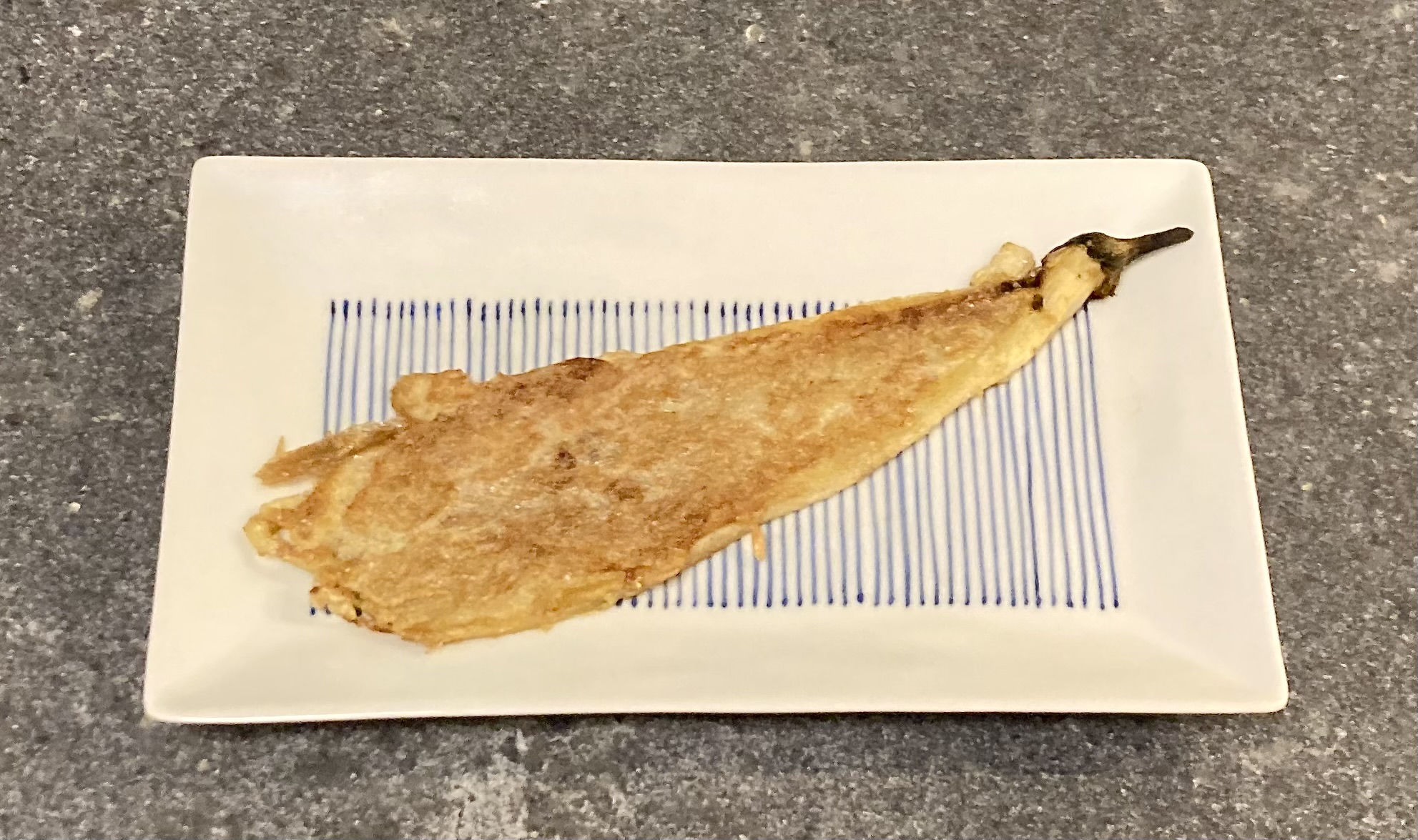
Perhaps you wonder what kind of fish we prepared for this post. Well, actually, it’s Tortang Talong, a Philippine dish made with charred eggplant. Earlier this year we made banana ketchup and the idea was to serve it with Tortang Talong, but we couldn’t find the right eggplants. For Tortang Talong you need long, purple, slender eggplants, known as Chinese or Japanse eggplants. They not only look different from the oblong eggplant, their taste is slightly sweeter and softer. The shape is key to a moist and homogenous result.
Thanks Monch Weller for introducing us to the delectable sauce and the very tasty Tortang Talong!
Food Pairing
Serve Tortang Talong with banana ketchup as a starter. We could also imagine it as a side dish with fried vegetables, rice and perhaps chicken.
What You Need
2 Chinese or Japanese Eggplants
1 Egg
Black Pepper
(optional) Salt
Oil
What You Do
Grill the eggplants for 5-10 minutes using the wire rack, following the instructions of your oven
Flip and grill for another 5-10 minutes or until charred
Let cool
Peel of the skin
Use a fork to flatten the eggplants
Combine egg, salt (if using) and pepper
Beat the mixture well
Heat a heavy iron skillet
Add oil to the skillet
Dip the eggplant in the mixture
Fry the eggplant
Flip and use a brush to coat the top with the egg mixture
In 1989 Antonio Carluccio published A Passion for Mushrooms. The book describes various mushrooms, discusses their habitat and edibility and of course offers a range of mushroom recipes. A Passion for Mushrooms includes some wonderful recipes and combinations we didn’t expect, for instance Truite aux Pied Blues and Ragout de Crevettes Rose et de Morilles. The book also includes a chapter on conservation techniques. Earlier we prepared two dishes from the book, Sandwiched Parasol Mushrooms and Halibut with Saffron Milk Cap. A Passion for Mushrooms is a must have for mushroom-lovers. The book is available via the usual channels and perhaps at your local second-hand bookstore. Prices will vary.
Trompette de la Mort
Horn of Plenty is a black chanterelle, also known as Trompette de la Mort, Black Trumpet, or Trumpet of the Dead. A very tasty mushroom, with just one downside: removing all the sand, small leaves and unappetizing bits is a lot of work. Carluccio poaches sole fillets and combines these with a combination of mushrooms, butter and lemon. Inspired by his recipe we prepared Horn of Plenty with Sole and a Lemon Sauce.
Wine Pairing
We enjoyed a glass of white Rioja with our Trompette de la Mort. The wine is made by Vivanco with three Spanish grapes: Viura, Tempranillo Blanco (a grape discovered in 1988) and Maturana Blanca (a grape that goes back to 1622). The result is a bright, intense white wine with aromas of citrus fruit and green apples. Fresh, tasty and a great match with the flavours of the mushrooms, the sole and the acidity of the sauce. In general, we suggest a non-oaked, fresh, dry white wine, with clear acidity.
What You Need
For the Poached Sole
4 fillets of Small Sole
5 cm of Carrot
5 cm of Celery Stalk
1 Bay Leave
Crushed black pepper
For the Mushrooms
100 grams horn of plenty
¼ Red Bell Pepper
Olive Oil
Black Pepper
For the Sauce
1 Egg Yolk
20 ml Lemon Juice
10 ml Water
1 Teaspoon of Mirin
White Pepper
What You Do
Clean the mushrooms
Finely cube the red bell pepper
Warm a pan of water until just simmering. It’s crucial not to overheat the water. The internal temperature of fish should be between 70 °C and 75 °C (or 160 °F and 165 °F).
Add sliced carrot, sliced celery, bay leave and crushed black pepper
Leave on this temperature for 10 minutes or so
Heat a heavy iron skillet and add some olive oil
Reduce heat and add cubed bell pepper
Role up the fillet: skin side on the outside and start with the smaller part of the fillet
Use a simple wooden cocktail stick to fix the role
Poach the sole until done, depending on the size, 4 minutes
Keep the sole warm in an oven at 65 °C or 150 °F
Add the mushrooms to the pan with the bell pepper
Fry gently
Add some black pepper to taste
Keep an eye on the mushrooms
Combine egg yolk, lemon juice and mirin
Make the sauce au bain marie or in the microwave
Add some white pepper to the sauce
Serve the sole on top of the mushrooms
Add the lemon sauce
Serve immediately on a warm plate
PS
The sauce is based on Japanese Kimizu. In this recipe we explain how to use a microwave.
You could also use grilled and peeled red bell pepper. That will give some smokiness to the dish, which is nice, but not necessary.
Earlier we wrote about Antonio Carluccio’s A Passion for Mushrooms, published in 1989. The book includes some wonderful recipes and intriguing combinations. The book also includes a chapter on conservation techniques. We prepared two dishes from the book, Sandwiched Parasol Mushrooms and Halibut with Saffron Milk Cap. A Passion for Mushrooms is a must have for mushroom-lovers. The book is available via the usual channels and perhaps at your local second-hand bookstore. Prices will vary.
Halibut with Saffron Milk Cap
We were keen to read his chapter on mushrooms and fish because the combination is both challenging and surprising. We spotted a recipe with saffron milk cap, a popular mushroom in Spain, Portugal, Turkey, Scotland, Poland, Russia and many other European countries. Earlier we combined it with chorizo, with squid and we prepared a stew with eggplant and potatoes. Carluccio used the mushrooms to create a rich, creamy mushroom sauce which he combined with poached halibut. The fish is supported by the flavours and texture of the mushrooms and vice versa. Is it about saffron milk cap or about halibut? Absolutely delicious.
Wine Pairing
We opened a bottle of Rosenstock Grüner Veltliner, produced by Markus Huber in the Traisental region in Austria. Markus Huber is a young, internationally successful winemaker. The vineyards and the winery are organic and sustainable. He made a fresh, dry, fruity and aromatic white wine. Great accompaniment of the fish and the light character of the wine worked also very well with the rich mushroom sauce. In general we suggest a light, refreshing, aromatic white wine.
What You Need
Filet of Halibut (skin on)
Butter
For the sauce
Saffron Milk Cap
Shallot
All Purpose Flour
Butter
Fish Stock
Vegetable Stock
Double Cream
Parsley
Dill
Mint
Mustard
Black Pepper
Crusted Bread
What You Do
Details of the recipe can be found in A Passion for Mushrooms. Buy the book and enjoy this dish and many more!
Clean the mushrooms and slice.
Chop the shallot finely.
Chop and combine equal quantities of parsley, mint and dill.
Add olive oil to a heavy iron skillet and fry the shallot.
After a few minutes add the mushrooms. Reduce heat and fry for 5-10 minutes.
Remove the shallot and the mushrooms from the pan.
Use flour, butter and stock to make a basic sauce.
Allow to integrate for a few minutes.
The sauce should have a clear but not overpowering fish flavour.
Add cream and mustard to the sauce. Mix.
Add half of the herbs to the sauce. Mix.
Add the mushrooms to the sauce.
If necessary, add more stock to the sauce. Taste.
In parallel, add butter to a non-stick pan and fry the halibut, skin down.
When nearly done, turn the fish, colour the meat side, remove the skin and turn again.
The sauce should be ready by now, so add the remainder of the herbs and some black pepper.
A few weeks ago we were reading Monch Wellers food and lifestyle blog. He writes about Via Mare, a Filipino restaurant that opened its doors 50 years ago. In his blog Monch writes about the food Via Mare offers, for instance Spanish Hot Chocolate, Bibingka (rice cake), Crab Omelette with Banana Ketchup, Lumpiang Ubod (spring rolls made with heart of palm) and Puto Bumbong, a glutinous rice dyed violet and steamed in bamboo tubes. We learn so much about the Filipino food culture thanks to Monchs excellent blog!
Why Bananas?
Maria Orosa (1893–1945) was born in the Philippian province of Batangas, some 100 kilometres south of Manilla. She studied food chemistry and pharmacology in the US. She returned to the Philippines in 1922. She was a food chemist, innovator and war hero. She saw the potential of many local products, for instance bananas and soy, and used these to empower the Philippines. She invented Soyalac (a protein-rich powdered soybean product), Darák (bran rice powder rich in vitamins) and Tiki-Tiki cookies. The powders and cookies saved many lives during wartime food shortages in the Philippines. One of her more frivolous inventions is Banana Ketchup. Why rely on imported tomatoes when it’s possible to make an equally tasty condiment using local bananas?
We loved the philosophy behind the ketchup and began searching for recipes. We noticed that tomato paste is often added, to give the ketchup a more familiar and appetizing colour. We didn’t do this. Afterall, the idea was not to use tomatoes. Plus: what’s wrong with the colour?
Food Pairing
The Banana Ketchup is smooth, its taste long, tangy, spicy and uplifting. The bananas give the ketchup natural sweetness and depth. They also support the spices. A condiment to love. We asked Monch for his favourite combination. He wrote us: It’s often paired with fried food here in the Philippines – spring rolls (both meat and vegetable versions), fried chicken, and eggplant omelette (which was No. 2 in TasteAtlas’ 50 Best Egg Dishes). We tried it with eggplant omelette and vegetable spring rolls. The ketchup paired perfectly with the moist and more delicate flavours of the omelette. Thanks Monch for introducing us to this unknown, delectable sauce!
What You Need
2 small ripe Bananas
½ Shallot
2 cloves of Garlic
20 grams fresh Ginger
½ Kashimiri Pepper
1/8 cup Brown Sugar
¼ cup Rice Vinegar
¼ cup Water
¼ teaspoon Turmeric
Dash of Cinnamon and Nutmeg plus 1 Clove (replacing dash of All Spice)
Oil
What You Do
Chop onion, garlic and ginger
Mash the bananas
Heat oil in a heavy iron skillet
Add chopped onion and glaze, about 5 minutes
Add garlic and ginger
Leave on medium heat, stirring constantly
Add bananas and combine
After a few minutes add vinegar, water, sugar, spices and Kashmiri pepper
When the mixture begins to simmer, reduce heat to low
Leave for 15-20 minutes, stir regularly
Remove from heat and let cool for 10 minutes
Transfer to a food processor and blend until smooth. This may take one or two minutes
Pass through a sieve to get the right velvety smoothness
Leave to cool before transferring the ketchup to the refrigerator
Serve with eggplant omelette (recipe next week!)
The ketchup will remain tasty for up to 3 days.
PS
In general, we find tomato ketchup too sweet, too salty and bland. Have we ever considered making our own tomato ketchup? No, we haven’t. We’re okay with a small bottle of Heinz Tomato Ketchup Zero, in case we have an irresistible craving for ketchup. Heinz doesn’t add sugar and salt to the Zero Ketchup. They add more tomatoes than usual (great) and a sweetener (pity). The taste? Well, still typically tomato ketchup. Fortunately, Banana Ketchup has far more flavour, spiciness and complexity.
We conclude our review of Asma Khan’s cookbook Ammu, Indian Home Cooking to Nourish Your Soul by preparing two dishes: Saffron Lamb and Pulao and asking our esteemed panel (André, Joke, Martine and Rutger) for their thoughts. In Part 1 we wrote about her Pumpkin and Coconutsoup and in Part 2 about her Pineapple and Chilli Chutney and Eggs in Tamarind Gravy.
Asma Khan is an Indian British chef, cookbook author and restaurant owner. In 2012 her pop-up restaurant started for 12 guests at her home, serving food cooked from traditional family recipes. Today her all-female Darjeeling Express restaurant in London offers Indian Rajput and Bengalihome cooking specialties.
In 2024 she won the Johannes van Dam Prize, a lifetime achievement award for an individual who has made an exceptional contribution to the world of gastronomy. Previous winners of the prestigious prize include Yotam Ottolenghi, Carlo Petrini, Alice Waters, Claudia Roden, Jeroen Meus and Alain Passard.
The book is called ‘Ammu’ which translates to ‘Mother’. The stories, the recipes, the whole book is a tribute to the food her mother (and the family’s cook) prepared. But we feel it’s more: it’s also a tribute to original flavours, to people taking time to prepare food, to sharing and enjoying, to communities and heritage.
Saffron Lamb
The recipe calls for a whole leg of lamb. For practical reasons we decided to make a stew using neck of lamb. The meat is marinated for at least 4 hours (or overnight) in a combination of yoghurt, garlic, chilli powder and saffron. Using saffron can be challenging. Asma Khan soaks the saffron in tepid water, which makes it much easier to add the right amount of saffron, not only at the beginning but also just before serving. The stew was a well-balanced combination of lamb, spices and saffron. To quote Asma Khan: “This is a good one to serve friends and family to make them feel loved without having to spend a lot of time in the kitchen!”. It was Rutger’s favourite.
Pulao
Doesn’t it look amazing? Basmati rice with cardamon, cinnamon, rose petals, pistachios, apricots, cloves, onion, rose water and bay leaf. The pulao surprised us all with its flavours, aromas and vibrant colours. The rice has a sweet undertone which makes it ideal to serve with spicy dishes. It combined very well with the lamb, the chutney and the eggs.
It was Martine’s favourite. Preparing it is, as you will expect by now!, a bit of work but it’s not difficult.
Should This Book Be On Your Shelf?
Our answer is “Yes, definitely” but our esteemed panel didn’t agree with us. They loved the dishes and the range of (new) flavours, the complexity of the aromas and the beautiful colours. They would be happy to enjoy more food from Asma Khan, but the time and effort required to prepare the food would be a problem. Which means we will plan another Asma Khan dinner, with dishes such as Stir-Fried Aubergines, Coconut Ladoo and Prawns with Peas and Potatoes. To be continued!
The Book
Ammu, Indian Home Cooking to Nourish Your Soul by Asma Khan is available via the usual channels or your local bookstore for 35,00 US$ or 26,00 EUR. Some of her recipes were published by the BBC, other recipes were published by Great British Chefs and these by the Foodnetwork.
It’s not every day that we visit a museum to explore the world of food, let alone the world of desserts. End of last year the Kunstmuseum in The Hague (the Netherlands) opened the exhibition Grand Dessert about the history and joy of European desserts. According to guest curator Janny Van der Heijde (author of cookbooks and member of the jury of the Dutch version of the Great British Bake Off), “A dessert is more than just the ultimate ending to a meal. It reflects changes in culture, society and tastes down the centuries. You can tell a lot of stories using desserts. Stories about wealth and poverty, about temptation and deception, dominance and oppression, but first and foremost about love of all things sweet.”[1]
On Display
The exhibition shows a variety of pastries (glass and ceramic, made by Shayna Leib), moulds, recipe books, baking tins and fun objects such as dessert-bags (made by Rommydebommy), dessert-clothing and knitted desserts (Kate Jenkins). It shows how ice-cream was made, what desserts would be served during royal banquets and how sugar was used to create centrepieces, for instance Sugar Flower pieces (Natasja Sadi). Also on display a large, pink, moving jelly, created in 2024 by Chinese artist Rong Bao.
Moulds
We were especially intrigued by the vast collection of moulds, in all kinds of shapes, classic ones, fish, lobster, pineapple, shells, elephant, cow, pig and a young child (very odd). Pudding can be both savoury and sweet, just think of the blancmange as it was made in 1510 with chicken, salt, flour, egg yolks, saffron, pepper, nutmeg, cinnamon, ginger and mace.
Jellies
The moulds made us think of jelly pudding, something we haven’t eaten for many, many years. We noticed a book by Sam Bompas and Harry Par, called Jelly, obviously. The book includes recipes for Campari & Orange jelly, Cherry jelly, Lavender jelly, Sex on the Beach jelly and many more. It discusses the history of jellies and techniques such as marbling. The shapes are incredible, look at their Jelly Parlour! We bought the book and will write about it in a future post. But first we must buy a pudding mould…
Practical
The exhibition Grand Dessert runs until October 26th. Jelly by Bompas and Par seems to be out of print. We bought our copy for 7 euro.
We continue our review of Asma Khan’s cookbook Ammu, Indian Home Cooking to Nourish Your Soul by preparing two dishes: Pineapple and Chilli Chutney and Eggs in Tamarind Gravy and asking our esteemed panel (André, Joke, Martine and Rutger) for their thoughts. . Earlierwe wrote about her Pumpkin and Coconut soup.
Asma Khan is an Indian British chef, cookbook author and restaurant owner. In 2012 her pop-up restaurant started for 12 guests at her home, serving food cooked from traditional family recipes. Today her all-female Darjeeling Express restaurant in London offers Indian Rajput and Bengalihome cooking specialties.
In 2024 she won the Johannes van Dam Prize, a lifetime achievement award for an individual who has made an exceptional contribution to the world of gastronomy. Previous winners of the prestigious prize include Yotam Ottolenghi, Carlo Petrini, Alice Waters, Claudia Roden, Jeroen Meus and Alain Passard.
The book is called ‘Ammu’ which translates to ‘Mother’. The stories, the recipes, the whole book is a tribute to the food her mother (and the family’s cook) prepared. But we feel it’s more: it’s also a tribute to original flavours, to people taking time to prepare food, to sharing and enjoying, to communities and heritage.
Wine Pairing
Aska Khan doesn’t include suggestions for drink pairing in the book. As a main we served four dishes: Pineapple and Chilli Chutney, Eggs in Tamarind Gravy, Saffron Lamb and Pulua. We paired this with a red wine called Magenta produced by Domaine de l’Arjolle from the Côtes de Thongue area (west of the French city of Montpellier) made with merlot and cinsault grapes. The wine has a light red colour, and its taste made us think of cherries and red fruit. Excellent light wine that combined very well with the various flavours of Asma Khan’s dishes. In general, we would suggest a light, fruity red wine. If you would like to enjoy a white wine, we would suggest one with limited acidity, for instance Pinot Gris.
Eggs in Tamarind Gravy
When going through the book, we noticed this delicious looking dish. It made us think of Sambal Goreng Telor, an Indonesian side dishe which combines fried hard-boiled eggs with a sauce made with chillies, lemon grass, shrimp paste and other ingredients.
The recipe for Eggs in Tamarind Gravy is not too difficult, just a bit time consuming. The gravy is made with very thinly sliced onions, garlic, ginger, turmeric, chilli, tamarind extract and water. Once combined it needs to be reduced by half. We read the recipe again and started to wonder why it was called ‘gravy’. The liquid in our pan resembled a watery soup, not gravy. We left it to reduce, on low heat, and we waited patiently. It started to thicken and after two or three hours we knew Asma Khan was right: gravy it was. We think that the very thinly sliced onion, cooked through and through, worked as a thickener. Ten minutes before serving we made three shallow slits on the surface of each hard-boiled egg, which helps the eggs to absorb the gravy. The panel loved the combination of subtle flavours: sweet, tangy, sour and rich. The sauce has the texture of old-fashioned gravy and it coated the eggs perfectly.
Pineapple and Chilli Chutney
We decided to prepare Saffron Lamb because of the intriguing recipe (more in our next review). Asma Khan suggests serving the lamb with Rose, Apricot and Pistachio Pulau and Pineapple and Chilli Chutney, so that’s what we did.
The chutney is made with red chillies (we used Kashmiri red chilies), Indian bay leave (tej patta), ginger, sugar, salt and water. It needs to cook until the chutney thickens and looks glossy. As with the gravy we were slightly worried: after thirty minutes our chutney wasn’t glossy or thick and the pineapple was bright yellow. But after three hours the chutney looked exactly as Asma Khan predicted. The panel was surprised by the sweetness and gentle spiciness of the chutney. The flavour of the pineapple was clearly present, but in a savoury way. Tasty in its own right, very nice accompaniment with the lamb and the rice.
The Book
Ammu, Indian Home Cooking to Nourish Your Soul by Asma Khan is available via the usual channels or your local bookstore for 35,00 US$ or 26,00 EUR. Some of her recipes were published by the BBC, other recipes were published by Great British Chefs and these by the Foodnetwork.
Recently we bought Asma Khan’s cookbook Ammu, Indian Home Cooking to Nourish Your Soul. ‘An entrancing book’, according to Nigella Lawson. Asma Khan is an Indian British chef, cookbook author and restaurant owner. In 2012 her pop-up restaurant started for 12 guests at her home, serving food cooked from traditional family recipes. Today her all-female Darjeeling Express restaurant in London offers Indian Rajput and Bengalihome cooking specialties.
In 2024 she won the Johannes van Dam Prize, a lifetime achievement award for an individual who has made an exceptional contribution to the world of gastronomy. Previous winners of the prestigious prize include Yotam Ottolenghi, Carlo Petrini, Alice Waters, Claudia Roden, Jeroen Meus and Alain Passard.
We prepared five dishes from the book and asked our esteemed panel (André, Joke, Martine and Rutger) for their thoughts. In this post we will look into Asma Khans Pumpkin and Coconut Soup and a dessert from Bengali, Bhapa Doi. On July 17th we will post part 2 of this review.
Flavours and Aromas
Asma Khan’s cookbook is about the food she enjoyed when she lived in India, the food she missed so much when living in the UK. By publishing the recipes, she creates an opportunity for all of us to enjoy the food that is close to her heart. That’ s why we followed her instructions to the letter, with one exception; we used less chillies.
Spices
Buying the right spices was a bit of a challenge. One of the ingredients of the Pineapple Chutney is Tej Patta, or Indian bay leaf. It has a clear cinnamon-like flavour and is not to be confused with common bay leaf. We also needed not too spicy large chillies. We found some excellent Kashmiri Red Chilies. Flavourful, a touch spicy and dark red. One dish required Cassia Bark which we couldn’t find and replaced with cinnamon. We wanted to serve original Indian beer, so we had to find a few bottles of Kingfisher or Cobra. The shopping took a bit of time, but it was worth the effort!
Not Just Another Cookbook
The book is called ‘Ammu’ which translates to ‘Mother’. The stories, the recipes, the whole book is a tribute to the food her mother (and the family’s cook) prepared. But we feel it’s more: it’s also a tribute to original flavours, to people taking time to prepare food, to sharing and enjoying, to communities and heritage.
Pumpkin and Coconut Soup
When talking about our menu, we looked at the menu of The Darjeeling Express and decided to prepare one starter and four dishes as main course. A vegetarian Pumpkin and Coconut soup would be ideal as a starter. The ingredients are pumpkin, onion, garlic, ginger, red chillies, coconut cream, salt, star anise and fennel seeds. Two tablespoons of fennel seeds (for 6 servings)? Star anise? Would that work?
The panel was impressed: a delicious pumpkin soup, spicy, but not the kind of spiciness that lingers on. The fennel worked beautifully with the pumpkin and coconut. The star anise gave the soup a nice additional and unexpected aroma. André’s favourite.
Bhapa Doi
When reading the book, we noticed that the recipes are not too complex, however, most are rather labour intensive. The book includes several recipes for desserts but given the time we needed to prepare the other dishes we decided to make a relativity easy Bengali dessert (not included in the book).
The Bhapa Doi is rich and moist, the taste long and (not overly) sweet. It made us think of cream cheese pie. The raisins combined very well with the creamy flavours and the cardamom. Perhaps we could have made smaller portions?
What You Need (for 7 ramekins (150 ml))
One tin of Condensed Milk (approximately 400 grams)
250 ml Greek Yoghurt
100 ml Whole Milk
1½ teaspoon of finely crushed Cardamom Seeds
Handful of Sultana Raisins
Pistachio Nuts (to decorate)
What You Do
Soak the sultana raisins for 15 minutes in lukewarm water
Preheat your oven to 170 °C or 340 °F traditional (no fan)
Combine the condensed milk with the yoghurt until smooth
Add the milk and combine
Add the crushed cardamom seeds
Use kitchen paper to dry the raisins
Add the raisins to the mixture
Fill the ramekins with the mixture
Place the ramekins in a baking tray
Add boiling water up to 2/3 of the height of the ramekins
Close the oven door and reduce the temperature to 120 °C or 250 °F
Leave in the oven for 30 – 40 minutes, until set
Test with a needle (it should come out dry)
Remove the ramekins from the baking tray and allow to cool.
Best to refrigerate the ramekins for 4+ hours in the refrigerator before serving
Decorate with pistachio nuts
The Book
Ammu, Indian Home Cooking to Nourish Your Soul by Asma Khan is for sale via the usual channels or your local bookstore for 35,00 US$ or 26,00 EUR. Some of her recipes were published by the BBC, other recipes were published by Great British Chefs and these by the Foodnetwork.
The Johannes van Dam Prize 2024 was won by Indian British chef, cookbook author and restaurant owner Asma Khan. In 2012 her restaurant started for 12 guests at her home, serving food cooked from traditional family recipes. Today her all-female Darjeeling Express restaurant in London offers Indian Rajput and Bengalihome cooking specialties. On her current menu are dishes such as Chicken Momis (dumplings served with smoked chillies sesame chutney) and Badami Baingan (aubergine with coconut, peanut and tamarind). Sounds delicious!
Prize
The Johannes van Dam Prize is a lifetime achievement award for an individual who has made an exceptional contribution to the world of gastronomy. Previous winners of the prestigious prize include Yotam Ottolenghi, Carlo Petrini, Alice Waters, Claudia Roden, Jeroen Meus and Alain Passard. The prize giving ceremony used to be part of the Amsterdam Symposium on the History of Food, but for reasons unknown to us it was decided to separate the two events. As a result, the prize giving event in 2024 with Asma Khan was relatively small and went by hardly noticed. A pity.
Cookbook
We bought her cookbook Ammu, Indian Home Cooking to Nourish Your Soul. ‘An entrancing book’, according to Nigella Lawson. We were impressed by the great stories and of course the recipes. Over the coming weeks we will prepare some of the dishes and ask our review panel to taste the flavours of Asma Khan’s kitchen.
Join us!
Please join us in preparing one (or more) of her dishes. You could buy the book, look at her recipes as published by the BBC or these recipes published by Great British Chefs or these from the Foodnetwork. Post about it on your blog and ping back, track back, share or re-post.
Let’s enjoying Indian Home Cooking to Nourish Your Soul!
Food is much more than just food, it’s about culture, about being with friends, family, about learning from other cultures, about talking and sharing memories, about emotions, about special days and celebrations. It brings people together and enhances our understanding of others.
We take part in Jo Stacy’s BKD Cookbook Club and this month the focus is on Christmas recipes for us all to make and share. Our choice is a recipe for a Casserole from Together: Our Community Cookbook.
The book is written by a group of residents, gathering in the aftermath of the Grenfell Tower tragedy in London to cook food for their families, friends and neighbours. They began using the kitchen at the Al-Manaar Muslim Cultural Heritage Centre and used the kitchen for two days per week, preparing food and eating together. Gradually more local women began to join in, embracing the community and supporting their neighbours. This was the beginning of the Hubb Community Kitchen (‘hubb’ meaning ‘love’ in Arabic). In 2018 the group published Together: Our Community Cookbookwith 50 simple and tasty recipes from the Middle East, North Africa, Europe and other countries. Food that brings people together, food you prepare for your loved ones.
The book features mouthwatering recipes including Shakshouka (Algeria), Potato Fritters with Cilantro (India), Spicy Peanut Dip (Uganda), Green Rice (Iraq), Fennel and Orange Salad (Italy) and many more.
Food that helped restore hope and provided a sense of home.
Casserole
We decided to prepare Tepsi Baytinijan. To quote Intlak Alsaiegh, the author of this recipe: “Tepsi translates as ‘casserole’ and this is a traditional Persian dish of meatballs in tomato sauce with eggplant. It’s quite rich. You could make it with less oil, I suppose, but then it wouldn’t be so traditional—or taste so good.”
The dish is indeed a rich, tasty combination of small meat balls (ground beef, garlic, curry powder), fried egg plant, fried potatoes, onion, green pepper, tomatoes, tomato paste and tamarind paste, served with basmati rice or crusted bread. The detailed recipe can be found in Together: Our Community Cookbook or on Food52.
Together: Our Community Cookbook is dear to us, because it shows us that food can unite people. Preparing food from this book will bring you closer to the hope and strength of the Grenfell community.
The book is available via the usual channels and your local bookstore. A portion of the proceeds from the sales will help the Hubb Community Kitchen to strengthen lives and communities through cooking.
We wish you Happy Holidays and a Wonderful 2025! Mr. Cook and Mr. Drink






 Cook and Drink