Flammkuchen

We continue our series of very simple, tasty dishes by preparing Flammkuchen (Tarte Flambée in France, Feuerfleck in Austria). The dish originates from the Alsace. The first part of the name refers to fire and flames. The story is that bakers baked bread in wood fired ovens. The oven would initially become too hot, and the bakers had to wait for the oven to cool and reach the right temperature. The Flammkuchen would be the indicator. If it was ready within two minutes or so, then the temperature was right. If it would burn, the oven was too hot, but nothing was wasted. 

The dough of Flammkuchen is extremely simple, but also a bit puzzling. In all cases it’s flour, salt, olive oil and water. Some suggest adding egg yolks, others yeast. Adding yeast makes it into a bread dough. Doesn’t it seem obvious that the bakers would use the already prepared dough? Adding egg yolks seems odd too us. Why make a more expensive dough for a product that was to be used as an indicator only?

Back to yeast or no yeast. Which brings us to the question: isn’t Flammkuchen a kind of pizza? They do look very similar, and both are baked in a hot oven, but there are differences. Traditionally Flammkuchen are covered with crème fraîche, lardons and thinly sliced onions. The Flammkuchen should be very thin and very crispy. We think the bakers didn’t use their bread dough but made a quick, simple dough with the sole aim to test the temperature of the oven. Perhaps only water and flour?

Another difference is that Flammkuchen were not on the menu of restaurants until the 1960’s. Probably you would buy them at the local bakery or make them at home. Thanks to the global popularity of pizza, Flammkuchen have gained some visibility.

Drink Pairing

Flammkuchen are tasty, crispy, flavourful and not complex. Enjoy with a glass of white wine, with a beer, or your favourite drink.

What You Need
  • For the Dough
    • 250 grams of Flour
    • 2 tablespoons of Olive Oil
    • 125 ml Water
    • Pinch of Salt
  • Crème Fraîche
  • Black Pepper
  • Mushrooms (we used Trompettes de la Mort)
  • Red Onion
What You Do
  1. Pass the flour through a sieve
  2. Add a pinch of salt and mix
  3. Add water and olive oil and quickly turn the mixture into a dough using your hands
  4. Don’t kneed too long
  5. Leave on room temperature for an hour
  6. Pre-heat your oven to 220 °C or 430 °F
  7. Roll out until very thin, 2 millimetre is perfect.
  8. Add black pepper to the crème fraîche and mix
  9. Place the dough on baking or parchment paper in a baking tray, cover with a layer of crème fraîche, add mushrooms and sliced onion
  10. Bake for 10-12 minutes or so and serve immediately.

Baking Flammkuchen on a higher temperature is preferred, but then you can’t use baking or parchment paper. Best is to use a pizza stone. The baking time will be 3 to 5 minutes on 300 °C or 570 °F.

Flammkuchen ©cadwu
Flammkuchen ©cadwu

Claudia Roden – The Book of Jewish Food, part 2

As contributor to the cookbook review project by Bernadette we reviewed The book of Jewish Food, An Odyssey from Samarkand and Vilna to the Present Day. The book combines more than 800 recipes with the stories and histories that have shaped Jewish cooking over the centuries. The book showcases the diversity of Jewish food. It’s about (Jewish) culture, about how food is part of our shared culture, how we are all connected and how food can help us understand history.

We prepared Joodse Boterkoek and Aliyah, a dish that combines chicken, tomato, tamarind, basil and cilantro. We served it with polenta. Both are delicious!

We also very much liked Fish Balls in Tomato Sauce as prepared by John Rieber. The fish balls are a combination of white fish with ginger and nutmeg. The dish originates from Egypt and Morocco. It will perhaps make you think of Gefilte Fish, a traditional appetizer. The recipe is not complex and the result as prepared by John looks great. One we will be making soon!

Jo Tracey prepared a Goulash Soup with beef, sweet paprika and a touch of chilli. She writes: “I first bought the digital version of this book a few years ago but I never got around to reading it or cooking from it until now. And what a treat it’s been.” The soup is rich and one we would cook on a wintery day.

Robbie Cheadle baked a Honey Cake, made with honey, brandy, coffee, cinnamon, cloves, orange zest, almonds and sultanas. Sounds wonderful! According to Robbie: “This cake is delicious, and we all enjoyed it. The orange zest, coffee, and honey create a lovely symphony of flavors.

Bernadette herself chose a recipe from the Ashkenazi section of the book – Holishes or Stuffed Cabbage Leaves; a dish that appeared frequently in her childhood home. The leaves are stuffed with a combination of beef, rice and onion. The sauce is made with tomatoes, lemon, ginger, apple, raisins and honey. Not the most obvious combination! The result looked absolutely yummy.

The book of Jewish Food by Claudia Roden is available via your local bookstore or the usual channels for approximately 50 US$ or 40 euro. Highly recommended!

Claudia Roden – The Book of Jewish Food, part 1

The cookbook review project by Bernadette is a great way to explore cookbooks. The book of Jewish Food by Claudia Roden was not yet on our bookshelf, so we bought a copy of the 25th edition for 40 euro.  Its subtitle is An Odyssey from Samarkand and Vilna to the present day. The book combines more than 800 recipes with the stories and histories that have shaped Jewish cooking over the centuries. The book showcases the diversity of Jewish food. 

The first time we saw Claudia Roden was during the 2016 Amsterdam Symposium on the History of Food. In 1999 she received the Prince Claus Award in recognition of her exceptional initiatives and achievements in the field of culture. She is author of the classic comprehensive book Food of Italy and member of the jury of the prestigious Johannes van Dam prize, awarded in 2016 to Yotam Ottolenghi. We were far too impressed to actually talk to her. A bit silly, agreed, and we will make up for it in April 2025 during the next Symposium.

The Netherlands

The Dutch Jewish community plays an important role in the Netherlands, and more specifically in Amsterdam. The community was formed in the seventeenth century by people who came from Portugal (Sephardi Jews) and from Germany and Eastern Europe (Ashkenazi Jews). In general the first group was worldly, cultured and well connected to the Dutch upper classes. The second group was poor and unskilled. They worked as market traders, food sellers (for instance pickled vegetables and salted herring with chopped onions, which is still a Dutch treat) and pedlars.

Over the years both groups influenced Dutch cuisine. According to food author and publisher Jonah Freud dishes such as Haringsalade met Bietjes (see here for our version) and Broodje Halfom (a bun with beef liver and salted beef (somewhat similar to pastrami) with white pepper) are typical examples of the Jewish influence on Dutch cuisine. Gemberbolussen (a sweet cake with ginger) and Kugel (a cake with almonds and pears) are still widely available in Amsterdam.

Two Recipes

We decided to make two recipes from the book. Boterkoek is very typical for the Netherlands. A rich combination of lots of butter, sugar, flour and a pinch of salt. Classic and easy to make. We slightly adjusted Claudia Roden’s recipe, inspired by Dutch Pâtissier Cees Holtkamp. Early on during his career he learned how to bake Boterkoek when he worked for a Jewish Bakery. 

The second recipe is for Aliyah, stewed chicken with tomatoes, tamarind, cilantro and basil. An intriguing combination and one we simply had to try. The recipe originates from the Georgian town of Kulashi. This small town was once the home of one of the largest Georgian Jewish communities.

Obviously we decided to enjoy a kosher wine with the Aliyah. We bought a bottle of Barkan Classic Merlot-Argaman 2021. The Argaman grape (an Israeli creation) is combined with Merlot. The result is an intensely coloured red wine with dark fruit, supple tannins and depth. In general, we would suggest a medium to full-bodied red wine with sufficient depth and length.

Your Bookshelf

We think this book should be on your bookshelf. It’s about (Jewish) culture, about how food is part of our shared culture, how we are all connected and how food can help us understand history. It took Claudia Roden 16 years to write it. We can only thank her for this impressive and relevant achievement.

The book of Jewish Food by Claudia Roden is available via your local bookstore or the usual channels for approximately 50 US$ or 40 euro.

Recipes for Joodse Boterkoek and Aliyah on Bernadette’s website.

Deviled Eggs with Chervil and Crayfish

Deviled (or stuffed) eggs are a traditional appetizer or hors-d’œuvre, easy, tasty and always welcome. Simply cook the eggs, halve them, scoop out the yolk and mix with butter, cream or mayonnaise and add for instance mustard, or curry powder, or pickles or, well, actually, most combinations work.

The idea of deviled or stuffed egg goes back many years. See for instance this recipe from Carolus Battus (published in 1593). Or try this recipe for uova ripiene from Pellegrino Artusi (1891): boil, peel and halve the eggs. Use one anchovy per two eggs. Use a fork to combine anchovy, egg yolk, a little parsley, very little onion and butter to make a smooth paste. Stuff the eggs with the paste and cover with mayonnaise.

Artusi also described a second recipe: stuff the eggs with a mixture of egg yolk, bread (soaked in milk) and mushrooms (soaked in lukewarm water). Stuff the eggs. Arrange the eggs in an oven dish, cover with potato puree and serve warm. We could imagine topping with grated cheese and turn it into Deviled Eggs Au Gratin.

We combine the eggs with mayonnaise, mustard, chervil and crayfish. Chervil is a delicate herb. It brings a hint of liquorice or anise to food, for instance to omelettes, salads or in this case the egg mixture and the cray fish. Decorating with chervil is not only nice; it also makes the chervil more present.

Drink Pairing

Deviled eggs are flexible when it comes to drink pairing. Simply enjoy with your favourite drink!

What You Need
  • 6 Organic Eggs
  • Dijon Mustard
  • Mayonnaise
  • Chervil
  • Cray Fish
  • Black Pepper
What You Do

Boil the eggs, peel and halve. Scoop out the egg yolk, finely chop the chervil, add a teaspoon or two of mustard (after all, they are called deviled egg), two or three teaspoons of mayonnaise, some black pepper and a generous amount of chervil. Mix with a fork. Taste and adjust. Stuff the eggs and decorate with grayfish and chervil. Keeps well in the refrigerator for a few hours if covered with cling foil. Just before serving, decorate the eggs with chervil.

Deviled Eggs with Chervil and Crayfish ©cadwu

Chicken with Fennel and Sage

We start 2024 with a series of simple and tasty recipes. It’s such fun to prepare delicious food with only a handful of ingredients. James Tanner is author of Takes 5: Delicious Dishes Using Just 5 Ingredients with over 90 recipes, ranging from Roasted Red Bell Peppers with Anchovies to Scones. Short shopping lists, easy recipes and tasty results: what more can you ask for!

This dish combines fennel with chicken, pancetta and sage. The mild anise flavour of the fennel works very well with the pancetta. The aromatic, slightly bitter flavour of sage is great with the chicken. And believe it or not, after having simmered in butter for some 15 minutes the dish comes together. Rich, fresh and uplifting.

Wine Pairing

A light to medium bodied red wine will be great with the dish. Unoaked, fruity, not too complex: a wine made with Pinot Noir, Tempranillo or perhaps a red wine from the Beaujolais.

What You Need
  • Organic Chicken Thighs (boneless)
  • Small Fennel
  • 6 Leaves of Sage
  • Pancetta
  • Butter
  • Black Pepper
What You Do
  1. Halve the thighs and fry in butter
  2. In the meantime dice the fennel
  3. When the chicken is nicely coloured, add the fennel
  4. Combine, wait for a few minutes
  5. Dice the pancetta
  6. Devein and chop the sage
  7. Add pancetta and sage to the pan and allow to simmer on low heat for some 15 minutes
  8. Add black pepper just before serving
  9. You could decorate with some fennel leaves.

PS

Takes 5: Delicious Dishes Using Just 5 Ingredients was published in 2010 and is available (probably second hand) via the well-known channels for something like 20 US dollar or Euro.

Your Favourites in 2023

Happy New Year! Let’s begin the new year with the 2023 highlights. Your favorite post was No-Knead Bread, We have been baking our own bread for several years, based on the method of no-knead bread (see Jim Lahey’s book My Bread for more detail) and using the ingredients (Blue Poppy Seeds, Linseed) of the French Talmière. The result is delicious!

Another very popular post is the one showing you how to make Kimizu. This is a classic, golden sauce from Japan, made with Egg Yolks, Rice Vinegar, Water and Mirin. We also have a version with Tarragon, let’s say the Béarnaise version of Kimizu. The recipes for Kimizu and Kimizu with Tarragon continue to be very popular. Although this is a classic sauce, we use a microwave to prepare it. An easy and very effective way of managing temperature and consistency.

We love mushrooms. Cultivated ones, like Shiitake, Oyster Mushrooms, Enoki and Champignons de Paris and seasonal ones, such as Morels, St. George’s mushroom, and Caesar’s Mushroom. One of the most popular posts is about Cèpes à la Bordelaise. You can also use more available mushrooms for this great combination. Always a pleasure to serve, with eggs, with meat, with more present fish.
Last year we had lots of Bay Boletes, which was such a pleasure. It’s a fairly common mushroom, as tasty as Cèpes, but much more affordable.

And finally The Queen’s Soup. We didn’t expect too much of this post, but the soup turns out to be very popular.

We were of course very pleased and honored to receive an award for our Pear and Almond pie in the Great Bloggers’ Bake Off.

Let’s start cooking!

Your Favourites in 2023 ©cadwu

The Art of Sauces: Ravigote

A classic, French sauce, traditionally served with Tête de Veau, but in general great with cold meat and cold, poached fish. A very simple, easy to make sauce with just the right acidity to brighten up your cold starter. The warm version is made with a broth, the cold one with oil, vinegar and mustard, as you would prepare a vinaigrette.
No eggs?
Indeed, no eggs. If you look at the list of ingredients, you could think of Remoulade or Tartare Sauce (both mayonnaise based) or Gribiche (made with hard boiled eggs). Ravigote is different, it’s light and uplifting. Just give it a try next time you serve cold meat or fish as a starter. Forget about the mayonnaise and enjoy this delicious, flavourful sauce.
We served our Ravigote with Pâté de Tête Persillé and crusted bread.

Wine Pairing

We enjoyed a glass of white Pontificis, made with Viognier and Chardonnay grapes by Badet- Clément. This is an oaked dry wine from the Languedoc-Roussillon region in France. It is elegant, with some oak, clear acidity and some bitterness. Creamy, with some vanilla, butter and perhaps tropical fruit. In general you’re looking for a white wine with clear acidity, oak and balance.

What You Need

  • Coarse Mustard (Moutarde à l’Ancienne
  • White Wine Vinegar
  • Oil (Sunflower, Avocado)
  • 3 Cornichons
  • 8 Capers
  • 1 Shallot
  • Parsley
  • Tarragon
  • Chervil
  • Black Pepper

What You Do

  1. Finely chop the shallot, slice the cornichons, halve the capers
  2. Chop the herbs
  3. Combine a spoonful of mustard with the same amount of vinegar
  4. Slowly add the oil until you have the right consistency and flavour
  5. Add more vinegar to get the right acidity
  6. Happy? Add shallot, cornichons and capers
  7. Mix
  8. Add a generous amount of parsley, tarragon and chervil
  9. Finish the sauce with black pepper.

PS

The amount of tarragon depends on the type of tarragon and your personal preference. There are actually three types: French tarragon (intense and aromatic, the one to use in the kitchen), Russian tarragon (limited flavour, no complexity) and Mexican (a touch of anise, but not even close to French tarragon). 

Pork with Enoki

It’s nearly the end of the mushroom season in Europe. It’s hard to find chanterelle (girolle), and nearly impossible to buy fresh cèpes. The black winter truffle (Tuber melanosporum) is an exception. It’s available until March, but the price may be prohibitive. Better to focus on cultivated mushrooms, such as enoki, available at your local Asian supermarket. A delicious mushroom with a pleasant texture and aroma. Its flavour is mild, a bit sweet and fruity. You can use it raw in a salad, in a soup or combine it with soba noodles. A few weeks ago, we wrote about an omelette with enoki and a light soy sauce. The result is a lovely sweet, rich and intriguing dish.
Combining enoki with pork is also a great idea. Feel free to adjust the recipe and make the sauce spicier or sweeter or thicker. The result will be tasty given all three elements in the dish bring some kind of sweetness.

Wine Pairing

You could emphasize the Asian influence by serving a glass of Pinot Gris, Riesling, Chenin Blanc or perhaps Soave. In general you’re looking for a light or medium bodied, unoaked, dry white wine with nice acidity. Benefits are minerality and florality. A glass of Côtes de Provence rosé will also be a good choice.
If you want to focus on the flavours of the pork, we suggest a glass of Beaujolais or a glass of wine made with Grenache (France) or Garnacha (Spain) grapes.

What You Need

  • Organic Pork Tenderloin
  • 100 grams of (Golden) Enoki
  • Soy Sauce
  • Light Soy Sauce (we used Tentsuyu)
  • Stock
  • Oyster Sauce
  • Black Bean Sauce (optional)
  • Red Chili Paste (optional)
  • Olive Oil

What You Do

Fry the pork in olive oil until pink. Turn on a regular basis. Remove the stem (bottom) of the enoki. Fry in olive oil for maximum one minute. Add some (vegetable stock), soy sauce, oyster sauce, black bean sauce and red chili paste and create a not overly sweet, intense sauce. We like some spiciness, hence the chili paste. Serve the meat on top of the enoki mixture.

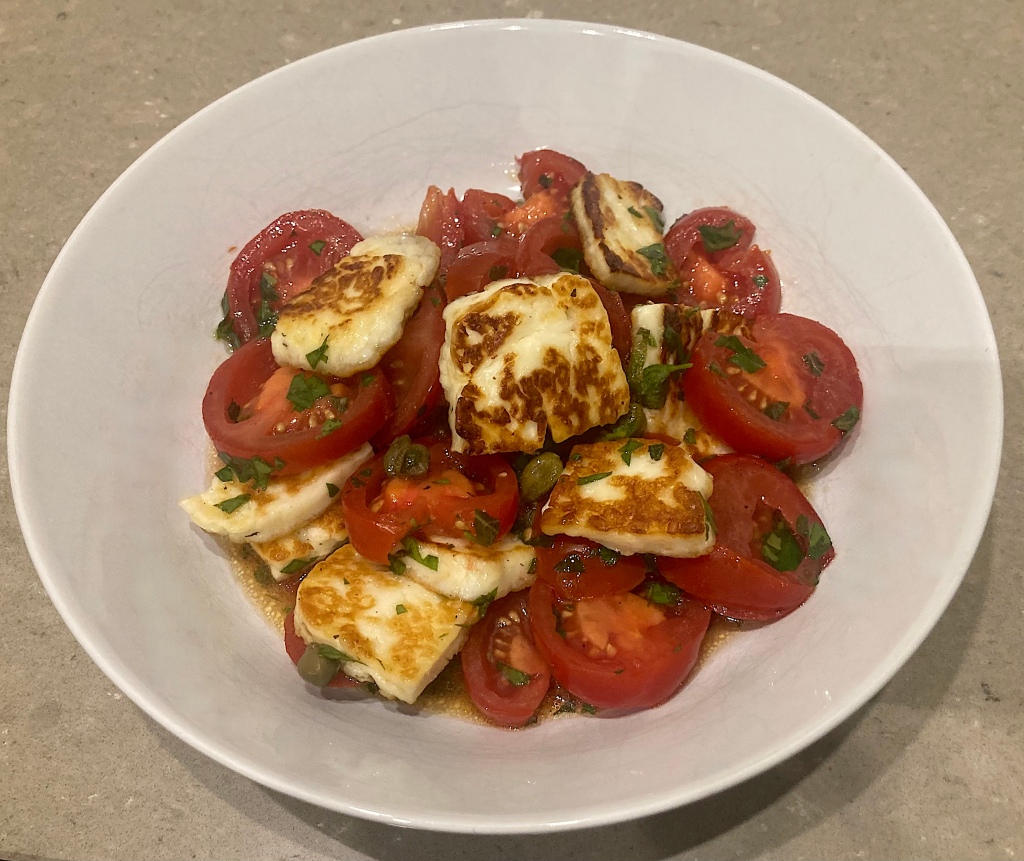
Tomato and Halloumi Salad

A simple and lovely salad, one that works very well as a starter with some crusted bread. Tomatoes, a touch of mint, parsley and warm halloumi. One of the first times we made this we used homegrown, ripe and tasty tomatoes. We also prepared the dish using tomatoes that were rather bland. That wasn’t much of a success.
The history of halloumi goes back centuries. Nowadays it’s a cheese made of goat’s and sheep’s milk. Sometimes cow’s milk is added to the mixture. In the EU it’s a protected product and must be produced in Cyprus. Because of its high melting point it’s ideal to grill or fry, although it can remain a bit firm and chewy. During the final phase of the production process the cheese is salted and sprinkled with chopped spearmint leaves.
Mint is also an essential ingredient of the salad. We tend to use it only occasionally because mint can be overpowering. It works very well in combination with the cheese and the tomatoes. It gives a boost to the flavours without being overly present.

Wine Pairing

A glass of rosé, a simple unoaked white wine or a beer will be great with the salad. When looking for a wine to go with a salad, make sure to think about the acidity. In general a more acidic salad requires a more acidic wine. The combination will make the wine fruiter and the salad softer. In this case the tomatoes, the dressing and the capers bring acidity. However, marinating the tomatoes makes the salad softer and emphasises the sweetness of the tomatoes. 

What You Need

  • Six excellent, tasty, ripe Tomatoes
  • 6 leaves of Mint
  • Parsley
  • Olive Oil
  • Vinegar
  • Teaspoon of Capers (in brine)
  • Black Pepper
  • Halloumi

What you Do

Core and slice the tomatoes. Chop the parsley and the mint. Combine oil and vinegar, add tomatoes, mix and add the herbs. Transfer to the refrigerator for a few hours. Mix every hour.
Slice the halloumi and fry on medium heat in olive oil. Turn regularly. Add the capers to the salad, mix, top with the fried halloumi and serve immediately with crusted bread.

Tomato and Halloumi Salad ©cadwu

Enoki with Eggs and Soy Sauce

Enoki is one of the most popular mushrooms. It’s been cultivated for many years (or better: centuries) and it is available in Asian supermarkets as enokitake. The cultivated enoki grows in the dark, hence it being white, and needle shaped with a small cap. Wild enoki benefits from the exposure to light and becomes brown and its shape is more mushroom-like. The golden enoki we use is also cultivated. 

Enoki has a pleasant texture and aroma. Its flavour is mild, a bit sweet and fruity. You can use it raw in a salad, in a soup or combine it with soba noodles. Combining it with pork is also a great idea. We decided to prepare an omelette with a light soy sauce. The result is a lovely sweet, rich and intriguing omelette.
We’re not sure if it’s an appetizer in its own right or that is should be served alongside other dishes. Suggestions welcome!

Wine Pairing

We enjoyed our golden enoki with a very special wine: Sint Catharinadal Norbertus 2022. The wine is made in the Netherlands by the sisters of the Norbetine convent, founded in 1271. For centuries the sisters used the grounds for cattle and corn. Since 2017 they also produce wine, with the help of many volunteers and experts. Their motto is I am the true vine, and my Father is the vinedresser.  Amongst the grapes are Chardonnay, Pinot Gris, Pinot Blanc, Pinot Noir, Auxerrois and Gamay. We would suggest opening a bottle of their white wine. It has subtle aromas (apple, pear, melon), some acidity and its taste is very pleasant (fruit, touch of almonds).
More information (in Dutch only) on their website. The wine can be bought via Les Généreux.

What You Need

  • 100 grams of (Golden) Enoki
  • 2 Eggs
  • Light Soy Sauce (we used Tsuyu)
  • 3 cloves of Garlic
  • ½ red Chilli Pepper
  • 2 Spring Onions (Scallions)
  • Olive Oil

What You Do

Remove the stem (bottom) of the enoki. Blanch the mushrooms for 60 seconds in very hot water. Remove and pat dry using kitchen paper. Start making a sauce with soy sauce, garlic, pepper and spring onions. Reduce. Fry the mushrooms in oil, just to remove excess water. Reduce temperature. Beat the eggs and add the mixture to the pan. Allow to become a moist omelette on very low heat. Remember not to fry it! The egg should set and become baveuse. Transfer the omelette to a plate, use a spoon to cover the omelette with the liquid and decorate with a mixture of garlic, spring onion and chilli pepper.