Pasta with Mushrooms

Most historical recipes are about meat, fish and poultry, using a range of herbs and spices. Vegetables were not considered to be a healthy (slimy and wet) or were seen as food for the poor. Afterall, the recipes were to be used by cooks and chefs for the upper class and the gentry. Eating meat, drinking wine and using spices also illustrated wealth.

Today’s food culture is very different: meat is seen by many as the most important aspect of a meal, we tend to eat far too much of it and we’re not willing to pay a decent price for it. Go to your local supermarket, visit your local snack restaurant and feel sorry for the animals. From happy pig in the mud to intensive farming where the animals are kept in gestation crates.
On the other hand, hurray, we see more and more vegetarian alternatives, with lentils, beans, vegetables etcetera inspired by, for instance, traditional vegetarian cuisine from India.

We were pleasantly surprised when Manon Henzen and Jeroen Savelkouls published their Historisch Kookboek Vega, discussing historical vegetarian cuisine. The book includes 14 recipes, for instance dishes like Surprise Honey Cake and Chick Pea Soup. Plus one for Pasta with Mushrooms. Sounds very much 21st century but is actually based on a Venetian recipe from the 14th century. It’s a nice combination of homemade pasta (a bit chewy perhaps), mushrooms and spices. We tweaked it a bit. The original recipe is included in the book which is available via the webshop for €12,50 (Dutch only). On the website you will also find a range of videos, helping you to cook historical vegetarian food.

Wine Pairing

You can be flexible in this case. We enjoyed a glass of Côtes de Provence rosé with our pasta, but a glass of not too complex, red or white wine will also be fine.

What You Need

  • Dough
    • 125 grams of All Purpose Flour
    • 2 Eggs
    • 50 grams of Parmesan Cheese
  • Spices
    • Black Pepper
    • 3 Cardamom Seed Pods
    • Cinnamon Powder
    • Laos Powder
    • Nutmeg
  • Shallot
  • 150 grams of Mixed Mushrooms
  • 4 Sage Leaves
  • Parsley
  • White Wine Vinegar
  • White Wine
  • Olive Oil

What You Do

Crush and combine the spices. Add 2 teaspoons of the mixture and the grated Parmesan cheese to the flour and mix. Whisk two eggs and add these to the mixture. A bit of kneading is required to make the dough. Set aside for an hour or so.
Knead the dough a bit more, flour your hands and make finger-long, thin pasta.
Chop the shallot, glaze in a large heavy iron pan, add the sliced mushrooms and fry these gently for a few minutes. Now add half of the deveined sage leaves and roughly chopped parsley plus some white wine. You could add a splash of white wine vinegar. Cook the pasta in a pan with boiling water for 10 minutes or until done. It behaves very similar to gnocchi. Five minutes before serving add the remaining sage and parsley. Drain the pasta, add to the pan and combine. Serve with some extra Parmesan cheese.

Pasta with Mushrooms ©cadwu

Mussels with Dashi and Kimchi

A few weeks ago we enjoyed dinner at l’Épicerie du Cirque “under the Palm Trees” in Antwerpen (Belgium). The restaurant is owned and run by Dennis Broeckx and Ellen Destuyver and offers contemporary Flemish cuisine with a focus on local products. Excellent choice of wines, great service, very original menu. One of the dishes was a combination of dashi, homemade kimchi, wasabi and Belgian mussels topped with foam. Lots of umami and great textures.

Back home we tried to replicate the dish, but the result was disappointing. The foam is a crucial aspect of the dish and sadly our foam collapsed after 2 seconds. But we did manage to buy some very tasty, mild Korean kimchi so the next day we prepared a dashi-based soup with mussels instead. Very tasty and the combination works really well.

What You Need

  • 500 ml of Dashi
  • Handful of Mussels
  • Kimchi (mild)
  • ½ tablespoon of Sake
  • Light Soy Sauce

What You Do

Prepare the dashi. Clean the mussels and discard broken ones. Quickly cook the mussels, add kimchi, sake and a drop of light soy sauce to the dashi, keep warm, remove the mussels from the shell and add to the soup. Serve immediately on warm plates.

Leek à la Wannée

Leek is such a tasty vegetable: essential when making stock, delicious when prepared in butter and served with a cheese sauce (Sauce Mornay) or when stir fried. Extravagant when served with a dressing (jus de truffe, lemon, mustard) and lots of summer truffle. A popular, tasty, aromatic and very affordable vegetable.

This was also the case in 1910 when Mrs. Wannée published her cookbook. A book dedicated to nutritious and inexpensive food. Or should we say cheap? She was teacher and director of the Amsterdam Huishoudschool, a school for domestic skills, aimed at training future maids and housewives. The book is currently in its 32nd edition and has sold over one million copies. It continues to be a popular cookbook because every new edition reflects the current views on food and nutrition.

We have a copy of the 14th edition (published around 1955?). It is beautifully illustrated (full colour pictures and drawings) and contains 1038 recipes. It probably very much reflects the 1910 style of preparing food. We followed recipe 451 for stewed leek with a corn starch-based sauce. Well, eh, honestly don’t do this at home. The texture of the leek was nice and soft, the taste gone and the sauce bland and gluey. Interesting as experiment but not worth repeating.

The recipe does not mention the use of pepper and/or nutmeg (both fairly obvious choices) which is part of a bigger problem. Another standard Dutch cookbook (Het Haagse Kookboek, first published in 1934) is also known for the very limited use of spices and herbs. Probably it is a reflection of the sober, Calvinist nature of the Dutch in the 19th and 20th century. Price over taste, quantity over quality.

This dominated Dutch cooking for many years. And in some cases it still does. As if Dutch food is over-cooked and under-seasoned.

Nonsense. When you read books by Carolus Battus or Mrs. Marselis you know that Dutch cuisine is absolutely about tasty and interesting food, using various herbs and spices.

What You Don’t Do

Wash and clean the leek. Slice it in 4 – 5 cm chunks. Cook these in salted water for 30 minutes. Drain. Use the liquid and corn starch to make a sauce. Add some butter to make the sauce richer. Transfer the leek back to the sauce and leave for 15 minutes.

We served the leek with organic pork loin in a creamy mustard sauce (yummy!)

Spanish Tortilla

We have fond memories of the Mercat Central in Valencia, one of the largest markets in Europe. Its architecture is amazing, but even more stunning are the products on sale: fruit, vegetables, mushrooms, chicken, fresh meat, sausages, hams, herbs, spices, fish, bread, wine, pickles, snails, weeds, offal, rice, nuts: anything and everything you can dream of.
And of course various bars with the tastiest tapas ever. We would go shopping early in the morning, buy what we needed that day (perhaps a bit more than just that) and buy two bocadillos de tortilla: a small crunchy roll with tortilla made with egg, onions and potato. We would run back to our apartment, make coffee, sit down and enjoy the rich, velvety, long taste of bread and tortilla.
Fond memories indeed.

Making Spanish tortilla is a matter of combining the best ingredients and being patient.

What You Need

  • 200 grams of Potato (waxy ones, we used Roseval)
  • 1 large Spanish (White) Onion
  • ½ Grilled Red Bell Pepper
  • 4 Eggs
  • Black Pepper
  • Olive Oil

What You Do

Heat a pan and gently fry the thinly sliced potatoes, slowly, in plenty of oil. You don’t want crunchy, golden potatoes, they should be nearly done, that’s all. In a separate pan glaze the quartered and sliced onion, also for let’s say 15 minutes. Let both cool. Dry the sliced grilled red bell pepper with kitchen paper. Beat the eggs and add potatoes and onions. Allow to rest for 15 minutes. For some reason this is a crucial step, one that should not be skipped. Add sliced red bell pepper and fresh black pepper. Warm a medium sized non-stick pan (22 cm or 9 inch), add oil and fry the tortilla until the top is slightly set. It could take 20 minutes so please don’t be tempted to increase the heat. Transfer to a plate, put the pan on top of the tortilla and flip. Fry a few minutes.
Serve lukewarm, perhaps with some chopped parsley and a crunchy roll.

PS

You could peel a fresh red bell pepper, but better is to clean it, slice in 4 to 6 chunks, flatten these and grill for 10 minutes. This should char the pepper significantly. Transfer to a plastic container and close. Leave for a few hours. Now you can easily remove the skin. This way a bell pepper has a richer, more complex taste and is easier to digest, but it is of course not as crunchy as a fresh bell pepper. 

Fennel

The bulb, the seeds, the leaves: fennel is such a generous plant! The bulb (the swollen base of the stem) can be cooked, grilled, stewed, used in salads or steamed. The leaves are great for decoration or in a salad and the crushed seeds can be used on their own or in a combination like five-spice powder. Overall fennel has an anise-flavoured, warm, sweet taste. 

We slow cook the bulb, capturing all the lovely flavours and creating a soft, fibrous texture. You could add star anise or some orange peel to the stew. We prefer adding a splash of pastis, because it adds depth to the fennel. We recommend pastis as produced by Henri Bardouin, because of its excellent, delicate taste.

We prepare the fennel using a cartouche. This way you get the tastiest moist fennel ever.

What You Need

  • Fennel Bulb
  • Pastis
  • Butter

What You Do

Use baking paper to make a cartouche. Remove the outer leave(s) of the fennel if so required. Slice the fennel in 4, from top to bottom. Slice every quarter in 3 to 6 segments, from top to bottom. The idea is that every segment looks a bit like a fan. Trim of parts that don’t look nice, but don’t remove the bottom. If you do remove it, the fan will fall apart.

Warm a heavy pan, add a very generous amount of butter, a splash of pastis and the sliced fennel. Cover tightly with the cartouche and leave on low heat for an hour or so, perhaps longer. Feel free to stir gently every 15 minutes. The fennel should be soft, sweet, anise-flavoured and rich. When serving, poor the remaining liquid over the fennel.
We served our fennel with Confit de Canard and enjoyed it with a glass of Bardolino.

Stuffed Eggs à la Carolus Battus

The very first recipe in the very first cookbook in Dutch is for stuffed eggs. The book Eenen seer excellenten gheexperimenteerden nieuwen Cocboeck (which would translate into something like A very excellent new cookbook with full proof recipes) was written by medical doctor Carolus Battus and published in 1593. The book contains some 300 recipes for a range of food and drink. It was published as an annex to his Medecijn Boec.

The term ‘full proof’ in the title is slightly inaccurate: Carolus Battus doesn’t mention quantities and it’s also unlikely that he, as a very important doctor in Antwerp and later Dordrecht and Amsterdam, would have had sufficient time to actually prepare the dishes mentioned in his book. 

2021

In 2021 Marleen Willebrands and Christianne Muusers published a book on the life of Carolus Battus, his books and his recipes. The book was awarded with the prestigious Joop Witteveenprijs. It’s beautifully illustrated, well written and it contains a wealth of background information plus photo’s that show the facsimile of the 1593 publication. Historian Alexandra van Dongen contributed with a chapter on 16th century ceramics and etiquette.

Their book gives a wonderful insight in 16th century food, which obviously is very different from today’s food. Sugar is often used (see for example the recipe below for stuffed eggs) as are raisins and fruit preserves. The focus is on meat, obviously. Vegetables (other than asparagus and artichokes) are seldom on the menu.

The book also includes suggestions how we, in the 21st century, could use the recipes from 1593. The book offers modern versions of recipes for onion soup, for sausages with pork meat and fennel seeds, for chicken with bitter orange, for buttermilk cheese etcetera. The fun of this section of the book is that it enables you to taste the flavours of the 16th century, without having to search for alternative ingredients.

Two Recipes

Earlier we prepared his Poached Chicken (originally Capon) with Almond Sauce.
His recipe for stuffed eggs is relatively simple:

  • Boil the eggs
  • Remove the yolk
  • Blanch and finely chop rosemary and marjoram
  • Mix sugar, cinnamon-, mace- and ginger powder
  • Use a fork to combine the egg yolk, rosemary, marjoram, sugar, cinnamon, mace and ginger
  • Stuff the eggs
  • Fry the eggs in brown butter (!)
  • Dust with powdered sugar and serve.

We enjoyed the stuffed eggs with a glass of rosé. The taste was very pleasant and the combination of the herbs and spices worked very well. Frying the eggs was a bit tricky but 3 minutes in a non stick pan worked well.

Our 2022 version:

  • Boil the eggs
  • Remove the yolk
  • Finely chop fresh rosemary and marjoram
  • Grate some fresh ginger
  • Use a fork to combine egg yolk, rosemary, marjoram, cinnamon, nutmeg and ginger
  • Stuff the eggs
  • Fry the eggs in butter and serve.

Het excellente kookboek van doctor Carolus Battus uit 1593 (Dutch only) is available via the usual channels and your local bookstore for € 29,95.

Lamb Gascogne

It was not your ordinary butcher, not your ordinary delicatessen, it was something very, very special. It said slagerij (butcher) on the window, but it was so much more, so very special. It was the only place in Amsterdam where you could buy Wagyu and truffles before they became popular, foie gras, quails, Spanish veal, bread from Paris, oysters with wasabi sabayon, Iberico pork, capon and home-made black pudding and pastrami. Expensive, delicious and always of the highest quality. Owners Yolanda and Fred de Leeuw and their staff were clearly passionate about what they did, what they sold and what they prepared. And if it wasn’t busy, they would gladly tell you how to prepare sweetbread or how to make sure you got the perfect cuisson for your bavette.

Expensive? Yes. But as Fred explained, quality meat was, is and will always be expensive, so it’s better to enjoy quality once a week than to eat industry produced meat 7 days per week. “And if you want to know why”, they said in 1999, “just read the papers”.
Which is, unfortunately, still very true in 2022.

In 1999 chef Alain Caron and author Lars Hamer published a book about the shop, the meat, the patés, the sausages, the salads and the dishes they prepared on a daily basis. 

Truffle Salad

One of our favourite recipes is for Yolanda’s truffle-egg salad. Beautiful, intense flavours and so much better and tastier than the ready-made misery that’s being sold today. Her salad is easy to make and only requires mayonnaise, eggs, truffle oil and yes, of course, lots of summer truffle!

Another great recipe is for Lamb Cascogne-style. The anchovies add saltiness and umami to the meat, the garlic brings lovely aromas and the spring onion sweetness. Use the cooking liquid to make a simple jus and you have a perfect meal. Some recipes suggest coating the lamb with tomato puree, others suggest making a tomato sauce with carrots, celeriac and the cooking liquid, but we prefer serving the lamb with tomato confit.

Het Vleesboek (Dutch only) by Alain Caron and Lars Hamer is out of print. A second-hand copy will probably cost around 10 euro.

Wine Pairing

We enjoyed a glass of Pontificis, a red wine produced by Badet Clément in France. It is made of the classic combination of Grenache, Syrah and Mourvèdre grapes (GSM). In general you’re looking for an aromatic red wine, with tones of red fruit and a touch of oak. Medium bodied and well balanced.

What You Need

  • Leg of Lamb (boneless)
  • Anchovies
  • Young Garlic
  • Spring Onion
  • Olive Oil
  • Tomato Confit

What You Do

Slice the meat, allowing you to press bits of anchovies, garlic and onion into the meat. Heat your oven to 180 °C or 355 °F. Fry until the centre is 60 °C or 140 °F. Allow to rest under aluminium foil for at least 10 minutes.

PS

You may think this is a rather low temperature. In the US it seems that 145 °F is the bare minimum for leg of lamb. The temperature in the centre will of course increase during the resting period. Feel absolutely free to go for 145 °F before removing the meat from your oven. Fred and Yolanda sold only the very best of meat, so serving it a touch seignant was never a problem.

Mushroom Cream Sauce from 1790

This recipe for a rich and tasty sauce is included in Het Receptenboek van mevrouw Marselis (the recipe book of Mrs. Marselis), published in the Netherlands in 1790. The combination of mushrooms, cream and nutmeg works remarkably well. One to prepare more often!

Mrs. Marselis doesn’t mention what the sauce is supposed to accompany. In this case we decided to combine it with pasta, making it a nice vegetarian dish, but we could also imagine combining it with veal or chicken. 

Wine Pairing

We suggest drinking an excellent rosé with the sauce, one with flavour, fruit, depth and refreshing acidity. For instance Monte del Frà Bardolino Chiaretto. This is a very affordable, tasty rosé with just the right balance between serious flavours, freshness and fruitiness.

What You Need

  • Mushrooms
  • Nutmeg
  • Flour
  • Chicken Stock
  • Cream
  • One egg
  • Butter
  • Lemon
  • Spaghetti

What You Do

We used yellow chanterelles, but you could also use Champignons de Paris. Clean and chop the mushrooms (we didn’t peel them, sorry Mrs. Marselis) and glaze them in butter. When glazed, sprinkle some flour over the mushrooms and stir. After a few minutes, slowly start adding chicken stock to make the beginning of a sauce. Add cream to the pan and some freshly grated nutmeg. Leave on low heat for at least 10 minutes. Beat one egg yolk. Slowly add the mixture from the pan to the egg yolk (marrying the sauce). Then add the egg yolk and cream mixture back to the pan. Warm carefully, otherwise it will split, or you just cooked an omelette. Taste and add a drop of lemon to make the sauce a touch fresher and lighter. No need for pepper or parsley.

We served the sauce with spaghetti and used the cooking liquid to give the sauce the right consistency.

Recipes from 1790

Het Receptenboek van mevrouw Marselis (The Recipe Book of Mrs. Marselis) published in 1790 gives a wonderful insight in the household and kitchen of an upper middle-class family in the 18th century. Mrs. Marselis (the lady of the house) wrote down instructions for her cook. Mrs. Marselis enjoyed dinners and lunches when she was visiting friends and family, she read cookbooks and collected recipes. Back home she explained to her cook how to prepare the food that she wanted to be served to her family and guests. Unfortunately she doesn’t include menus, so it’s not clear how her meals looked. She probably served various dishes at once (Service à la Française) as was custom until the mid-19th century.

The cook and her staff (perhaps 4 people) worked many hours in the kitchen downstairs to prepare cakes, beef, fish, chicken, pies, cookies, veal, soups, ragouts etcetera. You won’t find many recipes for vegetables because these were considered to be phlegmatic (slimy, cold, wet) and perhaps even more important, vegetables were eaten by the lower classes.

500 Recipes

She does include a recipe for snow peas: these are cooked in butter and water. Adding chopped onion is optional. When the peas are soft, the cook adds some sweet cream and one or two beaten eggs. And one for spinach: it is cooked until really well done, then chopped and stewed with butter, nutmeg and stock.

Some of the recipes are intriguing, for instance: shrimps are cooked in water with vinegar, anchovies, peppers and mace. When done, the shrimps are combined with cold butter to be served with salmon. Others are very tempting, for instance ravioli with a filing made of veal, parsley, pepper, nutmeg, mace, Parmesan cheese and butter. Sounds yummy!

Mushrooms are also on the menu, so we decided to follow Mrs. Marselis instruction and prepare mushrooms cooked in cream. It’s a rich, tasty sauce that enveloped the pasta very nicely. The combination of mushrooms and nutmeg works remarkably well. One to prepare more often! Recipe this week on Thursday, July 14th.
The pasta was our own idea; Mrs. Marselis doesn’t mention what the sauce is supposed to accompany.

Het Receptenboek van mevrouw Marselis, in Dutch only, is out of print. A second-hand copy will cost approximately € 15,00.

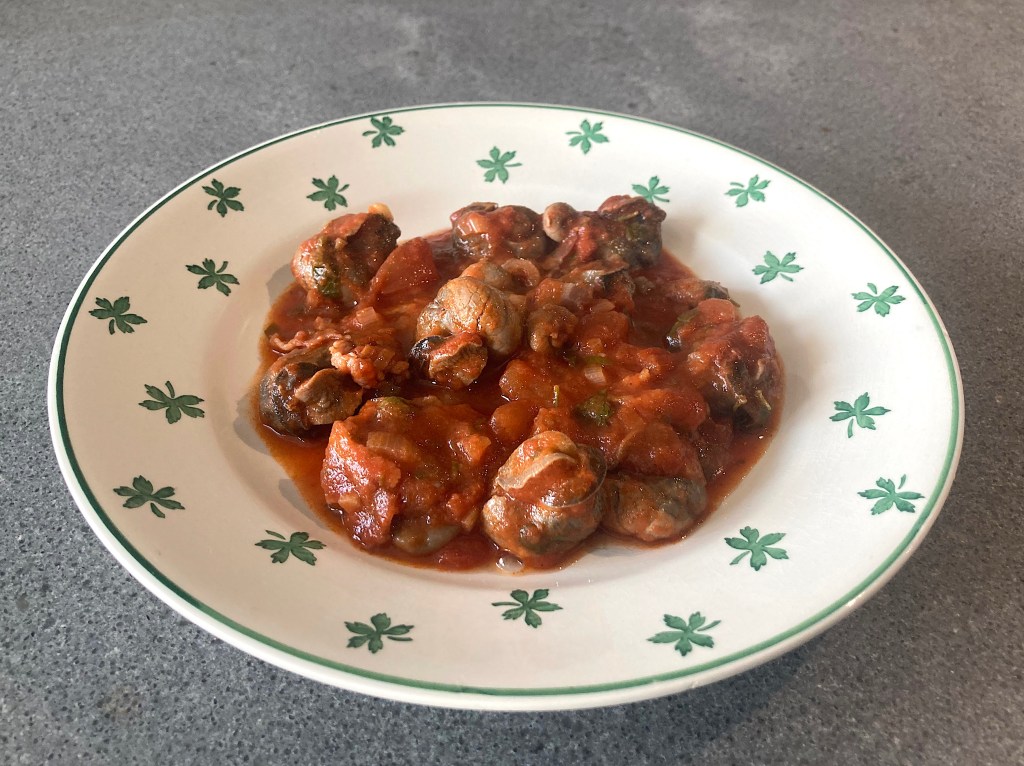
Escargots à la Bordelaise

For some reason we had booked a hotel in Coutras, some 65 kilometres from Bordeaux. A nice enough city, on the borders of the river Dronne, but not as interesting as nearby city Libourne with its castles, parcs and rivers (the Dordogne and the Isle). In all fairness, we could easily have forgotten our stay at Coutras, if it wasn’t for the dinner at La Table Du Buffet. It was a warm welcome, a nice plat du jour made with lots of local products and served with very nice local wine, obviously.
One of the dishes was Escargots à la Bordelaise, made with small snails. The taste was great although we think the snails could have been cleaner, but that’s a minor detail. The dish was a revelation: not the standard combination of snails, butter, garlic and parsley, but a rich tomato and wine sauce that supported the snails perfectly. Delicious with some crusted bread. We decided to prepare the dish as soon as we were back home.

Snails

Buying the right snails is not simple at all. The snail used for the classic Escargots de Bourgogne is called Helix Pomatia. Excellent taste, expensive and hard to find.
There are three alternatives: Helix Aspera (either the small one called Petit Gris or the large one called Gros Gris) and Helix Lucorum. The last one is considered to be less tasty than the other three, but when prepared well, it’s a very nice, affordable alternative.

Sometimes it simply says ‘Escargots’ and ‘Gros’ on the tin. Sounds good, doesn’t it? In most cases these ‘escargots’ are cooked and chopped large (sea) snails. The term ‘Gros’ is supposed to make you think of the Gros Gris. Don’t be fooled: these ‘escargots’ are rubbery, tasteless and a waste of money (and snail).

Fast Snails

And now for the sad part: as you know snails are slow. Very slow. And during winter they are even slower. They simply sleep 3 to 5 months before becoming active again. Some (most?) farmers are not that patient, so they turn up the light and the heat, pushing the snails towards a faster life, forcing them to skip hibernation and become fast snails.
Even the poor snails are turned into manageable products.
Let’s focus on the honest exception: some farms allow the snails to be slow, to sleep through winter, to be their natural self. Hurray!

Wine Pairing

Given the name of the dish (and the flavours of course) we suggest a red Bordeaux wine. Not too complex, not too expensive. We enjoyed a Côtes de Bordeaux produced by Château Cap Saint Martin in Blaye. In general you’re looking for a red wine with grapes such as Merlot, Cabernet Sauvignon, Cabernet Franc and Malbec. Rich in fruit, limited in tannins and acidity.

What You Need
  • 12-18 Snails
  • 50 grams of Pancetta (bacon is also fine)
  • 1 Shallot
  • 1 Garlic Clove
  • Parsley
  • Tomato Sauce
  • Red Wine
  • Olive oil
  • Black pepper
  • Crusted Bread
What You Do
  1. Chop the shallot, the garlic and the parsley
  2. Slice the pancetta
  3. Warm a heavy iron skillet
  4. Gently fry the shallot
  5. After a few minutes add the garlic
  6. Add the pancetta and fry for a few minutes
  7. Add the tomato sauce, some red wine, the chopped parsley
  8. Allow to reduce, thicken and integrate, let’s say 15 minutes. Longer is fine; the consistency of the sauce is important
  9. Add snails and cook for 10 minutes on a very low heat
  10. Serve immediately with crusted bread
Escargots à la Bordelaise ©cadwu