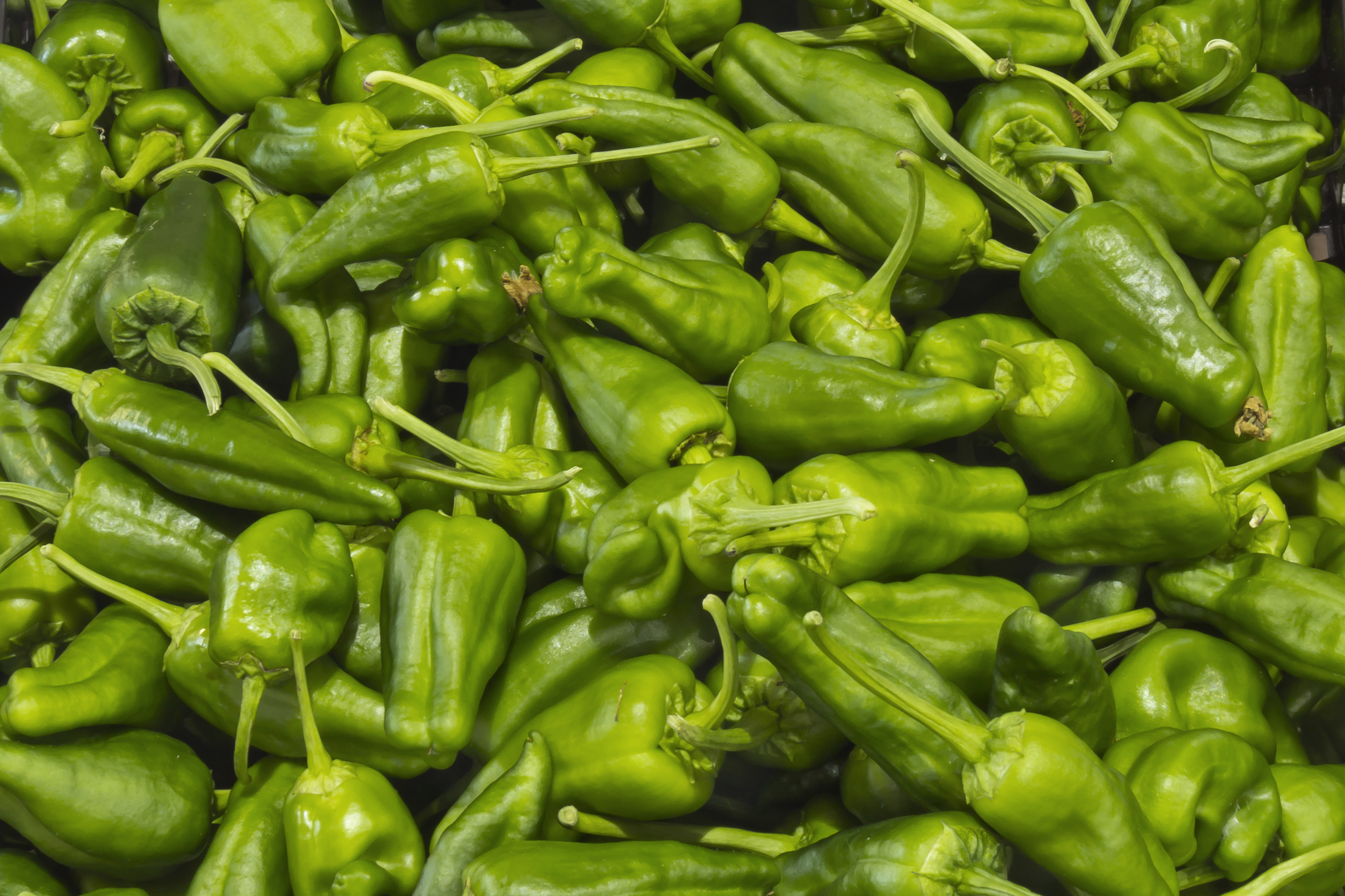
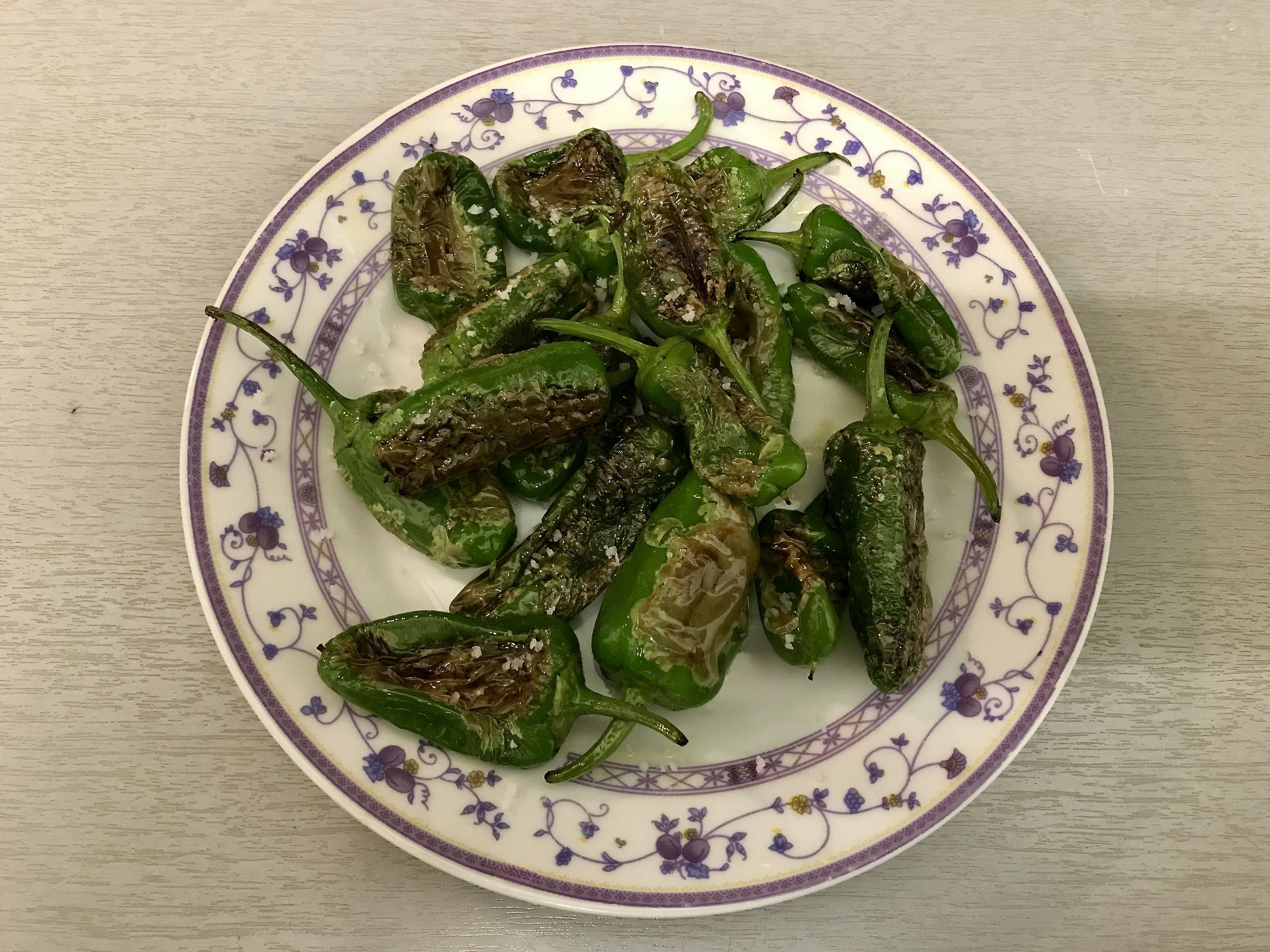
Pimientos de Padrón are mild, sweet tasting and small green peppers, originally from the Galicia region in Spain, but now they are more widely available. Story has it that one in a hundred (or more?) is actually very spicy, but rest assured, we have eaten many more and never encountered a spicy one.
Wine Pairing
The dish combines sweetness and saltiness. The charring of the peppers gives extra flavour. In general you’re looking for a crisp non-oaked white wine. We enjoyed a glass of white wine, made with verdejo grapes in the Spanish Rueda area by Bardos. The wine has a beautiful yellow colour and its taste is fruity and fresh with nice acidity. A glass of Cava will also be great with the peppers!
We could also imagine drinking a Vinho Verde with the Pimientos de Padrón. Vinho Verde is a wine from the most northern part of Portugal, between the Douro and Minho rivers. Verde refers to the fact that the grapes are harvested very early in the year. This implies that the grapes contain a fairly small amount of sugar. As a result of this the wine (in most cases) has a fairly low percentage of alcohol (think 10%). But don’t be surprised if you find one with a higher percentage. In general Vinho Verde is undervalued. It’s a great, very tasty wine; one that is not just wonderful on a summer’s evening
What You Need
Pimientos de Padrón
Olive Oil
Sea Salt
What You Do
Wash the peppers and dry
Heat a heavy iron skillet, add olive oil and fry or better said blister the peppers for a few minutes
Make sure the peppers are fried and not cooked
Remove from the heat
Sprinkle some salt over the peppers
Move the pan making sure the salt is evenly distributed and somewhat absorbed in the olive oil
A few years ago we were looking for a restaurant in Kyoto. We had difficulty in finding one (due to our lack of understanding of the language and the characters) but finally we found a tempura-beer-bar. Perhaps not ideal, but the menu came with helpful pictures. We enjoyed delicious tempura, fried to perfection, made with vegetables, with mushrooms, prawns and even with chrysanthemum leaves.
Tempura is served with a dipping sauce called Tentsuyu. Just before serving, the sauce is combined with grated daikon. It’s a light, umami rich sauce with subtle presence of soy sauce. We think it’s also a great dipping sauce for sashimi because it will not overpower the fish, something standard soy sauce will do.
Drink Pairing
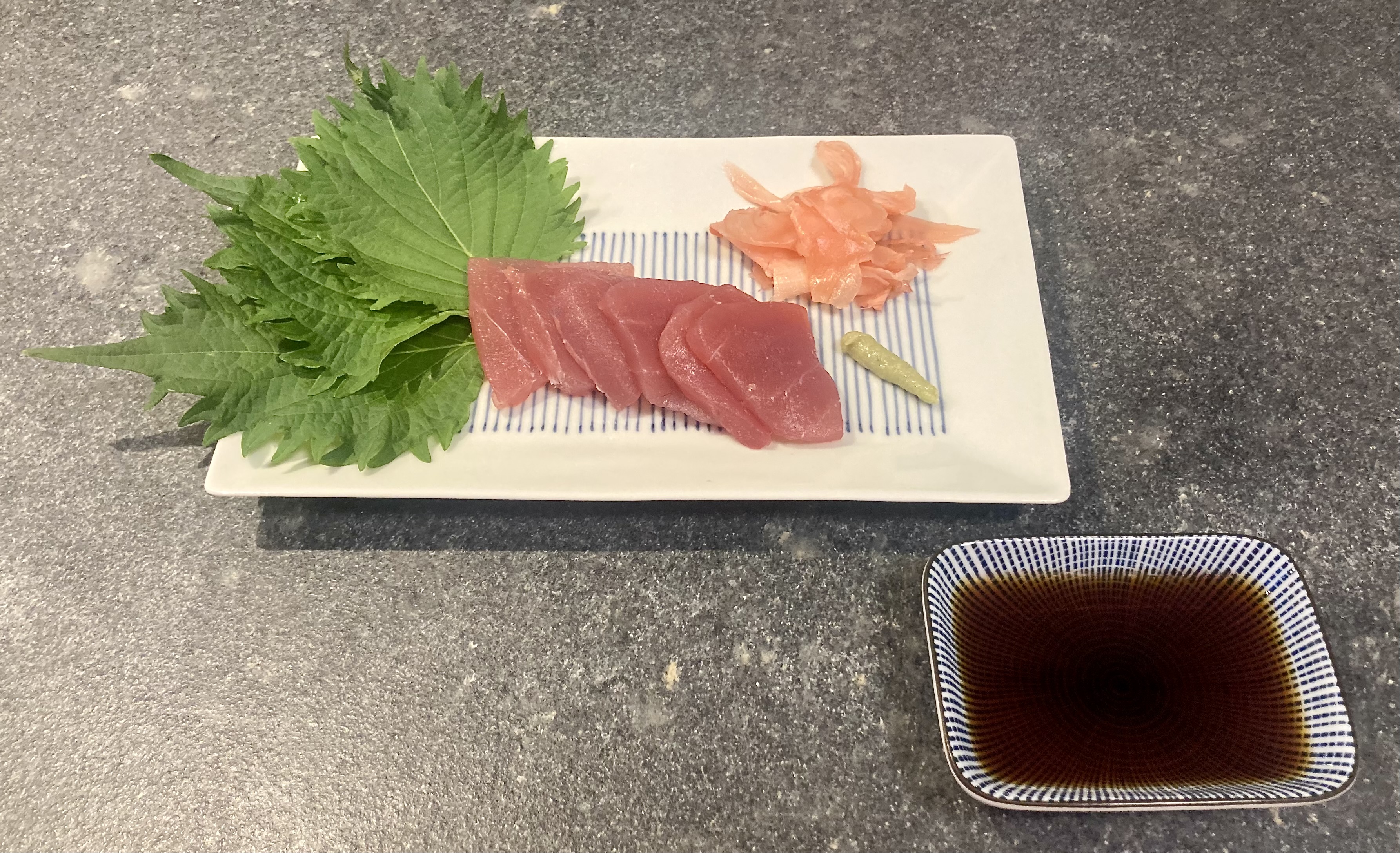
A beer obviously! We paired our sashimi of tuna with our favourite sake: Junmai Taru Sake as produced by Kiku-Masamune. This elegant sake is matured in barrels made of the finest Yoshino cedar. The aroma has indeed clear hints of cedar. The sake will cleanse your palate, allowing to taste the tuna even better.
We use less mirin because we prefer the sauce to be less sweet.
Bring to nearly boiling
Leave for one or two minutes
Remove from the heat and allow to cool
Store in the refrigerator; it will keep for maximum one week
PS
Why not combine the ingredients as they are and store immediately you wonder? One reason could be that heating the combination helps the flavours to integrate. Another reason is that Japanese mirin may contain alcohol and it needs to evaporate.
We serve the tuna with shiso leaves (ohba or perilla leaves), wasabi and pickled ginger. Shiso leaves can be purple or green. Its taste is difficult to describe. It’s vibrant, citrusy, herbaceous and refreshing. It goes very well with the fat in tempura or in salmon and tuna.
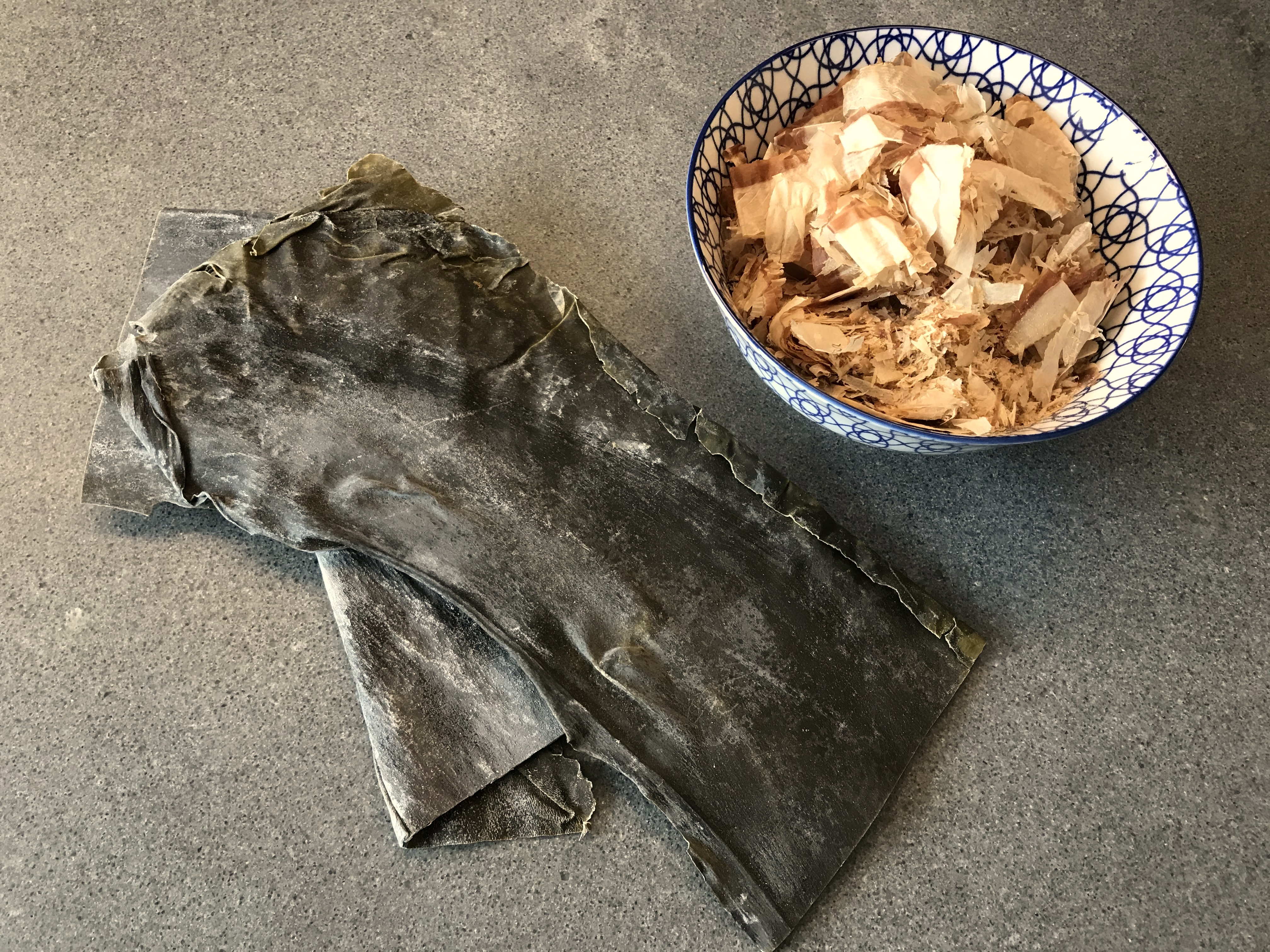
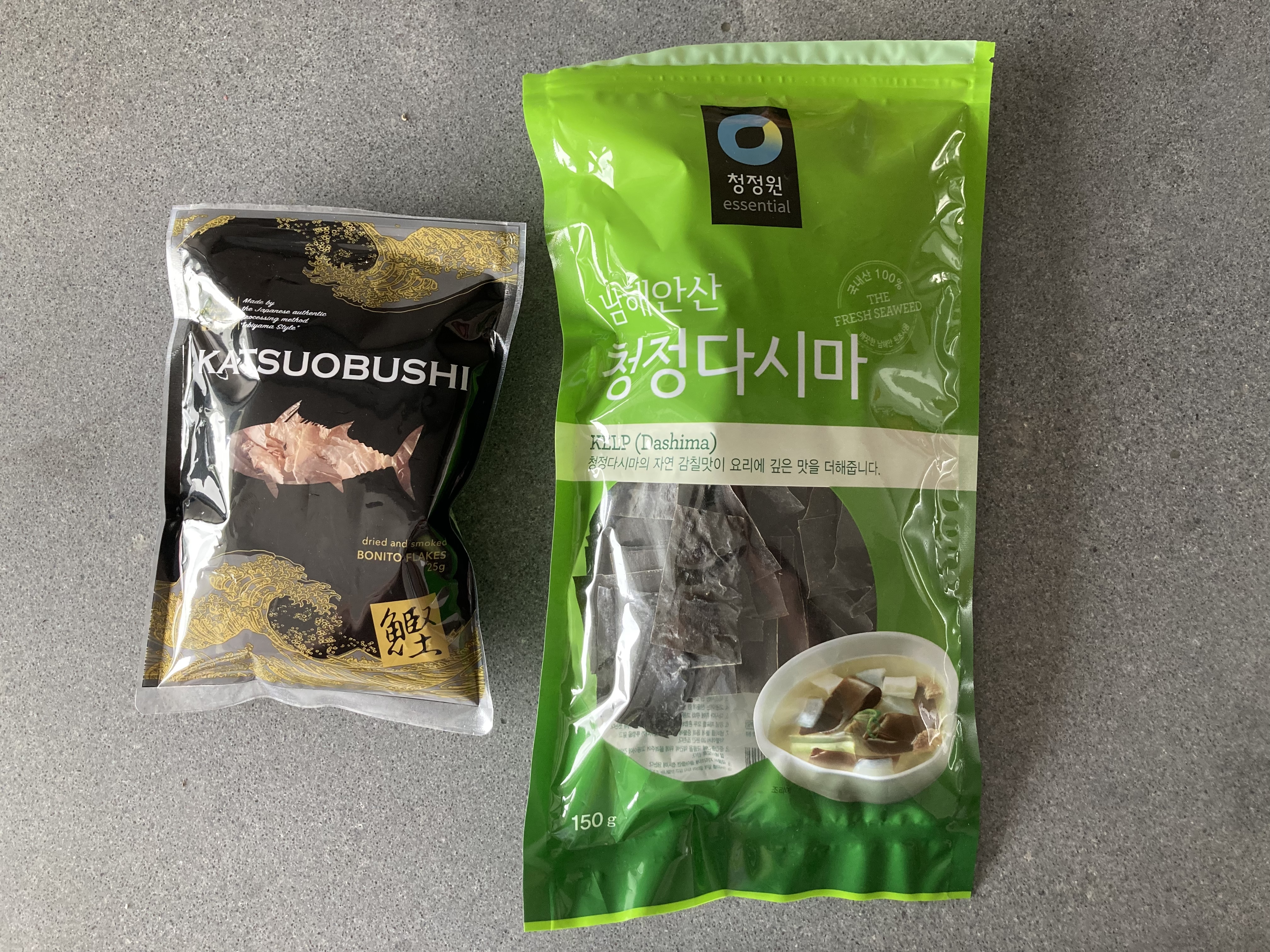
To prepare this classic Japanese broth you need between one and four ingredients. These are kelp (kombu), dried tuna flakes (katsuobushi), dried small anchovies or sardines and dried shiitake. The simplest dashi is made with kombu only. Its taste is gentle with a touch of umami. It’s a great vegetarian broth. We use it to make pumpkin soup. The best known is awase dashi and it’s made with kombu and katsuobushi. It is the basis of oden, miso soup and many other dishes. It’s also the basis of our dashi with matsutake and shrimps and for tentsuyu, the dipping sauce for tempura. If you add a splash of dashi and some Japanese mustard (karashi) to your mayonnaise you have your own Japanese mayonnaise.
Katsuobushi is made from skipjack tuna (bonito). It’s a complex and time-consuming process. A Japanese chef will begin her or his day with shaving katsuobushi. We keep it simple and buy flakes.
What You Need
1 liter of Water
20 grams of Kombu
30 grams of Katsuobushi
What You Do
Use a wet cloth to gently clean the kombu
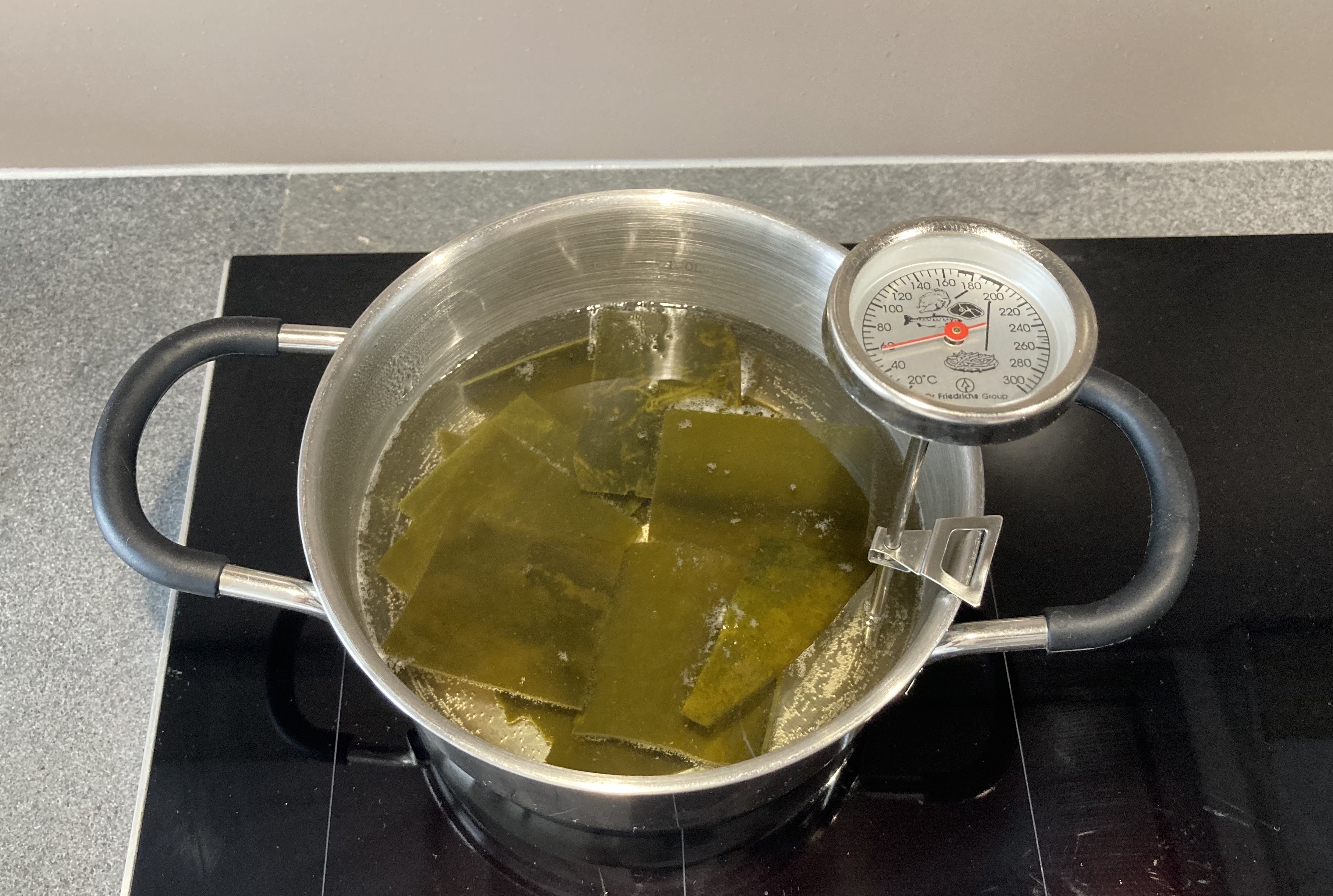
Put the kombu in the cold water and leave for 30 minutes
Heat slowly to 80 °C or 175 °F
Take you time!
When the temperature has reached 80 °C or 175 °F, remove the kombu (and store it for a second dashi)
Bring the liquid to the boil
Immediately reduce heat
Add the katsuobushi
Bring to a boil
Immediately remove from heat
Let it sit for 10 minutes or so until the katsuobushi has sunk to the bottom
Pass the liquid through a sieve
You can also use a clean cloth, but don’t squeeze it. You want a clear broth
The dashi can be used immediately, stored in your refrigerator for a few days or kept in the freezer for a few weeks (not preferred)
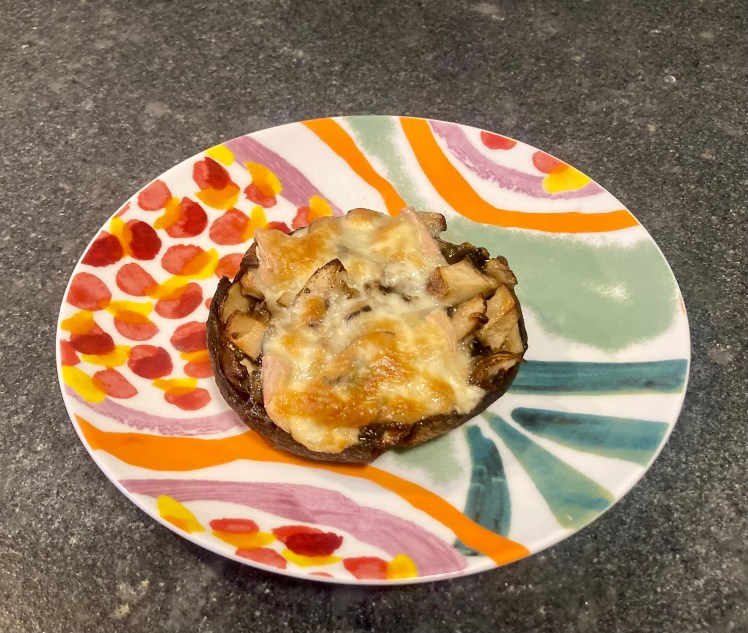
Portobello mushrooms are mature chestnut mushrooms (also known as common mushroom, champignon de Paris, button mushroom, cremini etcetera). Ideal to stuff and serve as a starter. We found them stuffed with ratatouille, with blue cheese and walnuts, with shrimps, with sausage and peppers: it seems anything goes! We decided to remain close to the flavour of the mushroom by stuffing them with chestnut mushrooms, shiitake and oregano. We topped them with taleggio, a semi-soft cheese from Italy with a mild taste. It melts easily, so you need to keep an eye on your oven! If you can’t get hold of taleggio, then use mozzarella instead and add a bit more flavour to the mushroom stuffing.
Wine Pairing
We decided to enjoy a glass of Viognier, made by Domaine Coudoulet in the Languedoc (France). The wine has aromas of peach and anise. The taste is fresh with a hint of orange zest. In general, we recommend a fresh, lightly fruity, unoaked white wine.
What You Need
For the Mushroom Stuffing
150 grams of Button Mushrooms and Shiitake
one small Shallot
one Garlic Clove
Oregano
Black Pepper
(Excellent) Olive Oil
2 Portobello mushrooms
Taleggio
What You Do
Clean and chop the button mushrooms and shiitake
Finely chop the oregano, the shallot and the garlic
Gently fry the shallot in olive oil in a heavy iron skillet
Add the mushrooms and fry on medium heat
Reduce heat
Add herbs and garlic
Continue on low heat for 10-15 minutes
Transfer the mushroom mix to a plate and let cool
Add some olive oil to make the mixture smoother
Taste and add some black pepper
Store in the refrigerator
Preheat your oven to 180 °C or 355 °F and line a baking sheet with parchment paper.
Remove the stem of the portobello
Using a small spoon, scrape out the dark gills from the caps
Generously brush both sides of the caps with olive oil
Slice the taleggio (with crust!)
Stuff the portobello with the mushroom mixture and top with slices of cheese
If you’re a true lover of taleggio: add a slice of cheese to the cap before stuffing with the mushroom mixture
Transfer the mushrooms to the oven for 15 minutes
(optional) During the last minutes increase to 200 °C or 400 °F
June 19th, 1926. Georges Cuvelier opens Chez Georges, a small neighbourhood restaurant in Brussels. One of the regulars told the chef: “Georges, chez vous, on mange comme chez soi” (meaning “Georges, in your restaurant one eats like at home”) which was meant as a compliment. The comment triggered a name change.
Georges Cuveliers daughter Simone married Louis Wijnants. Together they owned and managed the restaurant, now called Comme chez Soi. They focused on Belgian cuisine, local ingredients and quality. In 1966 their son Pierre Wijnants took over. He would become one of the finest and most celebrated chefs of Belgium. In 1979 the restaurant was awarded three Michelin stars.
Today the restaurant is owned by Laurence Wynants and Lionel Rigolet. It has one Michelin star.
A five course menu at Comme chez Soi will cost you 195 euro (225 US dollar) and with wine selection 270 euro (315 US dollar) per person. This summer the restaurant serves courses like cod fillet, candied ginger, parsley coulis, kohlrabi, Ndongo Bella Congo pepper and peach, nectarine, apricot, shortbread and a light lemon thyme mousse with verbena espuma.
Dining at Comme chez Soi is a bit above our budget, so we very happy to buy Fijnproeven in België, a book that celebrates the cuisine of Belgium. It’s written by Pierre Wijnants and Lionel Rigolet with beautiful photo’s by Tony Le Duc. It features wonderful dishes such as jelly of salmon, tea, lemon and tarragon and soup with cream, eel and hop shoots plus traditional Belgium dishes such as mashed potatoes with onions.
We decided to prepare frog legs with morels, fava beans, green asparagus, chervil, cream and lemon. We replaced the frog legs with organic chicken thighs because the frog population is in decline and frog farms are the worst ever.
The combination was very tasty and surprisingly light, with various textures and a rich sauce.
The suggestion is to pair the dish with a glass of bourgogne, more specifically a glass of Clos du Cellier aux Moines, Givry Premier Cru, a red wine made with 100% pinot noir grapes from the Côte Chalonnaise in France. We served the dish with a pinot noir made by La Cour Des Dames. In general you’re looking for a red, medium bodied wine with aromas of berries and floral notes. The tannins should be soft or well-integrated.
PS
The book includes quotes from guests including one that reads “Pourqoi est-ce meilleur que chez moi?” meaning “Why is it better than at my place?”
The combination of Lion’s Mane and Shiitake brings lots of umami. It pairs wonderfully with the aromatic ginger, the udon and the soy sauce. The Lion’s Mane is fried and slightly crispy. The overall flavour of the dish is long and complex. The Shiitake is essential in the sauce and the fried Lion’s Mane brings depth and texture. Simple and delicious!
Udon is very popular in Japan and Korea. It’s made with wheat flour, water and salt. It can be served hot or cold. Different from Italian pasta, you don’t need to add salt to the cooking water. Furthermore the noodle has to be rinsed with cold water before using it in a dish, which is an absolute no-go in Italian cuisine.
Wine Pairing
The obvious choice would be a white wine, one with some floral notes and sweetness. However, the taste of the fried lion’s mane allows you to serve a red wine. We enjoyed a glass of Bardolino, made by Monte del Frà from Italy. The grapes used are Corvina, Rondinella and Molinara. It is a well-balanced, vibrant red wine with lots of fruit and a hint of spices. Medium acidity. In general, you’re looking for a refreshing red wine with lots of fruit that should be served slightly chilled (15°C – 17°C or 59°F – 63°F).
1 tablespoon of (Marukin) Concentrated Dashi Stock
2 teaspoons of Sesame Oil
(Olive) Oil
Black Pepper
What You Do
Clean the shiitake with kitchen paper and remove the stems
Slice the shiitake
Clean the lion’s mane by removing discoloured and/or soft parts
Slice the lion’s mane (1 cm or 0.5 in)
Peel the ginger and chop finely
Cook the udon according to the instruction on the package in boiling water (no salt needed)
Heat a heavy iron pan, add some oil and fry the shiitake, reduce heat
Add ginger
After a few minutes add vegetable stock, soy sauce, oyster sauce and concentrated dashi stock to the pan with the shiitake
Add oil to a second heavy iron skillet and fry the lion’s mane until golden
When the udon is ready, drain and rinse thoroughly with cold water
Add the udon to the pan with the shiitake and the sauce, combine and adjusts
Perhaps you need to add some extra vegetable stock
Warm through and through
Add black pepper
Taste and adjust
Just before serving add some sesame oil
Plate up and serve the lion’s mane on top of the dish
PS
We love using Marukin Concentrated Dashi Stock in combination with udon and mushrooms. You can make your own by adding some mirin and soy sauce to a cup of strong dashi.
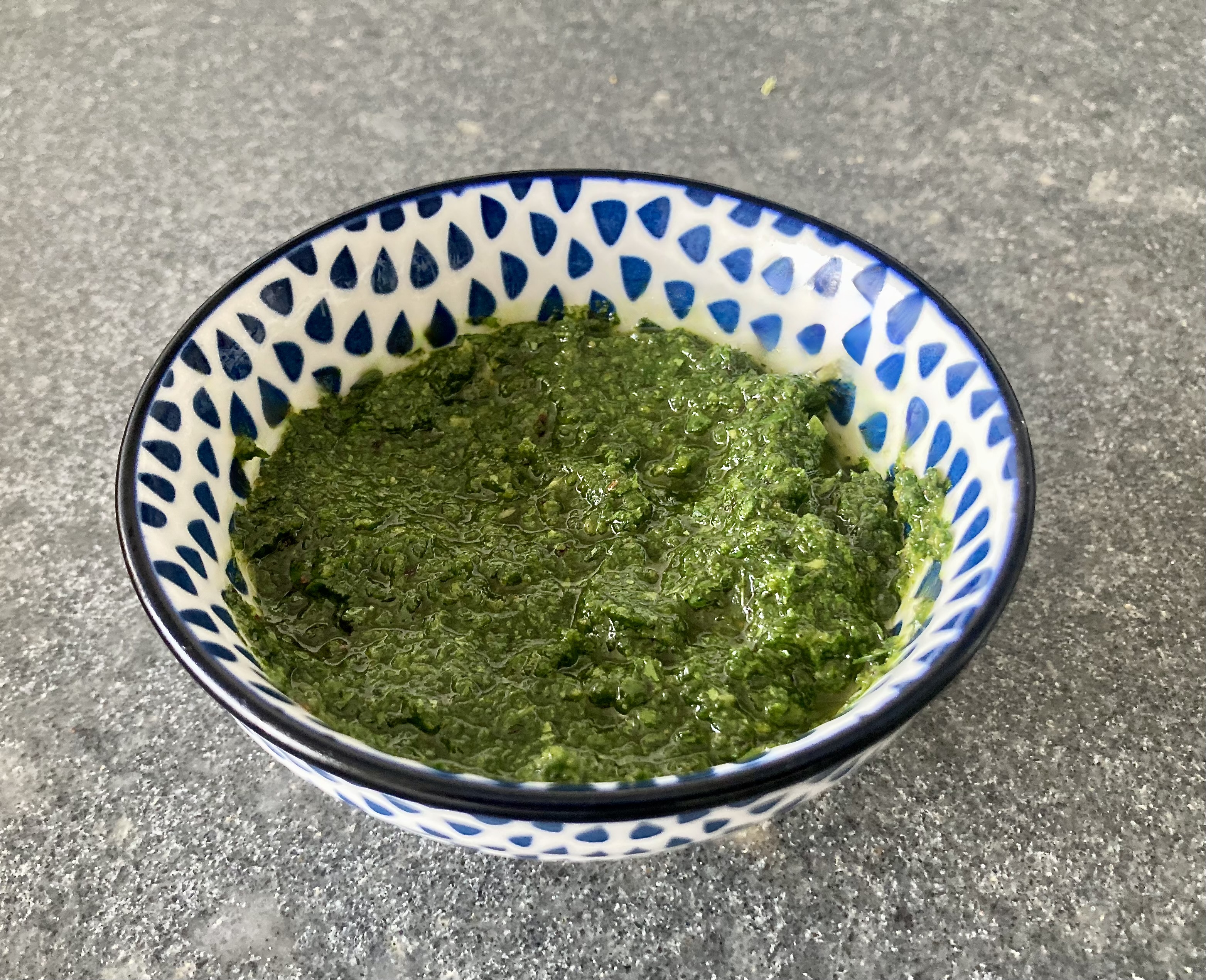
A few weeks ago Gido and Lien, owners of the now closed vegetarian restaurant Betty’s in Amsterdam, mailed us a recipe for Zhoug (also known as Zhug, Skhug or Schug), a hot sauce from Yemen. It combines cilantro, parsley, red or green peppers and various spices. Lien and Gido use a combination of spices known as Serinissima, produced by the French company Roellinger. Not something we have in our cupboard, so we used the ingredients as mentioned by Roellinger.
Zhug is spicy, bold, bright and intense. We enjoyed Zhug with crusted bread. We could imagine it’s also very tasty with falafel, grilled fish, oven roasted vegetables or fresh tomatoes.
What You Need
30 grams of fresh Cilantro
15 grams of fresh Parsley (leaves only)
Excellent Olive Oil
1 small clove of Garlic
½ Jalapeño
2 teaspoons in total of
Clove
Ginger Powder
Melegueta Pepper (Grains of Paradise)
Saffron
Cumin
Black Pepper to taste
½ teaspoon of Salt
Lemon Juice to taste
What You Do
Grate the cloves, ground the Melegueate pepper and the cumin
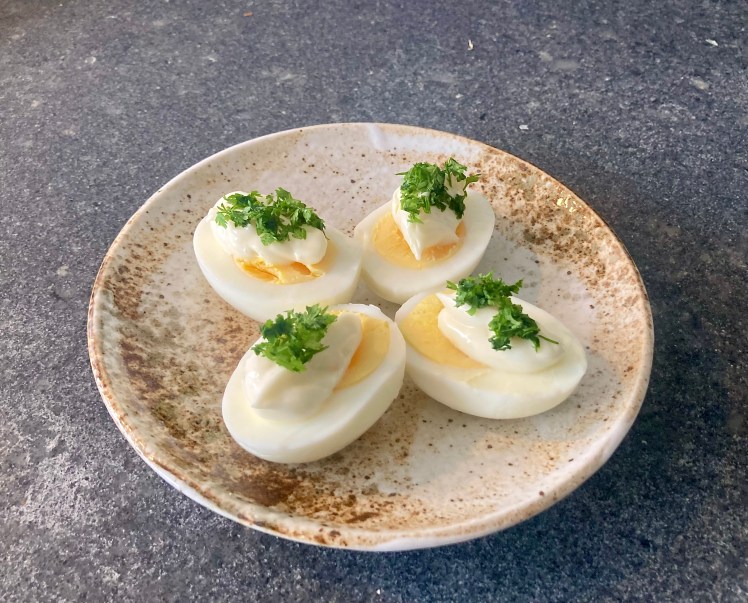
Œufs Dur Mayonnaise is a classic French bistro dish. Beginning of the 20th century the instruction was simple: make mayonnaise (egg yolk, white wine vinegar, oil, salt and white pepper), quarter or halve hard boiled eggs and place these on a layer of mayonnaise. Today’s versions use mayonnaise with mustard. Delia Smith adds garlic to her mayonnaise. Presentation-wise the eggs are topped with mayonnaise and served with lettuce, cornichons or olives. Another possibility is to serve the halved eggs as a dome, covered with mayonnaise.
Œufs Dur Mayonnaise may look simple, and perhaps you think it’s too simple to be a starter on its own. It’s actually very nice, if you use quality ingredients and make your own mayonnaise. Its simplicity doesn’t allow you to cheat (boil the eggs days in advance, overcook them, use cheap eggs, use ready made mayonnaise etcetera).
Today’s recipes suggest leaving the egg yolk slightly creamy. After having tried a number of cuissons (donenesses if that’s a word!) we think it’s best to use hard boiled eggs. We rely on our Emerio egg cooker to create the perfect egg!
Drink Pairing
The taste of Œufs Dur Mayonnaise is savoury, mineral and rich. The mayonnaise gives a velvety mouthfeel. As this is a classic bistro dish, we suggest a simple white wine, nicely cooled, or a beer, or a glass of cold water.
What You Need
fresh, organic Eggs
Mayonnaise
(optional) Chervil
What You Do
Prepare mayonnaise. We suggest adding a bit more mustard and vinegar than usual
Prepare hard boiled eggs
Peel the eggs and let cool
Halve the eggs and add some mayonnaise on top
(optional) decorate with chervil
PS
The number of bistro’s in France went down from some 170.000 in the 1960’s to 35.000 in the 2020’s. Œufs Dur Mayonnaise became unpopular: eggs contain a high amount of cholesterol and mayonnaise is high-fat food and calorie-dense. In 2018 L’Association pour la Sauvegarde de l’Œuf Mayonnaise (the association to protect Œuf Mayonnaise) was founded, to promote the dish and bring it back to the table. The Association organises an annual championship. The 2026 winner of the award was restaurant Au Rêve in Paris (Œufs Mayonnaise is on the menu for 4 euro).
In the 1860’s Lucien Olivier was chef of the restaurant Hermitage in Moscow. The restaurant served a dish with luxurious ingredients, such as pheasant, caviar, lobster, tongue, potatoes, pickles and lettuce with a sauce, perhaps sauce Provençal. These ingredients were served separately on one plate. One evening some of the guests combined the ingredients into one dish, which was not the intention of chef Olivier, but when he tasted it, he found that the blend worked very well. He improved the sauce by adding one or more secret ingredients and the Olivier Salad was born! It quickly became a very popular dish at the restaurant.
Sadly the recipe for the original Olivier Salad is not known. One of his sous chefs, Ivan Ivanov, wrote down what he thought was the recipe (without the secret ingredients, obviously), became head chef at another restaurant and sold the recipe to various publishers. It became known as Russian Salad. As more often, the popular version is made with less expensive ingredients, such as ham, chicken, carrots, green peas and mayonnaise.
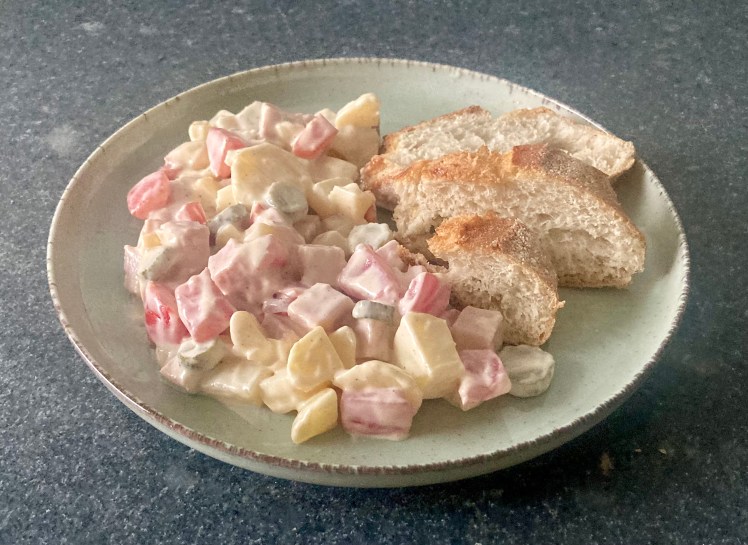
In 1909 Tsar Nicholas II visited King Victor Emmanuel III in Racconigi, some 35 kilometres south of Turin. Russian chefs explained to their Italian colleagues how to prepare Russian salad. The Italian chefs used vegetables from the royal gardens such as carrots, peas, beans and potatoes (which we think is a bit odd given the luxurious ingredients of the original). The salad was decorated with cream to evoke the snow of the Russian steppes. It became very popular in the Savoy region, a region that included the Principality of Piedmont and the County of Nice, among others. In the south of France it is known as Salade Piémontaise.
The anecdote about the creation of the Olivier Salad seems credible, but is it? The second edition of The Modern Cook by Charles Elmé Francatelli (chef to Queen Victoria) was published in 1846. Recipe number 1215 is for…. Russian Salad! It is made with lobster, thunny (‘tuna’ we think), anchovies, crayfish, prawn tails, stuffed olives, capers and red mayonnaise (a combination of lobster coral, mayonnaise, cayenne pepper and mustard), to be served in a vegetable border (made with cauliflower, asparagus, beans, peas, potatoes, artichoke bottoms and aspic). Two great chefs think alike?
We can’t recreate the Olivier Salad, but we can follow Francatelli’s instructions and make an original Russian salad. Anyone?
Our version of the Salade Piémontaise is based on the salad as sold by the Boucherie de France in Nice. It’s a surprisingly light dish that allows you to enjoy all ingredients, thanks to the lemon juice and the fairly neutral mayonnaise.
Wine Pairing
Piemonte is well known for its great wines, such as Barolo and Barbaresco, both made with Nebbiolo grapes. We decided to go for a more simple wine from the region, produced by Fontanafredda and made with 100% Barbera grapes. A wine that is fruity (black berries, plums) with low tannins and a relatively high acidity, which is very nice with the salad.
De-seed the tomatoes and slice, same size as the potatoes and the ham
Steam or boil the egg, let cool and dice
Slice the cornichons
Combine the ingredients
Coat with mayonnaise and mix gently
Add lemon juice, black pepper and adjust
Leave in the refrigerator until cool
Serve with crusted bread
PS
In 1852 Francatelli published A Plain Cookery Book for the Working Classes to help poorer members of society. The book contains 241 recipes with inexpensive ingredients. Not just royalty and exclusivity for him!
A few weeks ago John Rieber wrote about the miracle of garlic. He also explains the 10-minute rule and the way it creates additional benefits when using garlic. His post includes a recipe for a garlicky soup, a variation of Avgolemono.
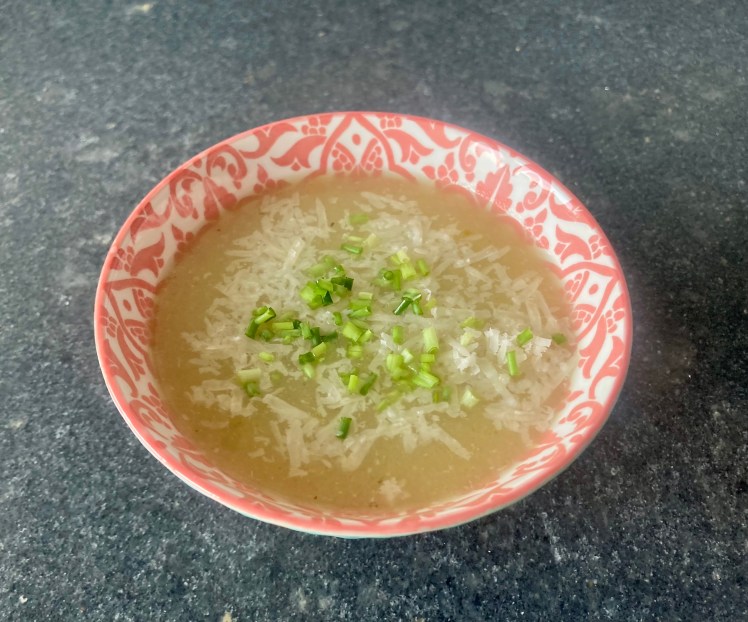
The post made us think of ‘knofsoep’ (in English it would be ‘garsoup’) as described by author, poet and performer Johnny Van Doornin 1988. He was known for his ecstatic performances, enabled by the use of various substances. His knofsoep, based on a recipe from Roman times, helped him through the day. The soup is uplifting, supports overall health and more specifically the liver. It is to be served with crusted bread and a glass of wine. We adjusted the recipe slightly by using vegetable stock and adding some chives. The soup has a very mild, sweet garlic flavour (thanks to not roasting or frying the garlic) and complexity thanks to the herbs and the clove.
The original recipe (in Dutch) is available in his diary Door de Weken Heen, available for 5 euros, second hand only.
What You Need
500 ml Vegetable Stock
8 cloves of Garlic
1 starchy Potato
Olive Oil
Bouquet Garni (Thyme, Sage, Rosemary, Parsley, Bay Leaf)
1 Clove
2 crushed Black Peppers
Parmesan Cheese
Chives
(optional) Black Pepper
(optional) Salt
What You Do
Bring the stock to a boil
Add garlic and potato
Reduce the heat
Add a small tablespoon of olive oil
Add bouquet garni, clove and crushed black peppers
After 40 minutes pass the soup through a sieve
Use a spoon to capture all the flavours of the ingredients