Burdock

Wintery weather in Amsterdam, cold and sunny. Time to enjoy some seasonal vegetables, such as beet root, fennel, leek, kale, turnips and Brussels sprouts. Our favourite vegetable and fruit stall on the market sells Burdock. We all know about forgotten vegetables (such as rutabaga, kohlrabi, parsnips and Jerusalem artichoke), but Burdock is not one of them. It’s an ignored vegetable.
According to chef Alan Bergo in his excellent book The Forager Chef’s Book of Flora, Burdock root is delicious with a mild and slightly nutty flavour. Native in Europe and Asia, and introduced worldwide. He offers six recipes with Burdock, using the flower stalks in summer and the root in winter. One of the recipes is for Kinpira Gobō, a common side dish in Japan in which Burdock is combined with carrots, lotus root, mirin and sesame seeds. All his Burdock-dishes look delicious. Which raises the question why we don’t eat Burdock more often. 
We prepare a Japanese dish called Ume Gobō (ごぼうの梅煮) which translates to Burdock with Plums, which is basically what it is.
We served our Ume Gobō with Tamagoyaki, which turned out to be a very tasty, uplifting combination.

Wine Pairing

We enjoyed a glass of Crémant d’Alsace, produced by Arthur Metz. A very pleasant dry sparkling wine, with hints of apple, almonds and peach. Excellent combination with the Ume Gobō and the Tamagoyaki. In general, we suggest a not too complex unoaked white wine.

What You Need
  • 250 ml of Dashi
  • 1 Burdock Root
  • 3 salted Plums
  • 2 teaspoons of Mirin
  • 2 teaspoons of light, reduced sodium Soy Sauce
What You Do

Wash the burdock to remove the dirt. If necessary use a knife. Trim off the ends. Warm the dashi and slice the root in 5 cm long chunks. Quarter these lengthwise. If the root is thick, slice again. Transfer the chunks immediately to the dashi to stop the root from discolouring. Remove the pits of the plums and add one plum to the dashi. Use a cartouche to cover the vegetables. Leave to simmer for approximately one hour. By then all the liquid should be evaporated and the vegetables relatively soft. You could cook it longer if you prefer them really soft. Keep an eye on the pan, you may have to add some extra dashi.
Finely chop the remaining plums and add the paste-like substance to a bowl with mirin and soy sauce. Mix. When the burdock is lukewarm, it’s time to add the chunks to the bowl and mix.

Burdock with Salted Plums ©cadwu

Authentic Dutch Pepernoten

Today, December 5th (actually December 6th), we celebrate the birthday (actually name day) of Sinterklaas or Sint Nicolas (270-343), patron saint of children (and Amsterdam), the Greek Bishop of Myra (now Demre), currently Turkey, but living in Madrid according to Dutch tradition and arriving end of November per steamboat. He rides a white horse over the rooftops at night and can be in different places at the same time. Very confusing but it makes perfect sense to children.

His assistants, (called Pieten), carry bags with sweets and presents. They used to be Zwarte Pieten (Black Pete) but thankfully that part of the tradition has now changed significantly making the Sinterklaas festivities more inclusive. Piet has become a Sooty Piet (they squeeze down and up sooty chimneys in order to deliver presents).

The celebration is not just about presents and sweets, it is about behaviour: Sinterklaas carries a big book with information about children: who has been good (sweets, presents) and who has been naughty (spanking with the birch rod that is used by Piet to sweep chimneys or being put in a now empty bag and taken back to Spain). Now you know why most Dutch and Belgian children become nervous and restless beginning of December!

Culinary

The culinary aspect of Sinterklaas is about sweets: chocolate letters (the first letter of your name), chocolate coins, marzipan figures, chocolate frogs (in a bathing suit, obviously) and mice (both stuffed with fondant), speculaas (spiced short crust), kruidnoten (as speculaas but slightly different) and pepernoten. Both kruidnoten en pepernoten were thrown through the room, for the children to look for.
The smaller sweets were part of a ritual: in the evening you would put a shoe in front of the fireplace (or a similar apparatus, as long as it was connected to a chimney, things became challenging with the introduction of central heating) and you would sing a traditional Sinterklaas song. If possible you would put a carrot in your shoe for Sinterklaas’ horse. The next morning the sweets would be waiting for you in your shoe. Wonderful memories!

Pepernoten

If you shop these days in the Netherlands, you will see lots and lots of pepernoten. One Dutch company specialises in pepernoten and produces them in over 50 flavours. These pepernoten are actually kruidnoten. In 1593 Carolus Battus mentions Peper-coecxkens. The recipe for the original pepernoot goes back to 1756 when Gerrit van den Brenk writes a book called Volmaakte onderrigtinge, ten dienste der koekbakkers of hunne leerlingen (which translates into something like Perfect lessons for cookie bakers and their pupils). The ingredients are honey, white rye flour, potash and grinded anise seed. Dutch pâtissier Cees Holtkamp modernized the recipe, enabling us to recreate pepernoten.

What You Need
  • 50 grams of Brown Caster Sugar
  • 75 grams of Honey
  • 150 grams of White Rye Flour
  • 2 grams of Salt
  • 20 grams of Water
  • 5 grams of Baking Powder
  • 6 grams of grinded Anise Seed
  • 10 grams of Water
  • Neutral Oil
  • No Pepper (despite the name!)
What You Do

Best option is to watch Cees Holtkamp preparing pepernoten with support from his granddaughter Stella. The video comes with English subtitles. An even better idea is to buy his book Dutch Pastry. It’s available via the usual channels or order it at your local bookstore. Price is approximately 20 – 25 euro or US dollar.
Combine sugar, honey and water in a pan. Heat the mixture without boiling. Remove from heat. Immediately add flour and salt. Use a kitchen aid with hooks to make the dough. It will be very sticky and odd. Allow to rest for a few hours.
Add baking powder, anise seed and water. Kneed, cover with plastic foil and allow to rest until the next day.
Preheat your oven to 180 °C or 355 °F traditional. Make small cubes and use your hands to turn these into balls. Generously coat a baking tin with oil. We used a spring baking tin, which is not what we should have done. It is better to use a seamless baking tin. Wet your hands with oil, coat every ball with oil and add to the tin. The tin must be completely filled, so the balls must touch each other. This way you get the typical rounded-cube-shape of pepernoten. If not, add some aluminium foil to the tin. Transfer to the oven and leave for 20 minutes. Detach the pepernoten as soon as possible.

PS

We could only find whole grain rye flour, which is not suitable for this recipe. Instead, we used all-purpose flour.

Lamb Shank with Star Anise, Ginger and Djeroek Poeroet

The obvious way to prepare lamb shanks is to fry them briefly in oil en butter and then cook them for hours in red wine with a bouguet garni of rosemary, thyme, parsley, sage and perhaps lavender. Maybe add a small tomato to help the sauce. We take a different approach by adding strong flavors like ginger, cilantro seeds, star anise, soy sauce and the leaves of the Makrut or Thai lime (also known as Djeroek Poeroet or Djeruk Purut). You will get a full, complex sauce in combination with tasty, juicy, tender and aromatic meat.

Wine Pairing

The obvious choice would be a glass of Pinot Blanc or Pinot Gris. We once enjoyed the dish with a glass of Gewurztraminer from the Alsace. A touch of spiciness and sweetness, which worked really well with the star anise and ginger.
Combining the lamb shanks with red wine is more challenging. Our choice was a bottle of Cuvée Equinoxe produced by Domaine d’Arjolle, from the Languedoc region in France. The wine is made with 100% merlot grapes. It has an intense ruby ​​color and aromas of red fruit. The flavour is soft and long, with a touch of sweetness and oak. A soft, not too complex Syrah could also be very nice with the lamb shanks.

What You Need
  • 2 Lamb Shanks
  • Shallot
  • Olive oil
  • Fresh Ginger (4 cm, depending on your taste)
  • 1/2 red Chili
  • 2 Garlic Cloves
  • Noilly Prat
  • teaspoon of Cilantro Seeds
  • 2 Star Anise
  • Low Salt Soy Sauce
  • 6 leaves of Djeroek Poeroet
What You Do

Fry the meat in olive oil, giving it a nice colour. In the mean time cut the shallot, peel the ginger and slice, remove the seeds from the chili and cut the garlic clove (but not too fine). Remove the meat from the pan and glaze the shallot, chili, ginger and garlic. Add the Noilly Prat, crushed cilantro seeds, star anise, some low-salt soy sauce and the djeroek poeroet. Stir. Transfer the meat back to the pan and add some water, perhaps 3 cm. Leave to simmer for 4 – 6 hours in total. Check the pan every hour and add water if so required. After 6 hours remove the shanks from the sauce and cool. Reduce the sauce, let cool and transfer to the refrigerator. The following day remove as much of the fat from the sauce as possible. Warm the sauce together with the shanks, check taste and tenderness.
Serve with steamed Bok Choy tossed with sesame oil or with rice.

Lamb Shank ©cadwu
Lamb Shank ©cadwu

Palmiers au Fromage

It’s Friday evening, friends are coming over for dinner, a nice bottle of crémant d’Alsace is waiting to be opened, you switch on your oven, slice the dough and transfer the slices to the oven. An hour or so later you serve a glass of crémant, accompanied by crispy, lukewarm, aromatic Palmiers au Fromage. Aren’t they lovely?

What You Need
  • Puff Pastry
  • 50 grams of Butter
  • 25 grams of very, very old cheese
  • (optional) Black Pepper and Mustard
What You Do

We used three sheets (12* 12 cm) of puff pastry. Combine the sheets into one by folding the dough. You want to keep the layered structure of the puff pastry. Transfer to the refrigerator for 30 minutes or so. In the meantime, combine 50 grams of very soft butter with 25 grams of finely grated very old cheese until it’s fluffy and creamy. This may take some time! Taste and decide if you want to add more cheese, mustard and/or black pepper.
Dust your work top with flour, roll out the dough, size 12 by 36 cm. Used a brush to coat the dough with the butter mixture. Pick up the left short side of the dough and fold until halfway. Do the same with the right size. It should now be 12 by approximately 18 cm. Repeat. Probably you can’t repeat it after having folded the dough twice. If you think you can, please do so. Now brush halve the dough and fold. The result looks like a 12-cm-long sausage. Wrap in plastic foil, transfer to the refrigerator and let cool through and through.
Preheat your oven to 200 °C or 390 °F. Use a sharp knife to slice the dough-sausage, 0.5 cm is perfect. Cover a baking tray with parchment (baking) paper and bake the Palmiers au Fromage for 10 – 15 minutes or until golden-brown.

Palmiers ©cadwu
Palmiers ©cadwu

Paillasson with Pied de Mouton

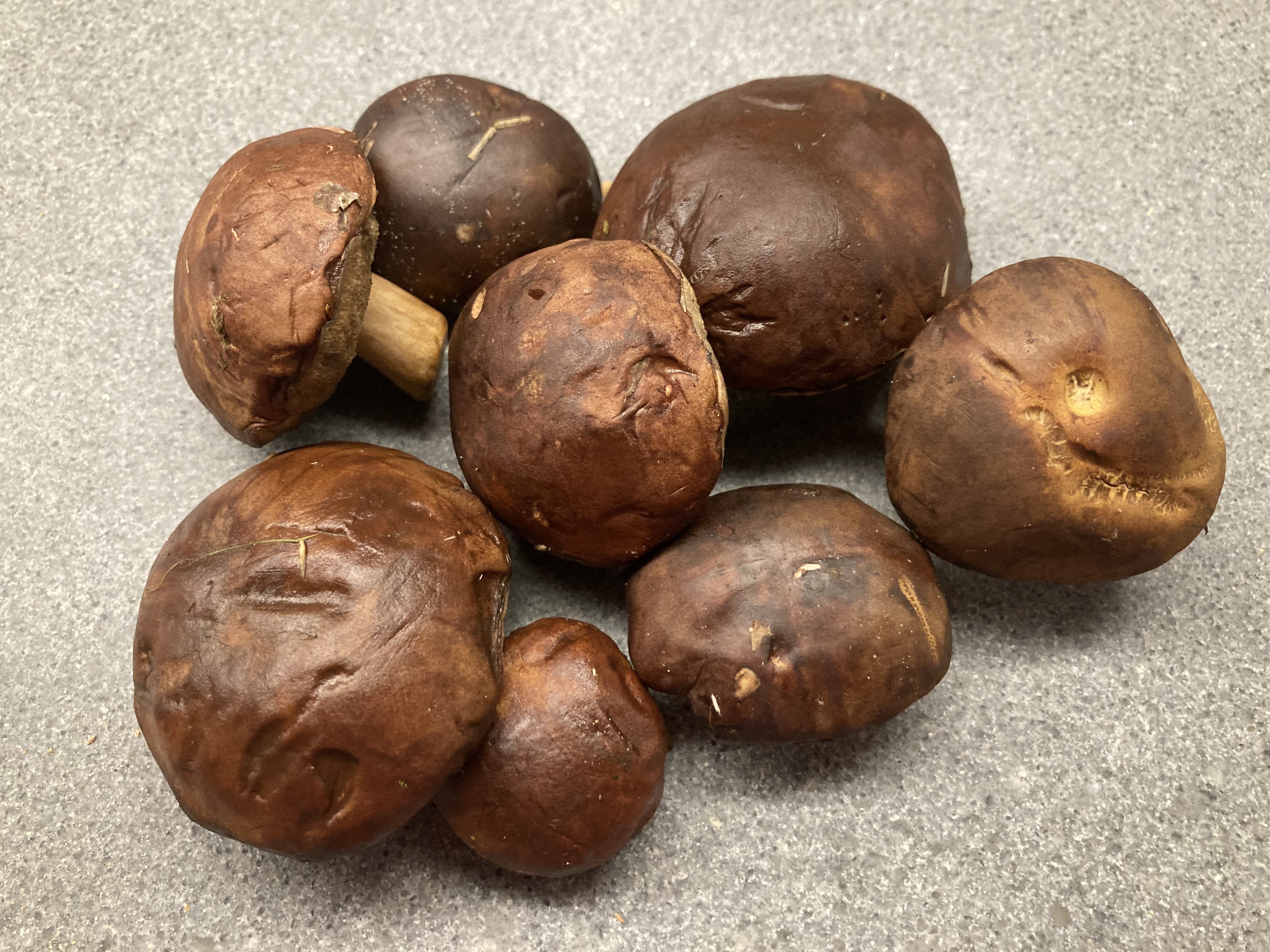
Going through our list of mushroom recipes, we noticed we didn’t have one with Pied de Mouton. Very odd! The taste of this firm mushroom is a bit sweet, nutty and mild. The mushroom is slightly dry and tends to absorb flavours and juices of other ingredients.
The season of the Pied de Mouton begins in August and continues until January, sometimes even March. A very affordable and tasty wild mushroom that keeps very well in your refrigerator. Very nice in a creamy pasta dish, with a meat ragoût or in a casserole with vegetables and lentils.
We decided to add them to a Paillasson de Pommes de Terre, which is similar to the Galette de Pommes de Terre, the Reibekuche in Germany and the Rösti in Switzerland. Ingredients vary per country, per region. Inspired by the Potato paillasse with sage and young garlic by Alain Passard, we decided to keep things simple and tasty.

Wine Pairing

The Paillasson with Pied de Mouton is creamy, moist, rich and aromatic. We think it’s best with a fruity, non-oaked red wine, for instance a Pinot Noir or a Merlot. Not too complex!

What You Need
  • 250 grams of Potatoes (waxy)
  • 200 grams of Pied de Mouton
  • 15 grams of Pancetta (Bacon)
  • Butter
  • Olive Oil
  • Rosemary
  • 2 cloves of Garlic
  • Black Pepper
What You Do

Heat a small non-stick pan. Dice the pancetta and fry in olive oil. Remove and set aside. Use a brush to clean the mushrooms. Dice. Fry the mushrooms for 5 minutes. Add finely chopped garlic and finely chopped rosemary. Remove and set aside. Add some black pepper. Grate the potatoes, add black pepper and combine with the mushrooms and the pancetta. Add a generous amount of butter to the pan. Fry the paillasson for 10 minutes, flip, and fry for another 10 minutes, depending on the thickness. We decided to go for 15+10.

PS

The easiest way to flip the paillasson is to let it slide from the pan on a cutting board. Cover the paillasson with the pan, turn the board and the pan and you’re done.

Quiche with Bay Boletes

Bay Boletes are often compared to cèpes (penny bun). Both have a slightly nutty taste and are aromatic. The texture of a bay bolete is a bit softer, smoother and moister. It’s a very common mushroom in Europe, China, Mexico and North America. Sadly, this very tasty, not expensive bolete is hard to find in shops and on markets. If you see them, make sure to buy them immediately. They are great when combined with stronger flavours, in this case with Emmentaler and thyme.

Quiche Lorraine is made with pâte brisée, or shortcrust pastry. The result is a flaky, crumbly crust. Sounds ideal, but we prefer to add some egg to the dough (also known as pâte à foncer). The result is a slightly firmer crust, still crumbly, very tasty and beautiful golden.

The filling of a traditional Quiche Lorraine is a combination of whisked egg, crème fraîche, (optional) milk, lardons (bacon), nutmeg, salt and pepper. The combination of eggs and crème fraîche works very well, also in our quiche.

Wine Pairing

We decided to open a bottle of South African red wine, produced by Kruger, their 2022 Pinot Noir Pearly Gates – Upper Hemel en Aarde. The wine has aromas like dark cherry and a touch of smokiness. The colour is light, pale ruby and the flavour is dry, complex and long. It worked very well the aromatic quiche. In general, we would suggest a gently oaked pinot noir, with some dark fruit and sufficient complexity.

What You Need
  • For the Crust
    • 100 grams Plain Flour
    • 50 grams of cold Butter
    • 12,5 grams of whisked Egg
    • 12,5 grams of cold Water
    • pinch of Salt
  • For the Filling
    • 200 grams of Bay Boletes
    • 2 whisked Eggs (minus 12,5 grams)
    • Crème Fraîche
    • Emmentaler or Gruyère
    • Thyme
    • Olive Oil
    • 2 Cloves of Garlic
    • Black Pepper
What You Do

Dice the cold butter and combine it with flour and salt. Rub the butter in gently with your fingertips until the mixture resembles fine breadcrumbs. Add the egg, continue, then add the cold water. It’s ready when the pastry comes together in a ball and doesn’t stick to the surface. Transfer to the refrigerator and leave for 30 minutes.
Roll out the dough on a lightly floured surface and use it to line a 14 cm (8 inch) loose-bottomed flan tin. Best is 2 millimetres. Prick the pastry with a fork, to prevent air bubbles forming during baking. Transfer to the refrigerator and leave for 30 minutes.
Now it’s time to clean the mushrooms using kitchen paper. Slice. The stems can be a bit unattractive, so we tend to discard them. Fry the mushrooms is a heavy iron skillet in olive oil. Reduce the heat and allow to cook for 5 minutes before adding the chopped garlic and thyme. Leave for 5 more minutes, add black pepper and allow to cool. Combine whisked egg and crème fraîche until it’s a creamy mixture. Add some grated Emmentaler or Gruyere, not too much. Add black pepper and mix.
Preheat the oven to 180 °C or 355 °F.
Add the mushrooms to the pastry case and spread evenly. Pour the mixture in the case, transfer to the oven for 25 – 30 minutes until golden and just set. Serve lukewarm.

PS

You could bake the quiche double-blind, but it’s not necessary.

The Art of Sauces: Green Sauce with Quails and Snails

Many years ago we were looking for a nice restaurant in Fréjus. It was our last evening in France before returning home and obviously we were looking for something special, something typical Provençal. The area of our hotel wasn’t very promising, so we were ready to settle for pizza until we saw a small restaurant with a very interesting menu. It offered Tisane de RomarinCailles et Escargots and many other exciting dishes we unfortunately forgot. We entered the restaurant and had a perfect evening.
Combining quails and snails isn’t the most obvious idea, but rest assured, it works beautifully, also thanks to the very intriguing green sauce. It took us some time to recreate it, but after a few attempts we think this is the right version.
The question remains why the two go together well. Is it about fat (quails leg) and no-fat (snail)? Because both are meaty and tender? Because both love the tarragon in the sauce?
Of course, we made a note of the name of the restaurant and of course, we lost it. A pity, although preparing this dish brings us back to a lovely evening in Fréjus.

Wine Pairing

Enjoy your Green Sauce with Quails and Snails with a glass of Chardonnay with a touch of oak. The wine must be dry, mineral and medium bodied. We enjoyed a glass of Bourgogne Couvent des Jacobins as produced by Louis Jadot. The wine partly matured in stainless steel tanks and partly in oak barrels. The result is a wine that has citrus and apple aromas in combination with oak and vanilla. Great with the freshness of the herbs and the richness of the sauce. It balances very well with both the quails and the snails.

What You Need
  • 6 Quail Legs
  • Butter
  • 12 Snails (click here when you want to know which snail to buy)
  • For the Green Sauce
    • 1 Bunch of Parsley
    • 1/4 Bunch of Tarragon
    • Chicken Stock
    • Cream
    • (optional) Beurre Manié or Potato Starch)
  • Black Pepper
What You Do

Wash the snails with plenty of water. Set aside. Warm a heavy iron skillet, warm some chicken or quail stock in a pan and bring a pan with water to the boil. Set your oven to 60 °C or 140 °F.
Now it’s time to make the Green Sauce:
Blanch parsley and tarragon in boiling water for 30 seconds and cool immediately in ice water. Dry. Blender the herbs with some cold stock until you have a very smooth green liquid. Set your blender to turbo! Pass through a fine sieve and store the chlorophyll. It will remain stable for at least a day.
Quickly fry the legs in butter. Warm the snails in some chicken stock. When both are ready, transfer the legs and the snails to the warm oven. Add chicken stock to the pan. Stir. Add cream to the pan. Let reduce for 5-10 minutes or until you’re happy with the consistency. Add chlorophyll until you have the right colour and taste. Be very careful, if you overheat the sauce it will lose its vibrant green colour. Perhaps you need to thicken the sauce with Beurre Manié or Potato Starch. Add black pepper and taste. Serve the legs and the snails in the sauce. Enjoy with crusted bread.

Green Sauce ©cadwu
Green Sauce ©cadwu
PS

You could also use two quails. Remove the breasts and the legs. Use the remainder to make the stock you need for the sauce. To make the dish more refined, remove the main bone of the legs.

Sandwiched Parasol Mushrooms

In 2005 Antonio Carluccio published The Quiet Hunt, the Complete Mushroom Book. In this book he describes various mushrooms, discusses their habitat and edibility and of course offers a range of mushroom recipes. Recently we were at a second-hand bookstore, and we spotted La Passion des Champignons. We assumed that this was the French version of The Quiet Hunt, but surprisingly it wasn’t! The original of this book is called A Passion for Mushrooms and was published in 1989. We obviously expected some overlap between the two, but since we saw several new recipes, we decided to buy it. As soon as we were at home, we compared the two books. In a Passion for Mushrooms, you will also find descriptions of various mushrooms plus a range of mushroom recipes. The overlap however is minimal. A Passion for Mushrooms includes some wonderful recipes and combinations we didn’t expect, for instance Filet de Bœuf aux Pleurotes et aux ChanterellesTruite aux Pied BluesRagout de Crevettes Rose et de Morilles and Velouté d’Huitre aux Truffes. The book also includes a chapter on conservation techniques.

We prepared two dishes from the book, Sandwiched Parasol Mushrooms and Halibut with Saffron Milk Cap.

A Passion for Mushrooms is a must have for mushroom-lovers. The book is available via the usual channels and perhaps at your local second-hand bookstore. Prices will vary.

Sandwiched Mushrooms

The Parasol Mushroom is a common mushroom in many countries. It is very tasty and easy to prepare. It has a beautiful juicy and meaty texture, and its flavour is delicate with a touch of lemon. Simply fry the caps alla Milanese or stuff young parasol mushrooms with onion, sage or minced meat. Or in this case, with ham and cheese!
We liked the idea of sandwiching because it allows for a nice amount of stuffing and it keeps the mushroom intact. By frying the sandwiched parasol mushrooms in the oven, the mushrooms will become thin and crunchy. The flavour of the stuffing was more complex than we expected. The combination of ham, cheese and parsley worked very well. Be careful with the breadcrumbs, these are only needed to get the right consistency.

Wine Pairing

A Pinot Grigio from the Italian Alto Adige region will be a great accompaniment. In general, you’re looking for a white, fresh, dry, non oaked wine with floral notes.

What You Need
  • 4 Parasol Mushrooms or large Mushrooms (portabella)
  • Shallot
  • Garlic
  • Egg
  • Breadcrumbs
  • Gruyere or Emmenthaler
  • Parmesan Cheese
  • Ham
  • Parsley
  • Black Pepper
  • Olive Oil
What You Do

Details of the recipe can be found in A Passion for Mushrooms. Buy the book and enjoy this dish and many more!
Finely chop the shallot and fry in olive oil. Clean the mushroom and discard the stem (if using parasol mushrooms, otherwise chop the stems and fry with the shallot). Add finely chopped garlic to the pan. After a few minutes remove from the heat and allow to cool. Chop the ham and the parsley, grate the two cheeses. Whisk the egg, add cheeses, black pepper, parsley and ham. Add the shallot and garlic. Add breadcrumbs. Add half of the mixture on top of a cap and close with another slightly smaller cap. Add oil to a baking tray, add the two sets of mushrooms. Brush with olive oil, sprinkle with some breadcrumbs and then add a few drops of olive oil. Fry in the oven at 180 °C or 355 °F for 20 minutes.

Saffron Milk Cap with Eggplant and Potatoes

The Saffron Milk Cap is a popular mushroom in Spain, Portugal, Turkey, Scotland, Poland, Russia and many other countries. In Spain they are combined with garlic and parsley, in Turkey with spinach to make börek or used in a rich tomato stew and in Poland and Russia they are salted with herbs such as dill and caraway. We have prepared them with red bell peppers and chorizo and squid.
We love the flavour of the Saffron Milk Cap (mild, nutty, a touch peppery) and since they keep their texture when cooked we wanted to use them in a stew. We combined the mushrooms with egg plant and potatoes. It worked very well: the aromas and taste of the mushrooms with the slight bitterness of the egg plant and the generous flavour of the potatoes cooked in vegetable stock. During the cooking process the potatoes will become more yellow thanks to the Saffron Milk Cap. Beautiful, delicious (as in Lactarius Deliciosus) and uplifting.

Wine Pairing

We decided to enjoy a glass of Chardonnay, produced by Mont Clou, Spain. The wine has aged ‘sur lie’, which means that the wine remained in contact with (dead) yeast cells, grape skin and other remainders of the grapes. The effect of this way of ageing is that the wine will become more complex and more flavourful. Champagne is an example of a wine aged ‘sur lie’.
The chardonnay from Mont Clou has aromas of ripe fruit, pineapple perhaps? Its flavour is round, soft and a touch oaky. A very nice accompaniment of the stew. In general you’re looking for a medium bodied, fruity, white wine, preferably with some oak.

What You Need
  • 150 grams of Saffron Milk Cap
  • One small Shallot
  • One Garlic Clove
  • One Potato (waxy)
  • One small Egg Plant
  • Paprika (Powder)
  • Chilli Powder
  • 250 ml Vegetable Stock
  • Parsley
  • Olive Oil
  • Crusted Bread
What You Do

Slice the eggplant and quarter each slice. Wash the potato and quarter. Clean the mushrooms and quarter. You want the eggplant, potato and mushrooms chunks to be of similar size. Chop the shallot and the garlic, not too fine. Fry the eggplant in a non-stick pan with lots of olive oil until golden. Set aside. Glaze the shallot in a heavy iron skillet. When ready, add the garlic. Wait a few minutes, then add the mushroom. Fry for a few minutes. Add the potato and fry for another few minutes. Add the paprika and chilli powder. Make sure everything is coated with spices and olive oil. Add the eggplant and the vegetable stock. Allow to cook for 30 minutes or until the potato is ready. You may want to add some water and mix, so check every 5 or 10 minutes. Two minutes before serving add some chopped parsley. Mix.
Serve with crusted bread.

PS

More mushroom recipes on our mushroom page.

Saffron Milk Cap with Eggplant and Potatoes ©cadwu

Girolle and Guineafowl

The Girolle (or Chanterelle) season in Europe runs from late summer until late autumn. It’s a much-loved mushroom, especially the golden (common) girolle, but let’s not forget the chanterelle jaune, the chanterelle grise and the trompette de la mort. The common girolle remains tender and somewhat meaty when cooked, which makes it ideal when thinking of a rich sauce. You will taste delicate nutty, buttery and earthy flavours. Delicious when combined with the gentle flavours of guineafowl. The sauce we made is fairly simple: it’s all about enhancing the texture and the flavours of the mushroom. The parsley will bring a freshness and bitterness to the sauce.

Guineafowl meat is leaner, somewhat darker and more flavourful compared to chicken. It is not difficult to prepare, but due to the low-fat content you must be careful not to overcook. In this recipe we use guineafowl supreme (the breast fillet with the skin on plus the wing bone) which is perhaps the tastiest part of the guineafowl. 

Wine Pairing

We enjoyed a glass of Le Jardin de Fleur La Mothe made by Château Fleur la Mothe with merlot and cabernet sauvignon grapes. An affordable wine from the French Médoc region. The wine has a beautiful deep red colour, the tannins are balanced and the fruit nicely present, both in the aroma and the flavour. In general, we suggest a smooth, medium bodied red wine with fruity aromas. 

What You Need
  • For the Guineafowl
    • 2 Guineafowl Supremes
    • Pancetta
    • Olive Oil
  • For the Sauce
    • 150 grams of Golden Girolle
    • One small Shallot
    • One small Garlic Clove
    • Double Cream
    • Crème Fraîche
    • Dijon Mustard
    • Vegetable Stock
    • Parsley
    • Butter
    • Black Pepper
What You Do
  1. Pre-heat your oven to 180 °C or 355 °F
  2. Thinly slice the pancetta
  3. Open the supreme, add pancetta and then close the supreme, using kitchen twine
  4. Fry the supreme in olive oil in a heavy iron skillet until golden
  5. Transfer the skillet to the oven. The internal temperature of the meat should be minimum 70°C or 160°F.
  6. Clean the mushrooms with kitchen paper.
  7. Halve or quarter the mushrooms, depending on the size
  8. Finely chop the shallot and the garlic.
  9. When the guineafowl is ready, transfer the pan to your kitchen top, cover the meat with aluminium foil and allow to rest. This way the meat will be moist and not over-cooked.
  10. Now it’s time to prepare the sauce. Add butter to a warm pan, add the shallot, gently fry for a few minutes, add the girolles, fry, reduce heat, add the garlic.
  11. After a few minutes add the vegetable stock. Stir.
  12. After a few minutes add double cream, crème fraîche and some Dijon mustard.
  13. Stir well and create a thick creamy sauce. Taste and add some black pepper.
  14. wo minutes before serving add the parsley.
  15. Slice the guineafowl and serve 3 or 4 slices on top of the sauce.
Girolle and Guineafowl ©cadwu
PS

More mushroom recipes on our mushroom page.