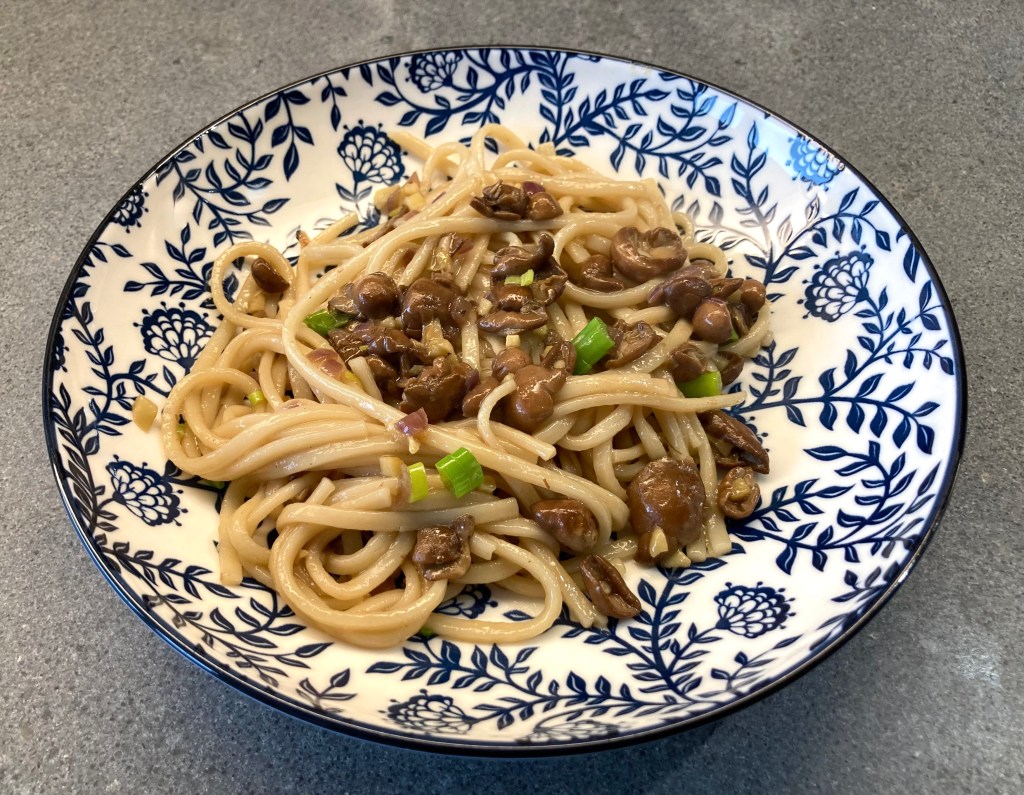
Fairy Ring Mushroom with Udon

Spring brings us several edible or even delicious mushrooms, such as the Fairy Ring Mushroom, Morels and the Mushroom of Saint George.
The Fairy Ring mushroom is a very common mushroom in many countries. The name is not very helpful since many mushrooms grow in the pattern of a ring. The German and Dutch names (Rasen-Schwindling and Weidekringzwam) are more helpful; these refer to the fact that the mushroom grows in meadows and lawns.
It’s a small, very edible mushroom, available from early spring until late autumn. Its taste is a bit sweet and perhaps that’s why some people suggest using them to make sweet mushroom cookies. Hm, we think you can do better than that! Earlier we combined the mushroom with pork chops. Today we use the sweetness as a starting point of a vegetarian dish with udon, our favourite noodle.

Drink Pairing

Given the sweetness of the dish, the depth of the udon and the hint of spiciness (fresh ginger), we suggest a medium bodied, dry white wine. Could be a Riesling or perhaps a Grüner Veltliner. A well balanced, round sake will also be great with the dish.

What You Need

  • 100 gram of Fairy Ring mushroom
  • 2 Scallions
  • Soy Sauce
  • Sesame Oil
  • Ginger
  • Oyster Sauce or Mirin
  • Vegetable Stock
  • Olive Oil
  • Udon

What You Do

Start by cleaning the mushrooms with kitchen paper. Remove the stems. Slice the scallions thinly, separate the white and the green. Add the udon to boiling water. The noodles will take some 10 minutes, which gives you sufficient time to prepare the mushrooms. Fry the caps in olive oil. After a few minutes, add the white of the scallions. Fry for a minute or so. Reduce heat. Add some grated ginger, soy sauce and sesame oil. To enhance the sweetness of the mushroom, add some oyster sauce or mirin. Add a teaspoon to start with. Taste and adjust. Perhaps a second one? Be careful not to overpower the delicate flavor of the mushroom. When ready, add the udon straight from the pan to the mushrooms. Combine. Leave for a minute or two. Add a bit of stock. You’re looking for generous coated udon with shining mushrooms. Just before serving add some freshly grated ginger, a dash of sesame oil and the green of the scallions.

PS

In some countries the mushroom is known as Mousseron, which sounds French, however in France the Fairy Ring mushroom is called Faux-Mousseron, to distinguish it from the real Mousseron, the mushroom we know as the Mushroom of Saint George. At least both are edible!
Fairy Ring Mushroom with Udon ©cadwu

Petits Farcis

Not only do they look delicious, but they also taste delicious: Légumes Farcis or Petits Farcis. Easy to make and always a pleasure to serve. Perhaps you can buy them ready made from your delicatessen or butcher, but why would you? Prepare them at home the way you personally prefer them, perhaps with some extra shallot, herbs or garlic.

Let’s talk a bit about the farce, the stuffing of the vegetables. It should fill the vegetable, obviously, and remain connected to the vegetable, also when cooked. Its texture must be loosely. This is where most recipes go wrong when they tell you to add panko or breadcrumbs to the farce. Follow this instruction and you will notice that during the cooking process the filling will become smaller and firmer. There you are: a meatball in a tomato. That’s not what you want. Not at all! Lesson learned, no panko, no breadcrumbs.

The meat should be nicely fat, not too finely minced and preferably a combination of porc and veal. Tasty, sufficiently fat and elegant. You could also use sausage meat. When in doubt, ask your butcher.

Wine Pairing

Keep it simple! A dry white wine, a rosé or a nice beer will be perfect. Serve what you think is best with this tasty, juicy and heart-warming food.

What You Need

  • Vegetables such as Tomatoes, Courgette, Red Bell Pepper
  • Minced Meat or Sausage Meat
  • Shallot
  • Parsley
  • Garlic
  • Black Pepper

What You Do

  1. Finely chop the shallot, the garlic and the parsley. Additionally you could use thyme, rosemary or oregano
  2. Combine the meat with the shallot, the garlic, the herbs and black pepper
  3. Cut off the top of the tomato and use a knife and a teaspoon to hollow out the tomato. Keep the pulp and the seeds
  4. Slice the bell pepper lengthwise and remove the seeds and the ribs. Discard
  5. Cut off the top of the courgette and use a teaspoon to hollow out the courgette. Keep the pulp
  6. Add the farce to the vegetables
  7. Close the tomatoes and the courgettes with the caps
  8. Transfer to a baking dish, add some olive oil, the pulp and the seeds of the tomatoes and the courgette to the dish
  9. You could add some extra shallot.
  10. Cook in the oven for 45 minutes (depending on the size) on 180 °C or 355 °F.
  11. Enjoy hot or lukewarm (with some of the cooking liquid), perhaps with a simple green salad or rice.
Petits Farcis ©cadwu

The Art of Sauces: Beurre Blanc

We love the classic ways of eating white asparagus, served with a nice white wine from the Alsace region in France (Pinot Blanc, perhaps a dry Muscat). We were talking about different ways of preparing them. We browsed through various recipes and found a combination new to us: white asparagus with scallops (Coquilles Saint Jacques). Some add a tomato and tarragon sauce, others mayonnaise or (even) a tapenade. Not combinations we would like to see on our plate. Why not serve with a sauce that supports the subtle sweetness of both the asparagus and the scallops? Could be Hollandaise or Kimizu, but these are probably too rich for the scallops.

Beurre Blanc is an interesting sauce: it’s basically a reduction of white wine, vinegar and herbs, thickened with very cold butter.  The more butter you add, the thicker the consistency, although it will remain thinner than an emulsified sauce. The benefit of beurre blanc is that it comes with that lovely velvety mouthfeel without being too rich. And the acidity works beautifully with the asparagus and the scallops.

What You Need

  • 4 tablespoons Dry White Wine
  • 2 tablespoons White Wine Vinegar 
  • 4 tablespoons of Water
  • 1 Shallot
  • Thyme
  • Bay Leaf
  • Black Pepper
  • Double Cream
  • 75 (or more) grams very cold Butter

What You Do

Chop the shallot and crush the black pepper corns. Add the wine, the vinegar and the water to a pan. Add the shallot, the black pepper, thyme and one bay leaf to the pan. Allow to reduce to 1/3. Pass through a sieve. In total you should have 3 or 4 tablespoons of reduction. Warm the reduction. Add a splash of cream and reduce to 1/2 or 1/3. Whisk regularly. Remove the creamy reduction from the heat and start adding small cubes of ice cold butter, one by one, whisking constantly. Keep adding butter until you have the taste and the consistency you want.

Asparagus and Scallops

We served the Beurre Blanc with steamed white asparagus and scallops sautéed in butter. We opened a bottle of Mâcon-Vinzelles ‘En Paradis’ 2021, produced by Château Vitallis. The wine, made from 100% Chardonnay grapes, is vinified in stainless steel tanks. It has just the right level of citrusy acidity, it is fresh with floral aromas, and comes with minerality and a touch of butter. In general, you’re looking for an unoaked chardonnay, with freshness and some acidity.

Asparagus, Scallops and Beurre Blanc ©cadwu

Moosewood

A new cookbook is always welcome. We read it, try a recipe, adjust it, tweak it and look for inspiration. When we opened Mollie Katzen’s cookbook Moosewood we were very pleasantly surprised. The lay out is great, the font clear, the drawings good fun, the index comprehensive and above all, the recipes look tempting. Let’s start cooking!

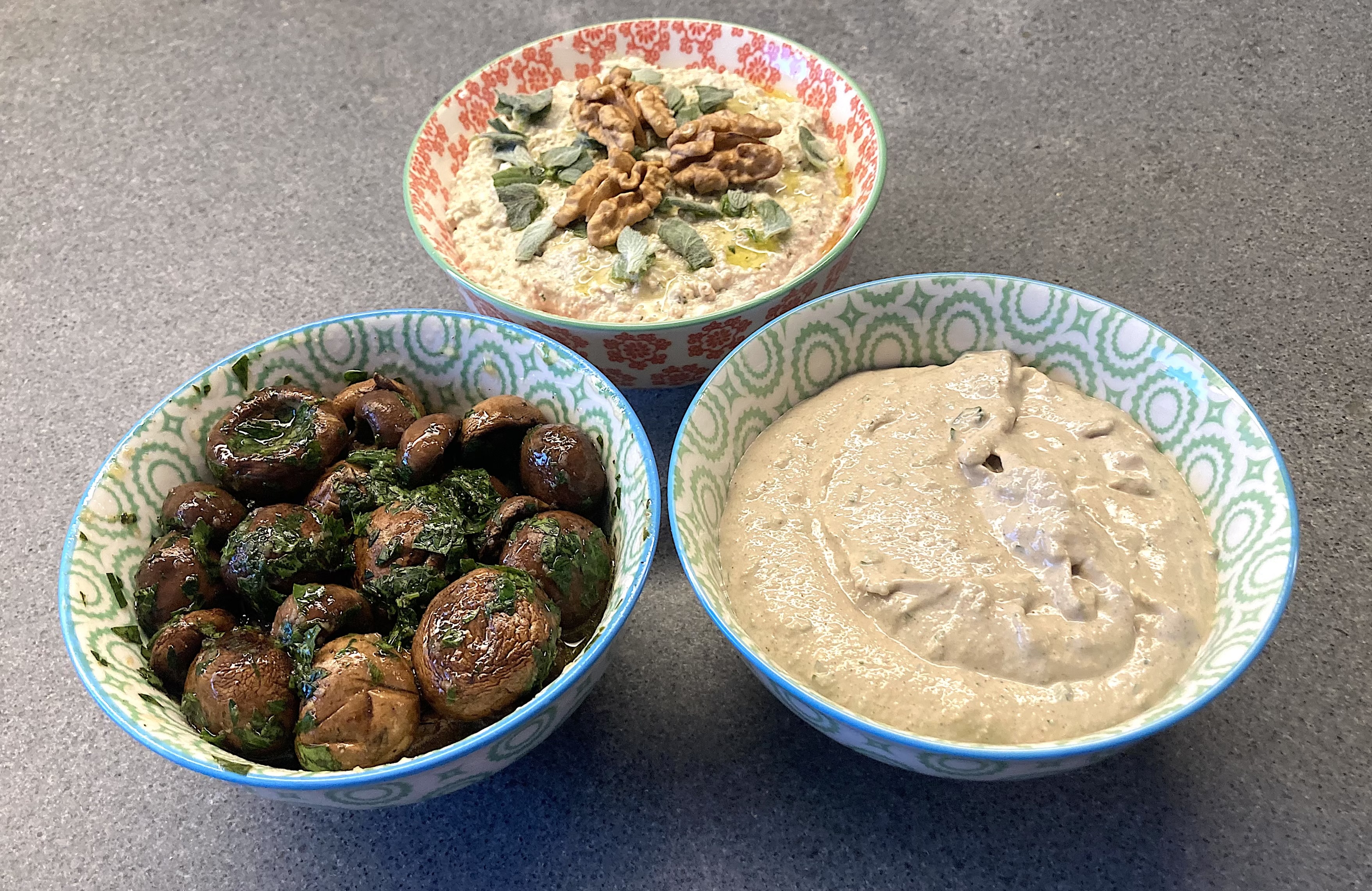
We prepared three antipasti: Feta-Walnut Dip, Tahini-Lemon Sauce and Marinated Mushrooms. Mollie Katzen suggests serving the Feta-Walnut Dip on sesame crackers or roasted Pita Bread, so we baked Pita Bread and bought some sesame crackers.

Tahini-Lemon

The Tahini-Lemon Dip is a combination of ¾ cup of tahini and 5 tablespoons of lemon juice. We opened a jar of tahini made with hulled sesame seeds, stirred it and decided it was too thin. Its taste was astringent and we didn’t think mixing it with lemon juice was a good idea. We bought another jar of tahini, this one made with roasted, unhulled sesame seeds. Much better taste, some bitterness and a great consistency.

Feta-Walnut

The recipe for the Feta-Walnut Dip contains a fair amount of Feta, which is not our favourite cheese. In most cases it’s rubbery and the taste bland and salty. Since 2002 Feta is a Protected Designation of Origin in Europe. When a product has the PDO status you can be sure of the quality, the authenticity, the ingredients used and the production methods. When you buy Feta cheese, make sure it comes with an PDO label.

The Panel

Our test panel (Carine, Marion and Rutger) welcomed the idea of vegetarian antipasti. We served a glass of Crémant d’Alsace, produced by Fernand Engel. This sparkling white wine is made of Chardonnay grapes and has fruity aromas, freshness, gentle acidity and typical Alsace sweetness.

The Results

The Panel started with the Marinated Mushroom: lovely flavours, fresh, intense, umami, mushrooms surprisingly firm.
The Tahini-Lemon Dip: fresh, nice with the acidity of the lemon, light, makes you think of peanut butter, but not too much. It tasted very well when served on a sesame cracker. The panel thought the dip was lacking something, perhaps some za’atar (a spice mixture with sesame seeds, sumac, oregano, thyme, cumin and more)?
The Feta-Walnut Dip was simply delicious. New unexcepted flavour, fresh, long lasting. The panel was unanimous, the Feta-Walnut Dip was their favourite.

Recipe Feta-Walnut Dip

It is made by combining 1 cup of chopped walnuts with a nice amount of parsley and 1 cup of feta cheese. The walnuts and the parsley are blended until fairly smooth, then the cheese, some water, a teaspoon of paprika powder and some cayenne pepper is added. Just before serving sprinkle with excellent olive oil and decorate with fresh oregano and three halved walnuts. We could imagine chopping the oregano and adding it to the dip.
The Feta-Walnut Dip doesn’t keep well, but that should not be a problem because it doesn’t take more than 10 minutes to prepare.

Moosewood by Mollie Katzen clearly deserves a space on (y)our shelf. It is a great and reliable resource when you’re looking for tasty, healthy vegetarian food and snacks. It is available via the usual channels and your local bookstore for something like € 20,00 or US$ 30.00.

PS This review was published earlier on Bernadette’s website. Follow her blog and read inspiring and creative recipes and stories.

Coronation Quiche

The coronation of King Charles is a wonderful combination of tradition, religion and mystery, a ceremony loved by many, for its pageantry, the celebrations, the concerts and of course the coronation food. Just think about a lovely Victorian Sponge Cake with raspberry jam and buttercream or a Coronation Chicken (Poulet Reine Elizabeth) with carrots, green peas, rice and a creamy curry sauce.

King Charles’s coronation quiche is supposed to somehow reflect his vision regarding the monarchy and its role in modern society. The quiche is tasty, healthy, nutritious, not expensive and relatively easy to make. Plus, when you replace the lard in the original recipe with butter (as we do), then it’s a nice vegetarian dish. Great to share with friends.

The quiche combines spinach with broad beans, tarragon and cheddar cheese. We suggest baking it one day ahead and serving it at room temperature.

We read the recipe, watched a few videos (this one is good fun, it also shows how to make a Victorian Sponge cake) and decided to prepare a Coronation Quiche, topped with a Crown!

What You Need (for a 15 cm tin)

  • For the Pastry
    • 125 grams All Purpose Flour
    • Pinch of Salt
    • 50 grams Cold Butter
    • 2 tablespoons Water
  • For the Filling
    • 200 ml Double Cream
    • 2 Eggs
    • 1 tablespoon chopped Fresh Tarragon
    • 100 grams grated Cheddar Cheese
    • 400 grams fresh Spinach
    • 450 grams fresh Broad Beans (or Fava Beans)

What You Do

Start by making the shortcrust pastry. Dice the butter. Sieve the flour, add a pinch of salt and combine. Add the butter and mix using your fingertips until is has a crumble-like texture. Add the water and turn the mixture into a dough. Cover and allow to rest in the refrigerator for one hour.

Now it’s time to prepare the vegetables. Wash and cook the spinach. Let cool. Drain and squeeze to remove as much liquid as possible. Chop finely. Remove the beans from the shell. Cook for 2 minutes. Let cool and double pod.
Flour your work surface and roll out the pastry to a circle a little larger than the top of the form. The dough should be approximately 4 mm thick. Coat the form with butter. Line the form with the pastry. Use a knife to remove the excess dough. Cover and let rest for 30 minutes in the refrigerator.

Preheat the oven to 190 °C or 375 °F. Use a fork to make small holes in the pastry. Line the pastry with greaseproof paper, add baking beans and bake blind for 15 minutes. Remove the paper and the baking beans. If you think the pastry is a bit wet, then transfer back to the oven for 2 or 3 minutes.
Reduce the oven temperature to 160 °C or 320 °F.
Beat the eggs and keep some of the egg apart. You need it later to give some extra colour to the crown. Beat together cream, eggs, herbs and fresh black pepper. Scatter half of the grated cheese in the blind-baked base, top with the chopped spinach and then the beans, and finally pour over the mixture with cream, eggs, herbs and pepper. Finish by sprinkling the remaining cheese.

Use the remainder of the dough to make a crown. Coat with the egg mixture. You could apply an extra coating halfway the baking process.

Place the quiche and the crown into the oven and bake for 30 – 35 minutes until set and lightly golden. The crown is ready after some 10 – 15 minutes.

Pita Bread

A few weeks ago we had the pleasure of reviewing the Moosewood Cookbook by Mollie Katzen, as part of the cookbook review initiated by Bernadette. Every month a group of chefs and cooks reviews a book by preparing recipes. Great initiative, one to follow.

The Moosewood Cookbook is an inspiring vegetarian cookbook with lots of recipes for tasty and flavourful snacks and dishes. We prepared three anti pasti from it and served these with sesame crackers and pita bread. When testing the recipes we used pita bread from the supermarket, only to find out how bland and tasteless it was. Obviously we needed to bake our own pita bread, which is a surprisingly simple thing to do.

What You Need

  • 150 grams All Purpose Flower
  • 50 grams Whole Grain Flower
  • 3 grams Salt
  • 3 grams Dry Yeast
  • 120 ml lukewarm Water 
  • 1 teaspoon Ras el Hanout

What You Do

Mix flower, salt, Ras el Hanout and yeast. Add the water and knead for 15 minutes. Cover the bowl and leave for one hour on a warm spot. Preheat your oven to 240 °C or 465 °F. The baking tray should already be in the oven. Divide the dough in 6 balls. Dust your kitchen surface with flower and flatten the balls until they are 0,3 cm thick. Put the flattened balls on the very hot baking tray and bake for 7 minutes. Transfer the pita breads from the oven and let cool on a wire rack. Don’t forget to see what happens in the oven, it’s so much fun to watch the pita’s being baked!

Pita Bread ©cadwu
Pita Bread ©cadwu

Royal Orange and Almond Cake

April 27th we celebrate the birthday of King Willem-Alexander of the Netherlands. Hip hip hooray!
The Dutch royal family is also known as ‘de Oranjes’, which is reflected in the use of the colour orange when referring to Dutch royalty. Actually, there is no link between the royal family and the colour. The ‘Oranje’ in the name refers to the French city of Orange, a Principality one of his ancestors inherited in 1544.

Nevertheless, over the years we prepared Orange Sabayon, Queen’s Soup, Bouchée à la Reine, Orange Flan and Canard à l’Orange on this day. What better way to celebrate a birthday than by baking a cake, a flavourful, moist Orange and Almond cake?

What You Need

  • One large Orange
  • 3 Eggs
  • 100 grams Fine Caster Sugar
  • 125 grams of Almond Flour
  • 3 grams of Baking Powder

What You Do

  1. Wash the orange and cook it (meaning the whole orange) for 2 hours in some water
  2. Let cool
  3. Preheat the oven to 170 °C or 340 °F.
  4. Coarsely cut the orange, remove the pits and blender the orange until you have a marmalade-like consistency
  5. Add the baking powder to the almond flour and mix
  6. Beat the eggs and the sugar until light and airy. This may take 5 minutes
  7. Add the blended orange and mix gently
  8. Add the almond flour and the baking powder and mix
  9. Coat a baking spring form (18 cm or 7 inch) with butter, add the mixture and transfer to the oven for 40-45 minutes.
  10. The cake will rise only a little during the baking process.
  11. When ready, leave the cake to cool in the tin.
Orange and Almond Cake ©cadwu

Wild Garlic Soup

Only a few days to go before the end of the Wild Garlic season. The season starts early February when the first leaves appear. Mid-April the star shaped white flowers appear, beautiful and also edible. When the flowers go to seed it’s the end of the season and the leaves become bitter and chewy.

Wild Garlic can be used to make pesto, it can be added to a dish with white asparagus and morels and it’s delicious when combined with fennel and potato. Preparing Wild Garlic soup is also a good idea. The first time we tasted it, at Zum Fliegenden Holländer in Potsdam, Germany, we expected the soup to be a bit simple, probably we would taste onion, touch of garlic and potatoes. We were wrong, the soup was much more complicated and sophisticated than expected. The flavour was mild, we could clearly taste the Wild Garlic, but very gentle, with some sweetness. The overall taste was pleasant and lasting. Perhaps the potato was too present, but that was a minor detail. Bärlauchsuppe proofed to be delicious, refreshing and very much a tribute to spring.

What You Need

  • 150 grams of Wild Garlic Leaves
  • 500 ml of Stock
  • 1 Shallot
  • ½ Garlic Clove
  • Potato Starch
  • Cream
  • Olive Oil
  • Black Pepper
  • Nutmeg

What You Do

Wash and dry the leaves. Chop the shallot and the garlic. We were lucky, our bunch of leaves also contained a few flower buds. We chopped these as well. Warm a pan, add some olive oil and glaze the onions and the garlic (and the flower buds). After a few minutes add the stock. We used homemade quail stock, which brought additional sweetness to the soup. Leave to simmer for a few minutes. Coarsely chop the leaves, add these to the pan and leave for perhaps one minute. Be careful, you don’t want to discolour the leaves. Use a blender to make a smooth liquid. Pass the liquid through a sieve. Add one to two teaspoons of potato starch and mix very well. Add cream and leave for a few minutes. Just before serving add some excellent olive oil and black pepper, blender for 1 or 2 seconds and serve with some freshly grated nutmeg.

PS

We use potato starch to remain close to the basic idea of the Bärlauchsuppe in Potsdam. Potato Starch has a neutral taste and a high binding strength. If you use a (starchy) potato, then peel and cube it and add it to the stock. Remove the potato cubes when they are ready, add the chopped leaves, leave to simmer and then blender. Mash the potato cubes, combine with some of the liquid, add the mash to the soup and whisk well. If you blender the liquid with the potato, you risk ending up with a gluey, sticky soup.

John Dory or Saint-Pierre

Not the prettiest of fish, but according to some the most delicious. Its meat is delicate, moist, dense, melt-in-your-mouth, a touch sweet and flavourful. It is one of the ingredients of a traditional Bouillabaisse.
The head of a John Dory (Saint-Pierre, San Martiño) is relatively large. Saint-Pierre is a fairly expensive fish and knowing that you will discard a significant part of it makes the Saint-Pierre even more expensive.

The shape of a Saint-Pierre could give you the impression that it’s a flat fish, but actually it’s a round fish. You will also notice that the spines on its fins look rather nasty. These two aspects make filleting a Saint-Pierre difficult. Our fish monger offered to do this for us, which we happily accepted.

Given the price (we paid €125,00 per kilo fillet) you don’t want to make mistakes when preparing it. Fortunately frying Saint-Pierre only requires a bit of patience and attention (it’s easily overcooked). 

We enjoyed our Saint-Pierre as a main course with a rich mushroom-based sauce and slow cooked fennel.

Wine Pairing

A delicious Saint-Pierre requires an equally delicious wine. We opened a bottle of Louis Jadot – Bourgogne Couvent des Jacobins – Chardonnay. The wine has fruitiness and freshness as well as structure. It has aged for some 8 months in oak barrels, giving the wine more roundness. A perfect combination with the fish, the rich sauce and the soft anise flavours of both the fennel and the chervil.
Maison Louis Jadot, producteur et négociant, based in Beaune, France, produces various quality wines from the Burgundy region and exports these to several countries including the UK and the USA.

What You Need
  • For the Fish
    • One Fillet (preferably without the skin)
    • Butter
    • Olive Oil
  • For the Sauce
    • Champignons de Paris
    • Butter
    • Cream
  • For the Slow Cooked Fennel
    • Fennel
    • Olive Oil
  • Chervil
  • Black Pepper
What You Do
  1. Remove the outer leave(s) of the Fennel, slice top down in 4 or 8, making sure the fennel doesn’t fall apart
  2. Warm a pan, add some olive oil and cook on very low heat for some 6 hours. 8 is also fine
  3. Turn halfway to make sure both sides are caramelised
  4. In parallel, do some shopping, read the papers, watch your favourite series on Netflix and be patient.
  5. A John Dory fillet is really special, without any trouble you can divide it into three parts. One small, the other two perfect
  6. Heat a small skillet, add some butter and fry the quartered mushrooms until golden
  7. Reduce the heat, add cream and heat through and through
  8. Heat a bigger skillet, add some olive oil and butter, gently fry the fillets until brown and nearly done
  9. Transfer to the oven at 50 °C or 120 °F
  10. Fill a glass with water, add the creamy mushroom mixture to the pan and immediately add some water
  11. The sauce will thicken quickly so you need your glass of water on standby
  12. Add some black pepper and lots of chervil leaves. Mix. Happy with the sauce?
  13. Now it’s time to plate up. Some sauce, the John Dory on top, the quartered fennel, some extra black pepper and more chervil.

Asparagus

Both White and Green Asparagus are seasonal products. Waiting for the season to begin is part of the fun of enjoying asparagus.

Green Asparagus

Preparing Green Asparagus is simple. Wash them and cut off 1 or 2 centimetres or so from the bottom. You could steam or cook them but you risk getting soggy asparagus. Better to prepare them in a skillet or in the oven. They will only take 10-15 minutes. Great to combine with basil and black olives. You could also grill them, see below.

White Asparagus

Buying and preparing White Asparagus requires a bit more work, but once you know what to do, it’s not difficult at all.

Fresh

Make sure the white asparagus are fresh. Just look at the bottom, where they have been cut off. If the cut looks dry, wrinkly or even moldy, then don’t buy them. If you want to be sure they are super fresh, then rub two asparagus together. If you hear a squeaking sound, then they’re super fresh.

Peeling

Peel White Asparagus, using a peeler, as you would potatoes. In the old days White Asparagus would be peeled twice, but nowadays we like a bit of texture.
Cut off 1 or 2 centimetres from the bottom. If your White Asparagus are fresh, it’s just a matter of removing the original cut.

Cooking

The most popular approach is to cook White Asparagus. Add the asparagus to a pan with plenty of cold water. Wait for the water to just begin boiling, keep it simmering for 1 minute, then transfer the pan to the work top. Wait for 10 minutes before removing the asparagus from the water. If you prefer them a bit softer, then leave them in the hot water for 5 more minutes.
Many add butter, sugar, salt, lemon and/or the skin of the asparagus to the water. We could imagine adding the skin. Adding sugar is a big NO for us.
You could use a special asparagus pan when cooking the asparagus, but actually there is no need for it. As long as the pan can accommodate the asparagus, you’re fine.

Steaming

We prefer steaming White Asparagus for 20 minutes in our Russell Hobbs. The taste of the asparagus will be more intense and richer.

Wine Pairing

In general a Pinot Blanc, Riesling or Dry Muscat from the Elzas will be very nice with your asparagus.

Recipes

Over the years we have prepared asparagus in many ways. Bon Appétit!

PS

You’re probably aware of the side effect of eating asparagus, the typical smell when peeing. It doesn’t happen to everyone, and it also depends on the type of asparagus. The sulphurous by-products (the result of your body digesting the asparagus) that cause the smell, will disappear within a few hours. Could take a bit longer, but nothing to worry about, it’s perfectly harmless.